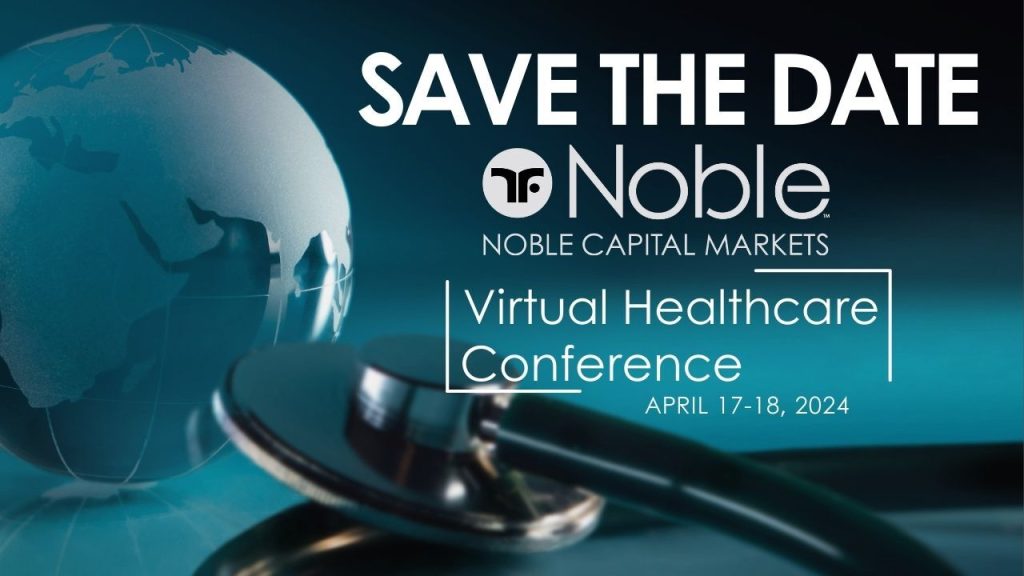
Noble Capital Markets Emerging Growth Virtual Healthcare Conference Presentation Replays

Anavex Life Sciences (AVXL)
Watch the Replay
Atara Biotherapeutics, Inc (ATRA)
Watch the Replay
Atossa Therapeutics (ATOS)
Watch the Replay
Cadrenal Therapeutics (CVKD)
Watch the Replay
CervoMed (CRVO)
Watch the Replay
Citius Pharmaceuticals Inc (CTXR)
Watch the Replay
DarioHealth (DRIO)
Watch the Replay
Electromed (ELMD)
Watch the Replay
Ensysce Biosciences Inc. (ENSC)
Watch the Replay
GoHealth (GOCO)
Watch the Replay
Immunic Therapeutics (IMUX)
Watch the Replay
IN8bio (INAB)
Watch the Replay
Kiora Pharmaceuticals (KPRX)
Watch the Replay
Lisata Therapeutics (LSTA)
Watch the Replay
MAIA Biotechnology (MAIA)
Watch the Replay
Ocugen Inc (OCGN)
Watch the Replay
SeaStar Medical Holding Corporation (ICU)
Watch the Replay
SelectQuote Inc (SLQT)
Watch the Replay
Tharimmune Inc (THAR)
Watch the Replay
Theravance Biopharma (TBPH)
Watch the Replay
Unicycive Therapeutics (UNCY)
Watch the Replay
XORTX Therapeutics (XRTX)
Watch the Replay
Zomedica Corp (ZOM)
Watch the Replay
ZYUS Life Sciences (ZLSCF)
Watch the Replay
  • Emerging Growth Public Healthcare Company Executive Presentations
  • Q&A Sessions Moderated by Noble’s Analysts and Bankers
  • Scheduled 1×1 Meetings with Qualified Investors

Noble Capital Markets, a full-service SEC / FINRA registered broker-dealer, dedicated exclusively to serving emerging growth companies, is pleased to present the Emerging Growth Virtual Healthcare Conference, taking place April 17th and 18th, 2024. This virtual gathering is set to be an immersive experience, bringing together a unique blend of investors, industry leaders, and experts in the life sciences, healthcare, and medical device sectors.

Part of Noble’s Robust 2024 Events Calendar

The Emerging Growth Virtual Healthcare Conference is part of Noble’s 2024 event programming, featuring a range of c-suite interviews, in-person non-deal roadshows throughout the United States, two more sector-specific virtual equity conferences, and culminating in Noble’s preeminent in-person investor conference, NobleCon20, to be held at Florida Atlantic University in Boca Raton, Florida December 3-4. Keep an eye out for the official press release on NobleCon20 coming soon.

Check out the calendar of upcoming in-person non-deal roadshows here.

Sign up to receive more information on Noble’s other virtual conferences here.

What to Expect

The Emerging Growth Virtual Healthcare Conference will feature 2 days of corporate presentations from up to 50 innovative public healthcare, biotech, and medical device companies, showcasing their latest advancements and investment opportunities. Each presentation will be followed by a fireside-style Q&A session proctored by one of Noble’s analyst or bankers, with questions taken from the audience during the presentation. Panel presentations are planned, featuring key opinion leaders in the healthcare sector, providing valuable insights on emerging trends. Scheduled one-on-one meetings with public company executives, coordinated by Noble’s dedicated Investor Outreach team, are also available to qualified investors.

Why Your Company Should Present

Looking to increase awareness in your company and increase liquidity? Paid participation in Noble’s investor conferences, both virtual and in-person, provides that opportunity, with a tailored experience aimed at delivering substantial value. After 40 years of serving emerging growth companies, and the investors who follow them, Noble has built an investor base eager to discover where the next success story lies.

Noble’s investor base is relevant and, in many cases, new to your company. Noble’s dedicated Investor Outreach team provides unmatched exposure to investors that can invest in your company, including small money managers, family offices, RIAs, wealth managers, self-directed investors, and institutions. Most of Noble’s investors specifically seek undervalued, overlooked, emerging investment opportunities.

The cost to present includes your corporate presentation with a Q&A session proctored by one of Noble’s analysts or bankers, a webcast recording, scheduled 1×1 meetings with qualified investors, and marketing on Channelchek.

Benefits for Investors

The emerging growth healthcare space may be poised for a breakout year.  The recent dislocation in the healthcare and biotech spaces has created compelling valuation profiles for many companies. Hear directly from the c-suite of the next innovators in this space and learn about new investment opportunities. The Q&A portion of each presentation gives you the opportunity to have your questions answered during or after the proctored session. The planned panel presentations are sure to provide expert insight on growing trends in the healthcare space. And, for qualified investors, one-on-one meetings are available with company executives; scheduled by Noble’s dedicated Investor Outreach team. All from the comfort of your own desk, and at no cost.

How to Register

Limited presenting slots are available

Publicly traded companies in the healthcare space can submit their registration details here.

If you have any questions about presenting, please contact [email protected]

Investor / Guest attendees can register here

Interested in becoming a sponsor of Noble’s virtual and in-person investor conferences?

Contact [email protected] for sponsorship information.

AI in Healthcare: The Next Frontier for Investors?

In the ever-evolving world of technology, few terms have captured the imagination of investors quite like artificial intelligence (AI). From autonomous vehicles to virtual assistants, AI has permeated nearly every facet of modern life, disrupting traditional business models and creating new opportunities for growth and innovation.

One sector that is increasingly feeling the transformative impact of AI is healthcare. As the industry grapples with challenges such as rising costs, workforce shortages, and the need for more personalized and efficient care, AI is emerging as a powerful tool to address these issues and unlock new frontiers in medicine.

The applications of AI in healthcare are vast and varied, ranging from drug discovery and disease diagnosis to patient monitoring and virtual nursing assistants. At the forefront of this revolution are companies that are harnessing the power of AI to develop cutting-edge solutions and drive technological advancements in the field.

One area where AI is making significant strides is medical imaging and diagnostics. Companies like Enlitic, a pioneer in deep learning for radiology, are developing AI systems that can analyze medical images with unprecedented accuracy, aiding in the early detection of diseases and reducing the risk of misdiagnosis. By automating and enhancing the analysis of X-rays, CT scans, and MRI images, these AI solutions have the potential to improve patient outcomes while reducing the workload on healthcare professionals.

Another promising application of AI in healthcare is drug discovery and development. Traditionally, the process of bringing a new drug to market has been time-consuming and costly, often taking years and billions of dollars in research and clinical trials. However, AI is revolutionizing this process by analyzing vast amounts of data, identifying promising drug candidates, and accelerating the drug discovery pipeline.

Companies are leveraging machine learning algorithms to search through millions of potential drug compounds, predicting their efficacy and safety profiles with remarkable accuracy. This not only speeds up the drug development process but also increases the likelihood of successful clinical trials and faster time-to-market for new therapies.

Beyond drug discovery and medical imaging, AI is also playing a crucial role in personalized medicine and patient care. Companies are developing AI-powered virtual healthcare assistants that can provide personalized medical advice, triage patients, and even monitor chronic conditions remotely. By leveraging natural language processing and machine learning, these AI solutions can offer accessible and affordable healthcare services, particularly in underserved or remote areas.

For investors, the proliferation of AI in healthcare presents both opportunities and challenges. On the one hand, the potential for groundbreaking innovations and disruptive technologies in this sector could translate into significant returns for those who identify and invest in the right companies early on. However, the healthcare industry is also heavily regulated, and navigating the complex web of regulatory approvals and clinical trials can be a significant hurdle for AI-driven healthcare solutions.

Furthermore, as with any emerging technology, there are ethical considerations and potential risks associated with the use of AI in healthcare. Concerns around data privacy, algorithmic bias, and the potential for AI to perpetuate or exacerbate existing healthcare disparities must be carefully addressed to ensure the responsible and equitable deployment of these technologies.

Despite these challenges, the investment community is eagerly watching the AI healthcare space, recognizing the immense potential for transformative innovations and lucrative returns. As the adoption of AI in healthcare continues to accelerate, companies that can successfully navigate the regulatory landscape, mitigate risks, and deliver tangible solutions that improve patient outcomes and healthcare efficiency are likely to emerge as leaders in this burgeoning field.

For savvy investors, the key to capitalizing on the AI healthcare revolution lies in conducting thorough due diligence, understanding the competitive landscape, and identifying companies with robust AI capabilities, strong intellectual property portfolios, and a clear path to commercialization and scalability.

While AI may be a buzzword that often moves markets, in the healthcare sector, it represents a genuine paradigm shift with the potential to save lives, reduce costs, and transform the way we approach healthcare delivery. As such, investors who can separate the hype from the reality and identify the true pioneers in this space may be well-positioned to reap the rewards of this technological revolution.

noble capital markets emerging growth virtual healthcare equity conference

Biotech Dealmaking Heats Up as Private Capital Charges Back In

A wave of multibillion dollar buyouts has swept the beaten-down biotech sector in recent months, marking a potential turning point for an industry hammered throughout 2022 – 2023.

With valuations of public companies still depressed, flush private investors have stepped up acquisitions of promising drug developers to bolster pipelines for the long-term. And in a bullish sign for the strategic direction of the space, therapeutics targeting high unmet needs and novel modalities remain key areas of focus amid dealmaking.

As macro gloom recedes, the renewed embrace of biotech M&A highlights a pivot back toward the innovation-driven spending required to sustain growth post-pandemic.

BMS Kicks Off Buying Spree With $13.2B Turning Point Deal

Bristol Myers Squibb fired the starting gun on big-ticket biopharma deals in October, announcing a $5.8 billion purchase of Mirati Therapeutics (MRTX). The buyout delivered a 122% premium in order to land Mirati’s promising portfolio of precision cancer medicines.

Market observers viewed the unsolicited, $58 per share bid as a credible benchmark of intrinsic value vigilantly researched by a strategic acquirer. Immediately in the deal aftermath, similar development-stage oncology names rallied sharply as traders priced in new takeout probabilities.

In fact, suitors moved swiftly to capitalize on improved biotech sentiment, with Horizon Therapeutics agreeing to a $26.4 billion around the same time. The transaction marked 2023’s largest healthcare buyout, further reinforcing peak valuations remain attainable for commercial-stage rare disease names.

Scaling Up to Compete in Gene Therapy

Gene therapy remains one especially alluring area for dealmaking despite lofty price tags. These ultra-rare disease medicines come with cure potential that commands premium sales and reimbursement pricing power.

Recognizing the imperative to bulk up gene therapy capabilities, Pfizer ponied up $5.4 billion to reinforce its genetic medicines pipeline through the acquisition of French outfit Vivet Therapeutics. The move added Vivet’s promising gene therapy for Wilson disease, along with manufacturing strengths across multiple delivery mechanisms.

And gene editing pioneer Sangamo Therapeutics is selling off its cell therapy assets to Sanofi for $700 million as it refocuses efforts around in vivo gene insertion. The deal hands Sanofi disruptive cell therapy technology utilizing precisely engineered zinc fingers to correct disease-causing mutations.

Analysts say more buyouts centered on next-gen platforms are likely on the horizon as drug developers vie for leadership in areas forecast to reshape therapeutic spaces.

Take a look at more biotechnology companies by looking at Noble Capital Markets’ Senior Research Analyst Robert LeBoyer’s coverage universe.

Private Capital Eagerly Steps in to Back Innovation

Beyond M&A from strategic acquirers, private equity firms have swooped in to capitalize on depressed biotech valuations. The robust dry powder levels built up during the boom years leave private investors eager to allocate while achieving advantageous cost bases.

Among notable deals, Angel Pond Capital teamed up with life science investor OrbiMed to take gene therapy biotech Generate Biomedicines private for $478 million. The transaction represented a 130% premium to ensure locking up Generate’s base editing technologies believed to be capable of correcting over 75% of known point mutations.

In cybersecurity and enterprise software, sponsor-led take privates had utterly dominated deal flow in 2022. But order books are now once again filling up with biotech buyouts from special purpose acquisition vehicles, highlighting a normalization in deal dynamics after last year’s freeze-out from rate-sensitive private market valuations.

Market Recovery Taking Shape

The fresh upswing in biotech M&A follows a wave of dip buying from some the world’s largest asset managers in shares of industry leaders like Vertex Pharmaceuticals and Regeneron Pharmaceuticals. Warren Buffett’s Berkshire Hathaway has been particularly aggressive stepping in to purchase stakes in key biopharma bluechips.

Meanwhile, the fund-raising backdrop continues improving for earlier stage biotechs as well after deal activity all but shuttered for much of 2023. Multiple debt offerings and venture rounds have successfully priced in recent months, ensuring the all-important continuity of innovation cycling.

With fundamentals stabilizing and access to capital normalizing, the environment for biopharma dealmaking has markedly improved. Expect the momentum to carry through 2024 as drug developers position through M&A for the next, post-pandemic leg higher while private capital readily supports compelling technologies at discounted prices. The long-term health of the biotech ecosystem depends on transactions advancing today’s high-potential assets, and the industry appears to have emerged from its lull ready to strike the necessary deals.

Pfizer Weight Loss Pill Hits Snag in Mid-Stage Trial

Pharmaceutical giant Pfizer suffered a setback this week in the high-stakes race to tap into the burgeoning multi-billion dollar weight loss drug market. The company announced it is halting development of the twice-daily formulation of its experimental obesity pill danuglipron after underwhelming mid-stage trial results.

While the drug induced significant weight loss in obese patients, it came at the cost of poor tolerability. Over half of participants dropped out of the phase 2 study due to adverse gastrointestinal side effects like nausea and diarrhea.

Nonetheless, Pfizer still intends to stay in the game with a once-daily version of danuglipron. The company aims to release fresh phase 2 data on the more competitive formulation in early 2024 before determining next steps.

For a drugmaker grappling with fading Covid-19 revenues, the news deals a tough blow to its strategy to offset declines through potential new blockbusters for obesity. Just last year, CEO Albert Bourla tagged the total addressable weight loss market at a whopping $90 billion.

But competition is cutthroat, with Novo Nordisk and Eli Lilly vying to convert millions from their injectable diabetes meds to an oral option. Their rival pills have already posted mid-teens percentage weight loss results that position them to potentially leapfrog Pfizer’s attempt.

Danuglipron Quick Facts

  • Twice-daily formulation now discontinued after 6.9% to 11.7% weight loss at 32 weeks
  • Well below 14-15% loss seen as competitive threshold
  • High rates of nausea, vomiting, diarrhea
  • Over 50% dropout rate

Key Takeaways for Investors
The disappointing data for danuglipron’s twice-daily pill underscores several investor concerns around Pfizer’s efforts to expand into weight loss medicines.

Uphill Battle Against Rivals
Novo Nordisk and Eli Lilly already dominate the obesity drug landscape with their injectable products Saxenda and Ozempic. Lilly’s oral candidate tirzepatide is showing roughly 15% weight loss over 72 weeks, clearing the competitive bar Pfizer failed to hit.

While the field is large enough for multiple winners, Pfizer faces substantial share challenges from these deeply entrenched rivals. Its best-case outcome may be carving off a small slice rather than market leadership.

Tolerability Issues Limiting
Danuglipron has now faltered twice in mid-stage studies due to side effects leading over half of volunteers to quit treatment. The once-daily route shows some promise, but gastrointestinal problems may hamper uptake if they persist. By comparison, tirzepatide posted a 21% dropout rate.

Uncertainty Remains High
With phase 3 trials still a distant prospect, the program faces a long road ahead fraught with risk. While danuglipron evinced significant weight-loss efficacy, real-world commercial success depends greatly on improving its poor tolerability profile.

Until then, uncertainty around Pfizer’s weight loss aspirations stays high. Expect sales projections to remain muted absent positive late-stage outcomes down the line. But rivals like Lilly and Novo aren’t standing still either, making danuglipron’s path ahead even trickier.

Three Biotech Industry Challenges Investors Should Monitor

Regulatory, Competitive, and Pricing Challenges That Analysts Believe Biopharma Will Face

Trends in biotech are changing, and if certain events play out, the field could become more challenging on three fronts, according to a new report from analysts from the biotech team at RBC Capital Markets. The report discusses advancements in science that could trump others currently in use or some nearing the end of pipelines, along with regulations that could alter scarcity and prices that stem from recent actions.

In its industry report released on August 4, RBC’s biotech team discussed how deep discounts may be dictated by government programs. It also details how new competition could arise for drugs now offered by Biogen (BIIB) and Incyte (INCY) companies. And also how improvements in public-health from new weight-loss drugs and from gene-editing treatments may reduce demand for other products.

Pricing Challenges

The Inflation Reduction Act in its current form will reduce the prices paid for drugs by federal programs like Medicare, the analysts warn. Mandatory discounts, which will rise from 25% to 60%, will phase in for covered medicines beginning at the ninth to 16th years on the market. Any increases in the prices charged to the government program Medicare would be capped at the inflation rate.

The mechanisms by which these pricing measures will be rolled out by the Centers for Medicare Services will become more clear later this year. On the positive side for the industry, RBC noted a number of biotech companies have asked federal courts to block the law enacted in 2022. And if Republicans win controlling seats in the House in the fall, or even the Executive Branch next year, this would increase the chances of a rollback of the federal pricing provisions.

Exclusivity Challenges

A separate issue is that a lapse of exclusivity protection could affect companies such as Biogen, says RBC. That company’s big-selling product Tysabri, a multiple sclerosis treatment brings in about $2 billion a year. But lower protections may cause it to face competition from a generic “biosimilar” version from the Sandoz unit of Novartis (NVS). Earlier this summer, a court denied Biogen’s request for a preliminary injunction that would have kept the Sandoz biosimilar off the market while Biogen would press a patent infringement claim. The RBC analysts see signs that the Food and Drug Administration (FDA) is gearing up to approve the Sandoz biosimilar. The analysts mentioned that any sales losses at Biogen could be offset by the successful growth of its new anti-Alzheimer’s treatments.

You’re Invited to Learn More About NobleCon19

Another exclusivity threat concerns the product Jakafi, which is a successful Incyte cancer and immune disorder drug, its annual sales could exceed $3.5 billion in the next few years. But the expiration of Jakafi’s patent protection in 2029 could bring a stream of generics it would compete with. This places the maker Incyte under pressure to develop products to extend its Jakafi franchise, says RBC.

Medical Success Challenges

The team at RBC writes that some welcome medical advances might prove so successful that they would reduce the need for other products. They gave examples that include the class of diabetes and obesity treatments known as GLP-1 drugs, which they expect are on their way to becoming enormous sellers for Novo Nordisk (NOVO) and Eli Lilly (ELI).

In addition to the dramatic weight loss achieved by the drugs, the GLP-1s may also become useful to reduce cardiovascular and liver disease. While the public health aspect would be cause to celebrate, investors should be cognizant that the prospects for other drugs sold to treat illnesses such as the liver disease called nonalcoholic steatohepatitis, or NASH, may get new competition.

Another promising breakthrough are gene-editing therapies, the one-time treatments that use the Nobel Prize-winning technology known as CRISPR to permanently blunt genetic illnesses.

Intellia Therapeutics (NTLA) and Verve Therapeutics (VERV) are testing such approaches as treatments for nerve and heart disorders that otherwise require continuing doses of medicines sold by other biotech companies. The RBC team says that the success of the one-shot editing therapies could trim the need for drugs that at present must be continually taken.

Take Away

Analysts don’t have a crystal ball, but investors do rely on their expertise to gain insight as to industry trends and individual company insights. There are many changes occurring in the biotech and biopharma space that could change the competitive landscape, some better for investors, some better for patients, and some even better for taxpayers and social security and Medicaid recipients.

Investors that wish to increase their knowledge of the industry and smaller innovative companies within the segment should explore the data and information in this section of Channelchek and dig even deeper into companies specifically covered by the industry analyst at Noble Capital Markets by using this link.

Paul Hoffman

Managing Editor, Channelchek

Sources

https://www.rbccm.com/en/insights/industries-in-motion/podcast.page?dcr=templatedata/article/podcast/data/2021/09/how_biotech_breakthroughs_are_changing_healthcare

https://www.barrons.com/articles/biotech-stocks-changing-regulation-disruption-1b4b3ee

https://www.fiercebiotech.com/biotech/peter-marks-says-base-editing-could-be-incredible-game-changer