One Stop Systems, Inc. (OSS) designs and manufactures innovative AI Transportable edge computing modules and systems, including ruggedized servers, compute accelerators, expansion systems, flash storage arrays, and Ion Accelerator™ SAN, NAS, and data recording software for AI workflows. These products are used for AI data set capture, training, and large-scale inference in the defense, oil and gas, mining, autonomous vehicles, and rugged entertainment applications. OSS utilizes the power of PCI Express, the latest GPU accelerators and NVMe storage to build award-winning systems, including many industry firsts, for industrial OEMs and government customers. The company enables AI on the Fly® by bringing AI datacenter performance to ‘the edge,’ especially on mobile platforms, and by addressing the entire AI workflow, from high-speed data acquisition to deep learning, training, and inference. OSS products are available directly or through global distributors. For more information, go to www.onestopsystems.com.
Joe Gomes, Managing Director, Equity Research Analyst, Generalist , Noble Capital Markets, Inc.
Joshua Zoepfel, Research Associate, Noble Capital Markets, Inc.
Refer to the full report for the price target, fundamental analysis, and rating.
A New Face. One Stop Systems announced the Company has appointed a new President and CEO in Michael Knowles, effective June 5, 2023. Mr. Knowles will be taking over for the previous CEO David Raun, who will continue to be a member of the Board of Directors.
Experience. Experience in the defense industry was an aspect for which the Company was looking in the search for a new CEO and Mr. Knowles delivers in spades. Mr. Knowles provides OSS with experience in several defense contractors, including Cubic Corporation, Rockwell Collins, Lockheed Martin, and Curtiss Wright Defense Solutions. Most recently, Mr. Knowles held the position of VP/GM of C5ISR Systems at Curtiss Wright and previously was President of Cubic’s Mission and Performance Solutions, where he led a $700 million global business unit with 2,000 employees.
Equity Research is available at no cost to Registered users of Channelchek. Not a Member? Click ‘Join’ to join the Channelchek Community. There is no cost to register, and we never collect credit card information.
This Company Sponsored Research is provided by Noble Capital Markets, Inc., a FINRA and S.E.C. registered broker-dealer (B/D).
*Analyst certification and important disclosures included in the full report. NOTE: investment decisions should not be based upon the content of this research summary. Proper due diligence is required before making any investment decision.
Understanding the Distinction between Algorithm-Driven Functionality and Artificial Intelligence
Technological advancement doesn’t sleep. Rapidly evolving and unfolding, it is hard to keep up with the difference between, machine learning, artificial intelligence, and generative AI. Natural language processing and speech recognition also have massive overlaps, but are definitively different. Two “whiz-bang” technologies that are often confused, or at least the words have been used interchangeably are “artificial intelligence” and “algorithm-driven functionality.” While both concepts contribute to the advancement of technology, one would fall behind if they don’t understand the distinctions. Below we aim to clarify the dissimilarities between algorithm-driven functionality and artificial intelligence functionality, shedding light on their unique characteristics and applications will help investors understand the nature of companies they may be evaluating.
Algorithm-Driven Functionality
Algorithm-driven functionality primarily relies on predefined rules and step-by-step instructions to accomplish specific tasks. An algorithm is a sequence of logical instructions designed to solve a particular problem or achieve a specific outcome. Algorithms have been utilized for centuries, even before the advent of computers, to solve mathematical problems and perform calculations.
In state of the art technology, algorithms continue to play a crucial role. They are employed in search engines to rank web pages, in recommendation systems to suggest personalized content, in market analysis to indicate potential trades, and in sorting to organize data efficiently. Algorithm-driven functionality typically operates within predefined parameters, making it predictable and deterministic.
While algorithms are powerful tools, they lack the ability to learn or adapt to new situations. They require explicit instructions to perform tasks and cannot make decisions based on contextual understanding or real-time data analysis. Therefore, algorithm-driven systems may not best fit a complex situation with dynamic scenarios that demand flexibility and adaptability.
Artificial Intelligence Functionality
Artificial intelligence encompasses a broader set of technologies that enable machines to simulate human intelligence. AI systems possess the ability to perceive, reason, learn, and make decisions autonomously. Unlike algorithm-driven functionality, AI algorithms are capable of adapting and improving their performance through continuous learning from data.
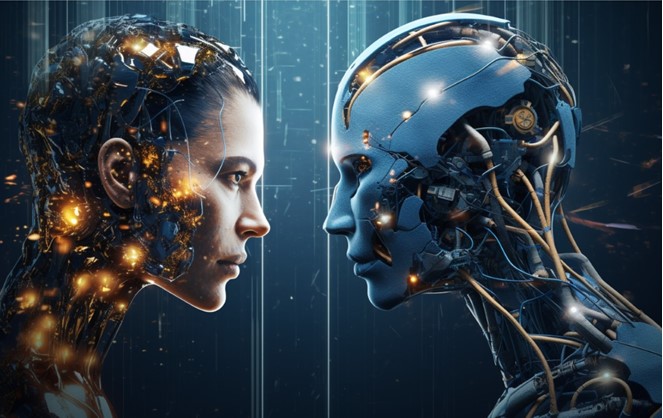
Eventually they can have a mind of their own.
Machine learning (ML) is a prominent subset of AI that empowers algorithms to automatically learn patterns and insights from vast amounts of data. By analyzing historical information, ML algorithms can identify trends, make predictions, and generate valuable insights. Deep learning, a specialized branch of ML, employs artificial neural networks to process large datasets and extract intricate patterns, allowing AI systems to perform complex tasks such as image recognition and natural language processing.
AI functionality can be found in various applications across different sectors. Chatbots like ChatGPT can understand and respond to human queries, autonomous vehicles navigate and react to their surroundings, and recommendation systems that provide personalized suggestions are all examples of AI-driven technologies. These systems are capable of adapting to changing circumstances, improving their performance over time, and addressing complex, real-world challenges.
Differentiating Factors
The key distinction between algorithm-driven functionality and AI functionality lies in their capability to adapt and learn. While algorithms are rule-based and operate within predefined boundaries, AI algorithms possess the ability to learn from data, identify patterns, and modify their behavior accordingly. AI algorithms can recognize context, make informed decisions, and navigate uncharted territory with limited explicit instructions.
What freightens many is AI functionality exhibits a higher degree of autonomy compared to algorithm-driven systems. AI algorithms can analyze and interpret complex data, extract meaningful insights, and make decisions in real-time without relying on explicit instructions or human intervention. This autonomy enables AI systems to operate in dynamic environments where rules may not be explicitly defined, making them suitable for tasks that require adaptability and learning.
Take Away
Algorithm-driven functionality and artificial intelligence functionality are distinct concepts within the realm of technology. While algorithm-driven systems rely on predefined rules and instructions, AI functionality encompasses a broader set of technologies that enable machines to simulate human intelligence, adapt to new situations, and learn from data. Understanding these differences is crucial for leveraging the strengths of each approach for a given solution and harnessing the full potential of technology to solve complex problems and drive innovation to provide solutions and benefit.
Image: An Artificial Intelligence Rendering of Tech Investor Cathie Wood
Cathie Wood’s Deflationary Expectations May Become Reality
Before Fed Chair Powell realized inflation might not be transitory, during the Fall of 2021, Cathie Wood sounded alarm bells about the risks of great deflationary pressures not being far off. The renowned hedge fund manager and founder of ARK Funds stood far apart from her peers with this forecast. Since then, the disruptive technologies investment expert has indicated the Federal Reserve should stop raising interest rates because the economy is poised for deflation rather than inflation. As most of the world has come to accept the notion that inflation may be a problem for years to come, her thoughts have been dismissed by most economists as wishful thinking.
Wood has not budged on her position, and it may serve her and her customers well. Investment success often comes with pointing yourself in a different direction than the loud narrative is pointing you. But, in the end, you have to eventually be right, and others then have to change their tune to match the once contrarian view – after all, you will need late-comers to buy your position from you.
I have to confess, as a lifelong Fedwatcher, market analyst, and cynic, I didn’t think there was a chance in the world that she could be right. Since her October of 2021 comments, not a long period of time, We’ve all witnessed a dramatic leap in technology that reduces costs, is easy to adopt, and is progressing at an exponential rate.
Cathie Wood may not be as wrong as most people thought, perhaps she is even right. Here are just some examples of when she spoke out about her deflationary outlook:
2022-10-10: Wood wrote an open letter to the Federal Reserve accusing it of stoking ‘deflation’ and looking at the wrong economic indicators.
2023-02-02: Wood gave a speech at the Sohn Investment Conference where she said that she believes deflation is a bigger threat to the US economy than inflation.
2023-03-08: Wood appeared on CNBC’s Squawk Box where she said that she believes deflation is “the biggest risk” to the global economy.
Cathie Wood has been quoted as saying:
“Deflation is the biggest risk to the global economy.”
“The rise of artificial intelligence is leading to a productivity boom, which is driving down prices.”
Less related to disruptive technologies providing businesses a more efficient means, Wood has also argued:
“The decline of globalization is leading to a decline in demand for goods and services.”
“The aging population is leading to a decline in consumption.”
“Deflation is not a bad thing. It can lead to a more sustainable economy, with lower interest rates and less debt.”
In November of 2022, ChatGPT was unveiled by OpenAI. Most everyone paying attention, including those in related tech businesses, were stunned at how far along the technology is and the potential for quickly advancing AI platforms. Currently, ChatGPT is trained on a dataset large enough that it can generate text, translate languages, write different kinds of creative content, and answer your questions in an informative way.
In 2023, ChatGPT was released to the broader public, it broke records for sign-ups and it has continued to grow in popularity. It is now used by a wide range of people, including students, writers, and businesses. This is still a beta version they are using and getting excellent results.
While generative AI for text is only one next-generation technology, example; this still under development tool alone is world-changing powerful. And it has the potential to dramatically alter the way we interact with computers – all of which can lead to dramatic gains in efficiency and productivity. Efficiency and productivity are ingredients that can stave off inflation, they can even bring prices lower – we know this because we experienced it for decades following the tech revolution.
ChatGPT and other OpenAI products are still beta tests of a text program from one institution. I understand OpenAI products can also write computer code, create graphics, and carry on a conversation. Where will OpenAI take their products next, how will the products take part in machine learning and then serve to better themselves, and how many other companies are dreaming up and developing new sources to enrich out lives at lower expense?
While Artificial Intelligence may or may not be able to lower the price of a dozen eggs, it can increase output across many industries or reduce expensive labor needs. I see examples of this in the office and at home where a search using ChatGPT can more precisely provide a response to a query than a Google internet search.
Take Away
Investors are often hurt by their ego, preventing them from rethinking and reevaluating. When exposed to new information, it’s good to take the time to reevaluate the probability of being incorrect or correct in one’s outlook.
It’s too early to know if Cathie Wood will turn out to be correct in her inflation forecasts. She lives and breathes high tech and I’m sure gets early behind-the-scenes glimpses of what has yet to come. For me, it is now easier to see how new business solutions could possibly unfold to a point where deflation becomes an issue in the world economies. I’m not sold on the idea, but I am not dismissing it as impossible either.
ChatGPT-Powered Wall Street: The Benefits and Perils of Using Artificial Intelligence to Trade Stocks and Other Financial Instruments
Artificial Intelligence-powered tools, such as ChatGPT, have the potential to revolutionize the efficiency, effectiveness and speed of the work humans do.
And this is true in financial markets as much as in sectors like health care, manufacturing and pretty much every other aspect of our lives.
I’ve been researching financial markets and algorithmic trading for 14 years. While AI offers lots of benefits, the growing use of these technologies in financial markets also points to potential perils. A look at Wall Street’s past efforts to speed up trading by embracing computers and AI offers important lessons on the implications of using them for decision-making.
This article was republished with permission from The Conversation, a news site dedicated to sharing ideas from academic experts. It represents the research-based findings and thoughts of,Pawan Jain, Assistant Professor of Finance, West Virginia University.
Program Trading Fuels Black Monday
In the early 1980s, fueled by advancements in technology and financial innovations such as derivatives, institutional investors began using computer programs to execute trades based on predefined rules and algorithms. This helped them complete large trades quickly and efficiently.
Back then, these algorithms were relatively simple and were primarily used for so-called index arbitrage, which involves trying to profit from discrepancies between the price of a stock index – like the S&P 500 – and that of the stocks it’s composed of.
As technology advanced and more data became available, this kind of program trading became increasingly sophisticated, with algorithms able to analyze complex market data and execute trades based on a wide range of factors. These program traders continued to grow in number on the largely unregulated trading freeways – on which over a trillion dollars worth of assets change hands every day – causing market volatility to increase dramatically.
Eventually this resulted in the massive stock market crash in 1987 known as Black Monday. The Dow Jones Industrial Average suffered what was at the time the biggest percentage drop in its history, and the pain spread throughout the globe.
In response, regulatory authorities implemented a number of measures to restrict the use of program trading, including circuit breakers that halt trading when there are significant market swings and other limits. But despite these measures, program trading continued to grow in popularity in the years following the crash.
HFT: Program Trading on Steroids
Fast forward 15 years, to 2002, when the New York Stock Exchange introduced a fully automated trading system. As a result, program traders gave way to more sophisticated automations with much more advanced technology: High-frequency trading.
HFT uses computer programs to analyze market data and execute trades at extremely high speeds. Unlike program traders that bought and sold baskets of securities over time to take advantage of an arbitrage opportunity – a difference in price of similar securities that can be exploited for profit – high-frequency traders use powerful computers and high-speed networks to analyze market data and execute trades at lightning-fast speeds. High-frequency traders can conduct trades in approximately one 64-millionth of a second, compared with the several seconds it took traders in the 1980s.
These trades are typically very short term in nature and may involve buying and selling the same security multiple times in a matter of nanoseconds. AI algorithms analyze large amounts of data in real time and identify patterns and trends that are not immediately apparent to human traders. This helps traders make better decisions and execute trades at a faster pace than would be possible manually.
Another important application of AI in HFT is natural language processing, which involves analyzing and interpreting human language data such as news articles and social media posts. By analyzing this data, traders can gain valuable insights into market sentiment and adjust their trading strategies accordingly.
Benefits of AI Trading
These AI-based, high-frequency traders operate very differently than people do.
The human brain is slow, inaccurate and forgetful. It is incapable of quick, high-precision, floating-point arithmetic needed for analyzing huge volumes of data for identifying trade signals. Computers are millions of times faster, with essentially infallible memory, perfect attention and limitless capability for analyzing large volumes of data in split milliseconds.
And, so, just like most technologies, HFT provides several benefits to stock markets.
These traders typically buy and sell assets at prices very close to the market price, which means they don’t charge investors high fees. This helps ensure that there are always buyers and sellers in the market, which in turn helps to stabilize prices and reduce the potential for sudden price swings.
High-frequency trading can also help to reduce the impact of market inefficiencies by quickly identifying and exploiting mispricing in the market. For example, HFT algorithms can detect when a particular stock is undervalued or overvalued and execute trades to take advantage of these discrepancies. By doing so, this kind of trading can help to correct market inefficiencies and ensure that assets are priced more accurately.
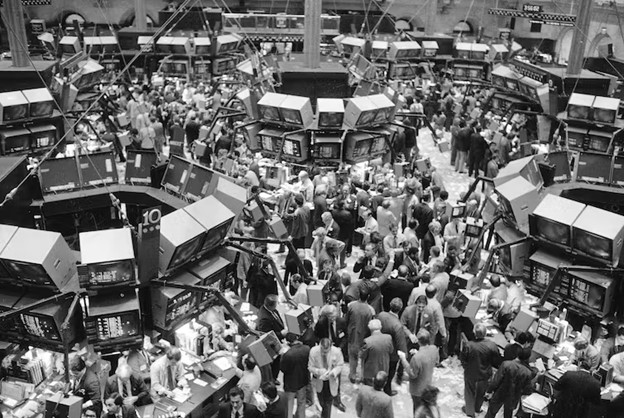
Stock exchanges used to be packed with traders buying and selling securities, as in this scene from 1983. Today’s trading floors are increasingly empty as AI-powered computers handle more and more of the work.
The Downsides
But speed and efficiency can also cause harm.
HFT algorithms can react so quickly to news events and other market signals that they can cause sudden spikes or drops in asset prices.
Additionally, HFT financial firms are able to use their speed and technology to gain an unfair advantage over other traders, further distorting market signals. The volatility created by these extremely sophisticated AI-powered trading beasts led to the so-called flash crash in May 2010, when stocks plunged and then recovered in a matter of minutes – erasing and then restoring about $1 trillion in market value.
Since then, volatile markets have become the new normal. In 2016 research, two co-authors and I found that volatility – a measure of how rapidly and unpredictably prices move up and down – increased significantly after the introduction of HFT.
The speed and efficiency with which high-frequency traders analyze the data mean that even a small change in market conditions can trigger a large number of trades, leading to sudden price swings and increased volatility.
In addition, research I published with several other colleagues in 2021 shows that most high-frequency traders use similar algorithms, which increases the risk of market failure. That’s because as the number of these traders increases in the marketplace, the similarity in these algorithms can lead to similar trading decisions.
This means that all of the high-frequency traders might trade on the same side of the market if their algorithms release similar trading signals. That is, they all might try to sell in case of negative news or buy in case of positive news. If there is no one to take the other side of the trade, markets can fail.
Enter ChatGPT
That brings us to a new world of ChatGPT-powered trading algorithms and similar programs. They could take the problem of too many traders on the same side of a deal and make it even worse.
In general, humans, left to their own devices, will tend to make a diverse range of decisions. But if everyone’s deriving their decisions from a similar artificial intelligence, this can limit the diversity of opinion.
Consider an extreme, nonfinancial situation in which everyone depends on ChatGPT to decide on the best computer to buy. Consumers are already very prone to herding behavior, in which they tend to buy the same products and models. For example, reviews on Yelp, Amazon and so on motivate consumers to pick among a few top choices.
Since decisions made by the generative AI-powered chatbot are based on past training data, there would be a similarity in the decisions suggested by the chatbot. It is highly likely that ChatGPT would suggest the same brand and model to everyone. This might take herding to a whole new level and could lead to shortages in certain products and service as well as severe price spikes.
This becomes more problematic when the AI making the decisions is informed by biased and incorrect information. AI algorithms can reinforce existing biases when systems are trained on biased, old or limited data sets. And ChatGPT and similar tools have been criticized for making factual errors.
In addition, since market crashes are relatively rare, there isn’t much data on them. Since generative AIs depend on data training to learn, their lack of knowledge about them could make them more likely to happen.
For now, at least, it seems most banks won’t be allowing their employees to take advantage of ChatGPT and similar tools. Citigroup, Bank of America, Goldman Sachs and several other lenders have already banned their use on trading-room floors, citing privacy concerns.
But I strongly believe banks will eventually embrace generative AI, once they resolve concerns they have with it. The potential gains are too significant to pass up – and there’s a risk of being left behind by rivals.
Blackboxstocks, Inc. is a financial technology and social media hybrid platform offering real-time proprietary analytics and news for stock and options traders of all levels. Our web-based software employs “predictive technology” enhanced by artificial intelligence to find volatility and unusual market activity that may result in the rapid change in the price of a stock or option. Blackbox continuously scans the NASDAQ, New York Stock Exchange, CBOE, and all other options markets, analyzing over 10,000 stocks and up to 1,500,000 options contracts multiple times per second. We provide our users with a fully interactive social media platform that is integrated into our dashboard, enabling our users to exchange information and ideas quickly and efficiently through a common network. We recently introduced a live audio/video feature that allows our members to broadcast on their own channels to share trade strategies and market insight within the Blackbox community. Blackbox is a SaaS company with a growing base of users that spans 42 countries; current subscription fees are $99.97 per month or $959.00 annually. For more information, go to: www.blackboxstocks.com .
Joe Gomes, Managing Director, Equity Research Analyst, Generalist , Noble Capital Markets, Inc.
Joshua Zoepfel, Research Associate, Noble Capital Markets, Inc.
Refer to the full report for the price target, fundamental analysis, and rating.
Results. Blackboxstocks generated revenue of $859,004 compared to $1.3 million in the prior year. Operating loss was at $1.9 million compared to a loss of $1.0 million last year. Net loss for the Company was at $1.9 million compared to a loss of $1.2 million in the previous year. The Company believes that the revenue decline has been stabilized, due to the release of the Blackbox 2.0 platform in March.
A Continued Trend. The volatility of the stock market along with inflation, higher interest rates, and ever-looming recession fears have continued to impact the Company’s performance. It is shown with the average member count, as it decreased to 3,555 in the first quarter from 5,709 in the prior year quarter and 4,607 in the previous quarter.
Equity Research is available at no cost to Registered users of Channelchek. Not a Member? Click ‘Join’ to join the Channelchek Community. There is no cost to register, and we never collect credit card information.
This Company Sponsored Research is provided by Noble Capital Markets, Inc., a FINRA and S.E.C. registered broker-dealer (B/D).
*Analyst certification and important disclosures included in the full report. NOTE: investment decisions should not be based upon the content of this research summary. Proper due diligence is required before making any investment decision.
Artificial intelligence (AI) is a true disruptive technology. As any informed content writer can tell you, the technology creates efficiencies by speeding up data gathering, research, and even graphics that specifically reflect the content. As an example, it is arguably quicker to use ChatGPT to provide a list of ticker symbols from company names, than it is to look them up one by one. With these small time savers, over the course of a week, far more can be produced as a result of AI tools saving a few minutes here and there.
This presents the question, what are the limits of AI – what can’t it do?
Worker Displacement
Technological revolutions have always benefitted humankind in the long run; in the short run, they have been disruptive, often displacing people who then have to retrain.
A new Goldman Sachs report says “significant disruption” could be on the horizon for the labor market. Goldman’s analysis of jobs in the U.S. and Europe shows that two-thirds of jobs could be automated at least to some degree. In the U.S., “of those occupations which are exposed, most have a significant — but partial — share of their workload (25-50%) that can be replaced,” Goldman Sachs’ analysts said in the paper.
Around the world, as many as 300 million jobs could be affected, the report says. Changes to labor markets are therefore likely – although historically, technological progress doesn’t just make jobs redundant, it also creates new ones. And the added productivity allows the masses to live wealthier lives. This clearly was the end result of the industrial revolution, and years after the computer revolution, we are at a high rate of employment and have at our fingertips much which we never even dreamed.
The Goldman report says the use of AI technology could boost labor productivity growth and boost global GDP by as much as 7% over time.
There are few reasons to expect that the AI revolution won’t also provide more goods and services per person for a richer existence. But, what about the disruption in the interim? I was curious to know what artificial intelligence is not expected to be able to do. There isn’t much information out there, so I went to an AI source and fed it a bunch of pointed questions about its nature. Part of that nature is to not intentionally lie, I found the responses worth sharing as we will all soon be impacted by what the technology can and cannot do.
Limitations of AI that Will Persist
Artificial intelligence has come a long way in recent years and the speed of progression and adoption is accelerating. As a result, applications have become increasingly sophisticated. But, there are still many things that AI cannot do now and may never be able to do.
One thing that AI cannot do now and may never be able to do is to truly understand human emotions and intentions. While AI algorithms can detect patterns in data and recognize certain emotional expressions, they do not have the ability to experience emotions themselves. This means that AI cannot truly understand the nuances of human communication, which can lead to misinterpretation and miscommunication.
Another limitation of AI is that it cannot replicate the creativity and intuition of humans. While AI can generate new ideas based on existing data, it lacks the ability to come up with truly original and innovative ideas. This is because creativity and intuition are often based on a combination of experience, emotion, and imagination, which are difficult to replicate in a machine.
AI also struggles with tasks that require common sense reasoning or context awareness. For example, AI may be able to identify a picture of a cat, but it may struggle to understand that a cat is an animal that can be petted or that it can climb trees. This is because AI lacks the contextual understanding that humans have built up through years of experience and interaction with the world around us.
In the realm of stocks and economics, AI has shown promise in analyzing data and making predictions, but there are still limitations to its abilities. For example, AI can analyze large datasets and identify patterns in market trends, but it cannot account for unexpected events or human behavior that may affect the market. This means that while AI can provide valuable insights, it cannot guarantee accurate predictions or prevent market volatility.
Another limitation of AI in economics is its inability to understand the complexities of social and political systems. Economic decisions are often influenced by social and political factors, such as government policies and public opinion. While AI can analyze economic data and identify correlations, it lacks the ability to understand the underlying social and political context that drives economic decisions.
A concern some have about artificial intelligence is that it may perpetuate biases that exist in the data it analyzes. This is the “garbage in, garbage out” data problem on steroids. For example, if historical data on stock prices is biased towards a certain demographic or industry, AI algorithms may replicate these biases in their predictions. This can lead to an amplified bias that proves faulty and not useful for economic decision making.
Take Away
AI has shown remarkable progress in recent years, but, as with everything that came before, there are still things that it cannot do now and may never be able to do. AI lacks the emotional intelligence, creativity, and intuition of humans, as well as common sense reasoning and social and political systems. In economics and stock market analysis, AI can provide valuable insights, but it cannot assure accurate predictions or prevent market volatility. So while companies are investing in ways to make our lives more productive with artificial intelligence and machine learning, it remains important to invest in our own human intelligence, growth and expertise.
One Stop Systems, Inc. (OSS) designs and manufactures innovative AI Transportable edge computing modules and systems, including ruggedized servers, compute accelerators, expansion systems, flash storage arrays, and Ion Accelerator™ SAN, NAS, and data recording software for AI workflows. These products are used for AI data set capture, training, and large-scale inference in the defense, oil and gas, mining, autonomous vehicles, and rugged entertainment applications. OSS utilizes the power of PCI Express, the latest GPU accelerators and NVMe storage to build award-winning systems, including many industry firsts, for industrial OEMs and government customers. The company enables AI on the Fly® by bringing AI datacenter performance to ‘the edge,’ especially on mobile platforms, and by addressing the entire AI workflow, from high-speed data acquisition to deep learning, training, and inference. OSS products are available directly or through global distributors. For more information, go to www.onestopsystems.com.
Joe Gomes, Managing Director, Equity Research Analyst, Generalist , Noble Capital Markets, Inc.
Joshua Zoepfel, Research Associate, Noble Capital Markets, Inc.
Refer to the full report for the price target, fundamental analysis, and rating.
1Q23 Results. Revenue of $16.8 million, slightly above guidance and our $16.2 million estimate but down 1.6% y-o-y. As expected, the Disguise business continues to run off. Higher operating expenses, including some one-time items, drove a net loss of $400,512, or a loss of $0.02/sh in the quarter, compared to net income of $579,234, or EPS of $0.03/sh per share last year. We had forecast net income of $31,200, or breakeven on a per share basis. Adjusted EPS was $0.00 compared to $0.05 last year.
Activity Remains High. OSS added seven new program wins during the first quarter. These wins should yield about $5 million of revenue in 2023. The Company also added three new pending major programs during the quarter. The pipeline of pending major programs at the end of the first quarter totaled 34, with 18 of these involving AI transportable applications in the U.S., Asia Pacific, and Europe.
Equity Research is available at no cost to Registered users of Channelchek. Not a Member? Click ‘Join’ to join the Channelchek Community. There is no cost to register, and we never collect credit card information.
This Company Sponsored Research is provided by Noble Capital Markets, Inc., a FINRA and S.E.C. registered broker-dealer (B/D).
*Analyst certification and important disclosures included in the full report. NOTE: investment decisions should not be based upon the content of this research summary. Proper due diligence is required before making any investment decision.
One Stop Systems, Inc. (OSS) designs and manufactures innovative AI Transportable edge computing modules and systems, including ruggedized servers, compute accelerators, expansion systems, flash storage arrays, and Ion Accelerator™ SAN, NAS, and data recording software for AI workflows. These products are used for AI data set capture, training, and large-scale inference in the defense, oil and gas, mining, autonomous vehicles, and rugged entertainment applications. OSS utilizes the power of PCI Express, the latest GPU accelerators and NVMe storage to build award-winning systems, including many industry firsts, for industrial OEMs and government customers. The company enables AI on the Fly® by bringing AI datacenter performance to ‘the edge,’ especially on mobile platforms, and by addressing the entire AI workflow, from high-speed data acquisition to deep learning, training, and inference. OSS products are available directly or through global distributors. For more information, go to www.onestopsystems.com.
Joe Gomes, Managing Director, Equity Research Analyst, Generalist , Noble Capital Markets, Inc.
Joshua Zoepfel, Research Associate, Noble Capital Markets, Inc.
Refer to the full report for the price target, fundamental analysis, and rating.
New Award. One Stop Systems received an initial order from a new military prime contractor for OSS 3U short-depth servers (SDS) for use by a U.S. Air Force anti-electronic warfare system. OSS has already commenced shipments under an initial purchase order. This program is the company’s first with this prime contractor. It is valued at approximately $3.5 million over the next three years.
SDS. The servers feature proprietary OSS Gen 4 PCI express NVMe controllers, OSS transportable hot-swap drive canisters, and NVMe SSDs that support government encryption standards. The servers are expected to serve as a head storage node for data collection located at U.S. Air Force ground stations that house military aircraft. They will be capable of recording large volumes of simulation data and deliver it at high speeds with low latency to data scientists on the network.
Equity Research is available at no cost to Registered users of Channelchek. Not a Member? Click ‘Join’ to join the Channelchek Community. There is no cost to register, and we never collect credit card information.
This Company Sponsored Research is provided by Noble Capital Markets, Inc., a FINRA and S.E.C. registered broker-dealer (B/D).
*Analyst certification and important disclosures included in the full report. NOTE: investment decisions should not be based upon the content of this research summary. Proper due diligence is required before making any investment decision.
ISG (Information Services Group) (Nasdaq: III) is a leading global technology research and advisory firm. A trusted business partner to more than 700 clients, including more than 75 of the world’s top 100 enterprises, ISG is committed to helping corporations, public sector organizations, and service and technology providers achieve operational excellence and faster growth. The firm specializes in digital transformation services, including automation, cloud and data analytics; sourcing advisory; managed governance and risk services; network carrier services; strategy and operations design; change management; market intelligence and technology research and analysis. Founded in 2006, and based in Stamford, Conn., ISG employs more than 1,300 digital-ready professionals operating in more than 20 countries—a global team known for its innovative thinking, market influence, deep industry and technology expertise, and world-class research and analytical capabilities based on the industry’s most comprehensive marketplace data. For additional information, visit www.ISG-One.com
Joe Gomes, Managing Director, Equity Research Analyst, Generalist , Noble Capital Markets, Inc.
Joshua Zoepfel, Research Associate, Noble Capital Markets, Inc.
Refer to the full report for the price target, fundamental analysis, and rating.
Seeing More Demand. ISG’s momentum has continued to build and this quarter realized an all time high in revenue, as demand for digital services, especially cost optimization, is providing ISG with a nice tailwind through the economic environment. Companies continue to invest in digital to maintain and build competitive advantage. The client base now exceeds 900.
Record Revenue. ISG reported an all-time record revenue of $78 million, exceeding guidance and our estimate of $74 million. Recurring revenue, driven by double-digit growth in the GovernX and risk management business, reached a record $33 million, up 27% y-o-y.
Equity Research is available at no cost to Registered users of Channelchek. Not a Member? Click ‘Join’ to join the Channelchek Community. There is no cost to register, and we never collect credit card information.
This Company Sponsored Research is provided by Noble Capital Markets, Inc., a FINRA and S.E.C. registered broker-dealer (B/D).
*Analyst certification and important disclosures included in the full report. NOTE: investment decisions should not be based upon the content of this research summary. Proper due diligence is required before making any investment decision.
ISG (Information Services Group) (Nasdaq: III) is a leading global technology research and advisory firm. A trusted business partner to more than 700 clients, including more than 75 of the world’s top 100 enterprises, ISG is committed to helping corporations, public sector organizations, and service and technology providers achieve operational excellence and faster growth. The firm specializes in digital transformation services, including automation, cloud and data analytics; sourcing advisory; managed governance and risk services; network carrier services; strategy and operations design; change management; market intelligence and technology research and analysis. Founded in 2006, and based in Stamford, Conn., ISG employs more than 1,300 digital-ready professionals operating in more than 20 countries—a global team known for its innovative thinking, market influence, deep industry and technology expertise, and world-class research and analytical capabilities based on the industry’s most comprehensive marketplace data. For additional information, visit www.ISG-One.com
Joe Gomes, Managing Director, Equity Research Analyst, Generalist , Noble Capital Markets, Inc.
Joshua Zoepfel, Research Associate, Noble Capital Markets, Inc.
Refer to the full report for the price target, fundamental analysis, and rating.
1Q23 Results. All-time record revenue of $78.5 million, up 8.2% y-o-y. Currency translation negatively impacted reported revenue by $2.1 million. By geography, Americas revenue rose 17% to $48.4 million, Europe was down 2% on a reported basis and up 5% on a constant currency basis to $23.1 million, and Asia-Pacific revenue of $7 million was down 8% on a reported basis and down 3% on a constant currency basis. We were at $74 million.
Results Continued. But higher direct costs and expenses for advisors negatively impacted operating income. Direct costs were up 11.9% to 62.7% of revenue compared to 60.6% in 1Q22. Operating income was down 9% to $7.1 million from $7.7 million. Net income was down 29% to $3.5 million, or $0.07/sh. Adjusted EPS was $0.12/sh. We had projected EPS of $0.08 and adjusted EPS of $0.12.
Equity Research is available at no cost to Registered users of Channelchek. Not a Member? Click ‘Join’ to join the Channelchek Community. There is no cost to register, and we never collect credit card information.
This Company Sponsored Research is provided by Noble Capital Markets, Inc., a FINRA and S.E.C. registered broker-dealer (B/D).
*Analyst certification and important disclosures included in the full report. NOTE: investment decisions should not be based upon the content of this research summary. Proper due diligence is required before making any investment decision.
Four Essential Reads on the Risks and Concerns Over Artificial Intelligence
If you’re like me, you’ve spent a lot of time over the past few months trying to figure out what this AI thing is all about. Large-language models, generative AI, algorithmic bias – it’s a lot for the less tech-savvy of us to sort out, trying to make sense of the myriad headlines about artificial intelligence swirling about.
But understanding how AI works is just part of the dilemma. As a society, we’re also confronting concerns about its social, psychological and ethical effects. Here we spotlight articles about the deeper questions the AI revolution raises about bias and inequality, the learning process, its impact on jobs, and even the artistic process.
Ethical Debt
When a company rushes software to market, it often accrues “technical debt”: the cost of having to fix bugs after a program is released, instead of ironing them out beforehand.
There are examples of this in AI as companies race ahead to compete with each other. More alarming, though, is “ethical debt,” when development teams haven’t considered possible social or ethical harms – how AI could replace human jobs, for example, or when algorithms end up reinforcing biases.
Casey Fiesler, a technology ethics expert at the University of Colorado Boulder, wrote that she’s “a technology optimist who thinks and prepares like a pessimist”: someone who puts in time speculating about what might go wrong.
That kind of speculation is an especially useful skill for technologists trying to envision consequences that might not impact them, Fiesler explained, but that could hurt “marginalized groups that are underrepresented” in tech fields. When it comes to ethical debt, she noted, “the people who incur it are rarely the people who pay for it in the end.”
Is Anybody There?
AI programs’ abilities can give the impression that they are sentient, but they’re not, explained Nir Eisikovits, director of the Applied Ethics Center at the University of Massachusetts Boston. “ChatGPT and similar technologies are sophisticated sentence completion applications – nothing more, nothing less,” he wrote.
But saying AI isn’t conscious doesn’t mean it’s harmless.
“To me,” Eisikovits explained, “the pressing question is not whether machines are sentient but why it is so easy for us to imagine that they are.” Humans easily project human features onto just about anything, including technology. That tendency to anthropomorphize “points to real risks of psychological entanglement with technology,” according to Eisikovits, who studies AI’s impact on how people understand themselves.
Considering how many people talk to their pets and cars, it shouldn’t be a surprise that chatbots can come to mean so much to people who engage with them. The next steps, though, are “strong guardrails” to prevent programs from taking advantage of that emotional connection.
Putting Pen to Paper
From the start, ChatGPT fueled parents’ and teachers’ fears about cheating. How could educators – or college admissions officers, for that matter – figure out if an essay was written by a human or a chatbot?
But AI sparks more fundamental questions about writing, according to Naomi Baron, an American University linguist who studies technology’s effects on language. AI’s potential threat to writing isn’t just about honesty, but about the ability to think itself.
Baron pointed to novelist Flannery O’Connor’s remark that “I write because I don’t know what I think until I read what I say.” In other words, writing isn’t just a way to put your thoughts on paper; it’s a process to help sort out your thoughts in the first place.
AI text generation can be a handy tool, Baron wrote, but “there’s a slippery slope between collaboration and encroachment.” As we wade into a world of more and more AI, it’s key to remember that “crafting written work should be a journey, not just a destination.”
The Value of Art
Generative AI programs don’t just produce text, but also complex images – which have even captured a prize or two. In theory, allowing AI to do nitty-gritty execution might free up human artists’ big-picture creativity.
Not so fast, said Eisikovits and Alec Stubbs, who is also a philosopher at the University of Massachusetts Boston. The finished object viewers appreciate is just part of the process we call “art.” For creator and appreciator alike, what makes art valuable is “the work of making something real and working through its details”: the struggle to turn ideas into something we can see.
This story is a roundup of articles originally puplished in The Conversation. It was compiled by
Molly Jackson, the Religion and Ethics Editor at The Conversation. It includes work fromAlec Stubbs, Postdoctoral Fellow in Philosophy, UMass Boston. Casey Fiesler, Associate Professor of Information Science, University of Colorado Boulder. Naomi S. Baron, Professor Emerita of Linguistics, American University. And, Nir Eisikovits, Professor of Philosophy and Director, Applied Ethics Center, UMass Boston. It was reprinted with permission.
Image: AI rendering of futuristic robot photobombing the VP and new AI Czar
Planning Ahead to Avoid an AI Pandora’s Box
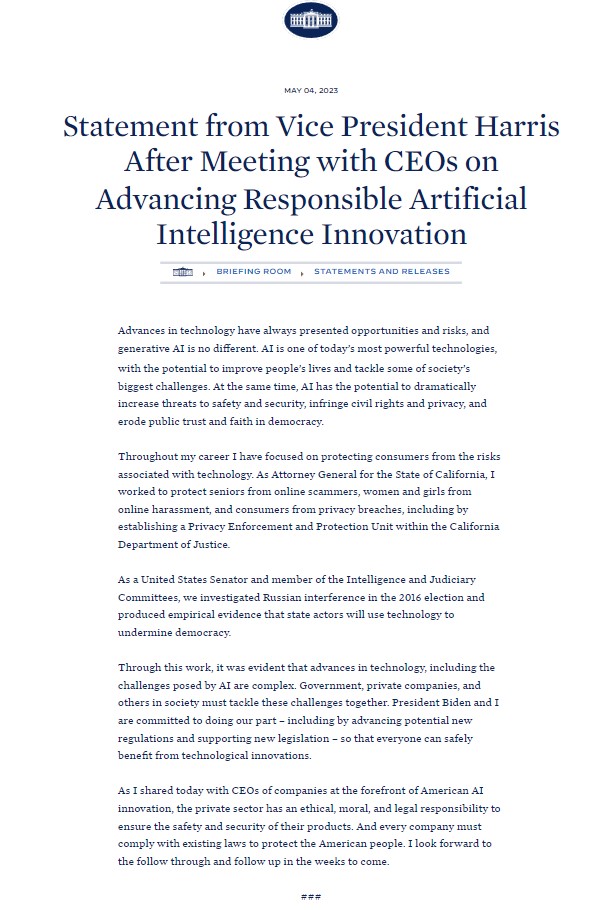
Vice President Kamala Harris wasted no time as the newly appointed White House Artificial Intelligence (AI) Czar. She has already met with heads of companies involved in AI and explained that although Artificial intelligence technology has the potential to benefit humanity, the opportunities it allows also come with extreme risk. She is now tasked with spearheading the effort to preemptively prevent a Pandora’s box situation where, once allowed, the bad that results may overshadow the good.
The plan that the administration is devising, overseen by the Vice President, calls for putting in place protections as the technology grows.
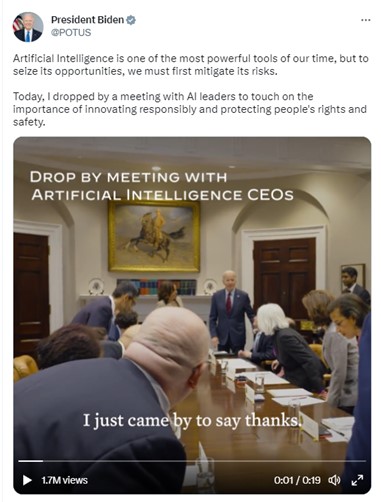
On May 4, Harris met with corporate heads of companies leading in AI technology. They included OpenAI, Google and Microsoft. In a tweet from the President’s desk, he is shown thanking the corporate heads in advance for their cooperation. “What you’re doing has enormous potential and enormous danger,” Biden told the CEOs
Image: Twitter (@POTUS)
Amid recent warnings from AI experts that say tyrannical dictators could exploit the developing technology to push disinformation, the White House has allocated $140 million in funding for seven newly created AI research groups. President Biden has said the technology was “one of the most powerful” of our time, then added, “But in order to seize the opportunities it presents, we must first mitigate its risks.”
The full plan unveiled this week is to launch 25 research institutes across the US that will seek assurance from companies, including ChatGPT’s creator OpenAI, that they will ‘participate in a public evaluation.’
The reason for the concern and the actions taken is that many of the world’s best minds have been warning about the dangers of AI, specifically that it could be used against humanity. Serial tech entrepreneur Elon Musk fears AI technology will soon surpass human intelligence and have independent thinking. Put another way; the machines would no longer need to abide by human commands. At the worst currently imagined, they may develop the ability to steal nuclear codes, create pandemics and spark world wars.
After Harris met with tech executives Thursday to discuss reducing potential risks, she said in a statement, “As I shared today with CEOs of companies at the forefront of American AI innovation, the private sector has an ethical, moral, and legal responsibility to ensure the safety and security of their products.”
The sudden elevation of artificial intelligence as needing to be managed came as awareness grew as to just how remarkable and powerful the technology has the potential to become. This broad awareness came as OpenAI released a version of ChatGPT which already had the ability to mimic humanlike thinking and interaction.
Other considerations, and probably many not yet conceived, is that AI can generate humanlike writing and fake images; there are ethical and societal concerns. As an example, the fabricated image at the top of this article was created within three minutes by a new user of an AI program.
IBM Will Stop Hiring Professionals For Jobs Artificial Intelligence Might Do
Will AI take jobs and replace people in the future? Large companies are now making room for artificial intelligence alternatives by reducing hiring for positions that AI is expected to be able to fill. Bloomberg reported earlier in May that International Business Machines (IBM) expects to pause the hiring for thousands of positions that could be replaced by artificial intelligence in the coming years.
IBM’s CEO Arvind Krishna said in an interview with Bloomberg that hiring will be slowed or suspended for non-customer-facing roles, such as human resources, which makes up make up 26,000 positions at the tech giant. Watercooler talk of how AI may alter the workforce has been part of discussions in offices across the globe in recent months. IBM’s policy helps define in real terms the impact AI will have. Krishna said he expects about 30% of nearly 26,000 positions could be replaced by AI over a five-year period at the company, that’s 7,800 supplanted by AI.
IBM employs 260,000 people, the positions that involve interacting with customers and developing software are not on the chopping block Krishna said in the interview.
Image credit: Focal Foto (Flickr)
Global Job Losses
In a recent Goldman Sachs research report titled, Generative AI could raise global GDP by 7%, it was shown that 66% of all occupations could be partially automated by AI. This could, over time, allow for more productivity. The report’s specifics are written on the contingency that “generative AI delivers on its promised capabilities.” If it does, Goldman believes 300 million jobs could be threatened in the U.S. and Europe. If AI evolves as promised, Goldman estimates that one-fourth of current work could be accomplished using generative AI.
Sci-fi images of a future where robots replace human workers have existed since the word robot came to life in 1920. The current quick acceleration of AI programs, including ChatGPT and other OpenAI.com products, has ignited concerns that society is not yet ready to reckon with a massive shift in how production can be met without payroll.
Should Workers Worry?
Serial entrepreneur Elon Musk is one of the most vocal critics of AI. He is one of the founders of OpenAI, and the robot division at Tesla. In April, Musk claimed in an interview with Tucker Carlson on Fox News that he believes tech executives like Google’s Larry Page are “not taking AI safety seriously enough.” Musk asserts that he’s been called a “speciesist” for raising alarm bells about AI’s impact on humans, his concern is so great that he is moving forward with his own AI company—X.AI. This, he says, is in response to the recklessness of tech firms.
IBM now has digital labor solutions which help customers automate labor-intensive tasks such as data entry. “In digital labor, we are helping finance, accounting, and HR teams save thousands of hours by automating what used to belabor intensive data-entry tasks,” Krishna said on the company’s earnings call on April 19. “These productivity initiatives free up spending for reinvestment and contribute to margin expansion.”
Technology and innovation have always benefitted households in the long term. The industrial revolution, and later the technology revolution, at first did eliminate jobs. Later the human resources made available by machines increased productivity by freeing up people to do more. Productivity, or increased GDP, is equivalent to a wealthier society as GDP per capita increases.