Defense Metals Corp. is a mineral exploration and development company focused on the acquisition, exploration and development of mineral deposits containing metals and elements commonly used in the electric power market, defense industry, national security sector and in the production of green energy technologies, such as, rare earths magnets used in wind turbines and in permanent magnet motors for electric vehicles. Defense Metals owns 100% of the Wicheeda Rare Earth Element Property located near Prince George, British Columbia, Canada. Defense Metals Corp. trades in Canada under the symbol “DEFN” on the TSX Venture Exchange, in the United States, under “DFMTF” on the OTCQB and in Germany on the Frankfurt Exchange under “35D”.
Mark Reichman, Managing Director, Equity Research Analyst, Natural Resources, Noble Capital Markets, Inc.
Refer to the full report for the price target, fundamental analysis, and rating.
Preliminary feasibility study. Defense Metals has engaged Hatch Ltd. and SRK Consulting (Canada) Inc. as principal consultants for the completion of the Wicheeda Rare Earth Element project preliminary feasibility study which is expected to be completed in the first half of 2024. SRK is one of four consultants working on the PFS and will take the lead role as well as handling the mining and tailings scope work with support from APEX Geoscience Ltd. who is acting as Defense Metals’ exploration, geology, and resource consultant. Hatch will focus on concentrating and hydrometallurgical processes, plant facilities and capital and operating costs. One-eighty Consulting Group is responsible for environmental studies, permitting, and social and community impact scoping.
SRK geotechnical investigations. SRK has made field site inspections and site infrastructure geotechnical investigations include a series of excavated test pits, and sonic overburden drill holes designed to support the preliminary characterization of the soil subsurface and bedrock foundations of potential future waste rock storage, mineralization stockpile, contact water pond, crusher, processing plant, and tailings storage facility locations. In addition to infrastructure geotechnical investigations, SRK has commenced a tailings alternatives assessment prior to advancing into a PFS-level design.
Equity Research is available at no cost to Registered users of Channelchek. Not a Member? Click ‘Join’ to join the Channelchek Community. There is no cost to register, and we never collect credit card information.
This Company Sponsored Research is provided by Noble Capital Markets, Inc., a FINRA and S.E.C. registered broker-dealer (B/D).
*Analyst certification and important disclosures included in the full report. NOTE: investment decisions should not be based upon the content of this research summary. Proper due diligence is required before making any investment decision.
Mark Reichman, Managing Director, Equity Research Analyst, Natural Resources, Noble Capital Markets, Inc.
Refer to the full report for the price target, fundamental analysis, and rating.
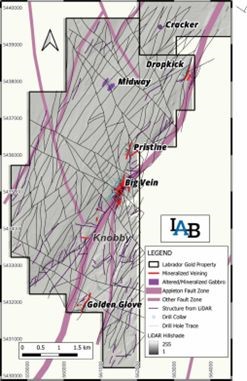
Prospecting yields high grade gold mineralization. Recent prospecting between the Big Vein and Golden Glove targets at the company’s Kingsway project has located a new gold showing called the Knobby occurrence. Grab samples from quartz vein outcrops returned gold values of up to 30.58 grams of gold per tonne, including samples grading 0.4 grams of gold per tonne, 2.7 grams of gold per tonne, and 29.19 grams of gold per tonne. Three parallel veins have been traced along an east-west strike for approximately 200 meters. This is the first indication of gold mineralization along the Appleton Fault Zone between Big Vein and Golden Glove targets.
New target expected to be drilled this year. Prospecting continues around the Knobby occurrence and a ground geophysical survey extending from the southern boundary to Big Vein is being completed. Labrador Gold has applied for permits to drill up to 95 drill holes along this portion of the Appleton Fault Zone. Management has prioritized this area for drilling in the later part of 2023 following the receipt of permits and completion of the ground magnetic/VLF survey.
Equity Research is available at no cost to Registered users of Channelchek. Not a Member? Click ‘Join’ to join the Channelchek Community. There is no cost to register, and we never collect credit card information.
This Company Sponsored Research is provided by Noble Capital Markets, Inc., a FINRA and S.E.C. registered broker-dealer (B/D).
*Analyst certification and important disclosures included in the full report. NOTE: investment decisions should not be based upon the content of this research summary. Proper due diligence is required before making any investment decision.
VANCOUVER, BC, Aug. 16, 2023 /CNW/ – Defense Metals Corp. (“Defense Metals” or the “Company“) (TSXV: DEFN) (OTCQB: DFMTF) (FSE: 35D) is pleased to provide a progress update with respect to its 2023 site infrastructure geotechnical investigations. The work, with support of the Defense Metals’ technical team and APEX Geoscience Ltd., is being completed by SRK Consulting (Canada) Inc. (“SRK“) one of the principal consultants for the preliminary feasibility study (“PFS“) regarding the Company’s Wicheeda Rare Earth Element (REE) Project located near Prince George, Canada.
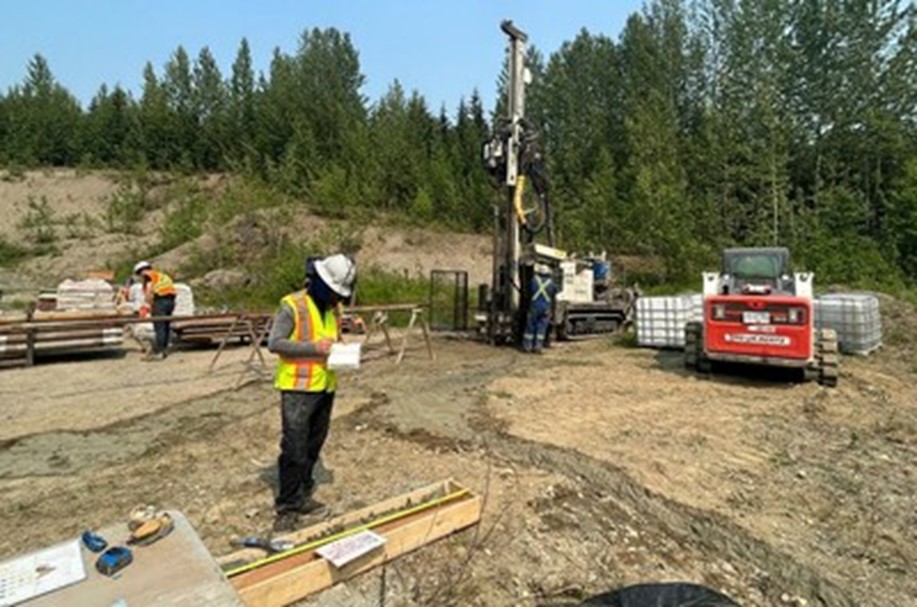
Image 1: SRK engineering personnel logging WSF sonic overburden material (CNW Group/Defense Metals Corp.)
“It is great to see our technical consulting teams making significant headway with the Wicheeda site investigations. Defence Metals has assembled a world class team of experts who have both the experience and technical skills to bring this project through pre-feasibility.”
The SRK geotechnical investigation includes the following scopes:
Geotechnical engineering (waste rock, tailings, contact water pond, and site infrastructure geotechnical investigation),
Tailings alternative assessment prior to advancing into PFS-level design of a preferred alternative,
Geochemical characterization (to support mine planning/waste management and to develop preliminary water chemistry predictions for the main mine facilities).
The work completed to date included field site inspections from SRK personnel: Principial Consultant – Mining Rock Mechanics, Ed Saunders, P.Eng. (waste storage facility geotechnical); Principal Consultant – Geochemistry, Kirsty Ketchum, Ph.D., P.Geo. (metal leaching and acid/alkaline rock drainage geochemical characterization); and Senior Consultant- Mining Rock Mechanics, Aton Bloem (open pit geotechnical).
Site infrastructure geotechnical investigations planned include a series of excavated test pits, and sonic overburden drill holes designed to support the preliminary characterization of the shallow soil subsurface and bedrock foundations of potential future waste rock storage (WSF), mineralization stockpile, contact water pond (CWP), crusher, processing plant (INF), and tailings storage facility (TSF) locations.
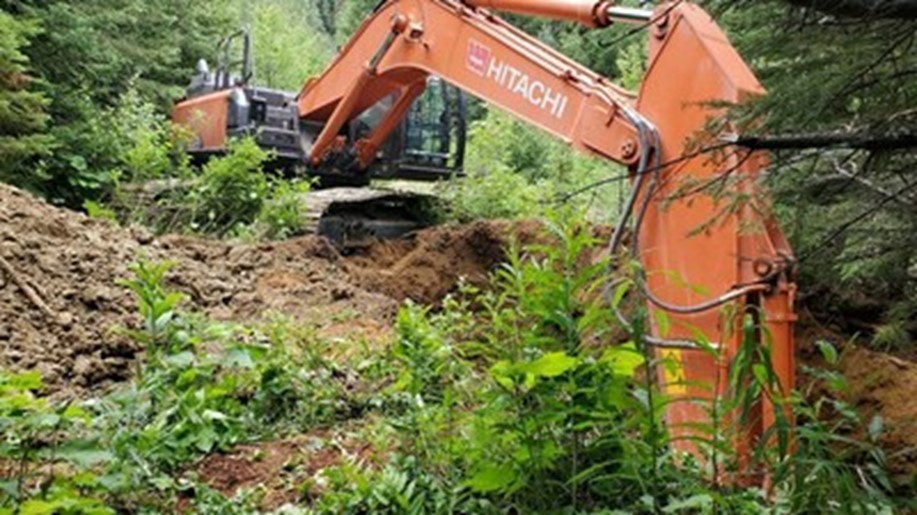
To date a total of 13 excavated tests pits and 4 sonic overburden geotechnical holes for a total of 93 metres have been completed to characterize surficial material conditions within the proposed WSF, CWP, and TSF areas (Images 1 and 2). Site geotechnical investigations encountered shallow overburden conditions (nil or <1 metre overburden depth), excavated test pit depths ranging from 1 to 5 metres; and sonic overburden drill holes in areas of thicker surficial material ranging from 7 metre to >36.6 metre depth to bedrock.
SRK on site engineering consultants supervised the investigations and carried out soil geotechnical logging, direct testing, sampling, photography of recovered materials, standpipe installation, and coordination of laboratory testing. SRK will process the data collected from the sonic drilling and test pit investigations, and laboratory testing results will be incorporated into the QA/QC dataset.
In addition to infrastructure geotechnical investigations, SRK has commenced a tailings alternatives assessment prior to advancing into PFS-level design of a preferred alternative. This will include tailings characterization and development of design criteria, a siting evaluation, and an alternatives trade-off.
As part of the geochemical characterization scopes SRK has completed a review and compilation of site geological and geochemical data and drill core logs that have been acquired since the 2021 preliminary economic assessment (PEA). These data will be used to develop a sampling plan of the existing drill core for geochemical characterization of the proposed mine facilities, and future set-up of on-site kinetic leach tests (barrel tests). Data will be interpreted to support mine planning/waste management and to develop preliminary water chemistry predictions for the main mine facilities (source terms). Source terms are an input to the site water and load balance model.
Excavated test pit and sonic overburden drilling is currently paused and is expected to resume as part of the WSF, CWP, INF, and TSF (and TSF alternative) geotechnical investigations during September in conjunction with the planned drilling of an additional four (4) pit geotechnical core holes totalling 820 metres.
Qualified Person
The scientific and technical information contained in this news release as it relates to the Wicheeda REE Project has been reviewed and approved by Kristopher J. Raffle, P.Geo. (B.C.), Principal and Consultant of APEX Geoscience Ltd. of Edmonton, Alberta, who is a director of Defense Metals and a “Qualified Person” as defined in NI 43-101.
About the Wicheeda REE Property
Defense Metals 100% owned, 6,759-hectare (~16,702-acre) Wicheeda Project is located approximately 80 km northeast of the city of Prince George, British Columbia; population 77,000. The Wicheeda REE Project is readily accessible by all-weather gravel roads and is near infrastructure, including hydro power transmission lines and gas pipelines. The nearby Canadian National Railway and major highways allow easy access to the port facilities at Prince Rupert, the closest major North American port to Asia.
The 2021 Wicheeda REE Project Preliminary Economic Assessment technical report outlined a robust after-tax net present value (NPV@8%) of $517 million and an 18% IRR1. This PEA contemplated an open pit mining operation with a 1.75:1 (waste:mill feed) strip ratio providing a 1.8 Mtpa (“million tonnes per year”) mill throughput producing an average of 25,423 tonnes REO annually over a 16 year mine life. A Phase 1 initial pit strip ratio of 0.63:1 (waste:mill feed) would yield rapid access to higher grade surface mineralization in year 1 and payback of $440 million initial capital within 5 years.
_____________________________
1 Independent Preliminary Economic Assessment for the Wicheeda Rare Earth Element Project, British Columbia, Canada, dated January 6, 2022, with an effective date of November 7, 2021, and prepared by SRK Consulting (Canada) Inc. is filed under Defense Metals Corp.’s Issuer Profile on SEDAR (www.sedarplus.ca).
About Defense Metals Corp.
Defense Metals Corp. is a mineral exploration and development company focused on the development of its 100% owned Wicheeda Rare Earth Element Deposit located near Prince George, British Columbia, Canada. Defense Metals Corp. trades on the TSX Venture Exchange under the symbol “DEFN”, in the United States, trading symbol “DFMTF” on the OTCQB and in Germany on the Frankfurt Exchange under “35D”.
Defense Metals is a proud member of Discovery Group. For more information please visit: http://www.discoverygroup.ca/
Neither the TSX Venture Exchange nor its Regulation Services Provider (as that term is defined in the policies of the TSX Venture Exchange) accepts responsibility for the adequacy or accuracy of this news release.
Cautionary Statement Regarding “Forward-Looking” Information
This news release contains “forward‐looking information or statements” within the meaning of applicable securities laws, which may include, without limitation, statements relating to advancing the Wicheeda REE Project, completion of additional geotechnical work including pit geotechnical core holes and the expected timelines, the expected completion of the PFS, the technical, financial and business prospects of the Company, its project and other matters. All statements in this news release, other than statements of historical facts, that address events or developments that the Company expects to occur, are forward-looking statements. Although the Company believes the expectations expressed in such forward-looking statements are based on reasonable assumptions, such statements are not guarantees of future performance and actual results may differ materially from those in the forward-looking statements. Such statements and information are based on numerous assumptions regarding present and future business strategies and the environment in which the Company will operate in the future, including the price of rare earth elements, the anticipated costs and expenditures, accuracy of assay results, performance of available laboratory and other related services, future operating costs, interpretation of geological, engineering and metallurgical data, the ability to achieve its goals, that general business and economic conditions will not change in a material adverse manner, that financing will be available if and when needed and on reasonable terms. Such forward-looking information reflects the Company’s views with respect to future events and is subject to risks, uncertainties and assumptions, including the risks and uncertainties relating to the interpretation of exploration, engineering and metallurgical results, risks related to the inherent uncertainty of exploration, metallurgy and development and cost estimates, the potential for unexpected costs and expenses and those other risks filed under the Company’s profile on SEDAR at www.sedarplus.ca. While such estimates and assumptions are considered reasonable by the management of the Company, they are inherently subject to significant business, economic, competitive and regulatory uncertainties and risks. Factors that could cause actual results to differ materially from those in forward looking statements include, but are not limited to, continued availability of capital and financing and general economic, market or business conditions, adverse weather and climate conditions, failure to maintain or obtain all necessary government permits, approvals and authorizations, failure to maintain community acceptance (including First Nations), risks relating to unanticipated operational difficulties (including failure of equipment or processes to operate in accordance with specifications or expectations, cost escalation, unavailability of personnel, materials and equipment, government action or delays in the receipt of government approvals, industrial disturbances or other job action, and unanticipated events related to health, safety and environmental matters), risks relating to inaccurate geological, metallurgical and engineering assumptions, decrease in the price of rare earth elements, the impact of Covid-19 or other viruses and diseases on the Company’s ability to operate, an inability to predict and counteract the effects of COVID-19 and other viruses and diseases on the business of the Company, the price of commodities, capital market conditions, restriction on labour and international travel and supply chains, loss of key employees, consultants, or directors, increase in costs, delayed results, litigation, and failure of counterparties to perform their contractual obligations. The Company does not undertake to update forward‐looking statements or forward‐looking information, except as required by law.
TORONTO, Aug. 16, 2023 (GLOBE NEWSWIRE) — Labrador Gold Corp. (TSX.V:LAB | OTCQX:NKOSF | FNR: 2N6) (“LabGold” or the “Company”) is pleased to announce results from recent prospecting along the highly prospective Appleton Fault Zone at its 100% owned Kingsway Project.
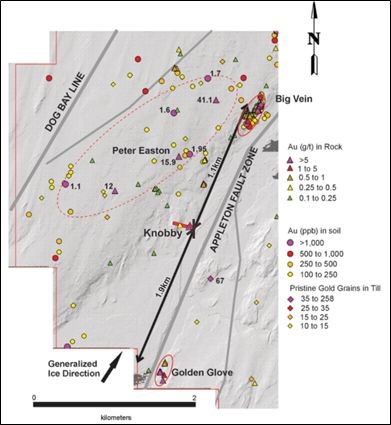
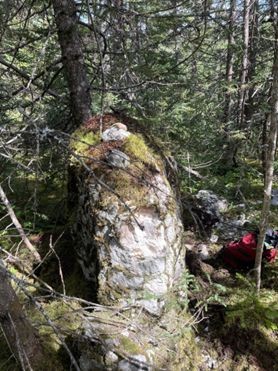
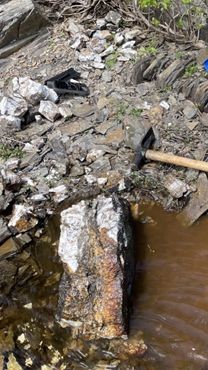
Recent prospecting between Big Vein and Golden Glove near the southern property boundary has located a new gold showing, the Knobby occurrence. Grab samples from quartz vein outcrops returned gold values from below detection (<5ppb) to 30.58 g/t including samples grading 0.4g/t, 2.7g/t and 29.19 g/t Au. Three parallel veins were observed and have been traced along an east-west strike for approximately 200 metres. Stibnite mineralization was observed associated with the quartz veining. This is the first indication of gold mineralization along the Appleton Fault Zone between Big Vein and Golden Glove, an area that has seen little work to date.
“Today’s results of high-grade, surface gold mineralization in quartz vein outcrops between Big Vein and Golden Glove is very encouraging for the prospectivity of this 3-kilometre section of the Appleton Fault Zone,” said Roger Moss, President and CEO of Labrador Gold Corp. “This is an area that we have prioritized for drilling in the latter part of this year once we complete an ongoing ground magnetic/VLF survey and receive the necessary permits. We are excited by the discovery of the Knobby occurrence which is reminiscent of our initial discovery of Big Vein by prospecting almost three years ago.”
Figure 1. Location of Knobby occurrence between Big Vein and Golden Glove.
Figure 2. Geochemical anomalies between Big Vein and Golden Glove.
Figure 3. Photos of Knobby Vein outcrop.
Prospecting is ongoing in the area of the Knobby occurrence and Groundtruth Exploration is currently completing a ground Mag/VLF survey extending from the southern property boundary to Big Vein. LabGold has submitted an application to drill up to 95 drill holes along this portion of the Appleton Fault Zone.
Upcoming Webinar
The Company is also pleased to announce that LabGold CEO, Roger Moss, will be presenting an exploration update on the Kingsway Project in a live webinar taking place on Wednesday, August 23rd at 12:00pm PT / 3:00pm ET. To register for the event please click the link below.
All rock samples are grab samples, which are selective samples and not necessarily representative of mineralization found on the property. Samples are securely stored prior to shipping to Eastern Analytical Laboratory in Springdale, Newfoundland for assay. Eastern Analytical is an ISO/IEC17025 accredited laboratory. Samples are routinely analyzed for gold by standard 30g fire assay with atomic absorption finish as well as by ICP-OES for an additional 34 elements. Samples containing visible gold are assayed by metallic screen/fire assay, as are any samples with fire assay results greater than 1g/t Au. The company submits blanks and certified reference standards at a rate of approximately 5% of the total samples in each batch.
Qualified Person
Roger Moss, PhD., P.Geo., President and CEO of LabGold, a Qualified Person in accordance with Canadian regulatory requirements as set out in NI 43-101, has read and approved the scientific and technical information that forms the basis for the disclosure contained in this release.
The Company gratefully acknowledges the Newfoundland and Labrador Ministry of Natural Resources’ Junior Exploration Assistance (JEA) Program for its financial support for exploration of the Kingsway property.
About Labrador Gold Labrador Gold is a Canadian based mineral exploration company focused on the acquisition and exploration of prospective gold projects in Eastern Canada.
Labrador Gold’s flagship property is the 100% owned Kingsway project in the Gander area of Newfoundland. The three licenses comprising the Kingsway project cover approximately 12km of the Appleton Fault Zone which is associated with numerous gold occurrences in the region. Infrastructure in the area is excellent located just 18km from the town of Gander with road access to the project, nearby electricity and abundant local water. LabGold is drilling a projected 100,000 metres targeting high-grade epizonal gold mineralization along the Appleton Fault Zone with encouraging results. The Company has approximately $12 million in working capital and is well funded to carry out the planned program.
The Hopedale property covers much of the Florence Lake greenstone belt that stretches over 60 km. The belt is typical of greenstone belts around the world but has been underexplored by comparison. Work to date by Labrador Gold show gold anomalies in rocks, soils and lake sediments over a 3 kilometre section of the northern portion of the Florence Lake greenstone belt in the vicinity of the known Thurber Dog gold showing where grab samples assayed up to 7.8g/t gold. In addition, anomalous gold in soil and lake sediment samples occur over approximately 40 km along the southern section of the greenstone belt. Labrador Gold now controls approximately 40km strike length of the Florence Lake Greenstone Belt.
The Company has 170,009,979 common shares issued and outstanding and trades on the TSX Venture Exchange under the symbol LAB.
For more information please contact: Roger Moss, President and CEO Tel: 416-704-8291
Or visit our website at: www.labradorgold.com
Twitter: @LabGoldCorp
Neither TSX Venture Exchange nor its Regulation Services Provider (as that term is defined in policies of the TSX Venture Exchange) accepts responsibility for the adequacy or accuracy of this release .
Forward-Looking Statements: This news release contains forward-looking statements that involve risks and uncertainties, which may cause actual results to differ materially from the statements made. When used in this document, the words “may”, “would”, “could”, “will”, “intend”, “plan”, “anticipate”, “believe”, “estimate”, “expect” and similar expressions are intended to identify forward-looking statements. Such statements reflect our current views with respect to future events and are subject to risks and uncertainties. Many factors could cause our actual results to differ materially from the statements made, including those factors discussed in filings made by us with the Canadian securities regulatory authorities. Should one or more of these risks and uncertainties, such as actual results of current exploration programs, the general risks associated with the mining industry, the price of gold and other metals, currency and interest rate fluctuations, increased competition and general economic and market factors, occur or should assumptions underlying the forward looking statements prove incorrect, actual results may vary materially from those described herein as intended, planned, anticipated, or expected. We do not intend and do not assume any obligation to update these forward-looking statements, except as required by law. Shareholders are cautioned not to put undue reliance on such forward-looking statements.
Comstock (NYSE: LODE) innovates technologies that contribute to global decarbonization and circularity by efficiently converting under-utilized natural resources into renewable fuels and electrification products that contribute to balancing global uses and emissions of carbon. The Company intends to achieve exponential growth and extraordinary financial, natural, and social gains by building, owning, and operating a fleet of advanced carbon neutral extraction and refining facilities, by selling an array of complimentary process solutions and related services, and by licensing selected technologies to qualified strategic partners. To learn more, please visit www.comstock.inc.
Mark Reichman, Managing Director, Equity Research Analyst, Natural Resources, Noble Capital Markets, Inc.
Refer to the full report for the price target, fundamental analysis, and rating.
Innovative feedstocks for renewable fuel producers. Comstock Fuels demonstrated the production of lignocellulosic bio-intermediates suitable for use in existing renewable fuel refineries at pilot scale and the capability for ongoing operations. A baseline lifecycle carbon analysis (LCA) model has also been developed with a third-party to validate industry-leading carbon intensity scores for fuel produced through its pathways. Management is engaged with multiple potential customers and partners for early adopter commercial agreements and expects one or more agreements to be completed this year.
Advancing toward commercialization. Comstock Metals has leased an operating facility in Silver Springs, Nevada and submitted all permits for operating its proprietary metal processing and recycling system. Comstock anticipates full deployment of its entire production system by the end of 2023 with operations commencing upon receipt of the permits. Comstock Metals has engaged suppliers to secure photovoltaic feedstocks and expects initial supply-revenue agreements in advance of production.
Equity Research is available at no cost to Registered users of Channelchek. Not a Member? Click ‘Join’ to join the Channelchek Community. There is no cost to register, and we never collect credit card information.
This Company Sponsored Research is provided by Noble Capital Markets, Inc., a FINRA and S.E.C. registered broker-dealer (B/D).
*Analyst certification and important disclosures included in the full report. NOTE: investment decisions should not be based upon the content of this research summary. Proper due diligence is required before making any investment decision.
Mark Reichman, Managing Director, Equity Research Analyst, Natural Resources, Noble Capital Markets, Inc.
Refer to the full report for the price target, fundamental analysis, and rating.
Successful collaboration with Koch. Century Lithium is collaborating with Koch Technology Solutions (KTS) in the application of Koch’s proprietary Li-Pro direct lithium extraction (DLE) process. In April, Century installed equipment from KTS and has operated the equipment at the pilot plant with significantly improved results.
Li-Pro leads to a higher grade lithium concentrate. With the integration of KTS’s DLE process, the grades of the intermediate lithium solution produced at the pilot plant have increased to the highest levels to date with an average grade of 7.5 grams per liter or 7,500 parts per million lithium. Lithium concentrations are four times higher than previously produced and unwanted elements in the final solution have been reduced. The process has resulted in the complete removal of calcium and magnesium along with significant reductions of sodium and potassium.
Equity Research is available at no cost to Registered users of Channelchek. Not a Member? Click ‘Join’ to join the Channelchek Community. There is no cost to register, and we never collect credit card information.
This Company Sponsored Research is provided by Noble Capital Markets, Inc., a FINRA and S.E.C. registered broker-dealer (B/D).
*Analyst certification and important disclosures included in the full report. NOTE: investment decisions should not be based upon the content of this research summary. Proper due diligence is required before making any investment decision.
Mark Reichman, Managing Director, Equity Research Analyst, Natural Resources, Noble Capital Markets, Inc.
Refer to the full report for the price target, fundamental analysis, and rating.
Drilling program affirms prospectivity of the Appleton Fault. Drilling at Labrador Gold’s 100%-owned Kingsway gold project continues to target the Appleton Fault over a 12-kilometer strike length. The drilling is part of the company’s ongoing 100,000-meter diamond drilling program of which 83,000 meters of drilling has been completed. Assays are pending for samples from approximately 8,877 meters of core. Most of the drilling to date has occurred at the Big Vein target where recent drilling returned 1.10 grams of gold per tonne over 9.3 meters, including 1.49 grams of gold per tonne over 5.3 meters in Hole K-23-246 and 1.47 grams of gold per tonne over 6.55 meters in Hole K-23-237. Drilling at Big Vein has defined gold mineralization over a 720-meter strike length.
Drilling at Pristine yields high-grade gold mineralization. Follow up drilling at the Pristine target returned an intersection of 11.98 grams of gold per tonne over six meters, including 30.61 grams of gold over 2.33 meters and 82.2 grams of gold over 0.75 meters that contained 77 grains of visible gold in Hole K-22-270. To date, mineralization discovered at Pristine occurs above 86 meters vertical depth and extends over a strike length of approximately 160 meters.
Equity Research is available at no cost to Registered users of Channelchek. Not a Member? Click ‘Join’ to join the Channelchek Community. There is no cost to register, and we never collect credit card information.
This Company Sponsored Research is provided by Noble Capital Markets, Inc., a FINRA and S.E.C. registered broker-dealer (B/D).
*Analyst certification and important disclosures included in the full report. NOTE: investment decisions should not be based upon the content of this research summary. Proper due diligence is required before making any investment decision.
August 9, 2023 – Vancouver, Canada – Century Lithium Corp. (TSXV:LCE) (OTCQX: CYDVF) (Frankfurt: C1Z) (Century Lithium or the Company) is pleased to report successful progress in its collaboration with Koch Technology Solutions (KTS), a Koch Engineered Solutions (KES) company. As reported previously (see April 17, 2023, news release) Century Lithium and KTS are working together on the application of KTS’s Li-ProTM system at Century’s Lithium Extraction Facility (Pilot Plant) in Amargosa Valley, Nevada, USA.
“Century Lithium is delighted to see the progress made in our collaboration with Koch Technology Solutions” stated Bill Willoughby, President, and CEO of Century Lithium. “Our team, with KTS’s input has successfully incorporated and operated the equipment at our Pilot Plant with significantly improved results.”
Since October 2021, Century Lithium has been continuously testing the extraction of lithium from the claystone found at its 100%-owned Clayton Valley Lithium Project (Project) in Nevada utilizing a chloride-based leaching process. Testing of the Li-ProTM system was conducted to evaluate potential improvements in the direct lithium extraction (DLE) area of the Pilot Plant.
Adam Sackett, President of Koch Technology Solutions, added, “The steady state results generated onsite with the Koch Technology Solutions Li-Pro™ Direct Lithium Extraction process has hit all our key milestones for the Century pilot program. We are excited to move towards engineering and executing a Li-Pro™ installation with commercial process guarantees.”
With the integration of KTS’s DLE process, the grades of the intermediate lithium solution produced at the Pilot Plant have increased to the highest levels to date, with an average grade of 7.5 grams/liter (g/l) (7,500 parts per million) lithium. These lithium concentrations are four times higher than previously generated, with sodium concentrations almost an order of magnitude lower.
Highlights To Date
Successful installation and operation of Koch’s Li-ProTM DLE process
Li-ProTM plant achieved steady state using Century Lithium’s chloride leaching process
Manufacture intermediate solutions with lithium grades of 7 to 8 g/l concentrations with average lithium to sodium ratios of 0.9 to 1.1
No observed degradation of media or accumulation of deleterious elements
Operational Results
Since the installation of KTS’s DLE equipment, Century Lithium has focused on improvements related to the operational aspects of the Pilot Plant and adjustments to the final flowsheet. These improvements were well supported through the development and incorporation of KTS’s DLE equipment at the Pilot Plant.
Century Lithium, with the support of KTS, has identified techniques to improve lithium recovery within the DLE area while minimizing deleterious elements in the final solutions. Collaboration between Century Lithium and Koch staff is very productive, generating ideas and changes that have resulted in the complete removal of calcium and magnesium, and marked reduction of sodium and potassium in the product solutions.
Qualified Person
Todd Fayram, MMSA-QP is the qualified person as defined by National Instrument 43-101 and has approved the technical information in this release.
About Century Lithium Corp.
Century Lithium Corp. (formerly Cypress Development Corp.) is an advanced stage lithium company, focused on developing its 100%-owned Clayton Valley Lithium Project in west-central Nevada, USA. Century Lithium is currently in the pilot stage of testing on material from its lithium-bearing claystone deposit at its Lithium Extraction Facility in Amargosa Valley, Nevada and progressing towards completing a Feasibility Study and permitting, with the goal of becoming a domestic producer of lithium for the growing electric vehicle and battery storage market.
ON BEHALF OF CENTURY LITHIUM CORP. WILLIAM WILLOUGHBY, PhD., PE President & Chief Executive Officer
NEITHER THE TSX VENTURE EXCHANGE NOR ITS REGULATION SERVICES PROVIDER ACCEPTS RESPONSIBILITY FOR THE ADEQUACY OR ACCURACY OF THE CONTENT OF THIS NEWS RELEASE.
This release includes certain statements that may be deemed to be “forward-looking statements”. Forward-looking statements are subject to risks, uncertainties and assumptions and are identified by words such as “expects,” “estimates,” “projects,” “anticipates,” “believes,” “could,” “scheduled,” and other similar words. All statements in this release, other than statements of historical facts, that address events or developments that management of the Company expects, are forward-looking statements. Although management believes the expectations expressed in such forward-looking statements are based on reasonable assumptions, such statements are not guarantees of future performance, and actual results or developments may differ materially from those in the forward-looking statements. The Company undertakes no obligation to update these forward-looking statements if management’s beliefs, estimates or opinions, or other factors, should change. Factors that could cause actual results to differ materially from those in forward-looking statements, include market prices, exploration, and development successes, continued availability of capital and financing, and general economic, market or business conditions. Please see the public filings of the Company at www.sedar.com for further information.
TORONTO, Aug. 09, 2023 (GLOBE NEWSWIRE) — Labrador Gold Corp. (TSX.V:LAB | OTCQX:NKOSF | FNR: 2N6) (“LabGold” or the “Company”) is pleased to announce results from recent drilling targeting the highly prospective Appleton Fault Zone. The drilling is part of the Company’s ongoing 100,000 metre diamond drilling program at its 100% owned Kingsway Project.
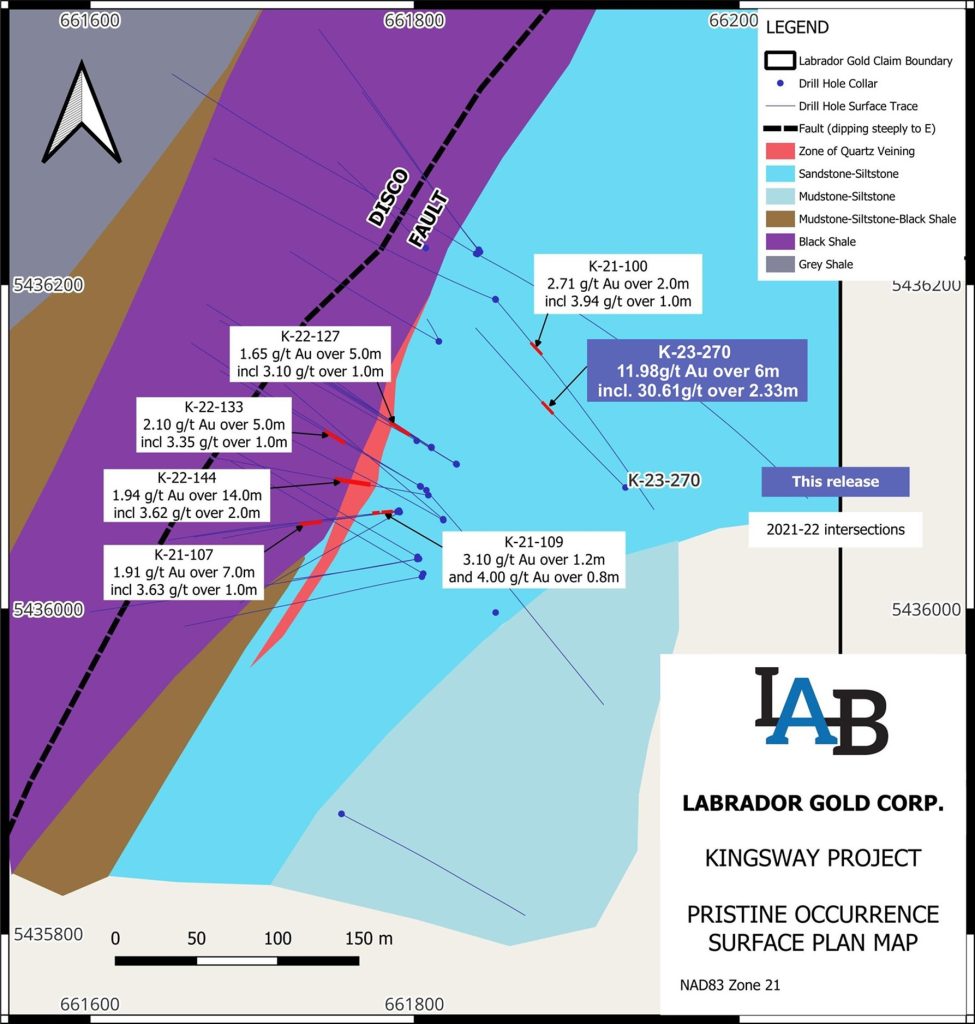
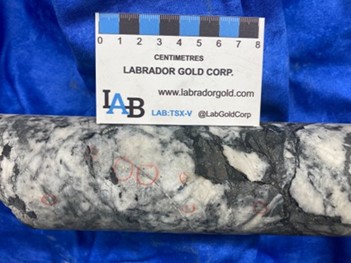
Highlights of follow up drilling at Pristine include an intersection of 11.98g/t Au over 6 metres from 91 metres (64 metres vertical) including 30.61g/t over 2.33 metres and 82.2g/t over 0.75 metres that contained 77 grains of visible gold in Hole K-22-270. All mineralization drilled to date at Pristine occurs above 86 metres vertical depth and extends over a strike length of approximately 160 metres.
Further results from first stage drilling at DropKick include 1.15g/t Au over 12.4 metres from 190.25 metres including 7.74g/t Au over 0.3 metres in hole K-23-231 and 1.46g/t Au over 6.75 metres from 162.25 metres including 3.72g/t Au over 2.15 metres in Hole K-23-251.
Ongoing drilling at Big Vein returned 1.10g/t Au over 9.3 metres from 195 metres, including 1.49g/t over 5.3 metres in Hole K-23-246 and 1.47g/t Au over 6.55 metres from 107.88 metres in hole K-23-237.
“Today’s result of high-grade, near surface gold mineralization at Pristine validates our belief that there is more to be found at Pristine. It is also the third discovery along the Appleton Fault Zone, after Big Vein and Dropkick, to produce such high grades associated with visible gold. Following our initial discovery of near surface visible gold at Pristine announced in May 2022, we did not intersect similar high-grades to those seen at Big Vein. As a result, we returned our focus to expanding Big Vein along strike and at depth and have successfully defined mineralization there over a 720-metre strike length.” said Roger Moss, President and CEO of Labrador Gold Corp. “With near surface mineralization at Pristine now drilled over an approximate 160 metre strike length and the potential for high grades demonstrated, we are looking forward to receiving the permit to drill The Gap between Pristine and Big Vein, a distance of approximately 700 metres, as we continue to focus our drilling along the very prospective Appleton Fault Zone.”
Hole ID
From (m)
To (m)
Interval (m)
Au (g/t)
Zone
K-23-270
91.00
97.00
6.00
11.98
Pristine
including
92.97
95.30
2.33
30.61
including
94.00
94.75
0.75
82.20
K-23-251
162.25
169.00
6.75
1.46
DropKick
including
166.45
168.60
2.15
3.72
including
167.00
168.60
1.60
4.48
K-23-250
152.40
152.80
0.40
6.87
Big Vein
K-23-246
195.00
204.30
9.30
1.10
Big Vein
including
199.00
204.30
5.30
1.49
K-23-240
75.22
75.63
0.41
1.82
DropKick
86.00
90.72
4.72
1.16
including
86.00
88.68
2.68
1.51
K-23-237
93.00
120.00
27.00
0.63
Big Vein
including
107.88
114.43
6.55
1.47
K-23-234
100.55
101.90
1.35
1.02
DropKick
116.00
117.00
1.00
1.26
K-23-231
190.25
202.65
12.40
1.15
Dropkick
including
197.45
201.60
4.15
1.78
including
201.30
201.60
0.30
7.74
K-23-230
16.00
19.30
3.30
0.41
Big Vein
K-23-229
nsv
Big Vein SW
K-23-228
91.55
91.85
0.30
1.18
DropKick
122.35
123.15
0.80
2.63
K-23-226
nsv
Big Vein SW
Table 1. Summary of assay results. All intersections are downhole length as there is insufficient Information to calculate true width.
Figure 1. Plan map of Pristine showing significant intersections.
Figure 2. Visible gold in drill core from Hole K-23-270. A total of 77 gold grains were observed.
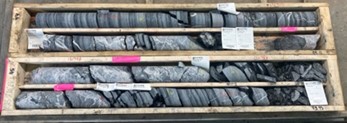
Figure 3. Interval of visible gold mineralization in Hole K-23-270
Almost 83,000 metres have been drilled to date out of the planned 100,000 metre program. Assays are pending for samples from approximately 8,877 metres of core.
The Company has approximately $12 million in cash and is well funded to carry out the remaining 17,000 metres of the planned drill program as well as further exploration to add to the current pipeline of drill targets on the property.
Hole ID
Easting
Northing
Elevation
Azimuth
Inclination
Total Depth
K-23-270
661930
5436075
52.0
315
45
187
K-23-251
663167
5438130
58.2
140
65
229
K-23-250
661554
5435471
53.0
125
70
320
K-23-246
661272
5435093
62.4
145
45
250
K-23-240
663365
5438261
60.2
140
45
128
K-23-237
661352
5435080
45.8
145
45
280
K-23-234
663304
5438259
55.9
140
45
266
K-23-231
663303
5438259
56.3
140
65
260
K-23-230
661737
5435329
44.7
20
45
208
K-23-229
661133
5434768
42.9
140
45
173
K-23-228
663348
5438353
54.7
140
65
126.2
K-23-226
661176
5434794
42.3
140
45
528
Table 2. Drill hole collar details
QA/QC
True widths of the reported intersections have yet to be calculated. Assays are uncut. Samples of HQ split core are securely stored prior to shipping to Eastern Analytical Laboratory in Springdale, Newfoundland for assay. Eastern Analytical is an ISO/IEC17025 accredited laboratory. Samples are routinely analyzed for gold by standard 30g fire assay with atomic absorption finish as well as by ICP-OES for an additional 34 elements. Samples containing visible gold are assayed by metallic screen/fire assay, as are any samples with fire assay results greater than 1g/t Au. The company submits blanks and certified reference standards at a rate of approximately 5% of the total samples in each batch. Approximately 5% of sample pulps are submitted to Bureau Veritas, an ISO 17025 accredited Laboratory in Vancouver, BC for check assays..
Qualified Person
Roger Moss, PhD., P.Geo., President and CEO of LabGold, a Qualified Person in accordance with Canadian regulatory requirements as set out in NI 43-101, has read and approved the scientific and technical information that forms the basis for the disclosure contained in this release.
The Company gratefully acknowledges the Newfoundland and Labrador Ministry of Natural Resources’ Junior Exploration Assistance (JEA) Program for its financial support for exploration of the Kingsway property.
About Labrador Gold Labrador Gold is a Canadian based mineral exploration company focused on the acquisition and exploration of prospective gold projects in Eastern Canada.
Labrador Gold’s flagship property is the 100% owned Kingsway project in the Gander area of Newfoundland. The three licenses comprising the Kingsway project cover approximately 12km of the Appleton Fault Zone which is associated with numerous gold occurrences in the region. Infrastructure in the area is excellent located just 18km from the town of Gander with road access to the project, nearby electricity and abundant local water. LabGold is drilling a projected 100,000 metres targeting high-grade epizonal gold mineralization along the Appleton Fault Zone with encouraging results. The Company has approximately $12 million in working capital and is well funded to carry out the planned program.
The Hopedale property covers much of the Florence Lake greenstone belt that stretches over 60 km. The belt is typical of greenstone belts around the world but has been underexplored by comparison. Work to date by Labrador Gold show gold anomalies in rocks, soils and lake sediments over a 3 kilometre section of the northern portion of the Florence Lake greenstone belt in the vicinity of the known Thurber Dog gold showing where grab samples assayed up to 7.8g/t gold. In addition, anomalous gold in soil and lake sediment samples occur over approximately 40 km along the southern section of the greenstone belt (see news release dated January 25 th 2018 for more details). Labrador Gold now controls approximately 40km strike length of the Florence Lake Greenstone Belt.
The Company has 170,009,979 common shares issued and outstanding and trades on the TSX Venture Exchange under the symbol LAB.
Neither TSX Venture Exchange nor its Regulation Services Provider (as that term is defined in policies of the TSX Venture Exchange) accepts responsibility for the adequacy or accuracy of this release .
Forward-Looking Statements: This news release contains forward-looking statements that involve risks and uncertainties, which may cause actual results to differ materially from the statements made. When used in this document, the words “may”, “would”, “could”, “will”, “intend”, “plan”, “anticipate”, “believe”, “estimate”, “expect” and similar expressions are intended to identify forward-looking statements. Such statements reflect our current views with respect to future events and are subject to risks and uncertainties. Many factors could cause our actual results to differ materially from the statements made, including those factors discussed in filings made by us with the Canadian securities regulatory authorities. Should one or more of these risks and uncertainties, such as actual results of current exploration programs, the general risks associated with the mining industry, the price of gold and other metals, currency and interest rate fluctuations, increased competition and general economic and market factors, occur or should assumptions underlying the forward looking statements prove incorrect, actual results may vary materially from those described herein as intended, planned, anticipated, or expected. We do not intend and do not assume any obligation to update these forward-looking statements, except as required by law. Shareholders are cautioned not to put undue reliance on such forward-looking statements.
Haynes International, Inc. is a leading developer, manufacturer and marketer of technologically advanced, nickel and cobalt-based high-performance alloys, primarily for use in the aerospace, industrial gas turbine and chemical processing industries.
Mark Reichman, Managing Director, Equity Research Analyst, Natural Resources, Noble Capital Markets, Inc.
Refer to the full report for the price target, fundamental analysis, and rating.
Third quarter financial results. Haynes International reported third quarter fiscal 2023 net income of $8.8 million, or $0.68 per share compared to $15.6 million, or $1.24 per share, during the prior year period and $12.3 million, or $0.96 per share, during the prior quarter. We had forecast net income of $8.5 million or $0.67 per share. Revenues of $143.9 million increased 10.6% on a year-over-year basis but declined 5.8% compared to the prior quarter. A cybersecurity incident negatively impacted net revenues by an estimated $18 to $20 million. Lower production compressed gross margin and earnings were also impacted by costs associated with the investigation and restoration efforts. In total, the company estimates the impact of the event to be $0.40 to $0.45 per diluted share. Earnings were also negatively impacted by raw material fluctuations, primarily for cobalt, which resulted in a $0.09 per share impact.
Updating estimates. Management expects shipments, net revenues, and earnings during the fourth quarter to be the highest of the fiscal year. Anticipating a negative fourth quarter impact from fluctuations in raw materials prices, we have adjusted our 2023 EBITDA, net income, and EPS estimates to $82.0 million, $42.1 million, and $3.30 from $82.6, $43.2 million, and $3.40, respectively. We forecast 2024 EBITDA, net income, and EPS of $106.8 million, $59.1 million, and $4.65.
Equity Research is available at no cost to Registered users of Channelchek. Not a Member? Click ‘Join’ to join the Channelchek Community. There is no cost to register, and we never collect credit card information.
This Company Sponsored Research is provided by Noble Capital Markets, Inc., a FINRA and S.E.C. registered broker-dealer (B/D).
*Analyst certification and important disclosures included in the full report. NOTE: investment decisions should not be based upon the content of this research summary. Proper due diligence is required before making any investment decision.
Mark Reichman, Managing Director, Equity Research Analyst, Natural Resources, Noble Capital Markets, Inc.
Refer to the full report for the price target, fundamental analysis, and rating.
Douay first phase deep drilling program. Maple Gold Mines released complete gold assay results from the first phase of deep drilling at the Douay Gold Project which is held in a 50/50 joint venture between the company and Agnico Eagle Mines Limited (NYSE: AEM). During the first half of 2023, the joint venture completed a total of 5,793 meters of drilling in three new holes and two extension holes. The deep drilling program is intended to test the potential for a much larger gold system at Douay while demonstrating continuity of mineralization beneath the currently defined mineral resource.
All five drill holes intersected gold mineralization. All five drill holes intersected gold mineralization greater than 1 gram of gold per tonne, with 10 intercepts greater than 2.5 grams of gold per tonne and several broad low-grade intervals averaging 0.1 to 0.3 grams of gold per tonne. The drilling affirmed the continuity of the gold system down to at least approximately 1,600 meters vertical depth or up to four times deeper than Douay’s currently defined mineral resources.
Equity Research is available at no cost to Registered users of Channelchek. Not a Member? Click ‘Join’ to join the Channelchek Community. There is no cost to register, and we never collect credit card information.
This Company Sponsored Research is provided by Noble Capital Markets, Inc., a FINRA and S.E.C. registered broker-dealer (B/D).
*Analyst certification and important disclosures included in the full report. NOTE: investment decisions should not be based upon the content of this research summary. Proper due diligence is required before making any investment decision.
Haynes International, Inc. is a leading developer, manufacturer and marketer of technologically advanced, nickel and cobalt-based high-performance alloys, primarily for use in the aerospace, industrial gas turbine and chemical processing industries.
Mark Reichman, Managing Director, Equity Research Analyst, Natural Resources, Noble Capital Markets, Inc.
Refer to the full report for the price target, fundamental analysis, and rating.
Third quarter financial results. Haynes International reported third quarter fiscal 2023 net income of $8.8 million or $0.68 per share compared to $15.6 million or $1.24 per share during the prior year period and $12.3 million or $0.96 per share during the prior quarter. We had forecast net income of $8.5 million or $0.67 per share. Revenues of $143.9 million increased 10.6% on a year-over-year basis but declined 5.8% compared to the prior quarter. A June cybersecurity incident negatively impacted net revenues by an estimated $18 to $20 million and earnings per share by $0.40 to $0.45. Earnings were also negatively impacted by raw material fluctuations, primarily for cobalt, which resulted in a $0.09 per share impact. The prior year period benefited from a raw material tailwind of $0.25 per diluted share.
Growing order backlog. Orders during the quarter resulted in a record backlog of $468.1 million as of June 30th and represented a 4.8% increase compared to the prior quarter and a 38.4% increase on a year-over-year basis. Backlog pounds increased 3.2% during the third quarter to approximately 14.6 million pounds and increased 20.7% compared to the prior year period driven by strong demand in the aerospace and industrial gas turbine markets.
Equity Research is available at no cost to Registered users of Channelchek. Not a Member? Click ‘Join’ to join the Channelchek Community. There is no cost to register, and we never collect credit card information.
This Company Sponsored Research is provided by Noble Capital Markets, Inc., a FINRA and S.E.C. registered broker-dealer (B/D).
Vancouver, British Columbia–(Newsfile Corp. – August 3, 2023) – Maple Gold Mines Ltd. (TSXV: MGM) (OTCQB: MGMLF) (FSE: M3G) (“Maple Gold” or the “Company“) is pleased to report complete gold assay results from the first phase of deep drilling at the Douay Gold Project (“Douay”) located in Québec, Canada, which is held by a 50/50 joint venture (the “JV”) between the Company and Agnico Eagle Mines Limited. The Company is also pleased to announce the appointment of Jocelyn (Josh) Pelletier, M.Sc., P.geo. as its Chief Geologist. Mr. Pelletier is both a structural geologist and a specialist in metallogeny who brings more than 20 years of progressive exploration experience primarily focused on the formation of gold deposits and porphyry copper-gold systems. The Company also announces that Joness Lang and Fred Speidel have left the Company to pursue other opportunities.
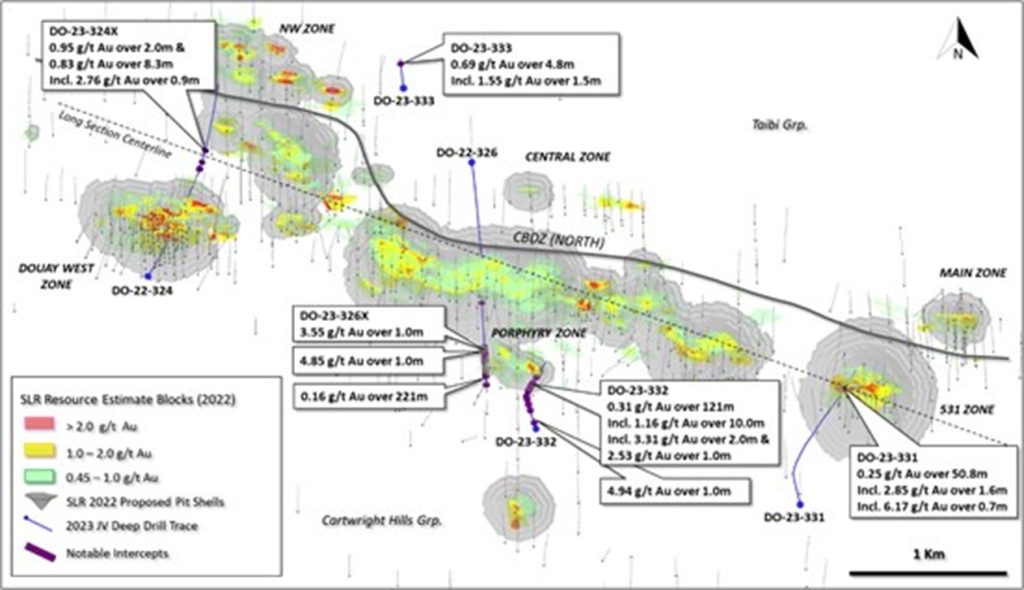
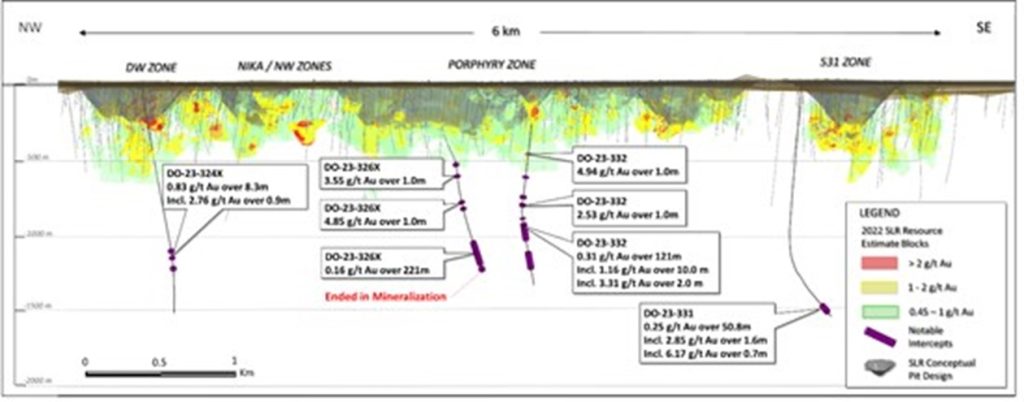
At Douay, the JV completed a total of 5,793 metres (“m”) in three new holes and two extension holes during the first half of 2023. Four drill holes were designed as deep conceptual exploration holes to test for mineralization extensions at greater depths (up to ~1,600 m vertical depth) beneath Douay’s currently defined Mineral Resources, and the fifth drill hole was a shallower step-out hole to the east of the NW Zone (see Figure 1 for a plan view map depicting drill hole locations and key results, Figure 2 for a composite longitudinal section and Table 1 for a detailed summary of assay results). This first phase of widely spaced (from ~500 m to ~3,000 m between holes) deep drilling returned 10 separate intercepts >2.5 gold grams per tonne (“g/t Au”) and four broad intervals (from ~59 to ~221 m in length) of low-grade (mostly >0.1 g/t Au) gold mineralization, demonstrating that a deep-rooted gold system is present to the current limits of drilling. Pending multi-element assays from the first phase of deep drilling will be incorporated into ongoing vectoring efforts to develop follow up targets to continue testing the depth potential at Douay from successful proof-of-concept towards potentially economic gold intercepts in undrilled zones over more than six kilometers of strike length.
Highlighted Results and Key Takeaways:
All five drill holes intersected gold mineralization >1 g/t Au, with 10 intercepts >2.5 g/t Au and several broad (from ~59 m to ~221 m in length) low-grade intervals (averaging 0.1 to 0.3 g/t Au), demonstrating continuity of the gold system down to at least ~1,600 m vertical depth.
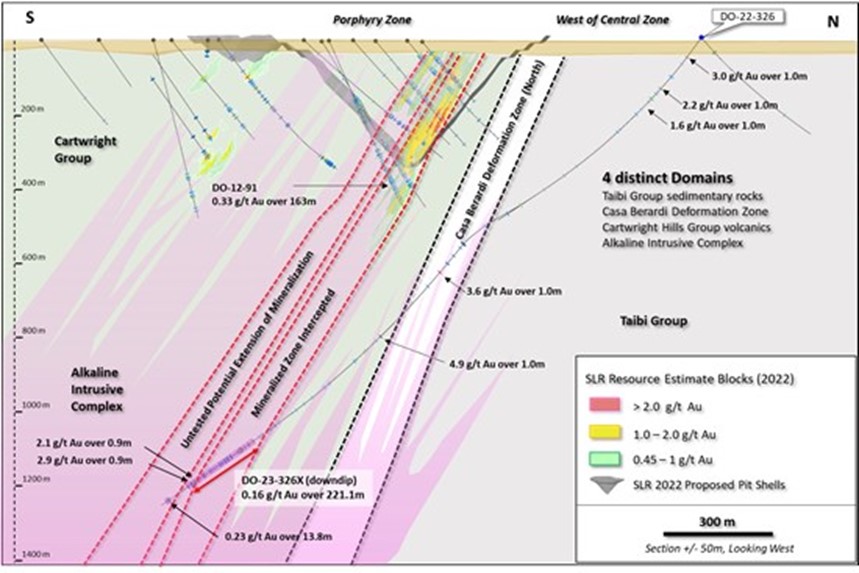
DO-23-332 and DO-23-326X both tested beneath the Porphyry Zone and returned the most compelling visual core observations with broad intervals of alteration and elevated fine grained pyrite mineralization. Such broad low-grade haloes, with multiple >1 g/t Au intercepts, are typical of the more peripheral parts of the Porphyry Zone.
DO-23-332 intersected 10 distinct intercepts of >1 g/t Au over at least 1.0 m. A broad (121 m) mineralized envelope with anomalous gold (0.31 g/t Au average) included intercepts of 3.6 g/t Au over 1 m, and 1.2 g/t Au over 10 m, including 3.3 g/t Au over 2 m. Additional 4.9 and 2.5 g/t Au intercepts over 1 m were obtained further up hole.
DO-23-326X returned eight intercepts grading >1 g/t Au over at least 1 m. Furthermore, this hole did not appear to intersect the full width of the potential zone and, importantly, bottomed in mineralization (see cross section in Figure 3). Visible gold was also identified at 1,826 m down-hole.
DO-23-331 was collared ~500 m south of the 531 Zone conceptual pit and returned 2.85 g/t Au over 1.6 m, including 6.2 g/t Au over 0.7 m, with a broader interval of 0.25 g/t Au over 50.8 m further up-hole.
“This deep drilling program was developed to test the potential for a much larger gold system at Douay while also demonstrating continuity of mineralization beneath currently defined Mineral Resources,” stated Matthew Hornor, President and CEO of Maple Gold. “The average vertical depth of all previous drilling at Douay is roughly 300 m, with limited data below 500 m, so this first pass of deeper drilling was discovery-focused with the aim of bringing us one step closer to uncovering a new zone at depth. The program was successful from a proof-of-concept standpoint in demonstrating mineralization continuity up to four times deeper than Douay’s currently defined Mineral Resources. Given what we’ve encountered in the JV’s first deep drill holes, the Company remains highly encouraged and confident that our detailed interpretation and vectoring work will lead to promising follow-up targets to incorporate into future drill campaigns at Douay. To support these ongoing initiatives, I am delighted to welcome Josh Pelletier as the Company’s new Chief Geologist and believe that his strong structural geology and metallogeny background will help unlock value at our strategically located and district-scale project portfolio within Quebec’s Abitibi greenstone belt.”
Technical Observations, Key Takeaways and Next Steps
The JV’s first phase deep drilling program delivered several key geological findings related to the potential depth continuity of gold mineralization at Douay:
From top-to-bottom (~2,000 m vertical depth), gold mineralization appears to be spatially associated with a porphyry-style intrusive complex and also appears in quartz-carbonate veins associated with shearing in the Casa Berardi Deformation Zone (“CBDZ”) that may be related to a separate orogenic gold system along this E-W regional structure.
Gold mineralization was identified within the contact zone between the two main lithologic sequences (Cartwright Hills Grp. volcanic sequences and Taibi Grp. sedimentary rocks) located along the crustal-scale CBDZ North structural corridor.
There are key structural corridors that appear to crosscut the auriferous porphyry-style mineralization, which provides potential for gold remobilization and reconcentration.
At Douay, two types of gold mineralization have been recognized: 1) gold that is spatially associated with porphyritic intrusive phases and 2) gold that is spatially associated with shear zones in the CBDZ. Both styles of mineralization may have formed in different conditions and time frames. The porphyry-style gold displays similarities to low-grade gold zones formed in magmatic-hydrothermal systems, while the gold related to shear zones is similar to other orogenic gold deposits that represent the majority of gold mines in the Abitibi gold belt. Therefore, it is important to distinguish both mineralization events, and to define their spatial distributions and orientations. The JV will be completing additional metallogenic interpretations and analysis to generate optimal targeting at Douay for future drill testing.
Figure 1: Plan view showing completed 2023 drill traces at Douay. Note DO-23-332 was drilled to 1,453 m but appears shorter due to subvertical inclination.
Multi-element analysis to define geochemical zonation and possible tracers to gold mineralization in order to improve vectoring within the mineralized system.
Paragenesis of gold mineralization based on mineralogical studies of the alteration patterns, gold deposition phases and other hydrothermal events.
Structural controls study to better constrain the geometry of known zones and improve targeting of structural traps.
Lithological studies to distinguish the different intrusive phases and evaluate their relationship with gold mineralization.
The Company will continue its vectoring work to refine the next set of priority drill targets at Douay, including follow-up on the first phase of deep drilling, as well as revisiting areas where the JV previously had successes (e.g. 531 and Western Porphyry zones). The Company is concurrently refining targets along its 100%-controlled Eagle Mine Project and in the Telbel Mine area within the JV’s Joutel Gold Project in preparation for anticipated fall and winter drilling campaigns, which are expected to be announced in the coming weeks. The Company’s VMS-focused exploration work is also ongoing with the aim of defining new drill targets, which are anticipated to be tested in early 2024.
Table 1: Complete Assay Results from the First Phase of Deep Drilling at Douay
Hole
UTME
UTMN
Azimuth
Plunge
Length (m)
From
To
Interval
Au g/t
DO-23-324X
704278
5490900
32
-66.5
779
1385.6
1397.0
11.4
0.28
including
1389.0
1391.0
2.0
0.95
DO-23-324X
1455.3
1457.5
2.2
0.74
DO-23-324X
1560.0
1568.3
8.3
0.83
including
1561.0
1561.9
0.9
2.76
including
1561.0
1565.9
4.9
1.28
including
1564.0
1565.9
1.9
1.50
DO-22-326
706400
5491650
172
-54
98
Master hole – reported on 11/30/22
DO-23-326XW1
706400
5491650
176.92
-50
1111
869.0
874.0
5.0
0.21
DO-23-326XW1
973.0
974.0
1.0
3.55
DO-23-326XW1
1213.0
1214.0
1.0
4.85
DO-23-326XW1
1276.0
1277.0
1.0
0.62
DO-23-326XW1
1641.0
1642.0
1.0
0.58
DO-23-326XW1
1664.8
1885.9
221.1
0.16
including
1670.0
1672.0
2.0
0.76
including
1695.0
1697.0
2.0
0.66
including
1706.0
1714.0
8.0
0.81
including
1711.0
1713.0
2.0
1.28
including
1739.0
1781.0
42.0
0.17
including
1790.0
1791.0
1.0
0.51
including
1826.0
1827.0
1.0
1.78
including
1833.3
1834.2
0.9
2.12
including
1850.5
1853.0
2.5
1.46
including
1852.0
1853.0
1.0
2.86
including
1861.0
1876.0
15.0
0.18
DO-23-326XW1
1945.4
1959.2
13.8
0.23
DO-23-331
706400
5491650
172
-54
2044
1869.0
1870.0
1.0
1.04
DO-23-331
1901.0
1951.8
50.8
0.25
including
1901.0
1902.0
1.0
1.15
including
1925.4
1927.0
1.6
2.85
including
1925.4
1926.1
0.7
6.17
including
1950.3
1950.8
0.5
2.96
DO-23-332
706820
5489915
340
-79.5
1453
135.0
136.0
1.0
1.10
DO-23-332
498.7
499.7
1.0
4.94
DO-23-332
653.7
664.7
11.0
0.29
including
657.0
659.0
2.0
0.74
DO-23-332
789.0
809.0
20.0
0.18
including
805.0
805.5
0.5
2.11
DO-23-332
845.2
852.0
6.8
0.29
DO-23-332
864.2
865.2
1.0
2.53
DO-23-332
953.0
953.5
0.5
1.26
DO-23-332
991.0
1112.0
121.0
0.31
including
1020.0
1021.0
1.0
3.61
including
1034.0
1044.0
10.0
1.16
including
1035.0
1037.0
2.0
3.31
including
1043.0
1044.0
1.0
1.01
including
1058.0
1059.0
1.0
1.25
including
1075.0
1077.0
2.0
1.12
including
1075.0
1076.0
1.0
1.49
including
1111.0
1112.0
1.0
1.07
DO-23-332
1205.0
1329.0
124.0
0.13
including
1295.0
1297.0
2.0
0.61
DO-23-333
705950
5492140.3
360
-55
297
248.0
252.8
4.8
0.69
including
251.3
252.8
1.5
1.55
Note: All reported intercepts are downhole core lengths. Estimated true widths are unknown at this time due to the limited data at the depths drilled.
Corporate Updates
Maple Gold is pleased to announce the appointment of Jocelyn (Josh) Pelletier as the Company’s new Chief Geologist. Mr. Pelletier is a structural geologist and a specialist in metallogeny with over 20 years of exploration experience primarily focused on the formation of gold deposits and porphyry copper-gold systems. He holds an M.Sc. degree in geology (UQAM – Montreal), a BSc in management and is a Fellow of the SEG as a Professional Geologist (OGQ). Mr. Pelletier has significant experience exploring Canada’s greenstone belts, including the Abitibi, Timmins, Red Lake, Beardmore and Rankin Inlet. He will work closely with the Company’s geological team, highly experienced Technical Committee and the JV to support the next phase of drill targets across the Company’s project portfolio.
The Company also announces that Joness Lang and Fred Speidel have left the Company to pursue other opportunities. The Company wishes both Mr. Lang and Mr. Speidel every success in their future endeavors.
Option Issuance
The Company has approved the grant to an employee and officer of stock options (“Options”) to purchase an aggregate of 400,000 common shares of the Company at an exercise price of $0.17 per common share. The Options have a 5-year term and vest 1/3 immediately, 1/3 in 12 months and 1/3 in 24 months from the date of grant until fully vested.
Qualified Person
The scientific and technical data contained in this press release was reviewed and prepared under the supervision of Jocelyn Pelletier, M.Sc., P.geo., Chief Geologist of Maple Gold. Mr. Pelletier has verified the data related to the exploration information disclosed in this press release through his direct participation in the work performed. Mr. Pelletier is a Qualified Person under National Instrument 43-101 Standards of Disclosure for Mineral Projects.
Quality Assurance (QA) and Quality Control (QC)
The Company implements strict Quality Assurance (“QA”) and Quality Control (“QC”) protocols at Douay and Telbel covering the planning and placing of drill holes in the field; drilling and retrieving the NQ-sized drill core; drill hole surveying; core transport; core logging by qualified personnel; sampling and bagging of core for analysis; transport of core from site to the Val d’Or, Québec ALS laboratory; sample preparation for assaying; and analysis, recording and final statistical vetting of results. Check assays for gold will be done on a sample subset at AGAT laboratory in Val d’Or. For a complete description of protocols, please visit the Company’s QA/QC webpage at www.maplegoldmines.com.
About Maple Gold
Maple Gold Mines Ltd. is a Canadian advanced exploration company in a 50/50 joint venture with Agnico Eagle Mines Limited to jointly advance the district-scale Douay and Joutel gold projects located in Québec’s prolific Abitibi Greenstone Gold Belt. The projects benefit from exceptional infrastructure access and boast ~400 km2 of highly prospective ground including an established gold resource at Douay (SLR 2022) that holds significant expansion potential as well as the past-producing Eagle, Telbel and Eagle West mines at Joutel. In addition, the Company holds an exclusive option to acquire 100% of the Eagle Mine Property.
The district-scale property package also hosts a significant number of regional exploration targets along a 55 km strike length of the Casa Berardi Deformation Zone that have yet to be tested through drilling, making the project ripe for new gold and polymetallic discoveries. The Company is well capitalized and is currently focused on carrying out exploration and drill programs to grow resources and make new discoveries to establish an exciting new gold district in the heart of the Abitibi. For more information, please visit www.maplegoldmines.com.
ON BEHALF OF MAPLE GOLD MINES LTD.
“Matthew Hornor”
B. Matthew Hornor, President & CEO
For Further Information Please Contact:
Mr. Matthew Hornor President, CEO & Director Cell: 778.955.6133 Email: [email protected]
NEITHER THE TSX VENTURE EXCHANGE NOR ITS REGULATION SERVICES PROVIDER (AS THAT TERM IS DEFINED IN THE POLICIES OF THE TSX VENTURE EXCHANGE) ACCEPTS RESPONSIBILITY FOR THE ADEQUACY OR ACCURACY OF THIS PRESS RELEASE.
Forward Looking Statements:
This press release contains “forward-looking information” and “forward-looking statements” (collectively referred to as “forward-looking statements”) within the meaning of applicable Canadian securities legislation in Canada, including statements about exploration work and results from current and future work programs. Forward-looking statements are based on assumptions, uncertainties and management’s best estimate of future events. Actual events or results could differ materially from the Company’s expectations and projections. Investors are cautioned that forward-looking statements involve risks and uncertainties. Accordingly, readers should not place undue reliance on forward-looking statements. For a more detailed discussion of such risks and other factors that could cause actual results to differ materially from those expressed or implied by such forward-looking statements, refer to Maple Gold Mines Ltd.’s filings with Canadian securities regulators available on www.sedar.com or the Company’s website at www.maplegoldmines.com. The Company does not intend, and expressly disclaims any intention or obligation to, update or revise any forward-looking statements whether as a result of new information, future events or otherwise, except as required by law.