
Mark Reichman, Senior Research Analyst, Natural Resources, Noble Capital Markets, Inc.
Refer to the full report for the price target, fundamental analysis, and rating.
Telbel drilling results are pending. The goal of exploration and drilling along the past-producing Eagle-Telbel mine trend is to define high-grade zones of gold mineralization and additional mineral resources to complement the established resource at Douay. Maple Gold has completed more than 21,500 meters of drilling across the four-kilometer Eagle-Telbel Mine trend, with 14,720 meters at Maple’s 100%-owned Eagle mine property and more than 7,000 meters of joint venture drilling at the Telbel Mine area of the Joutel Project, which is held by a 50/50 joint venture between Maple and Agnico Eagle Mines Limited. Assay results associated with the drilling at Telbel are pending.
Last of the 2022 Eagle results released. Maple recently released remaining assay results from ~20% of the 14,720 meters of drilling at Eagle. To date, the company’s drilling at Eagle has confirmed that gold mineralization is not limited to the Eagle-Telbel Mine Horizon, a narrow stratigraphic interval, but instead covers a significantly broader stratigraphic interval of over 100 meters straddling the Harricana Deformation Zone. Drill core observations support Maple Gold’s concept of a significant structural component to gold mineralization in the form of an orogenic gold overprint.
Equity Research is available at no cost to Registered users of Channelchek. Not a Member? Click ‘Join’ to join the Channelchek Community. There is no cost to register, and we never collect credit card information.
This Company Sponsored Research is provided by Noble Capital Markets, Inc., a FINRA and S.E.C. registered broker-dealer (B/D).
*Analyst certification and important disclosures included in the full report. NOTE: investment decisions should not be based upon the content of this research summary. Proper due diligence is required before making any investment decision.
Vancouver, British Columbia–(Newsfile Corp. – April 6, 2023) – Maple Gold Mines Ltd. (TSXV: MGM) (OTCQB: MGMLF) (FSE: M3G) (“Maple Gold” or the “Company“) is pleased to report results from the final 20% of assays that were received from the previously completed 14,720 metres (“m”) of drilling at the 100%-controlled Eagle Mine Property (“Eagle”). The Company is also pleased to report that more than 7,000 m have now been completed (6,000 m planned) at the Telbel Mine area of the Joutel Project, which is held by a 50/50 joint venture (the “JV”) between the Company and Agnico Eagle Gold Mines Limited.
The final batch of assays received from completed drilling at Eagle correspond to approximately 3,000 m of the 14,720 m drilled to-date. The results continue to demonstrate continuity of mineralization and the potential significance of the multiple horizons/splays to the northwest of the former Eagle mine. Highlights include (see Table 1 and Figure 1 for highlighted results from all Maple Gold drilling at Eagle to-date):
EM-22-008W intersected 6.2 grams per tonne (“g/t”) gold (“Au”) over 2.0 m in the South Mine Horizon (“SMH”) and 4.2 g/t Au over 3.9 m in sediments further downhole.
EM-22-006W1 intersected multiple intercepts including 6.5 g/t Au over 1.2 m and 2.0 g/t Au over 3.0 m in the SMH and 2.3 g/t Au over 3.0 m at the microgabbro/Harricana sediment contact further downhole.
EM-22-006W4 intersected 4.0 g/t Au over 0.7 m within a broader 1.1 g/t Au over 14.2 m intercept within the SMH.
EM-22-017A intersected 2.9 g/t Au over 2.0 m and additional lower grade over broader near-surface intervals (1.0 g/t Au over 15.5 m from 93 m downhole).
“We have come along way since first consolidating the Joutel ground into our JV property package,” stated Matthew Hornor, CEO of Maple Gold. “All of our exploration and drilling work along the past-producing Eagle-Telbel mine trend is designed with the aim of defining high-grade zones of gold mineralization and additional mineral resources to complement the established potentially bulk-mineable resource present at Douay. Our first year of drilling at Eagle has more than covered our exploration spending commitments to earn a 100% interest and we are now in position to finalize our compilation and model updates to support focused follow-up drilling in areas we believe have the most promise to deliver additional high-quality ounces.”
Overview Summary and Key Takeaways from Drilling at Eagle
The Eagle-Telbel Mine trend produced 1.1 Moz at 6.5 g/t Au from 1974 – 1993, during a period when the price of gold averaged approximately $350 per ounce. During the first year of the JV (2021), all historical mining, stope and drilling data was digitized to underpin a new 3D geological model. The Company signed an option agreement to acquire a 100% interest in the Eagle Mine Property (see press release July 19, 2021) and has since completed more than 21,500 m of drilling across the 4 km long Eagle-Telbel Mine trend, with 14,720 m at Eagle (see Figure 1) and more than 7,000 m (assays pending) of JV drilling at Telbel.
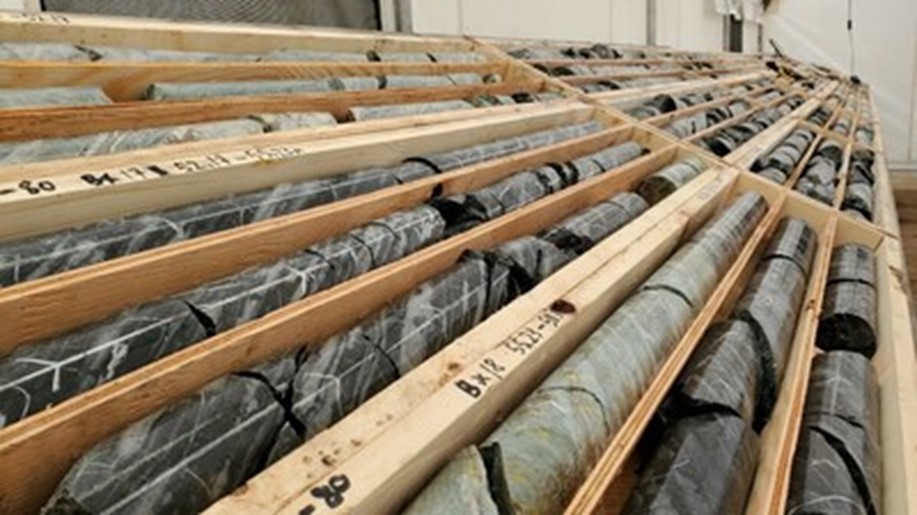
The Company’s drilling to-date at Eagle has served to confirm that gold mineralization is not limited to a narrow stratigraphic interval (Eagle-Telbel Mine Horizon) but instead covers a significantly broader stratigraphic interval of over 100 m straddling the Harricana Deformation Zone. Drill core observations also support the Company’s concept of a significant structural component to gold mineralization in the form of an orogenic gold overprint.
Figure 1: Plan view map showing drilling to-date at Eagle with highlighted intercepts.
Several highlights from the Company’s first year of drilling at Eagle are summarized below (see Figure 1 above for locations):
EM-22-005: 4.0 g/t Au over 7.5 m, including 6.4 g/t Au over 3.0 m
EM-22-009: 11.4 g/t Au over 3 m, including 24.4 g/t Au over 1 m
EM-22-013: 2.3 g/t Au over 10.4 m, including 5.0 g/t Au over 3.2 m
EM-22-015: 10.3 g/t Au over 7.8 m, including 41.1 g/t Au over 1.0 m
EM-22-015: 4.3 g/t Au over 3.9 m, including 7.4 g/t Au over 1.5 m
EM-22-016: 3.1 g/t Au over 7.3 m, including 4.0 g/t Au over 3.6 m
When combining the Company’s drilling results and observations with notable historical results and new geophysical data, several priority target areas emerge along the SMH and North Mine Horizon (“NMH”); including multiple cross-plunging target concepts that will form part of the focus for the Company’s next phase of drilling (~5,000 m). The Company has initiated target definition and permitting work for a planned summer 2023 follow-up program at Eagle (see press release March 16, 2023) and priority follow-up targets will also be defined at Telbel once assay results have been received and interpreted from the first phase of deep drilling.
Figure 2: Oblique view showing SMH and NMH trends with grade contouring and highlighted pierce points with corresponding intercepts and target areas.
Table 2: Highlighted Assay Results from Maple Gold Drilling at Eagle to-date
Hole
UTME
UTMN
Azimuth
Plunge
Length (m)
From
To
Interval
Au g/t
EM-22-001
690565
5486334
40.6
-66.8
356.6
132.0
134.6
2.6
1.7
including
133.7
134.6
0.9
4.4
EM-22-002
690565
5486334
22.0
-52.4
243
183.2
185.0
1.8
2.1
EM-22-002
200.4
205.0
4.7
2.4
including
200.4
202.4
2.1
3.8
EM-22-003
690642
5486322
59.1
-70.5
288
Narrow intercepts <1 g/t Au
EM-22-004
690673
5486120
49.9
-56.0
288
139.0
141.0
2.0
1.2
EM-22-005
690758
5486043
22.6
-75.7
714
346.0
360.0
14.0
2.2
including
346.0
353.5
7.5
4.0
including
350.0
353.0
3.0
6.4
EM-22-006
690737
5485828
25.9
-63.2
777.75
539.3
543.0
3.7
1.3
EM-22-007
690736
5485826
23.9
-73.2
985
877.0
878.0
1.0
2.0
EM-22-009
690921
5485639
17.5
71.4
1009
920.4
921.0
0.6
10.8
EM-22-009
951.0
956.0
5.0
1.6
EM-22-009
984.0
993.0
9.0
4.0
EM-22-009
990.0
993.0
3.0
11.4
EM-22-009
991.0
993.0
2.0
15.5
including
992.0
993.0
1.0
24.4
EM-22-010
690841
5485795
32.5
-71.4
570
539.5
540.0
0.5
14.0
EM-22-010
543.0
544.0
1.0
8.3
EM-22-010W
690841
5485795
34.1
-61.2
932
921.0
922.0
1.0
3.7
EM-22-011
690547
5485859
56.7
-62
924
858.3
859.0
0.7
3.2
EM-22-012
691098.7
5485413
35.3
-78.6
1284
1232.2
1234.3
2.1
2.0
EM-22-013
690757.5
5486043
63.8
-69.8
327
257.0
267.4
10.4
2.3
including
257.0
260.2
3.2
5.0
EM-22-014
690565
5486334
64.5
-67.9
646
231.0
231.7
0.7
4.6
EM-22-015
690757.5
5486043
45
-50.1
408
142.5
148.6
6.1
1.6
EM-22-015
164.9
165.5
0.7
4.8
EM-22-015
217.1
221.0
3.9
4.3
including
218.5
220.0
1.5
7.4
EM-22-015
228.0
235.8
7.8
10.3
including
228.5
232.8
4.3
15.9
including
230.0
231.0
1.0
41.1
EM-22-015
246.7
248.4
1.7
4.3
including
247.5
248.4
0.9
7.1
EM-22-015
252.2
255.0
2.8
1.8
EM-22-016
690757.8
5486043
45.1
-62.6
297
193.0
206.2
13.2
2.2
including
193.0
200.3
7.3
3.1
including
196.0
199.6
3.6
4.0
EM-22-016
202.0
206.2
4.2
1.7
EM-22-017A
690643
5486322
41.3
-55.76
201
93.5
109.0
15.5
1.0
including
97.0
103.0
6.0
1.4
EM-22-017A
137.0
144.0
7.0
1.4
including
141.0
143.0
2.0
2.9
EM-22-005W
690795
5486136
2.2
-65.5
364
364.3
365.8
1.5
1.3
624.0
625.0
1.0
1.2
EM-22-006W1
690736.7
5485828
29.5
-57
435.2
476.0
479.0
3.0
2.0
EM-22-006W1
482.8
484.0
1.2
6.5
EM-22-006W1
652.0
655.0
3.0
2.3
including
653.5
654.1
0.6
6.6
EM-22-009W2A
690921
5485639
21.4
-65.9
634
828.0
830.0
2.0
1.4
EM-22-010W1
690841
5485795
30.8
-62
361
583.5
584.0
0.5
1.5
EM-22-008W
690737
5485828
45.6
-58.1
377
527.0
529.0
2.0
6.2
EM-22-008W
630.1
634.0
3.9
4.2
including
631.0
632.5
1.5
6.8
EM-23-006W4
690737
5485828
24.5
-39.4
236
472.0
486.2
14.2
1.1
including
472.0
477.4
5.4
1.4
including
481.6
482.3
0.7
4.0
EM-23-006W4
521.0
523.6
2.6
1.9
EM-22-012W
691098.7
5485413
20
-45.6
524.7
1095.3
1097.4
2.1
1.2
Notes: Drill holes EM-22-006W, EM-22-006X, EM-22-008 and EM-22-009W1 returned no significant assays. Drill hole EM-22-017 was lost at 51 m. True widths estimated at 40% to 70% of downhole width depending on the hole inclination.
Qualified Person
The scientific and technical data contained in this press release was reviewed and prepared under the supervision of Fred Speidel, M. Sc., P. Geo., Vice-President Exploration of Maple Gold. Mr. Speidel is a Qualified Person under National Instrument 43-101 Standards of Disclosure for Mineral Projects. Mr. Speidel has verified the data related to the exploration information disclosed in this press release through his direct participation in the work.
Quality Assurance (QA) and Quality Control (QC)
The Company implements strict Quality Assurance (“QA”) and Quality Control (“QC”) protocols at Eagle covering the planning and placing of drill holes in the field; drilling and retrieving the NQ-sized drill core; drill hole surveying; core transport; core logging by qualified personnel; sampling and bagging of core for analysis; transport of core from site to the Val d’Or, Québec AGAT laboratory; sample preparation for assaying; and analysis, recording and final statistical vetting of results. Check assays for gold are being done on a sample subset at ALS’ laboratory in Val d’Or. For a complete description of protocols, please visit the Company’s QA/QC webpage at www.maplegoldmines.com.
About Maple Gold
Maple Gold Mines Ltd. is a Canadian advanced exploration company in a 50/50 joint venture with Agnico Eagle Mines Limited to jointly advance the district-scale Douay and Joutel gold projects located in Québec’s prolific Abitibi Greenstone Gold Belt. The projects benefit from exceptional infrastructure access and boast ~400 km2 of highly prospective ground including an established gold resource at Douay (SLR 2022) that holds significant expansion potential as well as the past-producing Eagle, Telbel and Eagle West mines at Joutel. In addition, the Company holds an exclusive option to acquire 100% of the Eagle Mine Property.
The district-scale property package also hosts a significant number of regional exploration targets along a 55 km strike length of the Casa Berardi Deformation Zone that have yet to be tested through drilling, making the project ripe for new gold and polymetallic discoveries. The Company is well capitalized and is currently focused on carrying out exploration and drill programs to grow resources and make new discoveries to establish an exciting new gold district in the heart of the Abitibi. For more information, please visit www.maplegoldmines.com.
ON BEHALF OF MAPLE GOLD MINES LTD.
“Matthew Hornor”
B. Matthew Hornor, President & CEO
For Further Information Please Contact:
Mr. Joness Lang Executive Vice-President Cell: 778.686.6836 Email: [email protected]
NEITHER THE TSX VENTURE EXCHANGE NOR ITS REGULATION SERVICES PROVIDER (AS THAT TERM IS DEFINED IN THE POLICIES OF THE TSX VENTURE EXCHANGE) ACCEPTS RESPONSIBILITY FOR THE ADEQUACY OR ACCURACY OF THIS PRESS RELEASE.
Forward Looking Statements:
This press release contains “forward-looking information” and “forward-looking statements” (collectively referred to as “forward-looking statements”) within the meaning of applicable Canadian securities legislation in Canada, including statements about exploration work and results from current and future work programs. Forward-looking statements are based on assumptions, uncertainties and management’s best estimate of future events. Actual events or results could differ materially from the Company’s expectations and projections. Investors are cautioned that forward-looking statements involve risks and uncertainties. Accordingly, readers should not place undue reliance on forward-looking statements. For a more detailed discussion of such risks and other factors that could cause actual results to differ materially from those expressed or implied by such forward-looking statements, refer to Maple Gold Mines Ltd.’s filings with Canadian securities regulators available on www.sedar.com or the Company’s website at www.maplegoldmines.com. The Company does not intend, and expressly disclaims any intention or obligation to, update or revise any forward-looking statements whether as a result of new information, future events or otherwise, except as required by law.
Mark Reichman, Senior Research Analyst, Natural Resources, Noble Capital Markets, Inc.
Refer to the full report for the price target, fundamental analysis, and rating.
Collaboration with Invest Alberta. LithiumBank executed a Memorandum of Understanding with Invest Alberta Corporation (IAC) to support the development of a lithium production facility at the company’s Boardwalk brine project. Established as a crown corporation of the Government of Alberta, Invest Alberta promotes Alberta as an investment destination of choice to investors in Canada and internationally. LithiumBank’s commercial lithium production facility in northern Alberta could factor importantly in Alberta becoming a destination for critical mineral resource development and as a partner in the electrification supply chain.
Why is this collaboration important? With teams in Calgary and Edmonton along with 11 international locations, IAC connects industry, government partners, and economic development organizations and provides services to facilitate investment in Alberta. The organization will support LithiumBank by promoting the Boardwalk project domestically and internationally, facilitate relationships with key stakeholders and senior government officials, and bolster LithiumBank’s relationships with post-secondary institutions to create a qualified talent pipeline in support of the project.
Equity Research is available at no cost to Registered users of Channelchek. Not a Member? Click ‘Join’ to join the Channelchek Community. There is no cost to register, and we never collect credit card information.
This Company Sponsored Research is provided by Noble Capital Markets, Inc., a FINRA and S.E.C. registered broker-dealer (B/D).
*Analyst certification and important disclosures included in the full report. NOTE: investment decisions should not be based upon the content of this research summary. Proper due diligence is required before making any investment decision.
TORONTO, April 04, 2023 (GLOBE NEWSWIRE) — Labrador Gold Corp. (TSX.V:LAB | OTCQX:NKOSF | FNR: 2N6) (“LabGold” or the “Company”) is pleased to announce results of its annual general meeting of shareholders held in Toronto on April 3, 2023.
At the meeting shareholders re-elected five current directors, being Roger Moss, James Borland, Trevor Boyd, Leonidas Karabelas and Kai Hoffmann and approved the re-appointment of DeVisser Gray LLP, of Vancouver, British Columbia, as auditors of the Corporation. Shareholders also ratified the 2021 Stock Option Plan and approved the Corporation’s new 2023 Stock Option Plan which supercedes and replaces the 2021 Stock Option Plan.
Following the shareholder meeting the Board of Directors reconstituted its Audit Committee and also reappointed officers for the ensuing year as follows:
President and CEO: Roger Moss
Chief Financial Officer: Eric Myung
Corporate Secretary: William Johnstone
The Company also announces that in accordance with its Stock Option Plan, it has granted officers, directors, consultants and employees an aggregate of 3,100,000 incentive stock options exercisable until April 3, 2028 at $0.23 per share. The options will vest according to the following schedule, 20% on August 3, 2023, 20% on October 3, 2023, 20% on April 3, 2024, 20% on October 3, 2024 and 20% on April 3,2025.
About Labrador Gold Labrador Gold is a Canadian based mineral exploration company focused on the acquisition and exploration of prospective gold projects in Eastern Canada.
Labrador Gold’s flagship property is the 100% owned Kingsway project in the Gander area of Newfoundland. The three licenses comprising the Kingsway project cover approximately 12km of the Appleton Fault Zone which is associated with gold occurrences in the region, including those of New Found Gold immediately to the south of Kingsway. Infrastructure in the area is excellent located just 18km from the town of Gander with road access to the project, nearby electricity and abundant local water. LabGold is drilling a projected 100,000 metres targeting high-grade epizonal gold mineralization along the Appleton Fault Zone with encouraging results to date. The Company has approximately $16 million in working capital and is well funded to carry out the planned program.
The Hopedale property covers much of the Florence Lake greenstone belt that stretches over 60 km. The belt is typical of greenstone belts around the world but has been underexplored by comparison. Work to date by Labrador Gold show gold anomalies in rocks, soils and lake sediments over a 3 kilometre section of the northern portion of the Florence Lake greenstone belt in the vicinity of the known Thurber Dog gold showing where grab samples assayed up to 7.8g/t gold. In addition, anomalous gold in soil and lake sediment samples occur over approximately 40 km along the southern section of the greenstone belt (see news release dated January 25 th 2018 for more details). Labrador Gold now controls approximately 40km strike length of the Florence Lake Greenstone Belt.
The Company has 170,009,979 common shares issued and outstanding and trades on the TSX Venture Exchange under the symbol LAB.
Neither TSX Venture Exchange nor its Regulation Services Provider (as that term is defined in policies of the TSX Venture Exchange) accepts responsibility for the adequacy or accuracy of this release .
Forward-Looking Statements: This news release contains forward-looking statements that involve risks and uncertainties, which may cause actual results to differ materially from the statements made. When used in this document, the words “may”, “would”, “could”, “will”, “intend”, “plan”, “anticipate”, “believe”, “estimate”, “expect” and similar expressions are intended to identify forward-looking statements. Such statements reflect our current views with respect to future events and are subject to risks and uncertainties. Many factors could cause our actual results to differ materially from the statements made, including those factors discussed in filings made by us with the Canadian securities regulatory authorities. Should one or more of these risks and uncertainties, such as actual results of current exploration programs, the general risks associated with the mining industry, the price of gold and other metals, currency and interest rate fluctuations, increased competition and general economic and market factors, occur or should assumptions underlying the forward looking statements prove incorrect, actual results may vary materially from those described herein as intended, planned, anticipated, or expected. We do not intend and do not assume any obligation to update these forward-looking statements, except as required by law. Shareholders are cautioned not to put undue reliance on such forward-looking statements .
Are Safe Haven Investments Just Beginning Their Rise?
Gold is continuing to move up. Fueled by global tensions, rising prices, a weakening dollar, and new wariness of the banking system, gold seems to have regained its place as a safe haven portfolio allocation. Over the past five calendar days, the precious metal has gained $84 per ounce or 4.3%. In recent days price movement has been helped by lower yields on U.S. Treasuries and OPEC+ oil production cuts which can be expected to increase inflationary pressures as the cost of transportation and production rises for the majority of new goods.
Physical gold, priced in $USD, as seen on the chart below, is up 10.62% on the year. But that does little to tell the recent story. The investments in the yellow metal had gone negative on the year until two days before the Silicon Valley Bank’s problems became widely known in early March. This means much of the current increase on the year has occurred in under a month’s time. And the mindset that is driving the rise seems to be lingering.
Technicians point out that the $2020 level was an area of resistance that traders easily pushed through on Tuesday. Are there also fundamental reasons for it to continue its upward climb?
Global Tensions
Global tensions and geopolitical events can have a significant impact on the price of gold. Uncertainty surrounding the war in Europe, U.S. enemies forming closer alliances with each other, and a former U.S. President being indicted are providing heightened tensions. Gold has remained a safe-haven asset historically because investors turn to in times of political or economic uncertainty – it is perceived to be a store of value that is less vulnerable to fluctuations in currency values and stock markets.
We are in times of political and economic certainty now, this can continue to increase the demand for gold and drive up its price.
Inflation
Gold is often considered a hedge against inflation, so as inflation rises, the price of gold tends to increase. Recent reports in the U.S. have shown inflation, especially core inflation (net of food and energy price changes), has resumed an upward move. The spike in oil stemming from recently announced production cuts should increase both core and overall inflationary pressures.
When inflation is running high, the value of the U.S. dollar erodes. Investors gravitate to alternative stores of wealth that can maintain their purchasing power. Gold is seen as a safe-haven asset that can protect against inflation and currency devaluation. As a result, investors tend to buy more gold, driving up its price.
As mentioned above, a weakening U.S. dollar can have a significant impact on the price of gold expressed in U.S. dollars. Precious metals are typically priced in terms of U.S. dollars globally. When inflation runs higher than safe-haven U.S. Treasury yields than assets move toward alternatives like gold, real estate, or cryptocurrencies.
As a result, when the U.S. dollar weakens, the demand for gold may increase, driving up its price.
Systemic Risk
The risk of bank failures can impact gold prices in several ways. In times of perceived financial instability and/or economic uncertainty, investors’ confidence in banks and other financial institutions weakens. This often leads to a shift to safe-haven assets like gold.
In addition, if there is a continued risk of bank failures. If it happens, central banks could take steps to stabilize the financial system by injecting liquidity into the markets and lowering interest rates. These actions weaken currency which increases inflation. Inflation expectations, as mentioned earlier, support higher gold prices.
The chart shows the correlation between gold, and mining stocks since the beginning of the year. As a reference, the performance of the VanEck gold mining ETF (GDX), and the junior gold mining ETF (GDXJ) are charted against the S&P 500 (SPY), and an S&P mining index (XME). The XME is designed to track changes across a broad market-cap spectrum of metals and mining segments in the U.S.
The mining stocks have been moving in the same direction and pivoting at the same time as gold (XAUUSD). The difference is the moves have been more pronounced (up and down) for the mining stocks.
Investors expecting gold to continue to increase and considering increasing their exposure to safe-haven precious metals, ought to do their due diligence and determine if gold mining stocks are a better fit for what they are trying to accomplish.
In his Metals & Mining First Quarter 2023 Review and Outlook (April 3, 2023) Mark Reichman, Senior Research Analyst, Natural Resources, at Noble Capital Markets provides various potential scenarios to his outlook for gold and other metals. The report (available at this link) is a good place to start to weigh this industry expert’s considerations with your own.
Garibaldi Resources Corp. is an active Canadian-based junior exploration company focused on creating shareholder value through discoveries and strategic development of its assets in some of the most prolific mining regions in British Columbia and Mexico.
Mark Reichman, Senior Research Analyst, Natural Resources, Noble Capital Markets, Inc.
Refer to the full report for the price target, fundamental analysis, and rating.
A look back at 2022. The 2022 drill program at Garibaldi’s 100% owned E&L nickel-copper-cobalt massive sulphide project tested targets from the 2021 Geotech deep penetrating Z-Axis Tipper Electromagnetic (ZTEM) survey. Of four holes drilled, two were successful, including Hole EL-22-97b, a deep hole which intersected two intervals of E&L gabbro more than 200 meters down plunge from previous drilling and intersected nickel-bearing disseminated and semi-massive sulphide mineralization. Hole EL-22-97b targeted the down plunge extension of the eastern zone of the E&L intrusion, coincident with a large-scale low resistivity/elevated conductivity ZTEM anomaly identified in 2021. The two successful drill holes are lined with polyvinyl chloride (PVC) and Garibaldi intends to conduct a geophysical borehole electromagnetic (BHEM) survey to refine holes to be drilled in 2023.
Upcoming drill program. Drilling in 2023 will test for mineralization associated with broad ZTEM low-resistivity anomalies identified by the property wide Geotech ZTEM survey. The 2023 drill program will likely commence in June and entail three to four holes at the E&L target, two holes of approximately 500 meters depth at the B1 target, and two holes at the Palm Springs property. Drilling at E&L will focus on areas within the ZTEM anomaly tested in 2022.
Equity Research is available at no cost to Registered users of Channelchek. Not a Member? Click ‘Join’ to join the Channelchek Community. There is no cost to register, and we never collect credit card information.
This Company Sponsored Research is provided by Noble Capital Markets, Inc., a FINRA and S.E.C. registered broker-dealer (B/D).
*Analyst certification and important disclosures included in the full report. NOTE: investment decisions should not be based upon the content of this research summary. Proper due diligence is required before making any investment decision.
Mark Reichman, Senior Research Analyst, Natural Resources, Noble Capital Markets, Inc.
Refer to the bottom of the report for important disclosures
Gold shined during the first quarter. During the first quarter, mining companies (as measured by the XME) appreciated 6.7% compared to a gain of 7.0% for the S&P 500 index. The VanEck Vectors Gold Miners (GDX) and Junior Gold Miners (GDXJ) ETFs were up 12.9% and 10.8%, respectively. Gold, silver, and copper futures prices gained 7.8%, 0.5%, and 7.4%, respectively, while lead and zinc declined 3.6% and 4.3%, respectively. Despite continuing rate hikes by the Federal Reserve, turmoil in the banking sector, along with the market’s speculation of its potential impact on Federal Reserve monetary policy, enhanced gold’s appeal. Weakness in base metals, with the exception of copper, may be attributed to slowing economic growth and the potential for an economic downturn. In 2022, the price of copper declined 13.2% and so it was likely due for a rebound.
Further upside to the gold price? Assuming worries about the U.S. banking system abate, we think gold could give up some of its recent gains although we remain constructive on precious metals. After peaking in early March, the yield on the 10-year treasury note and the U.S. Dollar Index reversed course with the yield on the treasury ending at 3.49% compared to 3.88% at the end of 2022 and the U.S. dollar Index down 1% during the quarter. Most of this was the result of the recent banking turmoil. While we continue to believe interest rates could peak by mid-year, the big question is how long before they begin easing rates. This will obviously depend on economic conditions, the inflation rate, and employment.
Outlook for industrial metals. While the long-term investment case for owning industrial metals mining companies remains favorable, it may be too early to offer a bullish call due to near-term concerns about economic growth in the U.S. and abroad. During the recent Prospectors & Developers Association of Canada (PDAC) convention, key themes in the keynote presentations were electrification and growing demand for critical minerals and battery metals, including cobalt, copper, lithium, magnesium, and nickel, critical to securing a decarbonized future with broad applications in electric vehicles, charging infrastructure, solar power, and wind turbines.
Conclusion. We think precious metals mining companies, notably juniors, continue to offer attractive return potential. While the near-term outlook for industrial metals could be negatively impacted by near-term macroeconomic factors, an eventual return to economic growth could result in strong prices due to potential supply and demand imbalances.
GENERAL DISCLAIMERS
All statements or opinions contained herein that include the words “we”, “us”, or “our” are solely the responsibility of Noble Capital Markets, Inc.(“Noble”) and do not necessarily reflect statements or opinions expressed by any person or party affiliated with the company mentioned in this report. Any opinions expressed herein are subject to change without notice. All information provided herein is based on public and non-public information believed to be accurate and reliable, but is not necessarily complete and cannot be guaranteed. No judgment is hereby expressed or should be implied as to the suitability of any security described herein for any specific investor or any specific investment portfolio. The decision to undertake any investment regarding the security mentioned herein should be made by each reader of this publication based on its own appraisal of the implications and risks of such decision.
This publication is intended for information purposes only and shall not constitute an offer to buy/sell or the solicitation of an offer to buy/sell any security mentioned in this report, nor shall there be any sale of the security herein in any state or domicile in which said offer, solicitation or sale would be unlawful prior to registration or qualification under the securities laws of any such state or domicile. This publication and all information, comments, statements or opinions contained or expressed herein are applicable only as of the date of this publication and subject to change without prior notice. Past performance is not indicative of future results. Noble accepts no liability for loss arising from the use of the material in this report, except that this exclusion of liability does not apply to the extent that such liability arises under specific statutes or regulations applicable to Noble. This report is not to be relied upon as a substitute for the exercising of independent judgement. Noble may have published, and may in the future publish, other research reports that are inconsistent with, and reach different conclusions from, the information provided in this report. Noble is under no obligation to bring to the attention of any recipient of this report, any past or future reports. Investors should only consider this report as single factor in making an investment decision.
IMPORTANT DISCLOSURES
This publication is confidential for the information of the addressee only and may not be reproduced in whole or in part, copies circulated, or discussed to another party, without the written consent of Noble Capital Markets, Inc. (“Noble”). Noble seeks to update its research as appropriate, but may be unable to do so based upon various regulatory constraints. Research reports are not published at regular intervals; publication times and dates are based upon the analyst’s judgement. Noble professionals including traders, salespeople and investment bankers may provide written or oral market commentary, or discuss trading strategies to Noble clients and the Noble proprietary trading desk that reflect opinions that are contrary to the opinions expressed in this research report. The majority of companies that Noble follows are emerging growth companies. Securities in these companies involve a higher degree of risk and more volatility than the securities of more established companies. The securities discussed in Noble research reports may not be suitable for some investors and as such, investors must take extra care and make their own determination of the appropriateness of an investment based upon risk tolerance, investment objectives and financial status.
Company Specific Disclosures
The following disclosures relate to relationships between Noble and the company (the “Company”) covered by the Noble Research Division and referred to in this research report. Noble is not a market maker in any of the companies mentioned in this report. Noble intends to seek compensation for investment banking services and non-investment banking services (securities and non-securities related) with any or all of the companies mentioned in this report within the next 3 months
ANALYST CREDENTIALS, PROFESSIONAL DESIGNATIONS, AND EXPERIENCE
Senior Equity Analyst focusing on Basic Materials & Mining. 20 years of experience in equity research. BA in Business Administration from Westminster College. MBA with a Finance concentration from the University of Missouri. MA in International Affairs from Washington University in St. Louis. Named WSJ ‘Best on the Street’ Analyst and Forbes/StarMine’s “Best Brokerage Analyst.” FINRA licenses 7, 24, 63, 87
WARNING
This report is intended to provide general securities advice, and does not purport to make any recommendation that any securities transaction is appropriate for any recipient particular investment objectives, financial situation or particular needs. Prior to making any investment decision, recipients should assess, or seek advice from their advisors, on whether any relevant part of this report is appropriate to their individual circumstances. If a recipient was referred to Noble Capital Markets, Inc. by an investment advisor, that advisor may receive a benefit in respect of transactions effected on the recipients behalf, details of which will be available on request in regard to a transaction that involves a personalized securities recommendation. Additional risks associated with the security mentioned in this report that might impede achievement of the target can be found in its initial report issued by Noble Capital Markets, Inc.. This report may not be reproduced, distributed or published for any purpose unless authorized by Noble Capital Markets, Inc..
RESEARCH ANALYST CERTIFICATION
Independence Of View All views expressed in this report accurately reflect my personal views about the subject securities or issuers.
Receipt of Compensation No part of my compensation was, is, or will be directly or indirectly related to any specific recommendations or views expressed in the public appearance and/or research report.
Ownership and Material Conflicts of Interest Neither I nor anybody in my household has a financial interest in the securities of the subject company or any other company mentioned in this report.
Mark Reichman, Senior Research Analyst, Natural Resources, Noble Capital Markets, Inc.
Refer to the full report for the price target, fundamental analysis, and rating.
Full year financial results. Sierra reported a 2022 adjusted net loss attributable to shareholders of $23.1 million or $(0.14) per share, compared with adjusted earnings of $21.6 million or $0.13 per share in 2021. Adjusted losses per share for the fourth quarter and full year 2022 were less than our estimates of $(0.07) and $(0.17), respectively, due in part to higher fourth quarter revenue and modestly lower cost of sales. Adjusted EBITDA fell 88% to $13.0 million compared to $104.7 million in the prior year. Annual copper equivalent production fell 29% due to lower throughput and grades.
2023 Guidance. Management’s focus has been to stabilize operations following challenges experienced in 2022 and to return to higher production levels on an economically sustainable basis. Sierra forecasts 2023 copper equivalent production in the range of 74.3 million to 83.3 million pounds. As of the end of March, the Bolivar mine is operating at 3,070 tonnes per day and is expected to gradually ramp up to 5,000 tonnes per day by year end. The Yauricocha mine is expected to operate at 2,375 tonnes per day throughout 2023. Management considers the Cusi silver mine to be a non-core asset and it was excluded from guidance.
Equity Research is available at no cost to Registered users of Channelchek. Not a Member? Click ‘Join’ to join the Channelchek Community. There is no cost to register, and we never collect credit card information.
This Research is provided by Noble Capital Markets, Inc., a FINRA and S.E.C. registered broker-dealer (B/D).
*Analyst certification and important disclosures included in the full report. NOTE: investment decisions should not be based upon the content of this research summary. Proper due diligence is required before making any investment decision.
Petrodollar Dusk, Petroyuan Dawn: What Investors Need To Know
While most investors were trying to gauge the Federal Reserve’s next moves in light of recent bank failures last week, something interesting happened in Moscow.
During a three-day state visit, Chinese President Xi Jinping held friendly talks with Russian President Vladimir Putin in a show of unity, as both countries increasingly seek to position themselves as leaders of what they call a “multipolar world order,” one that challenges U.S.-centric alliances and agreements.
Among those agreements is the petrodollar, which has been in place for over 50 years.
In case you’re wondering, “petrodollars” are not a real currency. They’re simply dollars being used to trade oil. Early in the 1970s, the U.S. government provided economic aid to Saudi Arabia, its chief oil-producing rival, in exchange for assurances that Riyadh would price its crude exports exclusively in the U.S. dollar. In 1975, other members of the Organization of Petroleum Exporting Countries (OPEC) followed suit, and the petrodollar was born.
This had the immediate effect of strengthening the U.S. dollar. Since countries around the world had to have dollars on hand in order to buy oil (and other key commodities such as gold, also priced in dollars), the greenback became the world’s reserve currency, a status formerly enjoyed by the British pound, French franc and Dutch guilder.
All things must come to an end, however. We may be witnessing the end of the petrodollar as more and more countries, including China and Russia, are agreeing to make settlements in currencies other than the U.S. dollar. This could have wide-ranging implications on not just a macro scale but also investment portfolios.
This article was republished with permission from Frank Talk, a CEO Blog by Frank Holmes of U.S. Global Investors (GROW). Find more of Frank’s articles here – Originally published March 27, 2023
Dawn For The Petroyuan?
Putin couldn’t have been more explicit. During Xi’s state visit, he named the Chinese yuan as his favored currency to conduct trade in. Ever since Western sanctions were levied on the Eastern European country for its invasion of Ukraine early last year, Russia has increasingly depended on its southern neighbor to buy the oil other countries won’t touch.
In just the first two months of 2023, China’s imports from Russia totaled $9.3 billion, exceeding full-year 2022 imports in dollar terms. In February alone, China imported over 2 million barrels of Russian crude, a new record high.
Except that now, the yuan is presumably being used to make these settlements.
As Zoltar Pozsar, New York-based economist and investment research director at Credit Suisse, put it recently: “That’s dusk for the petrodollar… and dawn for the petroyuan.”
U.S. Dollar Still The World’s Reserve Currency, But Its Dominance Is Slipping
Before you dismiss Pozsar’s comment as an exaggeration, consider that other major OPEC nations and BRICS members (Brazil, Russia, India, China and South Africa) are either accepting yuan already or strongly considering it. Russia, Iran and Venezuela account for about 40% of the world’s proven oilfields, and the three sell their oil in exchange for yuan. Turkey, Argentina, Indonesia and heavyweight oil producer Saudi Arabia have all applied for admittance into BRICS, while Egypt became a new member this week.
What this suggests is that the yuan’s role as a reserve currency will continue to strengthen, signifying a broader shift in the global power balance and potentially giving China a bigger hand with which to shape economic policies that affect us all.
To be clear, the U.S. dollar remains the world’s top reserve currency for now, though its share of global central banks’ official holdings has slipped in the past 20 years, from 72% in 2001 to just under 60% today. By contrast, the yuan’s share of official holdings has more than doubled since 2016. The Chinese currency accounted for about 2.8% of reserves as of September 2022.
Russia Diversifying Away From The Dollar By Loading Up On Gold
It’s not all about the yuan, of course. Gold has also increased as a foreign reserve, especially among emerging economies that seek to diversify away from the dollar.
Last week, Russia announced that its bullion holdings jumped by approximately 1 million ounces over the past 12 months as its central bank loaded up on gold in the face of Western sanctions. The bank reported having nearly 75 million ounces at the end of February 2023, up from about 74 million a year earlier.
Long-Term Implications For Investors
The implications of the dollar potentially losing its status as the global reserve are numerous. Obviously, there may be currency risks, and a decrease in demand for U.S. Treasury bonds could result in rising interest rates. I would expect to see massive swings in commodity prices, especially oil prices, which could be an opportunity if you can stomach the volatility.
Gold would look exceptionally attractive, I think. A significant decrease in the relative value of the dollar would be supportive of the gold price, and I would be surprised not to see new highs. It’s for reasons like these that I always recommend a 10% weighting in gold, with 5% in physical bullion and the other 5% in high-quality gold mining equities. Be sure to rebalance at least on an annual basis.
All opinions expressed and data provided are subject to change without notice. Some of these opinions may not be appropriate to every investor. By clicking the link(s) above, you will be directed to a third-party website(s). U.S. Global Investors does not endorse all information supplied by this/these website(s) and is not responsible for its/their content.
Conference Call and Webcast will be held on March 29, 2023 at 11:00am ET
TORONTO–(BUSINESS WIRE)– Sierra Metals Inc. (TSX: SMT) (“Sierra Metals” or the “Company”) announces fourth quarter and year-end 2022 consolidated financial results. All amounts are in US dollars, unless otherwise noted.
Fourth Quarter and Year-End 2022 Operating and Financial Highlights
Revenue from metals payable of $46.2 million in Q4 2022 and $192.1 million in 2022.
Adjusted EBITDA(1) of ($0.5) million in Q4 2022 and $13.0 million in 2022.
Net loss attributable to shareholders for Q4 2022 of $26.5 million, or $0.16 per share and $87.5 million, or $0.53 per share in 2022.
Net loss of $88.3 million, or $0.54 in 2022, which includes impairment charges of $25.0 million for the Bolivar mine and $25.0 million for the Cusi mine; and $5.3 million non-cash depletion.
Cash and cash equivalents as at December 31, 2022 was $5.1 million; negative working capital of $84.4 million.
The focus in 2023 is to improve safety practices, reduce costs, improve productivity through increased equipment availability.
On March 13, 2023, the Company improved short-term liquidity through refinancing $6,250,000 of debt repayments due March 2023, with negotiations ongoing to refinance a total of $18,750,000 of term loan amortization payments due in 2023.
Ernesto Balarezo Valdez, Sierra Metals’ Interim CEO comments, “Sierra Metals enters 2023 with positive momentum. Since the start of 2023, we have stabilized our operations and begun to implement a program to optimize our operating performance, all with safety as the top priority. The expected operational improvements, alongside the corporate initiatives to improve our balance sheet, which includes the recently announced debt refinancing initiatives, has set the stage for Sierra Metals to increase production, lower costs and improve our financial position.”
(1) This is a non-IFRS performance measure, see Non-IFRS Performance Measures section of the MD&A.
Strategic Update
As first announced on October 18, 2022, a special committee comprised of the Company’s independent directors (the “Special Committee”) is undertaking a strategic review process. The mandate of the Special Committee includes exploring, reviewing and considering options to optimize the operations of the Company and possible financing, restructuring and strategic options in the best interests of the Company. The Company has engaged CIBC Capital Markets as a financial advisor in this process.
The Special Committee continues to evaluate certain strategic alternatives. The Company will report to shareholders upon completion of the Special Committee’s review. Concurrently, over the course of the strategic review process the Special Committee and the management team have identified and have implemented a number of opportunities to improve the Company’s operational and financial position.
Progress made to-date includes the following:
Successfully implementing a transition of executive level management.
Organizational changes designed to create a shift in the corporate culture and instill a more “hands-on” approach to operations.
Placing a renewed emphasis on safety and employee engagement. The Company has hired a VP of Health and Safety, instituted new safety protocols across all of its operations, increased training and communication efforts, and invested in remote-controlled equipment which is designed to reduce risk of injury.
Streamlining operations to reduce costs, and refinancing debt obligations in order to preserve working capital as production levels improve.
Advancing discussions with secured lenders on refinancing of material short-term obligations, and steps to improve short-term liquidity through ancillary financing arrangements.
Initiatives to increase productivity at the mines, including increasing asset utilization, focused underground development of mine sequencing, and improvements to ventilation and pumping systems.
Prioritizing spending to focus resources on the Company’s core assets at Yauricocha and Bolivar.
Initiating activities designed to identify additional mineral resources at the Yauricocha and Bolivar mines to sustain long-term production increases.
Enhancements to internal financial forecasting, reporting and integration of information across functions to ensure timely decision making.
2023 Guidance
Production Guidance
The Bolivar mine exited fourth quarter 2022 with improved operations and expectations of continued improved performance throughout 2023. The Yauricocha mine is expected to gradually and safely ramp up production throughout 2023 at the current depth. Meanwhile, Yauricocha’s focus will remain on obtaining the necessary permits to access the deeper, high-grade ore bodies.
The table summarizing 2023 production guidance from the Yauricocha and the Bolivar mines is provided below. Management considers the Cusi mine as ‘non-core’ and it has been excluded from the guidance.
Total sustaining capital for 2023, excluding Cusi, is expected to be $32.0 million, mainly comprised of mine development ($3.0 million) and drainage ($2.3 million) in Yauricocha, and mine development ($11.3 million), infill drilling ($5.3 million) and equipment replacement ($3.9 million) at the Bolivar mine.
Growth capital for 2023, projected at $15.0 million, includes costs of tailings dam expansion ($5.6 million) and Yauricocha shaft ($3.2 million) in Peru. Growth capital at Bolivar includes costs of the tailings dam and the starter dam.
Management will continue to review performance throughout the year, while exploring value enhancing opportunities.
Conference Call & Webcast
The Company will host a conference call on Wednesday, March 29, 2023, at 11:00 AM EDT to discuss the results. Details of the conference call and webcast are as follows:
The webcast, presentation slides and 2022 Financial Statements and Management Discussion and Analysis will be available at www.sierrametals.com, with an archive of the webcast available for 180 days.
Summary of Operating and Financial Results
The information provided below are excerpts from the Company’s Annual Financial Statements and Management’s Discussion and Analysis, which are available on the Company’s website (www.sierrametals.com) and on SEDAR (www.sedar.com) under the Company’s profile.
2022 Consolidated Financial Summary
Revenue from metals payable of $192.1 million in 2022, a decrease of 29% from 2021 annual revenue of $272.0 million. Lower revenue resulted from the decrease in throughput and grades at the Yauricocha and Bolivar mines;
Yauricocha’s cash cost per copper equivalent payable pound(1) was $2.23 (2021 – $1.46), and AISC per copper equivalent payable pound(1) of $3.69 (2021 – $2.77);
Bolivar’s cash cost per copper equivalent payable pound(1) was $2.99 (2021 – $2.18), and AISC per copper equivalent payable pound(1) was $5.07 (2021 – $4.22);
Cusi’s cash cost per silver equivalent payable ounce(1) was $16.77 (2021 – $16.71), and AISC per silver equivalent payable ounce(1) was $23.17 (2021 – $28.15);
Adjusted EBITDA(1) of $13.0 million for 2022, a decrease from the adjusted EBITDA(1) of $104.7 million for 2021;
Net loss attributable to shareholders for 2022 was $87.5 million or $0.53 per share (2021: net loss of $27.4 million, $0.17 per share). Net loss for the year ended 2022 includes an impairment charge of $25.0 million on the Bolivar mine and $25.0 million on the Cusi mine (2021: impairment of $35.0 million on the Cusi mine);
Adjusted net loss attributable to shareholders(1) of $23.1 million, or $0.14 per share, for 2022 compared to the adjusted net income(1) of $21.6 million, or $0.13 per share for 2021;
A large component of the net income (loss) for every period is the non-cash depletion charge in Peru, which was $5.3 million for 2022 (2021: $9.3 million). The non-cash depletion charge is based on the aggregate fair value of the Yauricocha mineral property at the date of acquisition of Sociedad Minera Corona S.A. de C.V. (“Corona”) of $371.0 million amortized over the life of the mine;
Cash flow generated from operations before movements in working capital of $5.2 million for 2022 was lower than the $91.1 million in 2021, mainly due to lower revenues and higher operating costs; and
Cash and cash equivalents of $5.1 million and working capital of $(84.4) million as at December 31, 2022 compared to $34.9 million and $17.3 million, respectively, at the end of 2021. Cash and cash equivalents decreased during 2022 as the $38.3 million used in investing activities exceeded the $1.1 million generated from financing activities and $7.3 million generated from operating activities.
(1) This is a non-IFRS performance measure, see Non-IFRS Performance Measures section of the MD&A.
Non-IFRS Performance Measures
The non-IFRS performance measures presented do not have any standardized meaning prescribed by IFRS and are therefore unlikely to be directly comparable to similar measures presented by other issuers.
Non-IFRS reconciliation of adjusted EBITDA
EBITDA is a non-IFRS measure that represents an indication of the Company’s continuing capacity to generate earnings from operations before taking into account management’s financing decisions and costs of consuming capital assets, which vary according to their vintage, technological currency, and management’s estimate of their useful life. EBITDA comprises revenue less operating expenses before interest expense (income), property, plant and equipment amortization and depletion, and income taxes. Adjusted EBITDA has been included in this document. Under IFRS, entities must reflect in compensation expense the cost of share-based payments. In the Company’s circumstances, share-based payments involve a significant accrual of amounts that will not be settled in cash but are settled by the issuance of shares in exchange for cash. As such, the Company has made an entity specific adjustment to EBITDA for these expenses. The Company has also made an entity-specific adjustment to the foreign currency exchange (gain)/loss. The Company considers cash flow before movements in working capital to be the IFRS performance measure that is most closely comparable to adjusted EBITDA.
The following table provides a reconciliation of adjusted EBITDA to the consolidated financial statements for the three months and years ended December 31, 2022 and 2021:
Non-IFRS Reconciliation of Adjusted Net Income (Loss)
Adjusted net income (loss) attributable to shareholders represents net income (loss) attributable to shareholders excluding certain impacts, net of taxes, such as non-cash depletion charge due to the acquisition of Corona, impairment charges and reversal of impairment charges, write-down of assets, and certain non-cash and non-recurring items including but not limited to share-based compensation and foreign exchange (gain) loss.The Company believes that, in addition to conventional measures prepared in accordance with IFRS, certain investors may want to use this information to evaluate the Company’s performance and ability to generate cash flows. Accordingly, it is intended to provide additional information and should not be considered in isolation or as a substitute for measures of performance in accordance with IFRS.
The following table provides a reconciliation of adjusted net income (loss) to the consolidated financial statements for the three months and years ended December 31, 2022 and 2021:
Cash Cost per Silver Equivalent Payable Ounce and Copper Equivalent Payable Pound
The Company uses the non-IFRS measure of cash cost per silver equivalent ounce and copper equivalent payable pound to manage and evaluate operating performance. The Company believes that, in addition to conventional measures prepared in accordance with IFRS, certain investors use this information to evaluate the Company’s performance and ability to generate cash flows. Accordingly, it is intended to provide additional information and should not be considered in isolation or as a substitute for measures of performance prepared in accordance with IFRS. The Company considers cost of sales per silver equivalent payable ounce and copper equivalent payable pound to be the most comparable IFRS measure to cash cost per silver equivalent payable ounce, copper equivalent payable pound, and zinc equivalent payable pound, and has included calculations of this metric in the reconciliations within the applicable tables to follow.
All-in Sustaining Cost per Silver Equivalent Payable Ounce and Copper Equivalent Payable Pound
All‐In Sustaining Cost (“AISC”) is a non‐IFRS measure and was calculated based on guidance provided by the World Gold Council (“WGC”) in June 2013. WGC is not a regulatory industry organization and does not have the authority to develop accounting standards for disclosure requirements. Other mining companies may calculate AISC differently as a result of differences in underlying accounting principles and policies applied, as well as differences in definitions of sustaining versus development capital expenditures.
AISC is a more comprehensive measure than cash cost per ounce/pound for the Company’s consolidated operating performance by providing greater visibility, comparability and representation of the total costs associated with producing silver and copper from its current operations.
The Company defines sustaining capital expenditures as, “costs incurred to sustain and maintain existing assets at current productive capacity and constant planned levels of productive output without resulting in an increase in the life of assets, future earnings, or improvements in recovery or grade. Sustaining capital includes costs required to improve/enhance assets to minimum standards for reliability, environmental or safety requirements. Sustaining capital expenditures excludes all expenditures at the Company’s new projects and certain expenditures at current operations which are deemed expansionary in nature.”
Consolidated AISC includes total production cash costs incurred at the Company’s mining operations, including treatment and refining charges and selling costs, which forms the basis of the Company’s total cash costs. Additionally, the Company includes sustaining capital expenditures and corporate general and administrative expenses. AISC by mine does not include certain corporate and non‐cash items such as general and administrative expense and share-based payments. The Company believes that this measure represents the total sustainable costs of producing silver and copper from current operations and provides the Company and other stakeholders of the Company with additional information of the Company’s operational performance and ability to generate cash flows. As the measure seeks to reflect the full cost of silver and copper production from current operations, new project capital and expansionary capital at current operations are not included. Certain other cash expenditures, including tax payments, dividends and financing costs are also not included.
The following table provides a reconciliation of cash costs to cost of sales, as reported in the Company’s consolidated statement of income for the three months and years ended December 31, 2022 and 2021:
Additional Non-IFRS Measures
The Company uses other financial measures, the presentation of which is not meant to be a substitute for other subtotals or totals presented in accordance with IFRS, but rather should be evaluated in conjunction with such IFRS measures. The following other financial measures are used:
Operating cash flows before movements in working capital – excludes the movement from period-to-period in working capital items including trade and other receivables, prepaid expenses, deposits, inventories, trade and other payables and the effects of foreign exchange rates on these items.
The terms described above do not have a standardized meaning prescribed by IFRS, and therefore the Company’s definitions are unlikely to be comparable to similar measures presented by other companies. The Company’s management believes that their presentation provides useful information to investors because cash flows generated from operations before changes in working capital excludes the movement in working capital items. This, in management’s view, provides useful information of the Company’s cash flows from operations and are considered to be meaningful in evaluating the Company’s past financial performance or its future prospects. The most comparable IFRS measure is cash flows from operating activities.
About Sierra Metals
Sierra Metals is a diversified Canadian mining company with green metal exposure including copper, zinc and lead production with precious metals byproduct credits, focused on the production and development of its Yauricocha Mine in Peru and its Bolivar Mine in Mexico. The Company is focused on the safety and productivity of its producing mines. The Company also has large land packages with several prospective regional targets providing longer-term exploration upside and mineral resource growth potential.
For further information regarding Sierra Metals, please visit www.sierrametals.com.
This press release contains forward-looking information within the meaning of Canadian securities legislation. Forward-looking information relates to future events or the anticipated performance of Sierra and reflect management’s expectations or beliefs regarding such future events and anticipated performance based on an assumed set of economic conditions and courses of action, including the accuracy of the Company’s current mineral resource estimates; that the Company’s activities will be conducted in accordance with the Company’s public statements and stated goals; that there will be no material adverse change affecting the Company, its properties or its production estimates (which assume accuracy of projected ore grade, mining rates, recovery timing, and recovery rate estimates and may be impacted by unscheduled maintenance, labour and contractor availability and other operating or geo-political uncertainties on the Company’s production, workforce, business, operations and financial condition); the expected trends in mineral prices, inflation and currency exchange rates; that all required approvals will be obtained for the Company’s business and operations on acceptable terms; that there will be no significant disruptions affecting the Company’s operations. In certain cases, statements that contain forward-looking information can be identified by the use of words such as “plans”, “expects”, “is expected”, “budget”, “scheduled”, “estimates”, “forecasts”, “intends”, “anticipates”, “believes” or variations of such words and phrases or statements that certain actions, events or results “may”, “could”, “would”, “might”, or “will be taken”, “occur” or “be achieved” or the negative of these words or comparable terminology. Forward-looking statements include those relating to the Company’s guidance on the timing and amount of future production and its expectations regarding the results of operations; expected costs; permitting requirements and timelines; anticipated market prices of metals; the Company’s ability to comply with contractual and permitting or other regulatory requirements; formalizing the refinancing contract and the timeline related thereto and the timing of senior management’s conference call to discuss the Company’s financial and operating results for the year ended December 31, 2022. By its very nature forward-looking information involves known and unknown risks, uncertainties and other factors that may cause actual performance of Sierra to be materially different from any anticipated performance expressed or implied by such forward-looking information.
Forward-looking information is subject to a variety of risks and uncertainties, which could cause actual events or results to differ from those reflected in the forward-looking information, including, without limitation, the risks of not meeting the expectations contemplated herein and the risks described under the heading “Risk Factors” in the Company’s annual information form dated March 28, 2023 for its fiscal year ended December 31, 2022 and other risks identified in the Company’s filings with Canadian securities regulators, which filings are available at www.sedar.com.
The risk factors referred to above are not an exhaustive list of the factors that may affect any of the Company’s forward-looking information. Forward-looking information includes statements about the future and is inherently uncertain, and the Company’s actual achievements or other future events or conditions may differ materially from those reflected in the forward-looking information due to a variety of risks, uncertainties and other factors. The Company’s statements containing forward-looking information are based on the beliefs, expectations, and opinions of management on the date the statements are made, and the Company does not assume any obligation to update such forward-looking information if circumstances or management’s beliefs, expectations or opinions should change, other than as required by applicable law. For the reasons set forth above, one should not place undue reliance on forward-looking information.
Investor Relations Sierra Metals Inc. Tel: +1 (416) 366-7777 Email: info@christiana-papadopoulossierrametals-com
ARLP is a diversified natural resource company that generates operating and royalty income from coal produced by its mining complexes and royalty income from mineral interests it owns in strategic oil & gas producing regions in the United States, primarily the Permian, Anadarko and Williston basins. ARLP currently produces coal from seven mining complexes its subsidiaries operate in Illinois, Indiana, Kentucky, Maryland and West Virginia. ARLP also operates a coal loading terminal on the Ohio River at Mount Vernon, Indiana. ARLP markets its coal production to major domestic and international utilities and industrial users and is currently the second largest coal producer in the eastern United States. In addition, ARLP is positioning itself as an energy provider for the future by leveraging its core technology and operating competencies to make strategic investments in the fast growing energy and infrastructure transition.
Mark Reichman, Senior Research Analyst, Natural Resources, Noble Capital Markets, Inc.
Refer to the full report for the price target, fundamental analysis, and rating.
Lowering estimates. We have lowered our 2023 EBITDA and earnings per share estimates to $1.09 billion and $5.50 from $1.14 billion and $5.90, respectively. While we lowered our first half revenue expectations, our full year revenue estimate was increased based on greater contributions from the coal segment and expectations for an improved commodity price environment in the second half of the year. Notably, we refined and increased our operating cost estimates to reflect higher labor costs, sales-related expenses, and operational costs related to longwall moves within the mining segment.
First half challenged by declining commodity prices. Prices for crude oil and natural gas have declined throughout the year. While coal prices have softened in recent weeks, 34.7 million tons of the partnership’s 2023 planned coal sales, or 94% at the mid-point of guidance, were committed and priced as of the date of ARLP’s fourth quarter conference call. Year-to-date through March 28, crude oil and natural gas futures prices averaged $76.33 per barrel and $2.84 per thousand cubic feet (Mcf) compared to $80.47 per barrel and $4.48 per Mcf at the end of 2022 and $73.38 per barrel and $2.16 per Mcf as of March 28. As a result, we lowered our expectations for the oil & gas royalty segment.
Equity Research is available at no cost to Registered users of Channelchek. Not a Member? Click ‘Join’ to join the Channelchek Community. There is no cost to register, and we never collect credit card information.
This Company Sponsored Research is provided by Noble Capital Markets, Inc., a FINRA and S.E.C. registered broker-dealer (B/D).
*Analyst certification and important disclosures included in the full report. NOTE: investment decisions should not be based upon the content of this research summary. Proper due diligence is required before making any investment decision.
The building wave of M&A deals in at least two of the mining sectors, is difficult to ignore. This week, lithium miner Albemarle (ALB) disclosed it had submitted a proposal to acquire Liontown Resources (LTR.Australia). Last month Newmont Mining’s proposed acquisition of Newcrest Mining, highlighted the rising interest in M&A in the gold sector. To date, both proposals have been shunned, but as companies look to increase production, inflation increases producers capital outlays, plus long permitting processes, a case could be made that growth by acquisition, friendly or not, is becoming more appealing in the sector.
Typically growing demand to buy smaller companies in a sector puts upward pressure on valuations.
The gold and lithium sectors have mostly lead over the past six months in terms of deal-making. For gold, the largest driver is these miners remain undervalued by historical levels. The trend for lithium producers in the years ahead, as battery production ramps up to meet surging demand for electric storage and green technology, is expected to continue to accelerate.
The Price of lithium, key to batteries found in most EVs, over the years has risen. This created a situation where car manufacturers themselves have realized that the best way to ensure a key ingredient to their product is to own all or part of a large enough producer. Lithium producers are looking for ways to increase yield and own more production facilities. These factors could unfold into a situation where the stock prices of companies producing either of these two metals, and even other mined minerals with growing demand, could outperform other sectors.
Five Reasons to Explore Small Mining Companies
While the real heat is on producers of minerals used to make batteries and gold miners, the below supply/demand concepts may apply to an increased need for other miners to involve themselves in M&A as well.
New List of Acquirers – The big car companies, energy companies, and other additional industrial consumers are in need of reliable supply.
Cheaper to Buy than Find – M&A is a solution to the increased costs of growing organically. It also helps circumvent what could be permitting delays and supply chain problems that prevent headway.
Scale – Gold companies normally try to extract synergies when seeking to size up, while lithium producers seek pure scale.
Big Picture Economics – The economic environment favors miners if inflation remains elevated; the companies’ production is more likely to sell for more. The cost of money, on an opportunity cost basis, especially net of inflation (real interest) favors mining.
Finding Value – Informed stock selection is key to discover and invest in companies best positioned to benefit from swelling M&A in the sector.
The fifth on this list is less of a reason to explore mining companies and more a common sense reminder. Last week the Channelchek Take Away Series brought to viewers a live in-depth presentation of 12 mining companies that were just coming off the huge PDAC mining conference in Canada. These presentations are being replayed and may be just the place to begin to hear from company executives, and a highly respected senior natural resources analyst. Audience questions and answers follow.
The information on these on-demand replay videos is current, and as you’ll see by clicking here, the list of video presentations includes a diversified mix of producers and explorers.
Defense Metals Corp. is a mineral exploration and development company focused on the acquisition, exploration and development of mineral deposits containing metals and elements commonly used in the electric power market, defense industry, national security sector and in the production of green energy technologies, such as, rare earths magnets used in wind turbines and in permanent magnet motors for electric vehicles. Defense Metals owns 100% of the Wicheeda Rare Earth Element Property located near Prince George, British Columbia, Canada. Defense Metals Corp. trades in Canada under the symbol “DEFN” on the TSX Venture Exchange, in the United States, under “DFMTF” on the OTCQB and in Germany on the Frankfurt Exchange under “35D”.
Mark Reichman, Senior Research Analyst, Natural Resources, Noble Capital Markets, Inc.
Refer to the full report for the price target, fundamental analysis, and rating.
Prelude to an updated mineral resource estimate. Defense Metals recently updated its 3-D geological model of the Wicheeda Rare Earth Element (REE) deposit. The update incorporated results from drilling completed during 2021 and 2022 that is not reflected in the January 2022 preliminary economic assessment (PEA), and will be used to update the mineral resource estimate and incorporated into a preliminary feasibility study (PFS) expected to be completed during the first quarter of 2024.
A lot of new information. Results for 47 holes representing 10,876 meters of drilling has now been included in the updated geological model. The drilling programs were designed to: 1) increase mineral resource confidence from inferred to indicated and measured categories, 2) define the northern endpoint of the Wicheeda carbonate complex, and 3) to provide detailed geotechnical and hydrogeological drilling data for advanced pit slope and mine design. By way of comparison, current resources outlined in the January 2022 preliminary economic assessment were based on a total of 27 diamond drill holes representing 4,249 meters of drilling.
Equity Research is available at no cost to Registered users of Channelchek. Not a Member? Click ‘Join’ to join the Channelchek Community. There is no cost to register, and we never collect credit card information.
This Company Sponsored Research is provided by Noble Capital Markets, Inc., a FINRA and S.E.C. registered broker-dealer (B/D).
*Analyst certification and important disclosures included in the full report. NOTE: investment decisions should not be based upon the content of this research summary. Proper due diligence is required before making any investment decision.