Gray Television Inc. (GTN) – Leapfrogs Into The Super Broadcast League

Tuesday, May 04, 2021

Gray Television Inc. (GTN)
Leapfrogs Into The “Super” Broadcast League

Gray Television, Inc. operates as a television broadcast company in the United States. As of April 6, 2010, it operated 36 television stations in 30 markets, including 17 affiliated with CBS Inc.; 10 affiliated with the National Broadcasting Company, Inc.; 8 affiliated with the American Broadcasting Company (ABC); and 1 affiliated with FOX Entertainment Group, Inc. (FOX). The company also operated 39 digital second channels comprising 1 affiliated with ABC, 4 affiliated with FOX, 7 affiliated with CW Network, LLC, 18 affiliated with Twentieth Television, Inc., 2 affiliated with Universal Sports Network, and 7 local news/weather channels. Gray Television, Inc. was founded in 1897 and is headquartered in Atlanta, Georgia.

Michael Kupinski, Director of Research, Noble Capital Markets, Inc.

Refer to the full report for the price target, fundamental analysis, and rating.

    Gains national scale.  The company will leap frog into the big leagues covering 36% of US TV households, without the UHF discount rule, upon the planned purchase of Meredith’s TV group. The purchase price of $2.7 billion represents 7.9 times blended 2019/2020 cash flow, after synergies, a reasonable price, in our view. The deal is expected to close year end 2021.

    Move viewed favorably.  The Meredith stations dovetail nicely with the company’s existing stations and creates significant scale in many States, including Nevada, Arizona, Missouri, positioning it well for Political advertising. The company plans to sell only one overlap station in Flint, MI, to expedite regulatory approval, which is expected …


This research is provided by Noble Capital Markets, Inc., a FINRA and S.E.C. registered broker-dealer (B/D).

*Analyst certification and important disclosures included in the full report. NOTE: investment decisions should not be based upon the content of this research summary.  Proper due diligence is required before making any investment decision. 

Online Media is Within an Hour of Becoming Main-Stream Media


Online Media is Within an Hour of Becoming Main-Stream Media


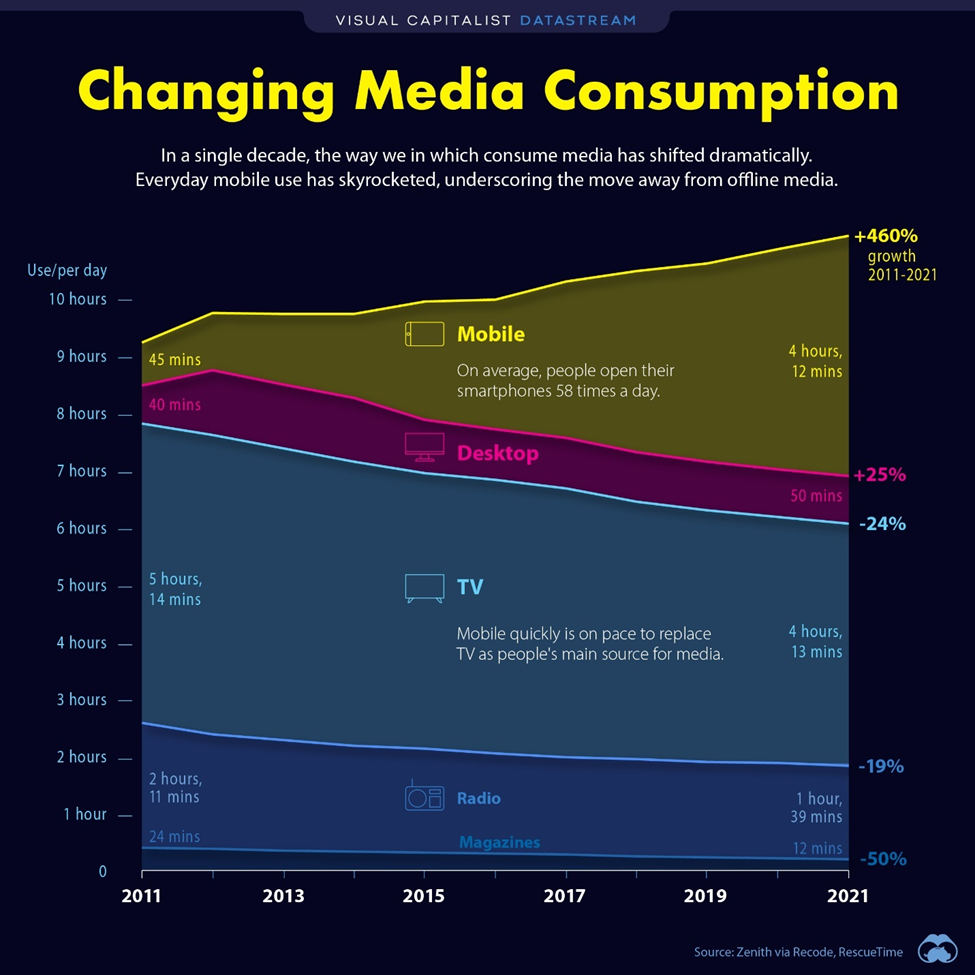
The clock is ticking on broadcast radio and TV as the technology is becoming dated relative to the greatly accelerated use of mobile devices and growth (albeit slower) of desktop computing.

Since 2011, media consumption for U.S. adults is up 20% across all categories.

One of those categories has grown by 460%. To have earned that growth, quite a bit of erosion was from TV and traditional radio.

Have you guessed which outlet has grown so dramatically?

An average of 4 hours and 12 minutes is spent on mobile devices compared to only 45 minutes just ten years ago.

Take a look at the graphic below; it demonstrates just how quickly habits change.


Graphics by Visual Capitalist


From a business perspective, adaption is key to growth and critical for survival.  In this case, understanding and satisfying changing audience preferences need to be part of the business plans of all doing business in the industry(s) represented above.

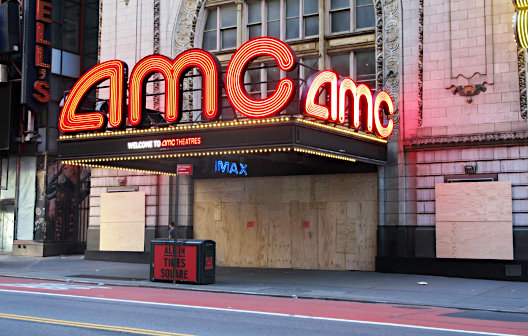
Photo by Allen, no changes were made

What’s the Future of Media Consumption

Esports Investors Better Able to Evaluate Stocks


Stay up to date. Follow us:


Stay up to date. Follow us:

Gray Television (GTN) – Sells Divestiture Stations From Quincy Media Transaction to Allen Media for $380 Million


Gray Sells Divestiture Stations From Quincy Media Transaction to Allen Media for $380 Million


ATLANTA, April 29, 2021 (GLOBE NEWSWIRE) — Gray Television, Inc. (“Gray”) (NYSE: GTN) today reached an agreement to divest certain television stations currently owned by Quincy Media, Inc. (“Quincy”) to Byron Allen’s Allen Media Broadcasting, LLC (“Allen Media”) for $380 million dollars in cash. Allen Media, which owns and operates local television stations in twelve markets, also owns 12 networks including The Weather Channel and the free-streaming service Local Now. Allen Media Group was founded by Byron Allen in 1993.

Earlier this year, Gray reached an agreement to acquire Quincy for $925 million in cash. To facilitate regulatory approvals for this transaction, Gray agreed to sell to Allen Media the following television stations currently owned by Quincy, each of which operates in a market in which Gray also owns and operates a television station:

KVOA (NBC), Tucson, Arizona (Nielsen DMA Rank 64)
WKOW (ABC), Madison, Wisconsin (DMA 81)
WSIL / KPOB (ABC), Paducah, Kentucky- Harrisburg, Illinois (DMA 84)
KWWL (NBC), Cedar Rapids, Iowa (DMA 92)
WXOW / WQOW (ABC), La Crosse-Eau Claire, Wisconsin (DMA 129)
WAOW / WMOW (ABC), Wausau-Rhinelander, Wisconsin (DMA 136)
WREX (NBC), Rockford, Illinois (DMA 139)

Gray’s acquisition of Quincy and Gray’s sale of the foregoing Quincy stations to Allen Media will close simultaneously. As such, at no time will Gray own, control or operate any of the divestiture television stations. Gray expects to close these transactions following receipt of regulatory and other approvals in the third quarter of 2021.

“I truly appreciate Gray and Quincy, two of the best broadcast groups in the business, working with us to acquire and transfer these amazing assets. Over the past year-and-a-half, we’ve invested close to $1 billion to acquire best-in-class, top-tier, broadcast network affiliates,” said Byron Allen, Founder/Chairman/CEO of Allen Media Group. “We plan to invest approximately ten billion dollars to acquire more ABC, CBS, NBC, and FOX television stations over the next two years with the goal of being the largest broadcast television group in America. All of our media assets, including these broadcast television stations, will work in concert to amplify our free-streaming service, Local Now.”

“We are thrilled to facilitate the transfer of these fine Quincy television stations to Byron Allen and Allen Media Group, who we are confident will continue the strong commitments to journalism and localism that have distinguished these stations under Quincy’s outstanding stewardship,” said Gray’s Executive Chairman and CEO Hilton H. Howell.

About Gray Television

Gray Television, headquartered in Atlanta, Georgia, is the largest owner of top-rated local television stations and digital assets in the United States. Upon the closing of its acquisition of Quincy Media, Inc., Gray will own television stations serving 102 television markets that collectively reach 25.4 percent of US television households, including the number-one ranked television station in 77 markets and the first and/or second highest ranked television station in 93 markets according to Comscore’s average all-day ratings for calendar year 2020. Gray also owns video program production, marketing, and digital businesses including Raycom Sports, Tupelo Honey, and RTM Studios, the producer of PowerNation programs and content and is the majority owner of Swirl Films.

Wells Fargo Securities, LLC served as financial advisor to Gray.

About Allen Media Group / Entertainment Studios

Chairman and CEO Byron Allen founded Allen Media Group/Entertainment Studios in 1993. Headquartered in Los Angeles, it has offices in New York, Chicago, Atlanta, and Raleigh. Allen Media Group owns 23 ABC-NBC-CBS-FOX network affiliate broadcast television stations and ten 24-hour HD television networks serving nearly 180 million subscribers: THE WEATHER CHANNEL, PETS.TV, COMEDY.TV, RECIPE.TV, CARS.TV, ES.TV, MYDESTINATION.TV, JUSTICE CENTRAL.TV, THEGRIO.TV, and THIS TV. Allen Media Group will add its eleventh network, THE WEATHER CHANNEL EN ESPANOL in 2021. Allen Media Group also owns LOCAL NOW and THE GRIO free-streaming AVOD services, powered by THE WEATHER CHANNEL and content partners, which delivers real-time, hyper-local news, weather, traffic, sports, and lifestyle information. Allen Media Group also produces, distributes, and sells advertising for 67 television programs, making it one of the largest independent producers/distributors of first-run syndicated television programming for broadcast television stations. Allen Media Group International Television continues to extend its corporate branding and content around the globe. It currently has active license agreements and programming in South Africa, The United Arab Emirates, Australia, The Bahamas, Canada and New Zealand. With a library of over 5,000 hours of owned content across multiple genres, Allen Media Group provides video content to broadcast television stations, cable television networks, mobile devices, multimedia platforms, and the World Wide Web. Our mission is to provide excellent programming to our viewers, online users, and Fortune 500 advertising partners.

Entertainment Studios Motion Pictures is a full-service, theatrical motion picture distribution company specializing in wide release commercial content. ESMP released 2017’s highest-grossing independent movie, the shark thriller 47 METERS DOWN, which grossed over $44.3 million. In 2018, ESMP also released the critically-acclaimed and commercially successful Western HOSTILES, the historic mystery-thriller CHAPPAQUIDDICK and the sequel to 47 METERS DOWN, 47 METERS DOWN: UNCAGED. The digital distribution unit of Entertainment Studios Motion Pictures, Freestyle Digital Media, is a premiere multi-platform distributor with direct partnerships across all major cable, digital and streaming platforms. Capitalizing on a robust infrastructure, proven track record and a veteran sales team, Freestyle Digital Media is a true home for independent films.

In 2016, Allen Media Group purchased The Grio, a highly-rated digital video-centric news community platform devoted to providing AfricanAmericans with compelling stories and perspectives currently underrepresented in existing national news outlets. The Grio features aggregated and original video packages, news articles and opinion pieces on topics that include breaking news, politics, health, business and entertainment. Originally launched in 2009, the platform was then purchased by NBC News in 2010. The digital platform remains focused on curating exciting digital content and currently has more than 100 million annual visitors. For more information, visit: www.entertainmentstudios.com

Gray Contacts:

www.gray.tv
Jim Ryan, Executive Vice President and Chief Financial Officer, 404-504-9828
Kevin P. Latek, Executive Vice President, Chief Legal and Development Officer, 404-266-8333

Allen Media Group Contact:
Eric Peterkofsky
Allen Media Group/Entertainment Studios
310-277-3500 x124 [email protected]

Source: Gray Television

Esports Investors are Now Better Able to Evaluate Performance Comparisons


Investors are Handed More Tools to Evaluate Esports and iGaming Performance


As the esports, gaming, and iGaming sector of digital media and technology grow, so does investor interest and the attention paid to measuring its performance relative to other media and technology sectors. Measurement tools now include indexes that can be used as a proxy for the industry segment to assist investors in determining the segment’s performance relative to other business sectors or to understand how well a company did relative to those operating in the same industry.


Indexes Worth Attention

Last year on April 30, Roundhill Investments launched what they say is the first iGaming index. The Roundhill Sports Betting & iGaming Index is designed to track the performance of the sports betting and iGaming industry globally. The Index consists of a tiered weight portfolio of internationally listed companies that are involved in the sports betting & iGaming industry.   The index’s valuation increased by 17.92% during the first quarter of 2021. By comparison, the S&P 500 index experienced a 6.2% increase.  The two largest weightings represented  8.77%, they are Entain PLC (ENT LN) and DraftKings, Inc. (DKNG).

In the category of esports, MVIS introduced their Global Video Gaming & eSports Index in July of 2018, with a full look back to January 2015. This index’s universe weighs less on gambling-associated companies focusing primarily on those with at least 50% of their revenues from video gaming and/or eSports. This includes developers and related software/hardware, streaming services, and those involved in eSports events. The index declined 2.7% over the first quarter. There are currently 25 components in the measurement, the top two holdings have a weighting of 16.54%, they are NVIDIA Corp. (NVDA) and Sea Ltd. (SE).

A more inclusive index was launched at the start of 2021 by Noble Capital Markets. Details of the Noble Esports and iGaming Index, which includes components of the other two indexes are found in a recently released report. According to their Digital, Media &
Entertainment Industry Quarterly Report
from April 19 written by Michael Kupinski, Director of Research, the index is now formulated by 16 publicly traded companies, with the two largest companies in the sector, Flutter Entertainment (ISE: FLTRl) and DraftKings (ticker DKNG). 

The Esports/Gaming Noble Index added 42.7% in the first quarter of 2021. The esports and iGaming section of the report drilled down and discussed strong performance by some of the index components, including Draft Kings, up 32.7% and BRAG, up 47%, The strongest stock performances within the Noble Esports and iGaming Index were from AESE, up 82.3%, SLGG, up 148.8%, SCR, up 124.5%, EGLX, up 106.2%, and, finally, GMBL (eSports Entertainment), Noble very closely follows, was up 136.4%.


Take-Away

Sports is changing in much the same way communication, media, transportation, and other industries have evolved to include new outlets. At some point, the new subsets reach a tipping point, and best serve investors if they have their own separate sets of measures. After all, as with all change, they may provide opportunities for investors. The different approaches by Roundhill Investments, MVIS, and Noble Capital Markets also help investors better grasp where performance has been and where strength and weakness can be capitalized on.


Suggested Content:

eSports Entertainment Group, NobleCon17 Presentation (Video)

eSports Entertainment Group Virtual Road Show (Video)


Esports: Show me the Money!

What’s the Future of Entertainment Consumption?


Sources:

Noble, Digital, Media & Entertainment Industry Quarterly Report

Roundhill Sports Betting & iGaming Index

MVIS Video Gaming and Esports


Photo Credit: Helix eSports 


Stay up to date. Follow us:


Stay up to date. Follow us:


Digital Advertising Continues its Double Digital Growth – Noble Capital Markets Media Sector Review – April 2021

Digital Advertising Continues its Double Digital Growth

Noble Capital Markets Media Sector Review – April 2021

On April 7, the Internet Advertising Bureau (IAB) released their 2020 internet advertising revenue report in conjunction with PricewaterhouseCoopers (PwC). The report concluded that digital advertising in the U.S. increased by 12.2% to $139.8B in 2020 from $124.6B in 2019.

Growth was fueled by a strong rebound in digital advertising in the second half of the year, in which $80B, or 57% of the year’s total was booked.

Digital advertising of $45.6B in 4Q 2020 was the highest quarterly revenue number ever. For perspective, the $80B of ad spend in the second half of 2020 was equivalent to the entirety of U.S. digital advertising in all of 2016.

By quarter, digital advertising increased by 10.5% year-over-year in 1Q 2020, decreased by 5.2% in 2Q 2020 (when Covid-19 first hit), reaccelerated to 11.7% growth in 3Q 2020, and finished exceptionally strong with 28.7% growth in 4Q 2020. Fourth quarter digital ad spend benefited from an influx of political advertising, but the bigger impact may have come from a “use or lose it” mindset, in which ad budgets that weren’t spent earlier in the year were available to spend in the fourth quarter.

More importantly, digital ad spend in the U.S. was not just confined to the “duopoly” of Google and Facebook, or the “tripoloy” of Google, Facebook and Amazon Advertising. According to the IAB, digital advertising revenues among the Top 10 companies grew by 14% in the U.S., as their share of ad spend increased to 78% in 2020 from 77% in 2019. Ad spend from the fifteen next largest companies (companies 11-25) increased by 2.4% to $8B. The remaining companies in the PwC universe were able to post revenue growth of 8.3% to $22B in 2020 from $20.3B in 2019. The key take-away is that the size of the “open internet” (after the “walled gardens” of the top 10 companies) remains a sizable addressable market ($30B+ in the U.S. alone) and grew at an attractive rate of 7% (when excluding the top 10), despite what we believe was a double-digit decline in ad spend in 2Q 2020.

OUTLOOK – INTERNET AND DIGITAL MEDIA

INTERNET AND DIGITAL MEDIA COMMENTARY

Introducing Noble’s Esports and iGaming Index

Noble’s quarterly media newsletter has always covered seven distinct segments: four digital media sectors (Digital Media, Ad Tech, Marketing Tech, and Social Media) and three traditional media sectors (TV, Radio and Publishing). With this edition, we are adding an Esports and iGaming sector, as advertising and sponsorships are key revenue categories for many esports companies. Over time, we expect sports betting and Esports betting to become larger revenue drivers of industry growth.

We have added 16 publicly traded companies to our new Esports and iGaming Index and comp sheet, with the two largest companies in the sector, Flutter Entertainment (ISE: FLTR, the owner of FanDuel) and DraftKings (ticker DKNG) accounting for 80% of the sector’s market cap. Many companies in the sector are experiencing tremendous revenue growth (except for those that host live events) with organic growth augmented by acquisitions, and negative EBITDA margins as companies invest for growth. Of the 16 companies in the sector, four are expected to generate positive EBITDA in 2021, while six companies are projected to do so in 2022.

Internet and Digital Media Stocks Perform In-Line with the Market

Internet and digital media stocks generally performed well in the first quarter, with the exception of Marketing Tech stocks. In a quarter in which the S&P 500 finished up 6%, Noble’s Digital Media (+13%) and Esports & iGaming (+12%) Indices outperformed, while our Social Media Index (+5%) performed in-line with the market and the Ad Tech (-1%) and MarTech (-5%) Indices underperformed the broader market. Notable gains were recorded by Inuvo (INUV; +125%); Enthusiast Gaming (TSX: EGLX; +106%), Travelzoo (TZOO; +78%), Pubmatic (PUBM; +76%) and Criteo (CRTO; +69%).

We believe the underperformance of the MarTech stocks reflects a rotation out of stocks where Covid-19 acted as an accelerant to long-term trends into stocks that will benefit from the economic recovery. For the latest twelve months (LTM), every Internet and Digital Media sector outperformed the S&P 500 (+54%), led by our Ad Tech Index (+305%), followed by Esports & iGaming (+193%); Social Media (+84%), Digital Media (+76%) and Marketing Tech (+65%).

Internet and Digital Media M&A Activity Off to a Strong Start in 2021

In the first quarter of 2021, Noble tracked 167 M&A transactions in the Internet and Digital Media sector, up 8% over the 154 transactions we tracked in the first quarter of 2020. The most active sectors included Digital Content (54 deals), Marketing Technology (43), Agency & Analytics (29) and Advertising Technology (16). Within the digital content sector, the most active subsector were companies in the gaming sector, such as game studios or mobile game developers. There were $6.0B worth of M&A in the gaming/entertainment sector, with the largest being Electonics Art’s nearly $2.0B acquisition of mobile game developer Glu Mobile, followed by Embracer Group’s $1.4B acquisition of Gearbox Entertainment, as shown in the PDF in the download below.

Within the Marketing Technology segment, the 43 announced deals during the quarter resulted in a reported $3.0 billion in transaction value. Active subsectors included 6 deals in the Customer Experience Management space, and 4 deals each in the CRM (Customer Relationship Management) and CDP (Customer Data Platforms) sectors. The largest MarTech deals were Twilio’s $2.9B acquisition of Segment, the market leading customer data platform, and Facebook’s $1.0B acquisition of Kustomer, which would provide Facebook with customer service tools for businesses on its platform.

Finally, Ad Tech companies saw a resurgence of M&A activity. The sector saw the largest transaction value of all sectors, with $15.9B of deal activity. The two largest transactions involved reverse mergers with SPACs. The largest announced transaction was mobile game/in-app advertising network ironSource’s reverse merger with the SPAC Thoma Bravo Advantage for $10.3B. The second largest transaction was Taboola’s reverse merger with the SPAC ION Acquisition Corp. for $2B. There were two additional in-app advertising deals similar to the ironSource deal: Digital Turbine’s $600M announced acquisition of Fyber N.V. and Digital Turbine’s $356M acquisition of mobile ad network AdColony. These firms are all particularly adept at generating app installs on behalf of their clients, many of whom are in the gaming sector.

OUTLOOK – TRADITIONAL MEDIA

TRADITIONAL MEDIA COMMENTARY

The following is from a recent note by Noble’s Media Equity Research Analyst Michael Kupinski

The Ride May Get A Little Bumpy

Investors appear eager to own companies that may benefit from a post pandemic recovery. To that end, Media & Entertainment stocks outperformed the general market as measured by the S&P 500 Index in the last quarter and for the past year, with many stocks having doubled since November 2020. For the first time in a long while, traditional media companies outpaced the performance of the Digital Media group. The Media outperformance is typical of an early stage economic and advertising recovery for these consumer cyclical stocks. But there may be some headwinds looming. Investors are likely to ponder these questions: Has the recovery in media stock valuations gone too far? How will the stocks react to the prospect of higher inflation? Will advertising continue to rebound with the prospect of increased corporate or personal taxes? How will the stocks perform in a period of rising interest rates? Stocks can climb a “wall of worry”, but it usually means that the road will become bumpier. We expect a lot more volatility for these cyclical stocks in the coming months and quarters. Stock valuations do not appear to be extended, with most stocks trading within historic average five-year trading ranges, but most media stocks have factored in a fairly robust recovery. In addition, for television stocks, there is anticipation that political advertising in 2022 may even exceed that of 2020, an historic political advertising year. It would be unusual for a biennial election year to exceed that of a Presidential election year, but there has already been a record amount of money raised by politicians, PACs, and advocacy groups. For now, we see no reason to be less optimistic on the advertising front given significant economic stimulus.

We believe that media stocks potentially have bigger headwinds with inflation, rising interest rates and taxes. In terms of inflation, historically media companies have been able to raise advertising rates faster than the rate of inflation. This was true until the advent of the internet, when advertising deflation occurred. As such, the story is still out on whether advertising historic trends prevail. Certainly, in an inflationary environment, we would anticipate that there would be a contraction in cash flow multiples. On the tax front, as of now, the discussion relates to tax increases for those making $400,000 or more and for corporate tax rates to rise. State taxes appear to be generally going up as well. Generally, tax increases decrease discretionary disposable income and is negative for advertising. States appear to be seeking additional taxes, however, some even considering taxes on services, such as advertising. This would be a negative, potentially lowering margins for advertising driven companies. Finally, media stocks tend not to do well in periods of rising interest rates, which appears on the horizon.

What are media investors to do? There is a significant amount of stimulus, which should support a robust economic and advertising recovery. We believe that volatility likely will increase and stock valuation multiples likely will contract. As such, it is important for investors to be selective and seek growthier companies. Companies that have developed digital operations and those that are well positioned to grow above average in an economic recovery that may include higher inflation.

Television Broadcasting

What does the Supreme Court Ruling Mean?

On April 1st, the Supreme Court ruled that the Federal Communications Commission (FCC) was within its right to relax media ownership rules, particularly with respect to the newspaper/TV cross ownership, radio/TV cross ownership, the number of radio and television stations an operator could own in a single market, and the number of TV stations an operator could own in a single market. These ownership rules were archaic, but the Supreme Court decision to uphold the FCC’s relaxation of the ownership rules are not likely to change much.

First, many broadcast television companies sold or spun off newspaper operations long ago. This decision was largely based on the fact that public broadcast companies that owned newspapers traded at a discount to peers given the far lower multiple assigned to newspapers. In addition, many broadcasters with newspaper operations saw little synergies.

The Supreme Court decision has more implications on a broadcaster owning two Big Four network stations in a market, commonly called the Big Four rule. The Supreme Court decision paved the way for the FCC to loosen the restriction and allow the ownership of two “big four” network stations in the market. The FCC has rarely done this in the past since the combination would need to serve the public interest. It is unlikely that broadcasters would seek acquisitions to combine “big four” stations in a market given the high hurdle of the “public interest” and, especially with the current administration that has been supportive of keeping ownership rules.

As such, the relaxation of these rules will not likely drive industry consolidation, nor did the Supreme Court ruling drive up media stocks, as some media outlets suggested. Investors are looking for the FCC to further lift television ownership rules, especially the current rule that limits television ownership to 39% of television households. We believe that this would be more important in driving industry consolidation. This is not expected to happen with the current administration. We believe that the recent rise in stock valuations relates to improving fundamentals.

We believe that television investors are buoyed by core advertising gains that are expected in the first quarter and the upcoming easy comparison in the second quarter. On average, we believe that first quarter revenues are likely to be down 1% to 2% due to the heavy influx of political advertising in the first quarter 2020. The first quarter is not typically a huge political quarter, but last year was different, influenced by spending by billionaire Presidential candidate Michael Bloomberg. The second quarter revenue comparisons will be much more favorable given the significantly less political advertising and the year earlier advertising fallout from Covid 19. We estimate that industry mean revenues likely will increase as much as 18% in the second quarter. Looking forward toward the second half, comparisons will be difficult due to the year earlier historic influx of political advertising. All together, we expect Television revenues to be down 2% to 3% for 2021.

The Noble TV index increased a strong 21% in the first quarter, heavily influenced by the volatility in the shares of ViacomCBS. Nonetheless, most Television broadcasters performed well in the first quarter and outperformed the S&P 500. We believe that investors are focused on the advertising recovery, which appears to be underway in the first quarter and into the second quarter. We believe that investors may give some pause in the enthusiasm for broadcast stocks heading into the second half, given the tough revenue comparisons to the year earlier heavy political advertising.

We are not looking for smooth sailing for the stocks in 2021. Nonetheless, we believe that investors should focus on 2022 and the prospect of an historic influx of political advertising. Many broadcasters indicated that political advertising could be greater than the record-breaking amount in 2020. This would be unprecedented, given that political advertising in biennial election years is usually lower than Presidential election years. But there is a close balance of power in the House and Senate and there appears to be a record amount of money already raised by candidates and political action committees. At this time, we anticipate that TV industry revenues will increase 15% in 2022.

As the Broadcast comparable chart indicates, television stocks do not appear to be overvalued, despite the recent outperformance in the market. On average, stocks appear to trade at roughly 8x Enterprise Value/2022E EBITDA. This is within the range of historic trading averages of 8x-12x which suggests there is room for multiple expansion in TV stocks.

Radio Broadcasting

Diving Into Digital

Radio companies leaned into their digital growth strategies in the last quarter, highlighting the contributions of this growth-oriented business which performed well during the pandemic. Digital revenue grew roughly 8% in 2020 and is projected to accelerate to a strong 15% in 2021. The digital growth was significant given that traditional radio advertising declined an estimated 30% in 2020. The compelling digital revenue growth has been fueled by podcasts, but also reflects other digital initiatives such as streaming, programmatic advertising, and subscription businesses. Furthermore, digital revenue is expected to grow an attractive 10% per year for the next several years.

While traditional radio advertising is expected to recover in 2021 as the economy reopens, we expect that traditional radio advertising is likely to struggle to reflect revenue growth thereafter given competition from alternative mediums. We estimate that traditional radio advertising will increase 15% in 2021, not fully recovering from the 30% drop in 2020. As a result, many radio companies are looking toward digital and other growth-oriented businesses, including gambling and esports, as growth drivers.

Some radio companies have accelerated the trajectory of their digital revenue contribution through acquisitions. In March, Entercom, now called Audacy, purchased Podcorn, a company that connects advertisers to podcast content. This recent acquisition follows earlier purchases of Cadence13 and Pineapple Street Studios, establishing the company as a leading player in the podcast space. Notably, podcasting is the fastest growing segment of audio and, according to eMarketer, is expected to increase a strong 41% in 2021. Furthermore, eMarketer projects that by 2024, 29% of digital audio ads will be derived from podcasts. Other companies, like UrbanOne, have looked outside of the audio space for growth. The company doubled down on its interests in casinos, partnering with the Colonial Downs owner to build a casino in Richmond, Virginia.

While companies like Audacy have used acquisitions to accelerate their digital transformation, Townsquare Media has largely grown organically. Notably, with roughly 50% of its revenues derived from digital, Townsquare leads the way in the industry in terms of diversified, growth-oriented revenue streams. Recently, Townsquare management rolled out its digital first strategy. Leading with its digital businesses is a change in strategy from the company’s “Local First” focus. The change is not surprising given the strong growth in its digital businesses over the past year. Townsquare Interactive’s subscription-based business grew 14% in 2020. Furthermore, its programmatic business, Ignite, and other digital advertising revenue streams appear to be accelerating from that growth.

Publishing

Tribune Publishing received a competing offer of $680.8 million, or $18.50 per share, for the company, beating the $634.8 million, or $17.25 per share sweetened offer from the hedge fund, and largest Tribune shareholder, Alden Global Capital. Alden owns 31.6% of the TPCO shares outstanding. The $18.50 per share offer by Newslight, which is run by Stewart Bainum Jr., CEO of Choice Hotels, and Swiss billionaire Hansjoerg Wyss, was surprising, but not unrealistic. Alden agreed to sell the Baltimore Sun to a charity run by Bainum. That deal fell apart and Bainum formed a company to buy all of Tribune.

It appears that Newslight recognizes the sum of the parts valuation that we identified in our January 28, 2021 report, which indicated that the company could be worth as much as $20.75 per share, recognizing the value of its unique newspaper assets and real estate holdings. Splitting up the company appears likely. Mason Slaine, a tech investor that has expressed interest in Tribune’s Florida newspapers, indicated plans to invest $100 million into the Newslight bid. Tribune’s special committee has determined that Newslight’s offer would be a “superior proposal” to the Alden offer.

The move by the Special Committee allows the company to provide information to Newslight, which now can perform due diligence. It appears that Newslight has the financing available to complete their offer. The ball is in Alden’s court to determine if they would sweeten their offer to be “superior” to the Newslight offer. In our view, there is value left on the table to do that, but investors should be mindful that Alden has walked away from the table before with its run at Gannett.

DOWNLOAD THE FULL REPORT (PDF)

Noble Capital Markets Media Newsletter Q1 2021

This newsletter was prepared and provided by Noble Capital Markets, Inc. For any questions and/or requests regarding this news letter, please contact >Chris Ensley

DISCLAIMER

All statements or opinions contained herein that include the words “ we”,“ or “ are solely the responsibility of NOBLE Capital Markets, Inc and do not necessarily reflect statements or opinions expressed by any person or party affiliated with companies mentioned in this report Any opinions expressed herein are subject to change without notice All information provided herein is based on public and non public information believed to be accurate and reliable, but is not necessarily complete and cannot be guaranteed No judgment is hereby expressed or should be implied as to the suitability of any security described herein for any specific investor or any specific investment portfolio The decision to undertake any investment regarding the security mentioned herein should be made by each reader of this publication based on their own appraisal of the implications and risks of such decision This publication is intended for information purposes only and shall not constitute an offer to buy/ sell or the solicitation of an offer to buy/sell any security mentioned in this report, nor shall there be any sale of the security herein in any state or domicile in which said offer, solicitation or sale would be unlawful prior to registration or qualification under the securities laws of any such state or domicile This publication and all information, comments, statements or opinions contained or expressed herein are applicable only as of the date of this publication and subject to change without prior notice Past performance is not indicative of future results.

Please refer to the above PDF for a complete list of disclaimers pertaining to this newsletter

Release – Gray Television (GTN) – Sells Divestiture Stations From Quincy Media Transaction to Allen Media for $380 Million


Gray Sells Divestiture Stations From Quincy Media Transaction to Allen Media for $380 Million


ATLANTA, April 29, 2021 (GLOBE NEWSWIRE) — Gray Television, Inc. (“Gray”) (NYSE: GTN) today reached an agreement to divest certain television stations currently owned by Quincy Media, Inc. (“Quincy”) to Byron Allen’s Allen Media Broadcasting, LLC (“Allen Media”) for $380 million dollars in cash. Allen Media, which owns and operates local television stations in twelve markets, also owns 12 networks including The Weather Channel and the free-streaming service Local Now. Allen Media Group was founded by Byron Allen in 1993.

Earlier this year, Gray reached an agreement to acquire Quincy for $925 million in cash. To facilitate regulatory approvals for this transaction, Gray agreed to sell to Allen Media the following television stations currently owned by Quincy, each of which operates in a market in which Gray also owns and operates a television station:

KVOA (NBC), Tucson, Arizona (Nielsen DMA Rank 64)
WKOW (ABC), Madison, Wisconsin (DMA 81)
WSIL / KPOB (ABC), Paducah, Kentucky- Harrisburg, Illinois (DMA 84)
KWWL (NBC), Cedar Rapids, Iowa (DMA 92)
WXOW / WQOW (ABC), La Crosse-Eau Claire, Wisconsin (DMA 129)
WAOW / WMOW (ABC), Wausau-Rhinelander, Wisconsin (DMA 136)
WREX (NBC), Rockford, Illinois (DMA 139)

Gray’s acquisition of Quincy and Gray’s sale of the foregoing Quincy stations to Allen Media will close simultaneously. As such, at no time will Gray own, control or operate any of the divestiture television stations. Gray expects to close these transactions following receipt of regulatory and other approvals in the third quarter of 2021.

“I truly appreciate Gray and Quincy, two of the best broadcast groups in the business, working with us to acquire and transfer these amazing assets. Over the past year-and-a-half, we’ve invested close to $1 billion to acquire best-in-class, top-tier, broadcast network affiliates,” said Byron Allen, Founder/Chairman/CEO of Allen Media Group. “We plan to invest approximately ten billion dollars to acquire more ABC, CBS, NBC, and FOX television stations over the next two years with the goal of being the largest broadcast television group in America. All of our media assets, including these broadcast television stations, will work in concert to amplify our free-streaming service, Local Now.”

“We are thrilled to facilitate the transfer of these fine Quincy television stations to Byron Allen and Allen Media Group, who we are confident will continue the strong commitments to journalism and localism that have distinguished these stations under Quincy’s outstanding stewardship,” said Gray’s Executive Chairman and CEO Hilton H. Howell.

About Gray Television

Gray Television, headquartered in Atlanta, Georgia, is the largest owner of top-rated local television stations and digital assets in the United States. Upon the closing of its acquisition of Quincy Media, Inc., Gray will own television stations serving 102 television markets that collectively reach 25.4 percent of US television households, including the number-one ranked television station in 77 markets and the first and/or second highest ranked television station in 93 markets according to Comscore’s average all-day ratings for calendar year 2020. Gray also owns video program production, marketing, and digital businesses including Raycom Sports, Tupelo Honey, and RTM Studios, the producer of PowerNation programs and content and is the majority owner of Swirl Films.

Wells Fargo Securities, LLC served as financial advisor to Gray.

About Allen Media Group / Entertainment Studios

Chairman and CEO Byron Allen founded Allen Media Group/Entertainment Studios in 1993. Headquartered in Los Angeles, it has offices in New York, Chicago, Atlanta, and Raleigh. Allen Media Group owns 23 ABC-NBC-CBS-FOX network affiliate broadcast television stations and ten 24-hour HD television networks serving nearly 180 million subscribers: THE WEATHER CHANNEL, PETS.TV, COMEDY.TV, RECIPE.TV, CARS.TV, ES.TV, MYDESTINATION.TV, JUSTICE CENTRAL.TV, THEGRIO.TV, and THIS TV. Allen Media Group will add its eleventh network, THE WEATHER CHANNEL EN ESPANOL in 2021. Allen Media Group also owns LOCAL NOW and THE GRIO free-streaming AVOD services, powered by THE WEATHER CHANNEL and content partners, which delivers real-time, hyper-local news, weather, traffic, sports, and lifestyle information. Allen Media Group also produces, distributes, and sells advertising for 67 television programs, making it one of the largest independent producers/distributors of first-run syndicated television programming for broadcast television stations. Allen Media Group International Television continues to extend its corporate branding and content around the globe. It currently has active license agreements and programming in South Africa, The United Arab Emirates, Australia, The Bahamas, Canada and New Zealand. With a library of over 5,000 hours of owned content across multiple genres, Allen Media Group provides video content to broadcast television stations, cable television networks, mobile devices, multimedia platforms, and the World Wide Web. Our mission is to provide excellent programming to our viewers, online users, and Fortune 500 advertising partners.

Entertainment Studios Motion Pictures is a full-service, theatrical motion picture distribution company specializing in wide release commercial content. ESMP released 2017’s highest-grossing independent movie, the shark thriller 47 METERS DOWN, which grossed over $44.3 million. In 2018, ESMP also released the critically-acclaimed and commercially successful Western HOSTILES, the historic mystery-thriller CHAPPAQUIDDICK and the sequel to 47 METERS DOWN, 47 METERS DOWN: UNCAGED. The digital distribution unit of Entertainment Studios Motion Pictures, Freestyle Digital Media, is a premiere multi-platform distributor with direct partnerships across all major cable, digital and streaming platforms. Capitalizing on a robust infrastructure, proven track record and a veteran sales team, Freestyle Digital Media is a true home for independent films.

In 2016, Allen Media Group purchased The Grio, a highly-rated digital video-centric news community platform devoted to providing AfricanAmericans with compelling stories and perspectives currently underrepresented in existing national news outlets. The Grio features aggregated and original video packages, news articles and opinion pieces on topics that include breaking news, politics, health, business and entertainment. Originally launched in 2009, the platform was then purchased by NBC News in 2010. The digital platform remains focused on curating exciting digital content and currently has more than 100 million annual visitors. For more information, visit: www.entertainmentstudios.com

Gray Contacts:

www.gray.tv
Jim Ryan, Executive Vice President and Chief Financial Officer, 404-504-9828
Kevin P. Latek, Executive Vice President, Chief Legal and Development Officer, 404-266-8333

Allen Media Group Contact:
Eric Peterkofsky
Allen Media Group/Entertainment Studios
310-277-3500 x124 [email protected]

Source: Gray Television

Digital, Media & Entertainment Industry – Quarterly Review & Outlook: What Kind Of Recovery Will It Be?

Tuesday, April 19, 2021

Digital, Media & Entertainment Industry
Quarterly Review & Outlook: What Kind Of Recovery Will It Be?

Michael Kupinski, DOR, Senior Research Analyst, Noble Capital Markets, Inc.

Refer to end of report for Analyst Certification & Disclosures

Overview. The Ride May Get A Little Bumpy. Investors appear eager to own companies that may benefit post pandemic. To that end, Media stocks outperformed the general market as measured by the S&P 500 Index in the last quarter and for the past year, with many stocks having doubled since November 2020. The outperformance is typical of an early stage economic and advertising recovery for these consumer cyclical stocks. But, there may be some headwinds looming. 

Broadcasting Television. Better Late Than Never. On April 1st, the Supreme Court upheld the relaxation of media ownership rules that the FCC tried to put in place, but was blocked by the Third District Court. These rules largely reflected cross ownership between owning a TV/Newspaper, TV/Radio and the number of radio and TV stations that one entity could own in a market. The Supreme Court ruling was not surprising, but could it pave the way for future FCC action on media ownership? 

Broadcast Radio. Diving Into Digital. Radio companies leaned into their digital growth strategies in the last quarter, highlighting the contributions of this growth-oriented business, which performed well even during the pandemic. Townsquare Media appears to be leading the way with nearly 50% of its revenues tied to Digital revenue. Most recently, one of the nation’s largest Radio companies rebranded its name from Entercom to Audacy to change the dynamics of the Radio industry and to recognize the key revenue growth driver for the company. 

Publishing. A Sweeter Offer. Tribune receives a competing bid of $18.50 per share, a substantial increase from the $17.25 per share from the Alden Group, which owns roughly 32% of the company. The latest offer inches closer to our original price target of $20.75. The question is whether the Alden Group walks away with an attractive return on its investment, as it did with the firm’s run at Gannett, or sweetens its offer?

Digital, Media & Technology. Taking A Breather? Most Digital Indices under performed the general market in Q1. The exceptions to the overall performance was notable. In this report, we highlight our coverage of Esports Entertainment and the fast growing industries of Esports and iGaming. Noble’s Esports/iGaming Index was up a strong 48% in Q1. While the pandemic adversely affected large stadium, in person tournament play, video gaming substantially increased due to stay at home mandates, What is the outlook post pandemic?

Overview

The Ride May Get A Little Bumpy 

Investors appear eager to own companies that may benefit from a post pandemic recovery. To that end, Media & Entertainment stocks outperformed the general market as measured by the S&P 500 Index in the last quarter and for the past year, with many stocks having doubled since November 2020. For the first time in a long while, traditional media companies outpaced the performance of the Digital Media group. The Media out-performance is typical of an early stage economic and advertising recovery for these consumer cyclical stocks. But, there may be some headwinds looming. Investors are likely to ponder these questions: Has the recovery in media stock valuations gone too far? How will the stocks react to the prospect of higher inflation? Will advertising continue to rebound with the prospect of increased corporate or personal taxes? And, how will the stocks perform in a period of rising interest rates. 

Stocks can climb a “wall of worry”, but it usually means that the road will become more bumpy. We look for a lot more volatility in the general market, as well as for these cyclical stocks, in coming months and quarters. In our view, stock valuations do not appear to be extended, with most stocks trading within historic five year trading average ranges. But, most media stocks have factored in a fairly robust recovery. In addition, for television stocks, there is anticipation that political advertising in 2022 may even exceed that of 2020, an historic political advertising year. It would be unusual for a biennial election year to exceed that of a presidential election year, but there has already been a record amount of money raised by politicians, PACs, and advocacy groups. For now, we see no reason to be less optimistic on the advertising front given significant economic stimulus. 

We believe that media stocks potentially have bigger headwinds with inflation, rising interest rates and taxes. In terms of inflation, historically media companies have been able to raise advertising rates faster than the rate of inflation. This was true until the advent of the Internet, when advertising deflation occurred. As such, the story is still out on whether advertising historic trends prevail. Certainly, in an inflationary environment, we would anticipate that there would be a contraction in cash flow multiples. On the tax front, as of now, the discussion relates to tax increases for those making $400,000 or more and for corporate tax rates to rise. State taxes appear to be generally going up as well. Generally, tax increases decrease discretionary disposable income and is negative for advertising. States appear to be seeking additional taxes, however, some even considering taxes on services, such as advertising. This would be a negative, potentially lowering margins for advertising driven companies. Finally, media stocks tend not to do well in periods of rising interest rates, which appears on the horizon. 

What are media investors to do? There is significant amount of stimulus, which should support a robust economic and advertising recovery. We believe that volatility likely will increase and stock valuation multiples likely will contract. As such, it is important for investors to be selective and seek “growthier” companies. Companies that have developed digital operations and those that are well positioned to grow above average in an economic recovery that may include higher inflation. Such companies in media exist and this report highlights a few of them including our favorites Esports Entertainment, Harte Hanks, Cumulus Media, Salem Media, Townsquare Media, Entravision, Gray Television and E.W. Scripps. 

Broadcast Television

What does the Supreme Court Ruling Mean?

On April 1st, the Supreme Court ruled that the Federal Communications Commission (FCC) was within its right to relax media ownership rules, particularly the newspaper/TV cross ownership, radio/TV cross ownership and the number of radio and television stations an operator could own in a single market and the number of TV stations an operator could own in a single market. These ownership rules were archaic. But, the Supreme Court decision to uphold the FCC’s relaxation of the ownership rules is not likely to change much.

First, many broadcast television companies sold or spun off newspaper operations long ago. This decision was largely based on the fact that public broadcast companies that owned newspapers traded at a discount to peers given the far lower multiple assigned to newspapers. In addition, many broadcasters with newspapers operations saw little synergies. 

The Supreme Court decision has more implications for a broadcaster owning 2 big four network stations in a market, commonly called the Big 4 rule. The Supreme Court decision paved the way for the FCC to loosen the restriction and allow the ownership of 2 “big four” network stations in the market. The FCC has rarely done this in the past since the combination would need to serve the public interest. It is unlikely that broadcasters would seek acquisitions to combine “big four” stations in a market given the high hurdle of the “public interest” and, especially, with the current administration that has been supportive of keeping ownership rules.

As such, the relaxation of these rules will not likely drive industry consolidation, nor did the Supreme Court ruling drive up media stocks, as some media outlets suggested. Investors are looking for the FCC to further lift television ownership rules, especially the current rule that limits television ownership to 39% of television households. We believe that this would be more important in driving industry consolidation. This is not expected to happen with the current administration. We believe that the recent rise in stock valuations relates to improving fundamentals.

Television investors are buoyed by core advertising gains that are expected in the first quarter and the upcoming easy comparison in the second quarter. On average, we believe that first quarter revenues are likely to be down 1% to 2% due to the heavy influx of political advertising in the first quarter 2020. The first quarter is not typically a huge political quarter, but last year was different, influenced by spending by billionaire presidential candidate Michael Bloomberg. Importantly, core advertising is expected to be up in March, which was not a huge political month. This bodes well for good advertising momentum in the second quarter.

The second quarter revenue comparisons will be much more favorable given significantly less political advertising and the year-earlier, advertising fallout from Covid 19. We estimate that industry mean revenues likely will increase as much as 18% in the second quarter. Looking forward toward the second half, comparisons will be difficult due to the year earlier historic influx of political advertising. All together, we expect television mean revenues to be down 2% to 3% for 2021. 

The Noble TV index increased a strong 21% in the first quarter, heavily influenced by the volatility in the shares of ViacomCBS. Nonetheless, most television broadcasters performed well in the first quarter and outperformed the S&P 500. We believe that investors are focused on the advertising recovery, which appears to be underway in the first quarter and into the second quarter. We believe that investors may give some pause in the enthusiasm for broadcast stocks heading into the second half, given the tough revenue comparisons to the year earlier heavy political advertising.

So, we are not looking for smooth sailing for the stocks in 2021. Nonetheless, we believe that investors should focus on 2022 and the prospect of an historic influx of political advertising. Many broadcasters indicated that political advertising could be greater than the record-breaking amount in 2020. This would be unprecedented, given that political advertising in biennial election years are usually lower than presidential election years. But there is a close balance of power in the House and Senate and there appears to be a record amount of money already raised by candidates and political groups. At this time, we anticipate that industry mean revenues will increase 15% in 2022. 

As the broadcast comparable chart indicates, television stocks do not appear to be overvalued, in spite of the recent out performance in the market. On average, stocks appear to trade at roughly 8 times enterprise value to 2022 cash flow estimates. In our view, this is within the range of historic trading averages between 8 to 12 times. As such, we believe that there is room for upside in the television group and reiterate our Outperform rating. We encourage investors to focus on our current favorites which include Entravision, E.W. Scripps and Gray Television. E.W. Scripps is an attractive political advertising play, but, also as a play on OTT broadcasting. For Gray, there is acquisition-fueled growth prospects. Entravision is an attractive recovery play as well as a play on acquisition fueled growth given its favorable, large cash position.


Broadcast Radio

Diving Into Digital

Radio companies leaned into their digital growth strategies in the last quarter, highlighting the contributions of this growth oriented business which performed well during the pandemic. Digital revenue grew roughly 8% in 2020 and is projected to accelerate to a strong 15% in 2021. The digital growth was significant given that traditional radio advertising declined an estimated 30% in 2020. The compelling digital revenue growth has been fueled by podcasts, but also reflect other digital initiatives including streaming, programmatic, and subscription businesses. Furthermore, digital revenue is expected to grow an attractive 10% for the next several years.

While traditional radio advertising is expected to have a recovery in 2021 as the economy reopens, we expect that traditional radio advertising is likely to struggle to reflect revenue growth thereafter given competition from alternative mediums. We estimate that traditional radio advertising will increase 15% in 2021, not fully recovering from the 30% drop in 2020. As a result, many radio companies are looking toward digital and other growth oriented businesses, including gambling and esports, as growth drivers.

Some radio companies have accelerated the trajectory of their digital revenue contribution through acquisitions. Entercom, now called Audacy, in March, purchased Podcorn, a company that connects advertisers to podcast content. This recent acquisition follows earlier purchases of Cadence13 and Pineapple Street Studios, establishing the company as a leading player in the podcast space. Notably, podcasting is the fastest growing segment of audio and is expected to increase a strong 41% in 2021 as forecasted by eMarketer. Furthermore, eMarketer projects that by 2024, 29% of digital audio ads will be derived from podcasts. Other companies, like UrbanOne, have looked outside of the audio space for growth. The company doubled down on its interests in casinos, partnering with the Colonial Downs owner, to build a casino in Richmond, Virginia.

While companies like Audacy have been playing catch up to transforming toward a digital, or even an entertainment-oriented company, through acquisitions, Townsquare Media has grown largely organically. Notably, with roughly 50% of its revenues derived from digital, Townsquare leads the way in the industry terms of diversified, growth oriented revenue streams. Recently, Townsquare management rolled out its “Digital First” strategy. Leading with its digital businesses is a change in strategy from the company’s “Local First” focus. But, the change is not surprising given the strong growth in its Digital businesses over the past year. Its Interactive subscription based business grew 14% in 2020. Furthermore, its programmatic business, Ignite, and other digital advertising revenue streams appear to be accelerating from that growth.  

As we look forward toward 2021, we believe that there will be a radio advertising recovery. Among our favorite radio advertising recovery play is Cumulus Media. Cumulus is expected to benefit from the radio advertising recovery given its less diversified revenue streams. We estimate that the company’s 2021 revenue growth will be roughly 12%. As the comparable chart shows below, the Cumulus shares trade among the lowest multiple of EV to EBITDA of the top tier Radio stocks.

In addition, as a diversified play, one with strong growth prospects in its Digital businesses, investors are encouraged to look at Salem Media. The company has significant Digital growth opportunities with is Salem Surround, its digital ad agency business, and SalemNow, an on demand pay-per-view video platform. Salem Surround, with over 3,000 customers, grew revenues strong double-digits in 2020 and the momentum continues into 2021. Furthermore, the company recently expanded its podcasting business with the launch of Salem Podcasting Network. 


Publishing

Tribune Publishing received a competing offer of $680.8 million, or $18.50 per share, for the company, beating the $634.8 million, or $17.25 per share, sweetened offer from hedge fund and largest Tribune shareholder, Alden Global Capital. Alden owns 31.6% of the TPCO shares outstanding. The $18.50 per share offer by Newslight, which is run by Stewart Bainum Jr., CEO of Choice Hotels, and Swiss billionaire Hansjoerg Wyss, was surprising, but not unrealistic. Alden agreed to sell the Baltimore Sun to a charity run by Bainum. That deal fell apart and Bainum formed a company to buy all of Tribune.

It appears that Newslight recognizes the sum of the parts valuation that we identified in our January 28, 2021 report, which indicated that the company could be worth as much as $20.75 per share, on a sum of the parts basis, recognizing the value of its unique newspaper assets and real estate holdings. Splitting up the company appears likely. Mason Slaine, a tech investor that has expressed interest in Tribune’s Florida newspapers, indicated plans to invest $100 million into the Newslight bid. Tribune’s special committee has determined that the Newslight’s offer would be a “superior proposal” to the Alden offer. 

So, what’s next and what should investors do? The move by the Special Committee allows the company to provide information to Newslight, which now can perform due diligence. It appears that Newslight has the financing available to complete their offer. The ball is in Alden’s court to determine if they would sweetened their offer to be “superior” to the Newslight offer. In our view, there is value left on the table to do that. But, investors should be mindful that Alden has walked away from the table before with its run at Gannett. 

In our view, investors have received the lion share of the upside in the TPCO shares. The prospective upside from here appears relatively modest. As such, investors should consider the opportunity costs of other potential investments. As such, we encourage investors to look at other of our favorite media names. 


Digital Media & Technology

Introducing Noble’s Esports and iGaming Index

Noble’s quarterly media newsletter has always covered seven distinct segments: four digital media sectors (Digital Media, Ad Tech, Marketing Tech, and Social Media) three traditional media sectors (TV, Radio and Publishing). With this edition, we are adding an Esports and iGaming sector, as advertising and sponsorships are key revenue categories for many esports companies. Over time, we expect sports betting and Esports betting to become larger revenue drivers of industry growth.

We have added 16 publicly traded companies to our new Esports and iGaming Index and comp sheet, with the two largest companies in the sector, Flutter Entertainment (ISE: FLTR, the owner of FanDuel) and DraftKings (ticker DKNG) accounting for 80% of the sector’s market cap.  Many companies in the sector are experiencing tremendous revenue growth (except for those that host live events) with organic growth augmented by acquisitions, and negative EBITDA margins as companies invest for growth.  Of the 16 companies in the sector, four are expected to generate positive EBITDA in 2021, but six companies are projected to do so in 2022.

The Esports/Gaming Noble Index increased 42.7% in the first quarter 2021, reflecting robust gains by several larger cap companies in the index. Companies with strong stock performance include Draft Kings, up 32.7% and BRAG, up 47%, which outperformed the general market as measured by the S&P 500 Index, which increased 5.8% in the comparable time frame. The strongest stock performances were from AESE, up 82.3%, SLGG, up 148.8%, SCR, up 124.5%, EGLX, up 106.2%, and, finally, Esports Entertainment, which is closely followed by Noble, up 136.4%.

Currently, one of our favored plays in the sector is Esports Entertainment. In our view, the company is establishing itself as a vertically integrated esports/gambling company. The company is expected to soon close on its Helix/ggCircuit acquisition, which will be one of the linchpins underscoring the company has a platform play in the space. 

Digital Stocks Take A Breather

Most Digital Media sectors under-performed the general market, as measured by the S&P 500 Index, in the first quarter, taking a breather from the strong year earlier stock performance. As the following figure illustrates, all of the digital media sectors outperformed the general market over the past 12 months, with a notably strong performance by the Noble Ad Tech Index, which increased an astounding 305%! 


That momentum faded as we entered 2021 as the digital stocks took a breather in the first quarter, with most digital sectors under-performing the general market. Only Noble’s Digital Media Index outperformed in the first quarter 2021, up roughly 13% versus the 6% gain by the S&P 500 Index. Noble’s Digital Media Index includes such company’s as Google, Spotify and Netflix, as well as closely followed Travelzoo. The Travelzoo shares increased a strong 110% from January 4th lows to recent highs in April. We believe that investors sought companies that would benefit as economies reopen, even global economies, and companies specifically related to the travel industry, the hardest hit during the pandemic. The other Digital sectors that under-performed in the first quarter were Noble’s Digital Technology Index, down 5%; Noble’s Ad Tech Index, down 2%; and, finally, Noble’s Social Media Index, up 5%.


Digital Advertising Continues its Double Digital Growth

On April 7, the Internet Advertising Bureau (IAB) released their 2020 internet advertising revenue report in conjunction with PricewaterhouseCoopers (PwC).  The report concluded that digital advertising in the U.S. increased by 12.2% to $139.8B in 2020 from $124.6B in 2019.  Growth was fueled by a strong rebound in digital advertising in the second half of the year, in which $80B, or 57% of the year’s total was booked.  Digital advertising of $45.6B in 4Q 2020 was the highest quarterly revenue number ever.  For perspective, the $80B of ad spend in the second half of 2020 was equivalent to the entirety of U.S. digital advertising in all of 2016. 

By quarter, digital advertising increased by 10.5% year-over-year in 1Q 2020, decreased by 5.2% in 2Q 2020 (when Covid-19 first hit), re-accelerated to 11.7% growth in 3Q 2020, and finished exceptionally strong with 28.7% in 4Q 2020.  Fourth quarter digital ad spend benefited from an influx of political advertising, but the bigger impact may have come from a “use or lose itâ€? mindset, in which ad budgets that weren’t spent earlier in the year were available to spend in the fourth quarter.

More importantly, digital ad spend in the U.S. was not just confined to the “duopolyâ€? of Google and Facebook, or the “tripoloyâ€? of Google, Facebook and Amazon Advertising.  According to the IAB, digital advertising revenues among the Top 10 companies grew by 14% in the U.S., as their share of ad spend increased to 78% in 2020 from 77% in 2019.  Ad spend from the fifteen next largest companies (companies 11-25 increased by 2.4% to $8B.  The remaining companies in the PwC universe were able to post revenue growth of 8.3% to $22B in 2020 from $20.3B in 2019.  The key take-away is that the size of the “open internetâ€? (after the “walled gardensâ€? of the top 10 companies) remains a sizable addressable market ($30B+ in the U.S. alone) and grew at an attractive rate of 7% (when excluding the top 10), despite what we believe was a double-digit decline in ad spend in 2Q 2020.

Internet and Digital Media M&A Activity Off to a Strong Start in 2021

In the first quarter of 2021, Noble tracked 167 M&A transactions in the internet and digital media sector, up 8% over the 154 transactions we tracked in the first quarter of 2020.  The most active sectors included digital content (54 deals), marketing technology (43), agency & analytics (29) and advertising technology (16).  Within the digital content sector, the most active subsector were companies in the gaming sector, such as game studios or mobile game developers.  There were $6.0B worth of M&A in the gaming/entertainment sector, with the largest being Electonics Art’s nearly $2.0B acquisition of mobile game developer Glu Mobile, followed by Embracer Group’s $1.4B acquisition of Gearbox Entertainment, as shown below. 

Among the stocks in the marketing technology space, investors should take a look at Harte Hanks. After a turbulent 2019 and 2020, the company appears to be on the mend, having restructured many of its vendor agreements, lowered infrastructure costs, and exited low margin businesses. The company has swung toward cash flow positive and has maintained a large cash position. This allows the company to service its debt and unfunded pension liabilities. Now, management appears to focus on driving the top line, a key element toward returning the company toward growth and positive free cash flow. The HRTH shares have had a strong performance so far this year, up 59% from January 4th lows to near current levels. We believe that the strong performance reflected favorable fourth quarter results, which reflected positive adjusted EBITDA.  


Companies mentioned in this report:

Cumulus Media

E.W. Scripps

Entravision

Esports Entertainment

Gray Television

Harte Hanks

Salem Media 

Townsquare Media

Travelzoo

Tribune Publishing

GENERAL DISCLAIMERS

All statements or opinions contained herein that include the words “we”, “us”, or “our” are solely the responsibility of Noble Capital Markets, Inc.(“Noble”) and do not necessarily reflect statements or opinions expressed by any person or party affiliated with the company mentioned in this report. Any opinions expressed herein are subject to change without notice. All information provided herein is based on public and non-public information believed to be accurate and reliable, but is not necessarily complete and cannot be guaranteed. No judgment is hereby expressed or should be implied as to the suitability of any security described herein for any specific investor or any specific investment portfolio. The decision to undertake any investment regarding the security mentioned herein should be made by each reader of this publication based on its own appraisal of the implications and risks of such decision.

This publication is intended for information purposes only and shall not constitute an offer to buy/sell or the solicitation of an offer to buy/sell any security mentioned in this report, nor shall there be any sale of the security herein in any state or domicile in which said offer, solicitation or sale would be unlawful prior to registration or qualification under the securities laws of any such state or domicile. This publication and all information, comments, statements or opinions contained or expressed herein are applicable only as of the date of this publication and subject to change without prior notice. Past performance is not indicative of future results.

Noble accepts no liability for loss arising from the use of the material in this report, except that this exclusion of liability does not apply to the extent that such liability arises under specific statutes or regulations applicable to Noble. This report is not to be relied upon as a substitute for the exercising of independent judgement. Noble may have published, and may in the future publish, other research reports that are inconsistent with, and reach different conclusions from, the information provided in this report. Noble is under no obligation to bring to the attention of any recipient of this report, any past or future reports. Investors should only consider this report as single factor in making an investment decision.

IMPORTANT DISCLOSURES

This publication is confidential for the information of the addressee only and may not be reproduced in whole or in part, copies circulated, or discussed to another party, without the written consent of Noble Capital Markets, Inc. (“Noble”). Noble seeks to update its research as appropriate, but may be unable to do so based upon various regulatory constraints. Research reports are not published at regular intervals; publication times and dates are based upon the analyst’s judgement. Noble professionals including traders, salespeople and investment bankers may provide written or oral market commentary, or discuss trading strategies to Noble clients and the Noble proprietary trading desk that reflect opinions that are contrary to the opinions expressed in this research report.

The majority of companies that Noble follows are emerging growth companies. Securities in these companies involve a higher degree of risk and more volatility than the securities of more established companies. The securities discussed in Noble research reports may not be suitable for some investors and as such, investors must take extra care and make their own determination of the appropriateness of an investment based upon risk tolerance, investment objectives and financial status.

Company Specific Disclosures

The following disclosures relate to relationships between Noble and the company (the “Company”) covered by the Noble Research Division and referred to in this research report.

Noble is not a market maker in any of the companies mentioned in this report. Noble intends to seek compensation for investment banking services and non-investment banking services (securities and non-securities related) with any or all of the companies mentioned in this report within the next 3 months

ANALYST CREDENTIALS, PROFESSIONAL DESIGNATIONS, AND EXPERIENCE

Director of Research. Senior Equity Analyst specializing in Media & Entertainment. 34 years of experience as an analyst. Member of the National Cable Television Society Foundation and the National Association of Broadcasters. BS in Management Science, Computer Science Certificate and MBA specializing in Finance from St. Louis University.

Named WSJ ‘Best on the Street’ Analyst six times.

FINRA licenses 7, 24, 66, 86, 87

WARNING

This report is intended to provide general securities advice, and does not purport to make any recommendation that any securities transaction is appropriate for any recipient particular investment objectives, financial situation or particular needs. Prior to making any investment decision, recipients should assess, or seek advice from their advisors, on whether any relevant part of this report is appropriate to their individual circumstances. If a recipient was referred to Noble Capital Markets, Inc. by an investment advisor, that advisor may receive a benefit in respect of transactions effected on the recipients behalf, details of which will be available on request in regard to a transaction that involves a personalized securities recommendation. Additional risks associated with the security mentioned in this report that might impede achievement of the target can be found in its initial report issued by Noble Capital Markets, Inc.. This report may not be reproduced, distributed or published for any purpose unless authorized by Noble Capital Markets, Inc..

RESEARCH ANALYST CERTIFICATION

Independence Of View
All views expressed in this report accurately reflect my personal views about the subject securities or issuers.

Receipt of Compensation
No part of my compensation was, is, or will be directly or indirectly related to any specific recommendations or views expressed in the public
appearance and/or research report.

Ownership and Material Conflicts of Interest
Neither I nor anybody in my household has a financial interest in the securities of the subject company or any other company mentioned in this report.

NOBLE RATINGS DEFINITIONS % OF SECURITIES COVERED % IB CLIENTS
Outperform: potential return is >15% above the current price 78% 31%
Market Perform: potential return is -15% to 15% of the current price 8% 3%
Underperform: potential return is >15% below the current price 0% 0%

NOTE: On August 20, 2018, Noble Capital Markets, Inc. changed the terminology of its ratings (as shown above) from “Buy” to “Outperform”, from “Hold” to “Market Perform” and from “Sell” to “Underperform.” The percentage relationships, as compared to current price (definitions), have remained the same.

Additional information is available upon request. Any recipient of this report that wishes further information regarding the subject company or the disclosure information mentioned herein, should contact Noble Capital Markets, Inc. by mail or phone.

Noble Capital Markets, Inc.
225 NE Mizner Blvd. Suite 150
Boca Raton, FL 33432
561-994-1191

Noble Capital Markets, Inc. is a FINRA (Financial Industry Regulatory Authority) registered broker/dealer.
Noble Capital Markets, Inc. is an MSRB (Municipal Securities Rulemaking Board) registered broker/dealer.
Member – SIPC (Securities Investor Protection Corporation)

Report ID: 12200

Gray Television (GTN) – Sets Date For First Quarter Earnings Release And Earnings Conference Call


Gray Television Sets Date For First Quarter Earnings Release And Earnings Conference Call


Atlanta, Georgia, April 13, 2021 (GLOBE NEWSWIRE) — . . . Gray Television, Inc. (NYSE: GTN) today announced that it will release its earnings results for the quarter ending March 31, 2021 on Thursday, May 6, 2021.

Earnings Conference Call Information

Gray Television, Inc. will host a conference call to discuss its operating results for the quarter ended March 31, 2021 on Thursday, May 6, 2021. The call will begin at 11:00 a.m. Eastern Time. The live dial-in number is 1-855-493-3489 and the confirmation code is 6866269. The call will be webcast live and available for replay at www.gray.tv. The taped replay of the conference call will be available at 1-855-859-2056 Confirmation Code: 6866269 until June 6, 2021.

About Gray Television

Gray Television is a television broadcast company headquartered in Atlanta, Georgia. Gray is the largest owner of top-rated local television stations and digital assets in the United States (“U.S.”). Gray currently owns and/or operates television stations and leading digital properties in 94 television markets that collectively reach approximately 24% of U.S. television households. During 2020, Gray’s stations were ranked first in 70 markets, and ranked first and/or second in 86 markets, as calculated by Comscore’s audience measurement service. Gray also owns video program production, marketing, and digital businesses including Raycom Sports, Tupelo Honey, and RTM Studios, the producer of PowerNation programs and content, and is the majority owner of Swirl Films.

Gray Contacts:

www.gray.tv
Jim Ryan, Executive Vice President and Chief Financial Officer, 404-504-9828
Kevin P. Latek, Executive Vice President, Chief Legal and Development Officer, 404-266-8333

Source: Gray Television

Release – Gray Television (GTN) – Sets Date For First Quarter Earnings Release And Earnings Conference Call


Gray Television Sets Date For First Quarter Earnings Release And Earnings Conference Call


Atlanta, Georgia, April 13, 2021 (GLOBE NEWSWIRE) — . . . Gray Television, Inc. (NYSE: GTN) today announced that it will release its earnings results for the quarter ending March 31, 2021 on Thursday, May 6, 2021.

Earnings Conference Call Information

Gray Television, Inc. will host a conference call to discuss its operating results for the quarter ended March 31, 2021 on Thursday, May 6, 2021. The call will begin at 11:00 a.m. Eastern Time. The live dial-in number is 1-855-493-3489 and the confirmation code is 6866269. The call will be webcast live and available for replay at www.gray.tv. The taped replay of the conference call will be available at 1-855-859-2056 Confirmation Code: 6866269 until June 6, 2021.

About Gray Television

Gray Television is a television broadcast company headquartered in Atlanta, Georgia. Gray is the largest owner of top-rated local television stations and digital assets in the United States (“U.S.”). Gray currently owns and/or operates television stations and leading digital properties in 94 television markets that collectively reach approximately 24% of U.S. television households. During 2020, Gray’s stations were ranked first in 70 markets, and ranked first and/or second in 86 markets, as calculated by Comscore’s audience measurement service. Gray also owns video program production, marketing, and digital businesses including Raycom Sports, Tupelo Honey, and RTM Studios, the producer of PowerNation programs and content, and is the majority owner of Swirl Films.

Gray Contacts:

www.gray.tv
Jim Ryan, Executive Vice President and Chief Financial Officer, 404-504-9828
Kevin P. Latek, Executive Vice President, Chief Legal and Development Officer, 404-266-8333

Source: Gray Television

PLBY Group Inc. (PLBY) – Playboy and Nifty Gateway Partner to Bring 70-Year Art Legacy to Blockchain


Playboy and Nifty Gateway Partner to Bring 70-Year Art Legacy to Blockchain


Partnership features upcoming NFT art collaborations with major digital artists and grants to support emerging artists

NEW YORK and LOS ANGELES, April 06, 2021 (GLOBE NEWSWIRE) — Playboy, the iconic brand owned by PLBY Group, Inc. (NASDAQ: PLBY) and Nifty Gateway, the Gemini-owned all-in-one platform that makes it easy to buy, sell, and store digital art and collectibles, today announced a partnership to create a series of Playboy x Nifty digital art collaborations on Nifty Gateway’s blockchain-powered marketplace as the start to its long-term relationship. The partnership will kick off with an upcoming Playboy x Slimesunday release of original works developed by Slimesunday in partnership with Playboy’s editorial and archival curators, followed by participation in a Pride-themed curation in June with digital artist Blake Kathryn.
The longer-term Playboy x Nifty relationship will focus on three key areas: artist collaborations with Playboy’s vast art and photography archive, an ongoing effort to incubate and commission new artist NFT works including providing grants specifically designed to support emerging and underrepresented artists entering the NFT art community, and the curation and sales of Playboy’s iconic art collection in NFT form.

Playboy’s entry into the crypto art world is a natural extension of the brand’s 67-year commitment to providing a platform for artists, writers and photographers to freely express themselves and to connect with vast audiences. From Pablo Picasso and Salvador Dalí to Keith Haring and Andy Warhol, Playboy has served as a creative incubator for some of the world’s most legendary artists. Playboy’s contemporary arts program continues to build on that legacy with a focus on platforming more female artists and diverse voices, including profiles and events with such artists as Marilyn Minter, Xaviera Simmons, and Hank Willis Thomas. Playboy’s archives contain an immense wealth of original artwork, photography, cartoons, interviews, and multimedia ripe for exploration by digital audiences, art lovers and collectors.

“Since its inception, Playboy has championed artists and creative self-expression, turning its magazine pages and the walls of Playboy’s iconic spaces into an ever-expanding, priceless art collection. We’re thrilled to partner with Nifty Gateway, a platform and team dedicated to the artist community and technology security and efficiency, to allow a new generation to not only experience, but also to collect unique works from, this unparalleled collection,” said Rachel Webber, Chief Brand Officer & President of Corporate Strategy at PLBY Group.

“And in addition to bringing our existing archive to the blockchain, what’s equally exciting about our partnership with the Nifty team is our shared commitment to fostering and commissioning new work and supporting up-and-coming artists. We can’t wait to release more details soon from our partnership with Blake Kathryn, and from our collaboration with Slimesunday, an artist we’ve worked with previously in print form. We wholeheartedly believe in the future of a blockchain- and crypto-powered art world that ensures artist and collector protection, ongoing artist compensation, and the democratization of distribution and collecting. We’re thrilled to dive in with Nifty, and to continue learning and contributing.”

Ashley Ramos, Senior Producer at Nifty Gateway, said, “It is exciting to work with such an iconic brand that has long served as an incubator for both established and up-and-coming artists. Nifty Gateway and Playboy are both committed to creating authentic opportunities for artists to showcase their work, and we are excited that Playboy has entered the NFT space with care, creative intention and commitment to the artists and the NFT community. We’re thrilled to give our artists access to the legendary work from Playboy’s archives for collaborative purposes, alongside new works in commission.”

About PLBY Group, Inc.
PLBY Group, Inc. (“PLBY Group”) connects consumers around the world with products, services, and experiences to help them look good, feel good, and have fun. PLBY Group serves consumers in four major categories: Sexual Wellness, Style & Apparel, Gaming & Lifestyle, and Beauty & Grooming. PLBY Group’s flagship consumer brand, Playboy, is one of the most recognizable, iconic brands in the world, driving more than $3 billion in global consumer spend annually across 180 countries. Learn more at http://www.plbygroup.com.

About Nifty Gateway
Nifty Gateway is the premiere, all-in-one platform that makes it easy to buy, sell, and store digital art and collectibles, otherwise known as Nifties (or NFTs). Nifty Gateway was founded by Duncan and Griffin Cock Foster in 2018, and acquired by Gemini in 2019, with the belief that crypto networks and the blockchain have the power to fundamentally change the art world by creating greater choice, independence, and opportunity for artists, creators, and collectors.

About Slimesunday
Slimesunday is a digital collage artist based out of Boston MA. He consistently pushes the limits of what is acceptable in mainstream media exploring censorship through bizarre and erotic topics. While often having his work banned from social platforms for violating their terms and conditions he ironically has amassed a large social following. Since he began sharing his work as NFTs, Slimesunday has become the 6th highest earning artist in the space. Slimesunday’s art can also be found in Playboy, Penthouse, Hunger, Plastik, and Glamour Magazine. He has been involved with projects with J. Cole, Lana Del Rey, Katy Perry, J Balvin, and Beck. He is the current art director for 3LAU and makes up half of the audio-visual project SSX3LAU.

About Blake Kathryn
Blake Kathryn is a Los Angeles based visual artist with a surreal futurist aesthetic. Her work fuses vibrant palettes with ethereal undertones, creating dreamlike experiences across various forms of media. Blake’s subject matter spans across several realms, including the female form, architectural studies and immersive dreamspaces.

Contacts:
PLBY Group: [email protected] 
Nifty Gateway: [email protected] 

Release – PLBY Group Inc. (PLBY) – Playboy and Nifty Gateway Partner to Bring 70-Year Art Legacy to Blockchain


Playboy and Nifty Gateway Partner to Bring 70-Year Art Legacy to Blockchain


Partnership features upcoming NFT art collaborations with major digital artists and grants to support emerging artists

NEW YORK and LOS ANGELES, April 06, 2021 (GLOBE NEWSWIRE) — Playboy, the iconic brand owned by PLBY Group, Inc. (NASDAQ: PLBY) and Nifty Gateway, the Gemini-owned all-in-one platform that makes it easy to buy, sell, and store digital art and collectibles, today announced a partnership to create a series of Playboy x Nifty digital art collaborations on Nifty Gateway’s blockchain-powered marketplace as the start to its long-term relationship. The partnership will kick off with an upcoming Playboy x Slimesunday release of original works developed by Slimesunday in partnership with Playboy’s editorial and archival curators, followed by participation in a Pride-themed curation in June with digital artist Blake Kathryn.

The longer-term Playboy x Nifty relationship will focus on three key areas: artist collaborations with Playboy’s vast art and photography archive, an ongoing effort to incubate and commission new artist NFT works including providing grants specifically designed to support emerging and underrepresented artists entering the NFT art community, and the curation and sales of Playboy’s iconic art collection in NFT form.

Playboy’s entry into the crypto art world is a natural extension of the brand’s 67-year commitment to providing a platform for artists, writers and photographers to freely express themselves and to connect with vast audiences. From Pablo Picasso and Salvador Dalí to Keith Haring and Andy Warhol, Playboy has served as a creative incubator for some of the world’s most legendary artists. Playboy’s contemporary arts program continues to build on that legacy with a focus on platforming more female artists and diverse voices, including profiles and events with such artists as Marilyn Minter, Xaviera Simmons, and Hank Willis Thomas. Playboy’s archives contain an immense wealth of original artwork, photography, cartoons, interviews, and multimedia ripe for exploration by digital audiences, art lovers and collectors.

“Since its inception, Playboy has championed artists and creative self-expression, turning its magazine pages and the walls of Playboy’s iconic spaces into an ever-expanding, priceless art collection. We’re thrilled to partner with Nifty Gateway, a platform and team dedicated to the artist community and technology security and efficiency, to allow a new generation to not only experience, but also to collect unique works from, this unparalleled collection,” said Rachel Webber, Chief Brand Officer & President of Corporate Strategy at PLBY Group.

“And in addition to bringing our existing archive to the blockchain, what’s equally exciting about our partnership with the Nifty team is our shared commitment to fostering and commissioning new work and supporting up-and-coming artists. We can’t wait to release more details soon from our partnership with Blake Kathryn, and from our collaboration with Slimesunday, an artist we’ve worked with previously in print form. We wholeheartedly believe in the future of a blockchain- and crypto-powered art world that ensures artist and collector protection, ongoing artist compensation, and the democratization of distribution and collecting. We’re thrilled to dive in with Nifty, and to continue learning and contributing.”

Ashley Ramos, Senior Producer at Nifty Gateway, said, “It is exciting to work with such an iconic brand that has long served as an incubator for both established and up-and-coming artists. Nifty Gateway and Playboy are both committed to creating authentic opportunities for artists to showcase their work, and we are excited that Playboy has entered the NFT space with care, creative intention and commitment to the artists and the NFT community. We’re thrilled to give our artists access to the legendary work from Playboy’s archives for collaborative purposes, alongside new works in commission.”

About PLBY Group, Inc.
PLBY Group, Inc. (“PLBY Group”) connects consumers around the world with products, services, and experiences to help them look good, feel good, and have fun. PLBY Group serves consumers in four major categories: Sexual Wellness, Style & Apparel, Gaming & Lifestyle, and Beauty & Grooming. PLBY Group’s flagship consumer brand, Playboy, is one of the most recognizable, iconic brands in the world, driving more than $3 billion in global consumer spend annually across 180 countries. Learn more at http://www.plbygroup.com.

About Nifty Gateway
Nifty Gateway is the premiere, all-in-one platform that makes it easy to buy, sell, and store digital art and collectibles, otherwise known as Nifties (or NFTs). Nifty Gateway was founded by Duncan and Griffin Cock Foster in 2018, and acquired by Gemini in 2019, with the belief that crypto networks and the blockchain have the power to fundamentally change the art world by creating greater choice, independence, and opportunity for artists, creators, and collectors.

About Slimesunday
Slimesunday is a digital collage artist based out of Boston MA. He consistently pushes the limits of what is acceptable in mainstream media exploring censorship through bizarre and erotic topics. While often having his work banned from social platforms for violating their terms and conditions he ironically has amassed a large social following. Since he began sharing his work as NFTs, Slimesunday has become the 6th highest earning artist in the space. Slimesunday’s art can also be found in Playboy, Penthouse, Hunger, Plastik, and Glamour Magazine. He has been involved with projects with J. Cole, Lana Del Rey, Katy Perry, J Balvin, and Beck. He is the current art director for 3LAU and makes up half of the audio-visual project SSX3LAU.

About Blake Kathryn
Blake Kathryn is a Los Angeles based visual artist with a surreal futurist aesthetic. Her work fuses vibrant palettes with ethereal undertones, creating dreamlike experiences across various forms of media. Blake’s subject matter spans across several realms, including the female form, architectural studies and immersive dreamspaces.

Contacts:
PLBY Group: [email protected] 
Nifty Gateway: [email protected] 

How Fast are People Cutting the Cable Cord?


Cord-Cutters, Advertisers, and Market Disruption


Internet television, or streaming TV, reached a tipping point last year. Viewers had more time at home to review the alternatives to cable and perhaps less money to pay for the cable subscription. This is only part of the reason why a full 15 percent of U.S. cable TV consumers cut the cord amid the pandemic-imposed lifestyle in 2020.

The number of subscribers to more traditional TV is fading just as the use of telephone landline customers faded after cell phones were adopted. And the change is happening quickly. The growth of TV viewers connected via streaming services grew to 84 million U.S. households according to eMarketer, while report fewer than 78 million U.S. households maintained a cable subscription by January 2021. This is causing accelerated disruption in spending on advertising. And the trend is unlikely to reverse. According to new research by TradeDesk and YouGov, the number of additional viewers who expect to cut the cord and be cable-free during 2021 is 27% which is an accelerated pace from the large 15% migration in 2020.

Subscriber Cost

Price is one of the factors driving this disruptive shift, but with untethered accessibility, fine-tuned selection, and the inclusion of traditional broadcasters offering online access, consumers can now opt for premium content they can watch where they want and on-demand. There is no longer a distinct prime time for viewing or advertisers, only prime shows.

Marketers acknowledge the rise of CTV and, as important, the move from linear TV. But, there still may be a heavier weighting toward ad spending on traditional TV relative to how the desired audience actually consumes news, sports, and entertainment. According to the TradeDesk report (The CTV Tipping Point), data indicates budgets are not yet fully allocated to where the target audience is most likely to be found. They reported that this is most prevalent for brands trying to reach a young audience. These brands are likely missing opportunities to reach potential customers who are no longer linked via a cable box. Despite the less than nimble shift, TradeDesk reports 89 percent of marketers believe that CTV advertising is just as, or more effective as linear TV. Each Spring a TV ad buying extravaganza named Upfronts is held where TV ad buyers and sellers hammer out billions in marketing agreements. At the most recent Upfronts, a majority (59 percent) of linear TV ad buyers said they’re making fewer upfront commitments in 2021, as the advertising industry is realigning to put their products on the screens of the right people.  One significant finding in the TradeDesk report is marketers’ preference for CTV to build awareness of their brands. Forty-three percent identified CTV as the number one channel for brand storytelling in 2021. The next best for introducing a brand was social media (29 percent), and then linear TV (26 percent).

Sports Impact

Live sports broadcasting is a factor helping to shift traditional activity among both advertisers and consumers. Live sports had been a key selling point keeping consumers attached to linear television. This is important because access to watch live sporting events has often been cited as a primary reason consumers continue to keep their cable subscriptions. However, the pandemic may have altered this as many viewers went without many major sporting events in 2020. Since then, as sports slowly return to traditional channels, audiences haven’t been following suit.


Advertisements

Many have migrated to new ways of watching live sports, including streaming and social. As a result of these shifts, TV marketers are adjusting their creative approach to take advantage of the benefits of CTV, which differ from the norms of linear TV. This has caused brands to develop new types of creative ads tailored for separate audiences.  According to the TradeDesk report, Ads are getting shorter, given that, the viewing experience on CTV differs from its linear counterpart. Additionally, marketers are also using more animation to prepare in case adjustments need to be made after the initial production.

Take-Away

Almost 50 percent of those who already have or plan to cut the cable cord say their main reason is that cable is too expensive. They just don’t feel they’re getting enough value with the service.  At the same time, more and more people are attracted to streaming services because they prefer the viewing experience and on-demand, where and when they’re ready. At present, about half of TV viewers say they still subscribe to cable TV services. Demographically the transition is being driven by more than the under-35 years-of-age population, 20 percent of cable subscribers 55 and older said they plan to cut the cord too.  

Once the cord is severed, and viewers adapt to the new services, they aren’t likely to return. Almost 79 percent of people who stopped paying for cable or never had it say they are unlikely to retain the service.

For investors, this growing shift to streaming means there could be opportunities in companies that provide streaming and ancillary services. Also, media companies to review to make see if they are changing as the world requires the new technology. Outside of the media industry, brands not reaching their intended audience with advertising may suffer as that could be a big differentiator between one brand and another with a similar product offering.

Suggested Reading:

Seeking Alpha Paywall Causes Frustration

Small Cap Names in a Big Crypto Market


Is it Smart to Avoid Brokers that Sell Order Flow?

Who Benefits from the American Jobs Plan?


Sources:

https://pages.thetradedesk.com/rs/527-INM-364/images/TheCTVTippingPoint_WhitePaper_TTD_Jan2021.pdf

https://digiday.com/marketing/upfrontses-wtf-upfronts/

https://www.fastcompany.com/90444295/the-major-battle-of-the-2020-streaming-wars-will-be-over-ads

Stay up to date. Follow us:


Stay up to date. Follow us:

Harte-Hanks Inc. (HRTH) – Raising Price Target; Shifting More Attention Toward Growth

Thursday, April 01, 2021

Harte-Hanks Inc. (HRTH)
Raising Price Target; Shifting More Attention Toward Growth

Harte-Hanks is a marketing services company that provides multichannel marketing solutions as well as consulting, data analytics, and strategic assessment. The company’s offerings focus on business-to-business, retail, finance, and automotive segments through digital, social, mobile, and print media offerings. Harte-Hanks strives to develop better customer relationships through its marketing and analytical services for clients. The majority of its revenue is derived from its marketing services in the retail, technology, and consumer brand segments.

Michael Kupinski, Director of Research, Noble Capital Markets, Inc.

Refer to the full report for the price target, fundamental analysis, and rating.

    Increased transparency. The company filed its 10K last week with segment results by quarter for 2019 and 2020. We believe that the segment data provides greater operating transparency. In this report, we provide our segment forecasts and our quarterly and full year 2021 estimates, as well as our full year 2022 estimates.

    Refining Q1 estimates.  Q1 ’21 is expected to reflect total company revenue growth, the first time since 2014, on the heals of a strong performance in its Customer Care segment. While revenue growth is not expected to be sustainable in the following 2021 quarters, it illustrates that the company is on the cusp of improved revenues and cash flow performance. Importantly, Q1 cash flow, as measured by …


This Company Sponsored Research is provided by Noble Capital Markets, Inc., a FINRA and S.E.C. registered broker-dealer (B/D).

*Analyst certification and important disclosures included in the full report. NOTE: investment decisions should not be based upon the content of this research summary.  Proper due diligence is required before making any investment decision.