Should The Stock Market Be Up Double-Digits On The Year?

How High Can the Market Go?

The markets continued to defy gravity after NASA, with the help of Zoom, rang the Nasdaq opening bell from space on Tuesday, June 3.  The major indexes have continued to reach higher each day since the March 23rd bottom, causing some to feel uncomfortable with the current level of the market. Nasdaq has been particularly ballistic. In just under six months this year, the Nasdaq 100 has gained 11.2%.

There are many economic, political, medical, and business concerns that would cause one to expect the market to be down. There are also various measures and valuation methods that suggest the most followed indexes are at their melting point. Rather than listing these concerns or rehashing the extreme valuations, it is helpful to understand the reason for the rise. In this way we are giving the market the benefit of the doubt. After all, successful investors know, the market is never wrong. To make money you must know where it is going, even if you don’t think it should go there.


A close up of a map

Description automatically generated

The Sustainability
of Daily Market Increases

The Michigan Consumer Sentiment Index (MCSI) is a monthly survey of U.S. consumer confidence levels conducted by the University of Michigan.  The current sentiment has not been this depressed in eight years. Obviously, with 14.7% now claiming unemployment, households are deciding which basic necessities they can afford and which they can put aside. For a large percentage of Americans, this makes discretionary spending out of the question.

With such a large population of consumers avoiding discretionary spending, corporate earnings will be squeezed in most sectors. Businesses already are going bankrupt at a record pace. Some of the more recognizable names that filed for bankruptcy in May included J. Crew, Neiman Marcus, Hertz, and Tuesday Morning. Airlines which had crew shortages in 2019 are laying off thousands this year.

Under even the best conditions, daily stock market increases are not sustainable. So it is safe to project they certainly will come to an end at some point. All rallies do. This latest rally has continued for three reasons. All three are positive expectations rather than actual experience.

  1. Expectations of a quick cure and/or vaccine for Covid-19 will get us back to work
  2. Expectations for built up post-pandemic demand will be highly stimulative
  3. Expectations that Government financial support will be immense and ongoing

These three by themselves are likely just fuel for the current height of the financial markets. After all, at the beginning of this year companies were guiding expectations lower. Channelchek discussed this in an article titled Is
the Market Disregarding Earnings Results?
which we published on February 14th of this year. This was before the coronavirus lockdown and well before the riots that have spread out of Minneapolis. At that time it was easy to make an argument that markets were steamy and needed to cool off a bit. There are significantly more headwinds now, to say the least. Still, the Nasdaq 100 actually passed it’s February 19th high in midday trading this week.

The University of Michigan also polls consumers on their expectations on improving business conditions. These numbers are quite positive. A higher percent of consumers than any time in the past ten years views the outlook as improving. This survey doesn’t ask “better than last year?”, it asks “better than now?” With this, it isn’t surprising that such a high percentage sees an improvement. Feeling that things will get better may have been the initial spark that stopped the fall in March.

University of Michigan Survey Data

Fear of Missing Out (FOMO)

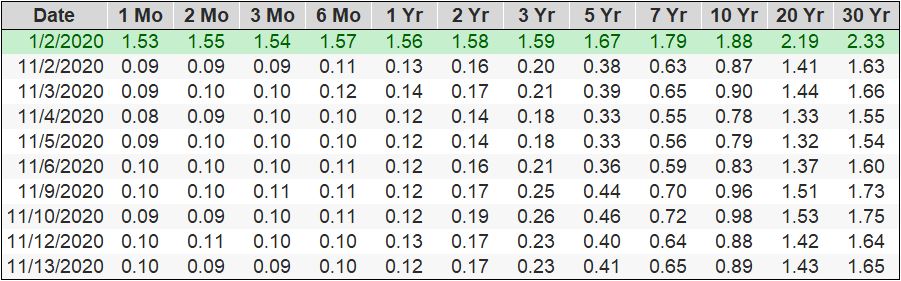
The average daily growth in the S&P 500 over the past 50 days is 0.78%, while the return for owning a US Treasury 10-year for 365 days is 0.76%. That’s less than 1/365 in return. Risk versus return is one driver of investor behavior. Confidence is another driver. On the day after election day in 2016 the Dow hit an all-time after a dramatic late-day rally. Nothing had fundamentally changed in the market except increased confidence in business conditions. This stoked some buying which then prompted more buying.

It often only takes a couple of strong days before the attention of a larger pool of investors begins to want in on the rise in prices. This then feeds on itself as more and more see the movement and fear they will miss out. This happened when US stocks bottomed in March 2009. The economy was still bad and quite uncertain. The result, confidence in the future, and governmental support led to the longest bull market in American history.

Take-Away

There are some faint signs that the economy is bottoming. For instance, the number of unemployment claims has slowly declined, and mortgage applications, both refinancing and new purchases, are rising. Airline passenger activity and restaurant traffic are climbing as well.

The opposite of the fear of missing out is fear of staying at the party too long — not booking profits on the way up. This causes a downward movement that is often more rapid than the upward climb. The Fed and participants long the market certainly hope that after defying gravity amid so much uncertainty, that any reduction in pace leads to a soft landing.


Suggested Reading:

The
Feds ETF Purchases Will Impact Investors

The
Correlation Between Passive Investing and Underperformance

Can
the Market Continue to Defy Gravity?


Enjoy Premium Channelchek Content at No Cost


Sources:

University
of Michigan Data

https://www.nasdaq.com/articles/how-nasdaqs-opening-bell-defied-gravity-2020-06-03

Koyfin Market Data

Unemployment
BLS

Irrational
Exuberance
, Chapter 8

Which Major Index Outperforms in June?

Is the Repeated Outperformance in June of the Russell 2000 Random?

“Sell in May and Go Away” is an investment axiom that suggests investors would do better to lighten their positions in stocks during the summer months. Is this good advice? It doesn’t tell us when in May that we should take our chips off the table. Is it May 1, Memorial Day weekend, May 31? And, is one sector or index more impacted than others? This May, the Nasdaq hit its low for the month on May 3, right before its 800 point climb. The S&P 500 bottomed later on May 14 before shooting up close to 10%. Overall, May 2020 was an excellent month for the major market indexes. If you didn’t sell, there’s a good chance it gave a boost to your portfolio.

What will June and the summer bring? I don’t know of any market sayings for June. I guess you were supposed to have already reduced your positions in May. I do know, from my years on Wall Street, that the trading desks during the summer months are often controlled by the rookies and interns. They’re often trying to demonstrate their abilities while the veterans are out playing golf or lying on a beach in South Hampton. Could this be the root of the “sell in may…” advice?

Serious investors don’t care about sayings; they care about company data, economic numbers, trends, and probabilities. I decided to look back at the trends over the past 20 Junes to see if history provided a verifiable pattern across the most followed market benchmarks.

June
Results Since 2000

Out of the past 20 years, the Russell 2000 has returned positive results 13 times (65%). This doesn’t sound overly impressive until you compare it to the Dow 30 which had been up in June for only 7 of the years (35%), the S&P 500 was up 11 of the 20 (55%), or the Nasdaq that was up 9 Junes (45%) over the past 20 years. So, over the period, only two indexes were up during June more than half the time. I should point out here that this 20-year period was not “cherry-picked” to compare performance history.  A quick review of the data for the ten years prior to this, and the ten years prior to that only reinforced this June “trend” with the small-cap index exceeding the others. Here is a link for the Underlying Data.


Data Source: investing.com  

In terms of performance, the track record for the Russell 2000 is even more compelling. With a one-month return average of almost 1% (0.94%) in June since 2000, the Russell has returned more than double the next closest index which is Nasdaq.


There May Be a Reason

Rather than caution that past history is not an indication of future performance, I’ll instead make sure readers know that during this period, the best year was 6.89% (June 2019), and the worst June was negative 8.60% (June 2008). So any particular year has its own circumstances. But there is something at play during June with this index. The Russell Indexes are being reworked and this creates activity that could be providing a predictable tailwind. The added companies typically have a good amount of new interest surrounding them. This added interest causes fresh institutional buyers of the new stocks being included and often a rise in their value leading up to and for a short time after their inclusion.

Take Away

Channelchek wrote two informative articles on the impact on investors of index reconstitution. They are Opportunity When Stock Market Indices
are Reshuffled
and The Russell Index Reconstitution. These two articles, coupled with the above data, make clear that investors should be aware of how the calendar impacts the index, which measures the lower 2000 stocks of the 3000 largest capitalized companies.

As far as selling everything else now that it’s the last day in May, normal market probabilities may not apply this year. The one thing certain in 2020 is that there are cross-currents that will continue to move markets dramatically. The normal drivers of stock price based largely on recent company performance, for now, are on hiatus. 


Paul Hoffman

Managing Editor


Suggested
Reading:

Why Index funds Could be a Mistake in
2020

Can the Market Continue to Defy Gravity?

Lower Multiple are a Good Case for Investing in Utilities

 Enjoy Premium Channelchek Content at No Cost

The New Age of Investor Relations

Investor Relations in 2020 — Meeting the Needs of Investors and Companies

Is face-to-face communication gone forever? Are nimbleness and strategic plan more critical than financial reports? Is loyalty from the investment community on par with having the loyalty of customers and employees? Are reputable company-sponsored research firms protecting their reputation when “business as usual” is on hold? Does this leave both investor and customer base maintained? Has the current economic weakness strengthened investor relations firms? These are among the questions addressed in this well-thought-out, well-presented release posted May 4th in USA Today titled: The New Age of Investor
Relations by Stuart Smith, CEO, and Founder of SmallCapVoices.com.

The New Age of Investor Relations

So far in 2020, we learned with abject certainty that “business as usual” is an axiom of the past. COVID-19 continues to wreak havoc on the world, leaving in its wake total carnage of economies, businesses, communities, schools and health care systems. As world leaders and health experts attempt to define a semblance of the “new” normal, we’re all reminded that the future can only be forecast, not foretold. This means it’s time to adapt.

Established crisis management plans, from a global perspective, did not anticipate this crisis. Determining the full scale of impact will take decades, though the effect on America’s businesses, however, is closer at hand. As the pandemic peaks and plateaus, we will see which public companies successfully adopted a new-age strategy to retain, attract and communicate with the lifeblood of their existence: the investor community.

The game plan for many CEOs thus far has been to reduce overhead and adjust operations to minimize impact on the bottom-line and ensure continuity with customers. In the midst of these changes, temporary disregard of the financial community to focus on corporate survival is expected, though admissible for only so long and to a small degree. If broader market performance is any indication, existing and perspective stakeholders are watching to gain clear understanding of what measures are taken to manage liquidity. Qualitative information – the company’s new business model and strategic direction – may be more important to convey in the near-term than quantitative financial documents. In order to stabilize stock prices, shareholder performance-expectation must align with the actual decisions made by management.

Of extreme, immediate importance is timely communication that answers the most common questions of the investment community.

For instance: Are there pressures on demand for your goods and services? Are you able to meet this demand? What is the impact from supply chain disruptions? Are projects being delayed or cancelled? How are you managing your human capital? Are you eligible for government assistance?

There are many more questions, with relevancy based upon industry sectors, some of which are impossible to answer during this changing environment. Even so, investors are observing management’s ability to handle the current crisis and evaluating the longer-term merits of making or holding investments. In the absence of concise answers, it is critical that public companies communicate to shareholders how they are monitoring economic indicators and steps they are taking to manage relationships with suppliers and customers.

Is Face-to-Face Gone Forever?

Nothing beats face-to-face communication. The tactility of an in-person meeting can never be replaced, but with the current environment, roadshows, investor luncheons and equity conferences are no longer on near-term calendars. Businesses are forced to find new ways to communicate in both business and social settings. In many cases, the results are better-than-expected and more cost-effective than in-person arrangements. Innovative companies are redirecting their travel dollars to improve their digital presence and create virtual offices. Websites are being overhauled; benign investor relations (IR) sections are coming to life; and webinars and virtual meetings have exploded in both number and the richness of content.

When face-to-face contact is deemed safe, executives will be back on airplanes and checking into hotels. This new digital awareness, however, will not be lost. When the cost-to-benefit analysis is complete, it will gain a permanent place in the IR toolbox.

Planning for Better Times

While trust is a prerequisite for effective IR, it is now more important than ever. “I don’t know what or who to believe,” has replaced “How are you?” as the opening catchphrase. Skepticism is at least on par with optimism.

Fortunately for corporate executives, world governments and mass media have usurped and preserved the lead as those least trustworthy. Mistrust for corporate America, however, still provides a sizable hurdle for those given the task of telling the company story.

When the storytellers are the inside players, the hurdles become taller. Only the most skilled CEOs and CFOs can effectively maneuver through this unprecedented territory. Pure transparency of message – passion without promotion – has always been the bedrock of effective IR and it will be critical in the planning of post-crisis strategies.

Specialized and accredited IR firms – together with third-party, institutional-quality equity research – can help deliver, verify and validate internal messaging.

Think of this in terms of a restaurant. Who best to provide a recommendation: the cook or the customer? Investing in an uncertain future is immensely difficult. But it is the companies with emergent strategies, in the midst of crisis, that captivate the attention of investors. Even Apple was once on the brink of bankruptcy.

Picking the Best Players

Developing an effective IR program is not easy. CEOs and CFOs cannot just hire the solution; they must take an active role in its development. Many companies churn through IR firms, particularly when expectations are not met. Where consistency and clarity of messaging is imperative, churn is not good. Picking the “right” players the first time is imperative in developing a sustainable IR program.

So, what should be looked for in the selection of IR professionals? Specialization is a good start, particularly for companies in complex sectors. It’s akin to choosing a heart surgeon who has performed thousands of surgeries; specific experience will aid in the management of unforeseen circumstances.

Longevity is paramount, both as a firm and in the retention of clients. Longer-term case studies will provide insight into the IR firm’s methodology and how it establishes a rapport with the investment community.

Personnel is also key. Consider the employees of the firm. CEOs and CFOs will need to spend considerable time with the person or team assigned to their account. The chemistry of these relationships will often determine the success of the program. A mutual respect promotes an honest exchange of ideas and information, and a candid discussion of expectations is the kind of relationship that will result in a more cohesive execution of the plan.

Over the last 15 years, attracting the attention of sell-side analysts has become increasingly difficult for small and microcap companies. Independent research provides the foundation for IR initiatives. Through a combination of decimalization, regulation and radical changes in the trading paradigm, small, more illiquid companies struggle to get coverage. Sell-side providers have an equal struggle getting paid by Wall Street for microcap research, so many have moved to higher market cap securities. The evolution of company-sponsored, or “paid” research has provided hope for these companies. With reputable firms, however, the decision to initiate coverage remains with the research department. A rule of thumb: if you can simply “pick them and pay them,” you probably should not.

Company-sponsored equity research (CSR) was stripped of the promotional / propaganda stigma when regulated, licensed equity analysts started writing it. Regulators have clear rules by which this level of analyst must abide by or incur hefty fines, or even ejection from the industry. The broker / dealer that sponsors the publishing analyst is also held responsible for ethical breaches. The relatively small cost to issuers of between $4,000 and $6,000 per month provides little incentive to cheat. Except for the payment method, the CSR process of selection, initiation and coverage through a licensed broker / dealer has not changed. Initially, there were conflict of interest concerns with CSR. Ironically, CSR can reduce conflicts arising from pay-to-play schemes, wherein research is offered in exchange for investment banking arrangements. For a company that has little or no coverage, if CSR is offered, it should be considered using similar standards of specialization and accreditation used in the selection of an IR firm.

Delivering the Message

A balanced and comprehensive IR strategy can only be measured by how it is accessed and by whom. On the research side, CSR or otherwise, institutional investors prefer access through aggregators such as Bloomberg, FactSet, Refinitiv (formerly known as Thomson Reuters) and Capital IQ. Retail distribution is more complex and is usually managed through direct communication with investors or their representatives. A new service, Channelchek.com, offers institutional-quality research on small and microcap companies to anyone who registers on the site. This free service also provides advanced market data, webinars and webcasts, podcasts and news. There are more than 6,000 companies listed on ChannelChek.com, opening a new channel of distribution to individuals and groups who did not have access though the aggregators, which charge hefty fees to users. Family offices, investment advisors, independent brokers, private equity, high-net-worth individuals and the huge and growing group of self-directed investors now have a fighting chance to making more informed decisions like the institutions; plus, at no cost.

Stay Optimistic

Management of even the largest companies are suspending guidance through what should be called the “Uncertainty Pandemic.” The uncertainty, however, doesn’t alleviate the responsibility to execute effective IR with the investment community. Tomorrow’s survival is arguably contingent on today’s strategies. Business leaders must establish flexible, yet defined, crisis management standards – such as the selection of a quality, modern IR firm – and demonstrate their ability to adapt as needed.

While the stock market has seen plenty of volatility this year, the numbers prove that investors are rallying behind American business. At all levels of adversity – and yes, this is probably the highest level we have seen – opportunity exists for those who successfully adapt. One sure strategy is to reevaluate and reenergize IR practices and communication strategies. Investors need companies as much as companies need them. Get on their radar screens. Carpe diem. Seize the day.

About the Author

Stuart Smith is the CEO and Founder of 
SmallCapVoice.com, which is a recognized corporate investor relations firm, with clients nationwide, known for its ability to help emerging growth companies build a following among retail and institutional investors via c-suite corporate profiles.

About Channelchek

Channelchek is among the services that have experienced a growing fan base through the pandemic. The online platform provides company-sponsored research and data on small and micro-cap companies alongside pertinent articles, virtual roadshows, CEO discussions, podcasts, and information on over 6,000 companies. For answers to your questions, please contact Channelchek here.


Enjoy Premium Channelchek Content at No Cost


Suggested
Reading:

Is Company Sponsored Research the Future for Small-Cap Stock
Investors?

The 2020s Could Become the Most Inclusive Decade for
Investors

Do Market Scares Provide Uncommon Opportunity?

Source:

USA Today, May 4, 2020 The New Age of Investor Relations

The Russell Index Reconstitution, What we Expect

The Annual Russell Index Revision and Stocks to Watch

The yearly process of recasting the Russell Indexes began on May 8, 2020, and will be complete by market open on June 29. During the period in between, Russell will rank stocks for additions, for deletions, and to evaluate the names to make sure they conform overall. The methodology is largely transparent to help smooth the process. Still, as you might imagine, with over $900 million invested in passive index funds and $9 trillion in assets linked to Russell indexes, the trading volume of these companies should increase dramatically during this period, and there is, of course, the potential for very profitable long and short trades.

Investors should be aware of the forces at play so they may either get out of the way or become involved by taking positions with those being added or those at the end of their reign within one of the Russell measurements.

COVid-19 Dramatic Valuation
Shifts

The reconstitution mid-year 2020 is going to impact a much larger number of companies than most years. As with everything else related to the financial markets, the price swings will likely be more amplified than usual. That is to say, more companies than in the recent past will move in, out, or to another index. There should be large price swings as we approach the last trading days in June.

The 2020 Russell
US Index Reconstitution Calendar is as Follows:

• Friday, May 8 – “rank day” – Russell US Index membership eligibility for 2020 reconstitution determined from constituent market capitalization at market close.

• Friday, May 22 – “query period” begins – preliminary shares & free-float information for Russell 3000 Index constituents are published daily & queries welcome (query period runs through June 12)

• June 5 – preliminary U.S. index add & delete lists posted to the FTSE Russell website after 6 PM US eastern time.

• June 12 & 19 – U.S. index add & delete lists (reflecting any updates) posted to the FTSE Russell website after 6 PM US eastern time.

• June 15 – “lockdown” period begins – U.S. index adds & delete lists are considered final • June 26 – Russell Reconstitution is final after the close of the U.S. equity markets.

 • June 29 – equity markets open with the newly reconstituted Russell US Indexes.


Stocks to Watch

The U.S. equity indexes that are subject to annual reconstitution include the broad-cap Russell
3000
  and Russell
3000E
, the Russell
Midcap
index, the large-cap Russell
1000
, Russell
Smallcap Completeness
, Russell
2000
, Russell
200
, Russell
Top 50 Megacap
, Russell
2500
, Russell
Microcap
, and the  Russell
Top 500 Index
. These links will provide the definition of each index, which will help if you’re trying to determine what companies will be put into each and what companies will be removed to create the new make-up until next year.

This link (Russell
2000 {19-00}
) may help you get started to find stocks with potential movement within some of the indexes. It is a spreadsheet of last year’s Russell 2000, the current largest U.S companies by capitalization (close of business 5/13/20), and a side-by-side comparison to determine which stocks may wind up in the Russell 2000. We’ve identified 101 candidates shown on our spreadsheet that we are watching. We encourage investors that are looking to avoid or become involved with stocks added or removed to do their own analysis and review of price movements.

In a previous article titled There’s Opportunity When Stock
Market Indices are Reshuffled
, there are samples of historical price and volume activity surrounding stocks being added or removed from a major index.


Suggested Reading:

Stock
Index Adjustments and Self-Directed Investors

Climbing the “Wall of Worry”

The Correlation between Passive
Investing and Underperformance


Enjoy Premium Channelchek Content at No Cost


Source:  

FTSE Russell Press Release

Expect A Record-Breaking Russell Reconstitution

Russell
2000 (19-00)

Russell
Methodology

Confirmation
June 2020

Russell 3000 Index

CoreCivic (CXW) – Dealing With COVID-19 Challenges

Monday, May 11, 2020

CoreCivic (CXW)

Dealing With COVID-19 Challenges

CoreCivic is a diversified government solutions company with the scale and experience needed to solve tough government challenges in flexible, cost-effective ways. We provide a broad range of solutions to government partners that serve the public good through corrections and detention management, a growing network of residential reentry centers to help address America’s recidivism crisis, and government real estate solutions. We are a publicly traded real estate investment trust and the nation’s largest owner of partnership correctional, detention and residential reentry facilities. We also believe we are the largest private owner of real estate used by U.S. government agencies. The Company has been a flexible and dependable partner for government for more than 35 years. Our employees are driven by a deep sense of service, high standards of professionalism and a responsibility to help government better the public good.

Joe Gomes, Senior Research Analyst, Noble Capital Markets, Inc.

Refer to the full report for the price target, fundamental analysis, and rating.

    1Q20 Results. First quarter was performing in-line with management expectations until the COVID crisis hit, forcing the Company to devote significant resources to combat the disease. In addition, an already expected ICE population decline was exacerbated.

    What about the Dividend? We believe the dividend remains covered even under our revised estimates, although we will note that management did lower the dividend in 2016 as a result of changes to the South Texas contract. Another alternative to cash dividends would be paying up to 80% of the dividend in stock, although we are not…


Click to get the full report.

This Company Sponsored Research is provided by Noble Capital Markets, Inc., a FINRA and S.E.C. registered broker-dealer (B/D).

*Analyst
certification and important disclosures included in the full report. 
NOTE: investment decisions should not be based upon the content of
this research summary.  Proper due diligence is required before
making any investment decision.
 

Dealing With COVID-19 Challenges

Monday, May 11, 2020

CoreCivic (CXW)

Dealing With COVID-19 Challenges

CoreCivic is a diversified government solutions company with the scale and experience needed to solve tough government challenges in flexible, cost-effective ways. We provide a broad range of solutions to government partners that serve the public good through corrections and detention management, a growing network of residential reentry centers to help address America’s recidivism crisis, and government real estate solutions. We are a publicly traded real estate investment trust and the nation’s largest owner of partnership correctional, detention and residential reentry facilities. We also believe we are the largest private owner of real estate used by U.S. government agencies. The Company has been a flexible and dependable partner for government for more than 35 years. Our employees are driven by a deep sense of service, high standards of professionalism and a responsibility to help government better the public good.

Joe Gomes, Senior Research Analyst, Noble Capital Markets, Inc.

Refer to the full report for the price target, fundamental analysis, and rating.

    1Q20 Results. First quarter was performing in-line with management expectations until the COVID crisis hit, forcing the Company to devote significant resources to combat the disease. In addition, an already expected ICE population decline was exacerbated.

    What about the Dividend? We believe the dividend remains covered even under our revised estimates, although we will note that management did lower the dividend in 2016 as a result of changes to the South Texas contract. Another alternative to cash dividends would be paying up to 80% of the dividend in stock, although we are not…


Click to get the full report.

This Company Sponsored Research is provided by Noble Capital Markets, Inc., a FINRA and S.E.C. registered broker-dealer (B/D).

*Analyst
certification and important disclosures included in the full report. 
NOTE: investment decisions should not be based upon the content of
this research summary.  Proper due diligence is required before
making any investment decision.
 

Climbing a “Wall of Worry”

Can the Market Continue to Defy Gravity?

The
stock market’s gyrations this year will be analyzed for generations. The year
2020 isn’t even half over, and to date, the market has experienced an all-time
record high, quickly followed by one of the steepest drops (33.9%, 32 days) in
history. The markets have also registered the highest volatility since the VIX was
launched in January 1990. All of this was immediately followed by a very
profitable market climb, which included the strongest month in 45 years (April
2020).

The remainder of the year is likely to be historic as well. The latest economic releases are unfathomably bad. Over the past six weeks, the US Department of Labor reported 30.3 million new unemployment claims. This represents roughly 20% of the workforce. The read on first-quarter GDP shows a 4.8% contraction in economic output during the quarter. Keep in mind, the first half of the quarter was before the economy was put under sedation, so it was still contributing growth at a robust rate. This portends a much deeper contraction during the current quarter. Corporate earnings have, of course, become extremely strained. This is not necessarily reflected in the major market indexes. Instead, the equity markets have been defying gravity since late March as they have moved upward and are now at the same levels we had a year ago in May. GDP last May was at least 7% stronger than the current pace, and unemployment was low at 3.6%.

Wall
of Worry

The strength of the markets may seem out of place when contrasted against the surrounding economic environment, but this behavior is so common that there is a name for it, “The Wall of Worry.” Investopedia defines it this way: “Wall of worry is the financial markets’ periodic tendency to surmount a host of negative factors and keep ascending. Wall of worry is generally used in connection with the stock markets, referring to their resilience when running into a temporary stumbling block, rather than a permanent impediment to a market advance.” The Investopedia description further explains, “The markets’ ability to climb a wall of worry reflects investor confidence that these issues will be resolved at some point. However, market direction once the wall of worry has been surmounted is impossible to ascertain and depends on the stage of the economic cycle at which it occurs.”

Climbing the wall of worry is what the markets are doing now during the eye of this economic storm.  Since the economic turmoil is self-induced and seems to have an (uncertain) expiration date, the situation is viewed as a temporary impediment. Most would presume the resumption of back-to-work both abroad and in the US before year-end. So the “shelter-in-place” situation that caused the sell-off initially is expected to clear, which leads to the market confidence of investors. The strong markets at first were probably driven by the opportunistic, searching for value, then carried by fear-based investors worried they would miss a chance to get in on the ride upward.

The
Market is Acting Rationally

In addition to looking past the crisis, investors are also picking their spots. When you peel back the layers of the market’s strength to reveal individual sectors rather than look at the performance of the whole composite index, the market appears to be rational. The sectors, where you’d expect strength such as health care and information technology, have acted the most bullish, while materials, real estate, and energy have been laggards. What is more noteworthy is that the strongest of the individual stocks within the S&P are five large-cap names that now account for almost one-fifth of the 500 stocks. If these handful of companies are doing well, their weight impacts the Unsupported image type.performance in a way that overstates overall market movement.

The success of these five (once small) companies’ accounts for much of the S&P 500’s climb. Small-cap, international, and value stocks are lagging. While these laggards made up some ground last week, they have more to go before they catch and pass the performance of the large-cap companies making up the indexes performance. Surpassing the large-cap stocks is likely to happen eventually. Over time, small-cap and value companies have outperformed large-cap. Look at the list above. Most can remember when four of the five were small-cap companies. The potential for outperformance within the equity arena is much higher away from large-cap equities.

Take-Away

While the market has recently experienced big gainers outpacing weaker names, the question of why stocks are showing strength at all confounds many market participants and TV pundits. The answer is that investors are climbing a classic wall of worry by looking through the next couple of quarterly economic releases. Also, they believe the current situation is temporary, and investors are confident that earnings will normalize in time. So, despite significant earnings declines, this situation is presumed to be short term.

Not unlike most rallies, forward-looking investors got in first. Others saw the move and joined them for fear of missing out; this drove the major market measures higher. Will these investors be quick to hit the sell button if the return to a stronger economic climate is slower than expected? Will the market climb of large-cap stocks cause some to seek opportunity in small-cap stocks or value? We are in the middle of this storm; the worst seems to be over, assessing the damages and repairing them will uncover new opportunities to embrace and others to avoid. Investors with the most information and insight into what is going on beneath the surface of both sectors and companies will have successful portfolios.

Suggested Reading:

Small-Cap
vs Large-Cap Investing

Economic Aid Programs – A Gargantuan Experiment with only
Modest Expectations

The Correlation Between Passive Investing &
Underperformance


Enjoy Premium Channelchek Content at No Cost

Sources:

Fed cuts rates
to blunt coronavirus impact, markets drop

States
reopening beaches, beauty salons, and bowling alleys, from Florida to Alaska

Betting
On Retail Stocks At the End of the Brick-And-Mortar World

Wall of
Worry

30 Million
Americans Have Filed Unemployment Claims

Top 10 S&P 500 Stocks by Index
Weight

Gaining More Clarity and Broadening Investment Options

An Investment Tool That’s More Important than Ever

The overall stock market performance during April was one for the record books. The Dow 30 (+11.1%) and S&P 500 (+12.7%) put in their best one-month performance since January 1987. The Nasdaq (+15.4%) delivered its greatest one-month gains since June 2000, and the Russell 2000 (+16.22%) outperformed the other three major market indicators.

The April rally was a welcomed reversal from March, which was the worst month since the height of the financial crisis in 2008. The question most stock investors are trying to discern now is, will stocks reverse again in May?  And How best to determine value?

Where to Now?

The economy and its impact on the stock market are in extraordinarily uncertain waters. Any previous trends have all been derailed. This is not just true of the market overall, but also true for both companies that will benefit from the pandemic and the majority which will be hurt by it. One fact that will keep many self-directed investors active is the reality that, during times like these, opportunity is at its highest. It is also true that at times like these the risk of short-term realized or unrealized losses are also at a high level. Volatility, truly is a double-edged sword.

Many market participants are accustomed to companies earnings guidance and earnings forecasts, especially in highly capitalized corporations that are widely covered by sell-side analysts. The quarterly forecasts of these companies are so broadly covered by mainstream news outlets, that they’re sometimes treated and delivered to investors like they’re an event themselves. The problem now is, over the past few weeks analysts along with one company after another have pulled their guidance and stated, “we just don’t know.” This takes away one of the valuation tools investors use in their decisions to buy or sell.

For the companies part, they can not offer the earnings insight into the near future which they do not have. This is safe for them to not offer numbers with far less confidence than the market is accustomed to. Without the companies insight, analysts from both sell-side Wall Street firms and company-sponsored research have placed many companies near-term projected revenue in a wait-and-see mode. The analysts, oddly enough, probably have better visibility out a year or more when the crisis is presumed to be behind us, than they have out three months. This may not be as much of a drawback for investors as it feels.

Investors, enjoy experiencing immediate gratification and reassurance after investing in a company. However, it is long term results (longer than 90 days) that is most often the reason an investment is made in the first place. Similarly, as far as selling,  a long-term negative outlook makes more sense than ridding your portfolio of a company because they are having a one-time hit to EBITDA.

Perhaps the economic lockdown will usher in an era of companies managing for long-term results. An era where analysts don’t feel a need to be as precise about their immediate estimates of income as opposed to longer-term prospects for the company and space in which it does business. Investors for their part could serve their future financial growth better if they look at companies through a longer-term lens. This would allow corporate management to create strategies with a longer-term focus.

Determining Value Now

Lower expectations of forecasting precision over the next two periods from the company’s investor relations or research analysts will be important for investors that want to stay involved and feel comfortable. By definition, people invest for the future, value expectations over a more appropriate time horizon may be the answer to this lack of information. Even during ideal times, it would be foolhardy to invest cash in a stock if you need that cash in a few months. A longer-term focus is more prudent for investors, and if companies are given leeway to focus long-term they should be able to make decisions that drive better results. This is better for investors and there are still forecasting tools. In fact, there are plenty of other fundamentals to review as a measure of future positive performance.

One thing the pandemic has done is cause us to see shifts in the economic landscape that may change industries. Some areas have earned a lot of buy-side interest because of the virus and lockdown and what it might usher in. Recognizing these changes early could be the key to finding performance and benefiting from the new paradigm. These could include industries providing work from home solutions, medical solutions, and safe havens such as precious metals, among many others.  Once industry expectations are recognized, sort through high-caliber industry reports to make sure you aren’t missing anything. From there, find companies within the space and check the recent price trend; you don’t want to chase after a stock that perhaps has already received too many speculative investors. Then comb through institutional-quality research analyst reports to get a clearer picture of the inner workings of the business model and growth prospects. Narrow down the list of possibilities and hope to find the deserving company that has been overlooked in all the other noise.  

Time Horizon Adjustment

The regularity of earnings projections with what had been a short feedback loop provides a sense of control and precision regarding accuracy, but perhaps not usefulness of these forecasts. Even with today’s murky conditions, wide estimation error, or lack of short-term guidance should not be a problem for investors. We know there is a temporary problem. If it were possible to forecast next quarter’s earnings per share for every stock in the S&P 500, any partially astute investor would assume that each companies profits this year are not representative of their longer-term potential. To put it another way, the accuracy of any earnings forecast during the first half of 2020 does not make it a valid measurement for determining normal expectations for the company. Companies that miss estimates can still have great earnings prospects. Conversely, companies that exceed expectations could still face difficulties. Within the past two months, and looking through next quarter, what is going on within the company books, within the various industries, and management goals to drive better performance can hardly be fully assessed by most self-directed investors or small RIA firms. They need more information and deeper insight on industries and company-specifics. The business model itself could be more telling than the numbers. 

Without a crystal ball, we don’t know how “normal” next year will be. However, as an investor, we should try to take advantage. We know the focus should be longer-term. As far as Wall Street analysts are concerned, the direction of future numbers and ability to resume normalcy down the road provides a very good start to discerning where assets should be deployed and which investments are best sold now. Looking out beyond the immediate quarter reduces short-term “noise.”  It also creates a longer-term horizon for management to measure success. Three years, five-years, ten years, these seem like an eternity in a world where immediate expectations drive stock price, and stock prices are available and rapidly changing throughout the day.  But if your investing for a future measured in years, you may be surrounded by opportunities that you’re afraid of taking advantage of because you aren’t as certain what will happen over the next 90 days. This will work against your success in the new paradigm.


Paul Hoffman

Managing Editor


Suggested Reading:

Stock Index Adjustments and
Self-Directed Investors

The Case for Silver

Small-Cap VS Large-Cap Investing


Register for Channelchek Premium Content and Tools at No Cost!

Sources:

Strategies
for Quarterly Earnings

“Words of Wisdom” Awaited – Berkshire Hathaway Annual Meeting

Has Warren Buffett Already Shown His Hand?

Market participants, of all levels, have been wondering aloud about Warren Buffett’s low profile. Shortly after other wealth destroying market events, the “Oracle of Omaha” tended to step-up and calm fears early in the financial turmoil. The orchestrated economic stoppage of today’s lockdown has left investors wondering. They’re wondering if and when they’ll get a glimpse into the thinking of the highly respected Chairman of Berkshire Hathaway. Well, they don’t have to wonder much longer. His “silence” will end Saturday (May 2) at the Berkshire Hathaway shareholder meeting (held virtually).  The discussions from that meeting have the potential to set the market tone in a number of industries and even the overall mood.

Has He
Already Shown His Hand?

Reviewing his actions and experience after the financial bubble burst late Summer 2008 may lend clues into his current focus. There was an excellent op-ed article written by Buffett for The New York Times just one month after the recognized start of the 2008 financial crisis. The piece was titled “Buy American – I Am” and contains one of his most famous quotes; “A simple rule dictates my buying: Be fearful when others are greedy, and be greedy when others are fearful.” The article uses market history to make compelling arguments for ignoring fear and to confidently move cash from the sidelines and into the market. The only problem with the article, at least according to the author himself; is, he was wrong.

The Oracle of Omaha used the op-ed to “cheerlead” for the country and the markets. He wrote about taking his personal account from 100% U.S. Treasuries to making significant investments in U.S. Companies. The piece helped calm fears and served to inspire others to be comfortable investing while the extent of trouble was not fully clear.

Unsupported image type.

Berkshire Hathaway, in 2008/2009, for its part, took large positions in beaten-up companies with excellent brands and excellent histories. The investments back then included Harley Davidson, General Electric, Tiffany & Co, and construction materials giant USG, among others. When discussing the crisis many months later, Buffett had lamented his timing and said he wished he had written his op-ed later than he did. He had spoken too soon.

This (jumping in early) by itself could easily explain his now shying away from making any bold statements. He is famous for confidently investing when others are fearful, but it is difficult to know when fear is near its peak. In 2008 he expressed extreme optimism only one month after the start of the market crisis. He was reminded that one month is too short to assess a new and highly unusual situation.

Charlie Munger, Warren Buffett’s business partner and Vice-Chairman of Berkshire Hathaway, spoke with The Wall Street Journal a week ago. He was very clear as to what was going on in the Berkshire Hathaway investment mindset and the deals coming their way. In short, he made clear, “The Phone Is Not Ringing Off the Hook.” 

Unsupported image type.

The Vice Chairman also said, “Warren wants to keep Berkshire safe for people who have 90% of their net worth invested here. We’re always going to be on the safe side. That doesn’t mean we couldn’t do something pretty aggressive or seize some opportunity. But basically, we will be fairly conservative. And we’ll emerge on the other side very strong.”

Munger also noted that they generally don’t go out searching for deals with companies. In the past, corporations looking to discuss their situation came to them. He said large corporations are most likely having those conversations with the U.S. government. Certainly, the U.S. has deeper pockets and greater ability to help than Berkshire Hathaway. 

What Others are
Saying

The speculation and consensus among investors is that he is quietly deploying capital and selectively buying shares of companies that are the backbone of America. In a podcast for The Knowledge Project titled “Getting Back Up,” Bill Ackman, CEO of Pershing Square Capital Management, discussed what he thinks Berkshire Hathaway may be doing and should be doing. In the podcast, Ackman is heard saying: “I’m surprised they haven’t done anything yet that’s visible, but my guess is they’ve been buying stocks a lot…” The hedge fund manager added,   “The big opportunity for Berkshire is Berkshire itself.”  He explained it was a “cheap stock” before the market route and now is a “real bargain.” Class B shares of BRK (BRK-B) closed Wednesday at $189.61.

Rest Assured He Will Be Comforting

If history offers any indication, Warren Buffett believes markets always come back. As an “oracle” his projections usually have a soothing mood of confidence. This is not to suggest that anyone should believe the markets have seen their worst, or that everything will perform equally. Instead it would suggest there are many bargains within the equity markets, but the strength of the overall market may have gotten a bit ahead of itself.

As far as thoughts he shares on sectors and industries within the market, the investors will be listening for tips relative to performance spreads between stock classifications, which industries he sees value within, and if he is more likely to be looking offshore this time.

The normally lavish Berkshire Hathaway Annual meeting will be held virtually for the first time. It has been announced that Charlie Munger, who is 96, will not be attending. You can “attend” yourself on Saturday with this live stream this link.

Suggested Reading:

“The Big Short” Dr.
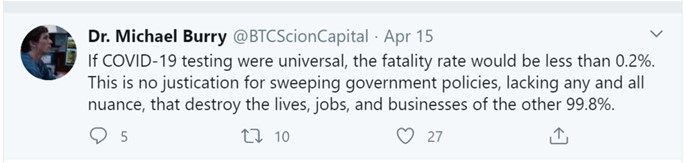
Michael Burry’s Views on the Shutdown

Why Index Funds Could be
a Mistake in 2020

What Now? Post Pandemic
Stock Market Investing

Register for Channelchek Premium Content and Tools at No Cost!


Sources:

Berkshire Hathaway 2020 Meeting Press
Release

“Buy American – I Am” NYT, 10/16/08

Charlie
Munger: ‘The Phone Is Not Ringing Off the Hook’

Bill Ackman:
Getting Back Up

What Now? Post-Pandemic Stock Market Investing

Your Move – Three Investment Ideas to Consider Now

(Note: companies that
could be impacted by the content of this article are listed at the base of the
story [desktop version]. This article uses third-party references to provide a
bullish, bearish, and balanced point of view; sources are listed after the
Balanced section.)

Stock market indices have gained a large portion of their value back after having been down as much as 34% over the past month. The major market averages are now off their high less than 20%. The unpredictable massive rally in these benchmarks included record moves that will surely be studied in history books – as will the selloff that took place the month earlier. 

The magnitude of this upward index bounce is very misleading. Have you noticed that most sectors have not participated in any meaningful way? In fact, some of the more deflated stocks are still near their lows, others have fallen further. Here’s why.

Stocks With
the Most Pull

“The top five companies in the
S&P 500 have never occupied a greater share of the benchmark’s total market
capitalization.”
 – Mike Bird, WSJ, April 20, 2020

Companies that have added the most to the rise of the Nasdaq and S&P 500 over the past month are tech giants such as Amazon, Intel, and Microsoft. Today, just five stocks MSFT, AAPL, FB, GOOG, and GOOGL account for 20% of the market cap for the entire S&P 500. That exceeds their concentration during the dotcom bubble of 2000.  The entire IT sector now accounts for a 25.4% weighting in the S&P 500 (a/o 4/17/20). None of the other ten major sectors even come close. While technology, which does not have a reputation of being defensive, has contributed most to index returns, some other individual companies have also held up well, especially in healthcare and consumer staples two more traditional defensive sectors.


Reuters Graphic

The performance of the entire S&P is in
large part because of participation by a few stocks.

Where Do We Go From Here

The market seems to be past the “blood in the streets” stage, where investors were tripping over themselves to unload stocks indiscriminately. The extreme rise in the tech sector looks to have been the standard kneejerk reaction by speculators trying to get in early and by those that followed the move and chased stocks behind them. The next move, if the worst is behind us, is typically more rational. That soberness may carry the overall market sideways to down as some participants wait for confirmation that indeed the economic road ahead will be positive.

While the overall indices may simmer, this will likely be because of cooling of the tech stocks while more traditional plays begin to heat up.

Strategies
for Low-Risk Exposure

The crisis fell upon us fast, but we learn fast. The follow-up in the investment markets is likely to be quick. In the same way, everyone quickly learned how to put on a mask, have Zoom meetings, and food shop for longer than a week at a time; investors are going to become more adept at crisis investing.

In the past, crisis investment strategies have always had three strong tenets:

1). Be very selective (not major market investing)

2). Be more defensive (base decisions on worst-case scenario)

3). Be among the first (don’t chase)  

The best risk/return opportunities for investors will likely present themselves from long-term secular trends. The pandemic and the coinciding stay-at-home policies have accelerated many of these trends in tech usage. Look to capitalize on the old strong sectors that could experience a tailwind from the revised world we’re entering.

The old trends that had been worth watching in stocks, that will be enhanced once most of the economic lights are turned back on, include; a world that is more digital, a world that is more in debt and a world that values medical miracles.  

Three
Investment Areas that Should get Warmer

1). Stable and
defensive stocks
– This may seem obvious, but many people still get caught up in “sexy” stocks and chasing what is most highlighted on CNBC or Fox Business News. Invest in stocks that display earnings growth trends that are less likely to be negatively impacted by “sheltering in place.”  Many people saw the TP shortage as an inconvenience; investors should have researched it as an opportunity. Consumer staples and healthcare products are always in demand without regard to economic conditions. This places them on stable ground for a defensive position. In many cases, the increased hours people stay at home has placed further demand on items such as soap, and paper products, while possibly lowering demand for items like hair gel and deodorant. This is why specific companies, rather than a consumer goods ETF, is preferable.

Many of these stocks pay dividends. This not only adds to return, it helps make the equities more attractive as yield investors are bumping up against sub 1% government bond rates. Dividends cause the stocks to be less volatile overall.

2). Cyclical stocks– Ahead of a firm-footed recovery, selective investing in cyclical companies that thrive as people open up their wallets, may look different than in the past. Discretionary spending will likely increase in areas that have pent-up demand. These could include household appliances, recreation, online dating, fitness, etc..

3). Long-term trends- We’ve already had a taste of the accelerated structural changes that could define this decade. There has been a digital transformation. This has set much deeper roots in the past month than it has in the past three years. The momentum is not likely to slow. Technological disruptors that improve work and home life seem to be in a position to maintain their above-average growth. Any dip in stock prices allows entry at a reasonable level as renewed activity should once again prove rewarding longer term. E-Commerce also got a boost from the lockdown’s effect on brick and mortar stores. The boost in popularity is likely to stick at a higher level than pre-crisis, thus providing a new base for these products.

Pharmaceutical and biotech companies with pipelines for drug and genetic therapies will continue to garner attention as the population has the pandemic fresh on their mind and now shows increased support for more rapid discovery, clinical trials, and FDA review.

Take-Away

The bounce that we have seen in the major indices is not representative of the movement in the various components of the underlying index. The split or bifurcation likely has sectors overbought while others that should get attention have been overshadowed by these “stars.” The coming recovery is likely to unfold slow but sure. Focusing on the surest beneficiaries of the eventual recovery is less speculative and more prudent. Chasing relatively high-flyers, or owning them by default because you have invested in an index fund may be less profitable. There is still much uncertainty moving forward. Picking your short, medium, and long term positions with more rationally will allow participation in moves upward with comfortable risk-adjusted returns in volatile times.

Suggested Reading:

Why
Index funds Could Be a Mistake in 2020

Stock
Index adjustments and Self-Directed Investing

Additional
Balance in 60/40 Asset Mixes

Sources:

The
Winner Takes All Stock Market Rally

Titans
Dominate Stock market

Twitter- @Birdyword

Why Index Funds Could be a Mistake in 2020

The 2020 Investment Buzzword No one is Using Yet!

(Note: companies that
could be impacted by the content of this article are listed at the base of the
story [desktop version]. This article uses third-party references to provide a
bullish, bearish, and balanced point of view; sources are listed after the
Balanced section.)

Today when investors say they are “in the market” or “out of the market,” they most often are using shorthand to discuss the stock market. This is understood, even though there are many other active investment markets.  The others don’t get as much attention. In fact, because of current investment practices, the term “in the market” usually implies exposure to one of the major index averages.

It wasn’t always this way. Not too long ago, investors would build a portfolio working with a broker and buy a small basket of stocks. Commissions were high, but a good broker was worth the price because of the in-depth research they conducted. Back then, “in the market” didn’t mean broad exposure to 500-2000 holdings.  Far fewer. The reason for the change, of course, is an evolution that gained momentum around 1980. It was then that mutual funds started to become understood throughout households, many of which had never been “in the market” before.  Mutual funds allowed investors, even small ones, to benefit from what has been a cyclical but rising market, but with much lower entry fees.

The combination of the ease with which large mutual funds allowed an investor to gain or reduce exposure to equities, the comfort of being extremely diversified, the rising trend in stock prices, and the painless built-in fee made mutual funds an easy sell for fund companies.

Once invested, to determine if the fund manager was doing a good job, marketers began benchmarking their funds against major market indexes on the futures exchange (Dow, S&P, and later Russell). Investors were taught that good returns were “index” returns. Investors began to measure if their fund performed satisfactorily by how it stacked up against a broad index.  When this became the standard by which investors measured success, mutual fund companies created index funds with the objective of meeting or beating a specific index. Here is where they ran into some problems.

Matching an index, which has no fees, no slippage, and no flow of assets in or out (often at the worst times), is mathematically impossible for a fund manager without taking on additional risk. Index mutual funds often fell short of their benchmark. It wasn’t their fault. When markets are rising, investors put money into the fund, this adds to the average price of the underlying holdings. When markets fall abruptly, investors often pull money out. This locks in lower performance and prevents the fund manager from buying at lower prices. Also, managing fund flows requires a cash position; this dampens fund performance. Innovative financial engineers then addressed the issues and came up with a product that was more capable of tracking a major index return. The product was exchange-traded funds, and these became more popular to people whose goal was “market” returns.

Lower Cost Options

With the goal of index investing and tracking much closer to index returns,  exchange-traded funds (ETFs) made their debut in early 1993. State Street Global Advisors created the first which was the S&P 500 Trust (SPDR). This new fund type had lower fees and held a set amount of the underlying stocks. As a result, the fund trades virtually tick for tick with the S&P 500 index. SPDR gained popularity very quickly and is still the most actively traded ETF. Investment advisors have been able to lower the cost to their index fund invested clients as they moved them into this new innovation.  

Today there are ETFs that cover all the major indexes. What’s better is they now also cover all the underlying sectors within an index. So if you don’t like Financials but feel Energy is undervalued, you are no longer limited to just receiving broad index returns. You can pick and choose the categories within the equity markets and focus more heavily on one sector over another.  Building a custom portfolio using indexed sectors has become a more refined way to give investors above-average potential.

Sector Bifurcation

Market sector movement at the start of 2020 is a solid example why those that maintain an active investment portfolio should do more than just sit idle with broad market index funds.

The graphic below demonstrates how the Spyder defined sectors deviate drastically from each other. The economy is going through a period where the markets are bifurcated. There are sectors that are strong and rising while there are sectors that are weak and sinking. This is different from recent experiences where we saw all sectors generally moving in the same upward direction. The markets are likely to remain bifurcated and volatile until the pandemic crisis is history.

For investors looking to “pick their spots” in what is a more difficult market, they now have the ability to target sectors they deem superior and avoid those with low probability of satisfaction. The six-month chart below (Red is S&P 500, SPDR) shows that back in November Healthcare began outperforming the major index while Energy was falling off quite a bit. That trend continued and accelerated during the pandemic. Investors in the Healthcare ETF are up 10% over the past six months, Energy sector investors are down over 40%.


A close up of a map

Description automatically generated

Investors should consider a bias in their holding toward sectors with a more positive outlook and away from those with more negative using targeted ETFs.

Further Bifurcation

Within investment categories, especially during the current crisis, there is further bifurcation. Investing strictly in ETFs, even sector ETFs,  means still accepting the bad with the good. The pandemic has clearly altered the direction of individual company earnings. Sector funds don’t take this into account. Here is an extreme example:  Midway through last quarter investors began to flee from the category of hospitality. This was wise, the sector includes hotels, travel, restaurants, and event services. Poor performance within this sector was all but guaranteed.

A close up of a map

Description automatically generated

Avoiding an ETF focused on hospitality certainly turned out wise as forecasted. But what was also easy to forecast is that within the sector there would be opportunities in meal-kit companies like Blue Apron (APRN). The conclusion from this is, not only should investors no-longer just “buy the market” they should not just buy sector funds either. Having a core in the broader market is fine, weighing that more heavily with some sector funds is also good, but stock-picking is becoming more important than ever.


A close up of a map

Description automatically generated

Here’s another example, Energy was one of the worst beaten down sectors. Even within the energy sector there were huge gains to be found in companies like COG. Fortunately, investing in individual positions is no longer as expensive per transaction. Picking targeted companies makes more sense than ever.

ETF investing is still a low-cost way for a small investor to benefit from overall market growth without experiencing brokerage fees cutting into their results. They have had their reign and are now just another option to keep in the mix. This has become extremely apparent over the past few weeks, and it appears it will be an issue for a while. Investors may now be entering a new investment cycle where a wider variety of vehicles are implemented.

Just like with other cycles, we seem to be moving back toward where we started, individual stocks.

Finding Opportunity

Looking back since the beginning of the year and looking forward to the foreseeable future, we are seeing some sectors of the market doing substantially better than others. The market is bifurcated and no longer finds most industries, sectors, or even segments within sectors moving in-synch. The differences within each category and within each company will impact a portfolios performance more than it did just nine months ago.

The low and no cost of trading today all but eliminates the cost of commissions from things investors worry about. This cost was a big reason that investors moved to funds, to begin with. The other concern was expertise. As mentioned earlier, investors moved to funds in part to not have to rely on a broker and their research. Today, the internet has brought the cost of quality research down to approximately zero. Just logging on to your computer can put any level investor in touch with more information than any full-service broker ever had in 1980. It also can flood you with bad information and pseudo- research and even schemes to artificially pump stocks. Make sure you can trust where you’re getting your information from. Providers of quality research such as Morningstar,
Channelchek, or Standard &
Poor’s
are either partially or completely no cost to subscribers. These, along with information from an online broker, should be plenty for most self-directed investors or even advisors. Sites that promise the next hot stock should be viewed with caution.

Take Away

There are more investment vehicles, low-cost options of transacting, and choice than ever before. Investors that lazily place money in the overall market are not trying to enjoy the best possible returns. The bifurcated market of today is likely to continue. Sectors that will win are often being spelled out for us as we listen to how various stimulus packages are being created. Individual stocks can have extreme performance if they have a unique characteristic that puts their product or service in high demand in changing times. The various research companies offering top-tier information on equities is indispensable as you look for potential opportunity.

Suggested Reading:

Where
Investors Found Double-Digit Growth in Q1

There’s
Opportunity When Market Indexes are Adjusted

Michael
Burry Says Covid-19 Cure Worse that the Disease


Channelchek Community:

Unlimited, no cost subscription to company
research and premium features

Sources:
SPDR Sector Tracker

Stock Index Adjustments and Self-Directed Investors

There’s Opportunity When Stock Market Indices are Reshuffled

(Note: companies that
could be impacted by the content of this article are listed at the base of the
story [desktop version]. This article uses third-party references to provide a
bullish, bearish, and balanced point of view; sources are listed after the
Balanced section.)

After the close of regular trading on Monday, April 13, it was announced by S&P Dow Jones Indices that they would be moving LHC Group (LHCG) out from the SmallCap 600 index and into the MidCap 400 index. The release also informed that they would fill the open spot in the S&P 600 with YETI Holdings (YETI).

It’s not uncommon for an index to change and adjust the underlying measures by listing or delisting companies used as a component. It’s something they often must do.  Listed corporations merge or are acquired, companies like LHC grow out of their market cap definition, and industries may gain or lose relevance as technologies change. One major index that does a thorough scheduled rebalance is the Russell 2000.

As you might expect, being listed or delisted causes out-of-the-ordinary price action around the stocks that are moved in or out of an index. The first rule of investing is; only where there is movement is there opportunity. Being listed or delisted causes price movement. As with most trading and positioning, if it were a sure thing, everyone would be doing it. Let’s look at some history.

Typical Activity for Newly Listed

The announcement of YETI being added let investors know that the companies price action will be represented in the S&P 600 as of the market open on Friday, April 17. The graph below shows the price and volume activity since the announcement (note that major market indices were also up 3-4%). The companies price rose while volume spiked the day after the unscheduled surprise announcement.

The reason a company becomes more active and sought after when it’s included in an index is simple. With the popularity of index funds and indexed ETFs, whenever a company is added, the mutual funds that are looking to mirror the index will act to develop a position with a similar weighting near the date of the change. And an ETF is required to own the index they represent, ETF administrators have no choice but to hold the stock, based on their prospectus.  Conversely, when a stock is dropped from an index demand may fade as interest by the index fund managers disappears.

A close up of a map

Description automatically generated

This is one example of what price activity often looks like after a new listing announcement and before the inclusion date. Price often improves and trading volume is typically much higher than average. The index will begin measuring YETI Friday, April 17; it will be interesting to see how it performs on that day and over the coming weeks relative to the market.

 Activity Immediately After Listing

In late June 2019, FTSE Russell reconstituted its indices, including the Russell 2000. Presented below is a table of all 12 Biotech firms added. The table lists the price at close (two hours before the announcement,) the percent increase/decrease as-of the open on the date included in the index, and lastly, the percent change for there three days after it was inserted into the index.

Included at the top of the table is the percent change of the Russell 2000 (RUT) during this period. On the very right side two columns of the table the RUT change is netted out of each companies’ price movement. This allows you to view movement from the baseline of where the market was on that day.

On Friday, June
28, 2019, twelve stocks were added to the FTSE Russell 2000 and/or Russell 3000
indices. As with most reconstitutions, the shares of the companies did show
inordinate activity and movement
.
Affimed N.V., Axsome
Therapeutics
, Eyepoint
Pharmaceuticals
, Apyx
Medical
, Organogenesis, Strongbridge
Biopharma
,
Zynerba Pharmaceuticals
, Misonix
Inc.
, Urogen
Pharma
, PhaseBio
Pharmaceuticals
, BioXcel
Therapeutics
, V
B Industries
.

Analysis

The price from announcement date to open on inclusion date was up on 9 of the 12 included stocks. The increase in price beat the index in 8 of the 12. The average of all 12 increased by 2.26% as compared to the RUT, which only increased by 1.78%.

Three days after inclusion in the index, 11 of the 12 stocks beat the index, with only one showing a negative return. The average return for the 12 companies over the three days was 5.73% (RUT gained 1.19%).

Opportunity

These examples demonstrate that finding plays as indexes reshuffle their underlying stocks is possible. In fact, if price increases before inclusion date are the norm, this could actually have the effect of the index listing the company at a higher than average or inflated price. This would weigh down the index performance and give the advantage to the investor seeking individual opportunity outside index investing.

In June, FTSE Russell will once again be adjusting the underlying listed securities. It’s always smart to watch the activity surrounding this, even if you’re uninvolved. A link to the schedule is below under “Sources.”


Suggested Reading:

Do
Market Scares Provide Uncommon Opportunity?

Taking
The FDA Shortcut

Additional
Balance in the 60/40 Asset Mix


Channelchek Community:

Unlimited,
no cost subscription to company research and premium features


Sources:

FTSE Russell 2020 Reconstitution Calendar

YETI Holdings to
Join S&P SmallCap 600

New
Additions to Russell Indexes

Should Equity Markets Close for the Pandemic?

Sorry We’re Open – Pros & Cons of Closing Equity Markets

Any Face-to-face discussion has been rare for me the past couple of weeks. But, my conversations with many people that have passed through my life, is at an all-time high. Last Sunday I received a Facebook message, with an attached article, from an intern who had worked for me years back. Advay was a sharp kid when I met him, he had a healthy sense of humor and an amazing capacity for statistics. His grasp of numbers always came in handy when we’d discuss baseball, less helpful when I’d assign him a project. Over time, he’s done quite well for himself as a mutual fund manager.

The last time I heard from Advay was when his son was born, that was four years ago, so we haven’t been in touch. The article he forwarded to me was from Bloomberg. It mildly suggested that the stock markets should be closed until the economy gets its grip. His own message, along with the article read, “This needs to happen now!”

I hadn’t given much thought to the markets closing for the pandemic. At my core, I’m a free-market believer that trusts there is a danger when markets of any kind are manipulated or the rules are otherwise changed. In my mind, to restrict trading would cause less certainty and more panic selling. I know I’m not alone in my thinking. Some expect that even the whisper that a market closure might happen could spark a total route. On Oct. 19, 1987—the day of the “Black Monday” market crash, the SEC chairman, David Ruder told reporters that trading might be halted. He never did follow through and pull the plug on trading, but having mentioned it, probably caused deeper panic selling.  He regretted even suggesting it. Ruder, years later said that closing markets is a mistake, “You could actually be causing more chaos by trying to close the U.S. markets down,” Ruder said.

Some Argue That Open Is Best

Before responding to my old intern’s IM on Facebook, I decided I’d learn a little more about the current discussion on the topic. I found, on the side of the debate to keep the markets open are key decision-makers like Treasury Secretary Mnuchin who said, “We think it is in the best interest to keep the markets open,” He said this at a meeting of the Financial Stability Oversight Council, which includes the heads of the Treasury, Federal Reserve, and the Securities and Exchange Commission.  The Trump Administration is even more resolute. They have continually vowed to keep the stock market open.  Terrence Duffy, chairman and chief executive officer the CME Group Inc., told The Wall Street Journal in an interview. “I think it’s a horrible idea. You could actually be causing more chaos by trying to close the U.S. markets down.” The Nasdaq head of North American Markets, Tal Cohen has said, “The markets are functioning well,” he added, “The direction of stock prices is another question.” Representatives from the New York Stock Exchange,  have also said they are committed to keeping their exchanges open.

Some Argue That Closed Is Best

Among those that think it best if the exchanges close to let the market catch its breath during the pandemic are Senator Manchin of W. VA who told MSNBC “Maybe close a day or two…Calm the waters if you will.”

Some in the financial industry agree. Although not a majority, Executives from some of the world’s largest asset managers told the Bank of England’s governor in a call earlier this month that they believe the markets should close for two weeks.

Closing the stock market has been done before. In 1888 it closed for two days for a blizzard, in 1914, the NYSE closed for about four months when World War I broke out, stock exchanges also closed for more than a week in March 1933 when President Franklin D. Roosevelt declared a bank holiday to stop financial panic,  again in 1985 after hurricane Gloria, then in 2001 after the World Trade Center attack, and then for two days in 2012 after hurricane Sandy.

Unsupported image type.

These are Emotional Times

I decided to respond to Advay by first understanding that he personally may be down quite a bit in the market. This could impact one’s thinking (and one’s mood). I also kept away from politics or my laissez-faire philosophies related to this wealth depleting (hopefully temporary) selloff. Lastly, I decided to call him rather than write. I wanted him to know from the tone of my voice that I was not against him personally, but instead may differ in my thoughts on the merits of closing equity markets.

I also dug a bit into my own thinking, then called him. I asked about his son and his wife and the delay of the baseball season. Then after a brief polite conversation, I explained that companies need access to capital and individuals need access to their investments. Neither can do this well with the markets closed. To limit either would further worsen the challenges both people and corporations are feeling. It isn’t about greed at all, it’s about having more options.


Paul Hoffman

Managing Editor


Suggested Reading:

Where Investors Found Double-Digit
Growth in Q1

Unemployment, how high can it go

Is there a gold lining among the
clouds?


Sources:  

Close the
Markets? Data and Psychology Say Maybe

Venues
may close. Trading should remain open

Authorities are being pressured to close markets

Some Top Asset
Managers Argue Financial Markets Should Close

U.S. Rebuffs
Calls to Close Stock Market