Do Analyst Price Targets Matter?


Half the Analysts Following Apple Have a Buy Rating Even Though the Stock is Above Their Target


The shares of AAPL have surged above $500 per share after having risen 70% year to date.  Most of the surge has come since the company announced a four-for-one stock split on July 30th.  Since the stock split announcement, the shares of AAPL have risen approximately 30%.  Sixty-one percent of the analysts following the stock have a positive rating on the shares of AAPL despite the shares trading above price targets.  The highest price target is $520 per share, and the average price target is $430 per share.  Whether or not analysts following AAPL raise their price targets or lower their ratings remains to be seen.  The current disparity, however, raises a bigger picture question: do analyst price targets matter at all?   In theory, an analyst’s price target is an indication of where an analyst thinks the stock will trade at a future date (usually twelve months).  As such, the difference between an analyst’s price target and the current stock price is a measure of how much an analyst believes the stock is under or overvalued.  In reality, price targets do not fully reflect an analyst’s sentiments regarding a stock for reasons discussed below. 

Bull Case (price targets are useful)

Price targets are regulated and can not be arbitrary. Following the collapse of Enron in 2002, regulators added additional restrictions regarding the use of price targets.  FINRA rules 2241 and 2241 require that price targets have a “reasonable basis” and include a disclosure of risks that may impede achievement of the price target.  Most analysts will justify their price targets mathematically, perhaps by applying a price-to-earnings ratio, a sum-of-the-parts calculation, or a discounted cash flow estimate.

Price targets imply direction more than magnitude.  As mentioned earlier, price targets represent an analyst’s estimated value of a stock.  That value, however, is not static.  It may be based on many factors that are constantly changing, including company fundamentals, its competitive environment, overall stock market conditions, interest rates, and many other factors.  In theory, an analyst should be changing his or her price target every day if not continuously.  This, of course, is impractical.  As such, investors should pay more attention to the direction of price targets, especially when they are updated.  A study by researchers at the University of Waterloo and Boston College found that analyst target price revisions are more accurate predictors of future stock price performance than the actual price target.

Price targets lag behind changes in fundamental company developments but will adjust. Analysts will typically review their price targets whenever they write a report.  They will take into account all changes that have occurred since their last report.  However, they will probably not make a change to their price target unless the change is significant.  If a drop in interest rates warrants raising a price target by $0.50, they may decide to wait until conditions warrant a larger change.  Consequently, price target levels typically lag minor changes in company fundamentals or other data points.

Bear Case

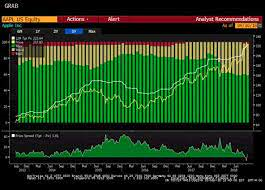
The analyst just raises their targets when they are hit.  Although analysts tend to think of price targets as a way to communicate their feelings on a stock, some investors and traders view them as a price limit for buying the stock.  Investors and traders get frustrated when analysts simply raise their price targets when stock prices reach their target. The chart below shows the stock price of Apple shares (yellow line graph) and the median twelve-month price target for Apple (white line graph).  As you can see, the two lines mirror each other, with the gaps growing during periods when the stock price has stagnated.  As indicated earlier, this may be a function of the fact that analysts are not constantly changing their targets, instead of waiting until the fundamental change is large enough to make a major move.  Often, such a move occurs when a company releases earnings or other news.  Of course, such an announcement often is associated with an increase in the company’s stock price.  Analysts try to stay ahead of the stock price, but that is not always possible when there are sudden moves.


Price targets are sticky on the downside.  Price targets typically increase over time.  If an analyst used a P/E ratio to set a price target, the price target would increase each year, assuming the company is growing earnings.  Occasionally, company fundamentals or other factors deteriorate, causing an analyst to lower high price targets.  This is certainly true in situations where a company makes a major negative announcement.  It is less true when a company’s fundamentals deteriorate slowly.  It is not unusual for an analyst’s price target to become outdated under such a scenario.

Conclusion

Price targets are a second tool (in addition to a stock’s rating) for analysts to communicate feelings about a stock’s value.  Price targets can become outdated when a stock’s price moves quickly.  However, that does not mean it is not important.  Investors and traders need to be cognizant of the limitations of using price targets for making investment decisions when making decisions regarding buying and selling stocks.  Price target changes may provide more information that the price target level.  Often, the magnitude of the change or the reasons behind the change tell a more complete picture.

Suggested Reading:

Investors Should Pay More Attention to ATM Offerings

Investment Journalists Would Make Horrific Fund Managers

Fear of Missing Out on the Next Apple

Enjoy Premium Channelchek Content at No Cost

 

Each event in our popular Virtual Road Shows Series has maximum capacity of 100 investors online. To take part, listen to and perhaps get your questions answered, see which virtual investor meeting intrigues you here.

Sources:

https://www.barrons.com/articles/wall-street-analyst-stock-price-targets-51561597085, Al Root, Barron’s, June 27, 2019

https://realmoney.thestreet.com/articles/08/03/2013/why-price-targets-matter, James Deporre, Real Money, August 3, 2013

https://www.theglobeandmail.com/globe-investor/investor-education/what-every-investor-should-know-about-analysts-price-targets/article627565/, John Heinzl, The Globe and Mail, March 29, 2012

https://financialpost.com/investing/analysts-target-prices-rarely-accurate-global-study-finds#:~:text=%E2%80%9CWe%20find%20that%20analyst%20target,subject%20to%20conflicts%20of%20interest.%E2%80%9D, David Pett, Financial Post, March 07, 2013

https://www.finra.org/rules-guidance/rulebooks/finra-rules/2241, FINRA

https://osboncapital.com/price-targets-are-obsolete-why-are-they-still-a-thing/, John Osbon, Osbon Capital Management, September 12, 2018


Kelly Services Inc. (KELYA) – Are the B Shares Telling Us Something?

Tuesday, August 25, 2020

Kelly Services Inc. (KELYA)

Are the B Shares Telling Us Something?

Kelly Services Inc is a provider of workforce solutions and consulting and staffing services. The company’s operations are divided into three business segments namely Americas Staffing, Global Talent Solutions (“GTS”) and International Staffing. It provides staffing solutions through its branch networks in Americas and International operations and also provides a suite of innovative talent fulfilment and outcome-based solutions through GTS segment. Americas Staffing generates maximum revenue from its operations.

Joe Gomes, Senior Research Analyst, Noble Capital Markets, Inc.

Refer to the full report for the price target, fundamental analysis, and rating.

    B Shares on a Tear. Since August 11th, Kelly Services’ B shares (KELYB) have traded in a range of $18 to $90, completely disconnecting from the A shares. On the 11th, the shares more than doubled to $38.28 on 494,100 shares of volume, with an additional 558,800 shares changing hands this past Friday.Yesterday the B shares closed at $35.17, with the A shares at $19.44 Historically, the A and B shares have traded in tandem with little price difference.

    What are the B Shares?  The 3.4 million outstanding B shares actually control the Company as they are the only voting shares. The Adderley Trust held 3.1 million of the B shares as of March 16, 2020, unchanged from the original Schedule 13D filing of October 19, 2018. If the Trust were to make a material change in its holding …


    Click to get the full report

This Company Sponsored Research is provided by Noble Capital Markets, Inc., a FINRA and S.E.C. registered broker-dealer (B/D).

*Analyst
certification and important disclosures included in the full report. 
NOTE: investment decisions should not be based upon the content of
this research summary.  Proper due diligence is required before
making any investment decision.
 

Will the COVID Crisis Permanently Change the Way We Work?


How Plausible is a Massive Permanent Switch to Work from Home?


The COVID-19 crisis has already caused significant changes in the way we live, from face mask regulations to social distancing, to restrictions on capacity. Many predictions have been made by the chattering class about how COVID-19 will change the way we live and work. But how plausible are some of these predictions?

One of the most common forecasts is a permanent move to “work from home” setups. Such a move enforces social distancing on employees, making wholesale disruption from another crisis less likely. From a company’s standpoint, employees working from home could reduce the amount of real estate needed, enabling firms to reduce a whole host of costs associated with owning or leasing real estate. According to the Bureau of Labor Statistics, pre-pandemic some 15% of U.S. employees had regularly scheduled work at home days, with about 25% of U.S. employees working from home at least occasionally.

Those Least Likely 

But how plausible is a massive switch to work from home? According to the Bureau of Labor Statistics, as of July 2020, there were approximately 118 million private-sector non-farm payroll jobs. Of these, some 20 million worked in the manufacturing, construction, and mining industries. Trades unlikely to see any meaningful move to “work from home.” Another 26 million jobs were in the Trade, Transportation, and Utilities segment. It wouldn’t appear many of the 5.3 million transportation jobs can be done at home. How many of the 14.8 million retail jobs can be done remotely is up to debate. How many of the 19.5 million health care jobs or the 12.6 million Leisure jobs can be performed from home? Now, some 21 million jobs are in the Professional & Business Services and Finance classifications, and its possible some portion of these jobs could be accomplished from home.

Other Challenges

But apart from the deciphering, whether a job can be performed adequately remotely, there remains a whole host of other questions. Working at your kitchen table temporarily is one thing. To do so on a full-time basis is untenable. Who pays to create office space in existing housing? Who pays to furnish such an office? What about utilities? Office supplies? Will employee collaboration be better or worse under a Zoom environment versus a face-to-face environment? How much flexibility is built into work schedules when an employee has their office in the home and can access it 24/7/365? Does a company need to alter the way productivity and performance are measured?

While a work from home reaction to a serious crisis sounds reasonable at face value, many more questions need to be answered before such a switch becomes plausible.

Suggested Reading:

Will Digital Media and Technology Stocks Take a Breather?

Can One “Do Good” and “Do Well” in Tandem?

Warren Buffett vs. Elon Musk, Who’s Right?


Enjoy Premium Channelchek Content at No Cost


Each event in our popular Virtual Road Shows Series has maximum capacity of 100 investors online. To take part, listen to and perhaps get your questions answered, see which virtual investor meeting intrigues you 
here.


Sources:

  1. https://www.politico.com/news/magazine/2020/03/19/coronavirus-effect-economy-life-society-analysis-covid-135579
  2. https://www.shrm.org/hr-today/news/hr-magazine/summer2020/pages/how-the-coronavirus-pandemic-will-change-the-way-we-work.aspx
  3. https://www.forbes.com/sites/williamarruda/2020/05/07/6-ways-covid-19-will-change-the-workplace-forever/#442ea46c323e
  4. http://www.ila-net.org/Reflections/rriggio.html?gclid=Cj0KCQjwvvj5BRDkARIsAGD9vlJMwG5tZcYVsCtBbSAN-hH-HUX_uv8ES8-mNOMe49i5ZKg7FRqUvDIaAseiEALw_wcB
  5. https://www.thedrum.com/opinion/2020/06/10/six-ways-covid-19-changing-business-the-better
  6. https://www.mckinsey.com/business-functions/risk/our-insights/covid-19-implications-for-business
  7. https://review.chicagobooth.edu/behavioral-science/2020/article/covid-19-will-change-way-we-think-risk

Onconova therapeutics ontx inspire fails what is next for onconova

Monday, August 24, 2020

Onconova Therapeutics Inc. (ONTX)

INSPIRE Fails, What is Next for Onconova?

Onconova Therapeutics Inc is a clinical-stage biopharmaceutical company operating in the US. It focuses on discovering and developing novel small molecule product candidates primarily to treat cancer. The company has created a library of targeted agents designed to work against cellular pathways important to cancer cells. Its product candidates are Single-agent IV rigosertib, Oral rigosertib + azacitidine, IV Briciclib, Recilisib, and ON 123300. The key product candidate Rigosertib is a small molecule which blocks cellular signaling by targeting RAS effector pathways.

Ahu Demir, Ph.D., Biotechnology Research Analyst, Noble Capital Markets, Inc.

Refer to the full report for the price target, fundamental analysis, and rating.

    Rigosertib fails to provide survival benefit for MDS patients. Onconova announced data from its pivotal INSPIRE study, assessing rigosertib in the 2nd-line high-risk myelodysplastic syndrome (HR-MDS) patients. The primary endpoint of overall survival was not met in this trial. The results showed that IV rigosertib plus best supportive care to physician’s choice (PC) did not provide any survival benefits in patients compared to PC alone (6.4 months versus 6.3 months (p=0.33), respectively).

    What is next for Onvonova? The results were disappointing. However, the company has the capital ($27.2 million as of June 30th, 2020) to advance other agents in…


    Click to get the full report

This Company Sponsored Research is provided by Noble Capital Markets, Inc., a FINRA and S.E.C. registered broker-dealer (B/D).

*Analyst
certification and important disclosures included in the full report. 
NOTE: investment decisions should not be based upon the content of
this research summary.  Proper due diligence is required before
making any investment decision.
 

Aurania Resources (AUIAF)(ARU:CA) – Near-Term Focus Turns to Copper

Monday, August 24, 2020

Aurania Resources (AUIAF)(ARU:CA)

Near-Term Focus Turns to Copper

As of April 24, 2020, Noble Capital Markets research on Aurania Resources is published under ticker symbols (AUIAF and ARU:CA). The price target is in USD and based on ticker symbol AUIAF. Research reports dated prior to April 24, 2020 may not follow these guidelines and could account for a variance in the price target.
Aurania Resources Ltd. is a Canada-based junior mining exploration company engaged in the identification, evaluation, acquisition, and exploration of mineral property interests, with a focus on precious metals and copper. Its flagship asset, The Lost Cities-Cutucu Project, is in southeastern Ecuador in the Province of Morona-Santiago. The company also has several minor projects in Switzerland.

Mark Reichman, Senior Research Analyst, Noble Capital Markets, Inc.

Refer to the full report for the price target, fundamental analysis, and rating.

    Scout drilling ready to commence at Tsenken copper target. Drilling is likely to begin the last week of August or the first week of September. Scout drilling will start at the Tsenken N2 target, followed by the Tsenken N3 and N1 targets. Following field mapping and soil sampling, scout drilling could also commence at Tsenken A, a fault-related breccia with high-grade copper and silver, and Tsenken B which contains sediment hosted copper and silver. We note that copper and silver have been confirmed over an area that extends 6 kilometers north from Tsenken A.

    The search for gold continues.  While we expect the company to focus on copper and silver targets during the third quarter, the epithermal gold and silver targets are located nearer to where COVID cases are more prevalent. Scout drilling at epithermal gold and silver targets could follow additional …


    Click to get the full report

This Company Sponsored Research is provided by Noble Capital Markets, Inc., a FINRA and S.E.C. registered broker-dealer (B/D).

*Analyst
certification and important disclosures included in the full report. 
NOTE: investment decisions should not be based upon the content of
this research summary.  Proper due diligence is required before
making any investment decision.
 

Gevo, Inc. (GEVO) – ATM Offering of $50 million Removes Funding Overhang

Monday, August 24, 2020

Gevo, Inc. (GEVO)

ATM Offering of $50 million Removes Funding Overhang.

Gevo Inc is a renewable chemicals and biofuels company engaged in the development and commercialization of alternatives to petroleum-based products based on isobutanol produced from renewable feedstocks. Its operating segments are the Gevo segment and the Gevo Development/Agri-Energy segment. By its segments, it is involved in research and development activities related to the future production of isobutanol, including the development of its biocatalysts, the production and sale of biojet fuel, its Retrofit process and the next generation of chemicals and biofuels that will be based on its isobutanol technology. Gevo Development/Agri-Energy is the key revenue generating segment which involves the operation of the Luverne Facility and production of ethanol, isobutanol and related products.

Poe Fratt, Senior Research Analyst, Noble Capital Markets, Inc.

Refer to the full report for the price target, fundamental analysis, and rating.

    Equity offering adds $50 million and tempers near-term funding overhang. After the strong stock price move on Thursday, the existing ATM program was tapped to issue 38.5 million shares at $1.30/share, or a 29% discount. While the total share count increases to 89.8 million, pro forma cash increases to ~$69 million.

    Likely warrant exercises could add ~$18 million and further temper near-term funding overhang. As we highlighted last week, the strong stock price move likely pushed many warrants holders to exercise early. If true, the warrant overhang would decline and pro forma cash would …


    Click to get the full report

This Company Sponsored Research is provided by Noble Capital Markets, Inc., a FINRA and S.E.C. registered broker-dealer (B/D).

*Analyst
certification and important disclosures included in the full report. 
NOTE: investment decisions should not be based upon the content of
this research summary.  Proper due diligence is required before
making any investment decision.
 

Orion Group Holdings (ORN) – Corpus Christi Accident Late Last Week

Monday, August 24, 2020

Orion Group Holdings (ORN)

Corpus Christi Accident Late Last Week

Orion Group Holdings, based in Houston, Texas, is a specialty construction company within the Marine and Industrial Construction sectors, with operations focused in the continental United States and Caribbean. Revenue is split roughly 50/50 between a Marine Construction segment that provides marine facility, pipeline and structural construction services and a Commercial Concrete segment that provides turnkey concrete services in the light commercial and structural construction markets.

Poe Fratt, Senior Research Analyst, Noble Capital Markets, Inc.

Refer to the full report for the price target, fundamental analysis, and rating.

    Tragic accident in Corpus Christi. On Friday morning, Orion’s dredging vessel Waymon L. Boyd caught fire, broke apart and sank in the Port of Corpus Christi. According to a US Coast Guard bulletin, two crew members were rescued by a MH-65 Dolphin helicopter on Friday, the bodies of two crew members were recovered on Saturday morning, and the search for other two crew members was suspended late Saturday. We hope that the injured crew members will fully recover, and we offer our condolences to families of the crew members who perished in the accident. ORN’s management team mobilized to Corpus Christi on Friday and has offered condolences and support for the employees and families impacted by this accident.

    Investigation under way. It appears that the cause of the accident has not been determined, and several state/federal agencies, including the Port of Corpus Christi, will investigate the cause of the accident. Several news sources have reported that a natural gas/propane pipeline operated by …


    Click to get the full report.

This Company Sponsored Research is provided by Noble Capital Markets, Inc., a FINRA and S.E.C. registered broker-dealer (B/D).

*Analyst certification and important disclosures included in the full report. 
NOTE: investment decisions should not be based upon the content of
this research summary.  Proper due diligence is required before
making any investment decision.
 

Are Mining Companies Facing a Shrinking Opportunity Set?


Resource Nationalism Risk When Evaluating Mining Companies


Country risk is generally a key consideration for multinational corporations as they evaluate asset portfolios and where to invest. To most, country risk connotes the stability of political regimes and policies such as taxation. The problem for mining companies is that some of the mining locations with the highest resource potential are in countries that are perceived as high-risk.  While various firms provide rankings, the Fraser Institute has conducted an annual survey since 1997 of mining and exploration companies to assess how mineral potential and public policy factors such as regulation affect exploration investment.


Investment Attractiveness Index

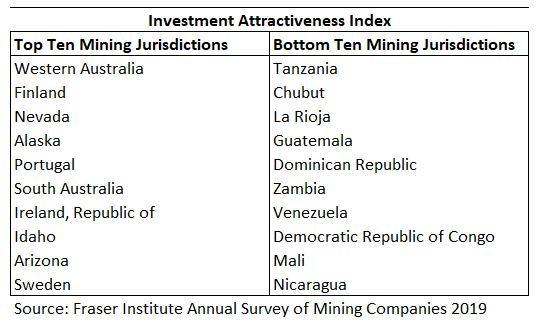
In 2019, the survey was based on 263 responses that provided enough data to evaluate 76 jurisdictions. In 2018, enough responses were generated to evaluate 91 mining jurisdictions. The investment attractiveness index reflects a jurisdiction’s mineral potential and geologic attractiveness and public policy considerations such as taxation and regulation. The table below summarizes the top ten and bottom ten rankings in the 2019 survey.


In 2019, Western Australia ranked first based on investment attractiveness, moving up from second place in 2018. Finland moved into second place after ranking 17th in 2018, while Nevada fell from first place in 2018 to third place in 2019. However, investors should keep in mind that investment attractiveness and the extent of the jurisdiction’s resource potential are not always perfectly aligned.


Mr. Warren Pearce, CEO of the Association of Mining and Exploration Companies noted that rankings have moved around substantially, reflecting a need for greater stability from government in the setting of policy and the treatment of the industry.


Take-Away

While the rankings do not tell the whole story, they are an important and informative aid not just for investors and mining company managements, but policymakers as well who are interested in making their jurisdictions more conducive to investment. Importantly, increasing environmental regulation is having an impact on the company’s investment decisions, which has partly contributed to Canada’s slip in the rankings despite stronger showings in past surveys.


Additionally, it is helpful to know which jurisdictions are moving up or down in the rankings and why. There are examples of countries, such as Ecuador, with significant mineral endowments but whose past policies discouraged investment and exploration. However, with a shift to more supportive policies, Ecuador’s ranking has improved in recent years, and those paying attention have been rewarded by gaining early entry to significant opportunities.


Suggested Reading:

U.S. Capitalism and Public Funds to Reduce Reliance on China Rare Earth Production

Metals & Mining: 2020-2Q Review and Outlook

Investors
Should Pay More Attention to ATM Offerings


Enjoy Premium Channelchek Content at No Cost

Each event in our popular Virtual Road Shows Series has a maximum capacity of 100 investors online. To take part, listen to and perhaps get your questions answered, see which virtual investor meeting intrigues you here.


Sources:

Fraser
Institute Annual Survey of Mining Companies 2019
, Fraser Institute, Ashley Stedman, Jairo Yunis, and Elmira Aliakbari, February 25, 2020.

The Best Places to Mine Are Still in the Developed World, and that’s a Problem, Reuters, Clyde Russell, March 5, 2020.

WA
Leads the World as Fraser Institute Survey Sees Australia’s Fortunes Rise
, Association of Mining and Exploration Companies, Press Release, February 26, 2020.

Picture: Abandoned Russian mining colony in Pyramiden.

Onconova Therapeutics (ONTX) – INSPIRE Fails, What is Next for Onconova?

Monday, August 24, 2020

Onconova Therapeutics Inc. (ONTX)

INSPIRE Fails, What is Next for Onconova?

Onconova Therapeutics Inc is a clinical-stage biopharmaceutical company operating in the US. It focuses on discovering and developing novel small molecule product candidates primarily to treat cancer. The company has created a library of targeted agents designed to work against cellular pathways important to cancer cells. Its product candidates are Single-agent IV rigosertib, Oral rigosertib + azacitidine, IV Briciclib, Recilisib, and ON 123300. The key product candidate Rigosertib is a small molecule which blocks cellular signaling by targeting RAS effector pathways.

Ahu Demir, Ph.D., Biotechnology Research Analyst, Noble Capital Markets, Inc.

Refer to the full report for the price target, fundamental analysis, and rating.

    Rigosertib fails to provide survival benefit for MDS patients. Onconova announced data from its pivotal INSPIRE study, assessing rigosertib in the 2nd-line high-risk myelodysplastic syndrome (HR-MDS) patients. The primary endpoint of overall survival was not met in this trial. The results showed that IV rigosertib plus best supportive care to physician’s choice (PC) did not provide any survival benefits in patients compared to PC alone (6.4 months versus 6.3 months (p=0.33), respectively).

    What is next for Onvonova? The results were disappointing. However, the company has the capital ($27.2 million as of June 30th, 2020) to advance other agents in…


    Click to get the full report

This Company Sponsored Research is provided by Noble Capital Markets, Inc., a FINRA and S.E.C. registered broker-dealer (B/D).

*Analyst
certification and important disclosures included in the full report. 
NOTE: investment decisions should not be based upon the content of
this research summary.  Proper due diligence is required before
making any investment decision.
 

The Federal Reserve and MIT are Experimenting with Digital Money


Backed by the Full Faith and Credit of Blockchain
Is the U.S. Ready for a Federal Reserve Digital Currency?


Cash may carry viruses, but computer code doesn’t.  Oh, wait a minute…

Last week The Federal Reserve discussed the research they’re undertaking to better understand the risks and benefits of central bank cryptocurrencies. I suspect risk of infection, both digital and microbic, are also being reviewed. The main considerations include speed, security, privacy, and resiliency. The task they’re undertaking in conjunction with MIT over the next several years will involve intense experimentation, modeling, and creative exploration.


Background:

According to a news release from the Federal Reserve Board of Governors, The Federal Reserve Board’s Technology Lab (TechLab) has been experimenting with crypto-currency technologies. TechLab conducts research that now includes the exchange or use of existing cryptocurrencies. Their activities are designed to further the Fed’s understanding of payment technologies so they may better develop views and policies. TechLab is composed of people with varied experience in the field of exchange mediums,  economics, law, information technology, and computer science.

It is the position of the Fed’s Board of Governors that it is essential, “given the (U.S.) dollars important role” that the Federal Reserve remains on the forefront of research and policy development regarding central bank digital currencies(CBDC). “Like other central banks, we are continuing to assess the opportunities and challenges of, as well as the use for, a digital currency, as a complement to cash and other payment options,” said Federal Reserve Board Governor Lael Brainard.

In addition, the Federal Reserve Bank of Boston is collaborating with researchers at the Massachusetts Institute of Technology (MIT) on a multiyear effort to build a hypothetical digital currency for central bank use. This project is intended to support the Fed Board’s broader efforts in assessing safety and efficiency of digital currency systems overseen by central banks. The project with MIT is said to focus on developing an understanding of the capacities and limitations of the technologies. It is not supposed to
serve as a prototype
for a Fed issued digital currency.


Federal Reserve Boston:

The Federal Reserve Bank of Boston’s multiyear collaboration with the Digital Currency Initiative at MIT will explore the use of existing and new technologies to build and test a hypothetical digital currency platform.

“We are thrilled to be working with the Digital Currency Initiative at MIT and our colleagues in the Federal Reserve System to learn the intricacies of building a CBDC platform,” said Boston Fed President and CEO Eric Rosengren. “Jim Cunha is leading our team here in Boston, and I know they are committed to researching and testing the leading technologies available to determine if they can meet the design requirements of a U.S. based central bank digital currency.”

The Boston Fed and MIT have mapped out their collaboration into work phases that extend over two to three years. The first phase involves jointly building and testing a hypothetical central bank digital currency (CBDC). The first phase objective is to determine how to develop the architecture for a scalable, accessible cryptographic platform able to meet the needs of a U.S. dollar CBDC.  Design considerations include stringent requirements for speed, security, privacy, and flexibility.

In later phases, researchers will assess technology trade-offs by coding and testing various architectures, to see how they impact the CBDC’s design goals. The research results will be published jointly with MIT, and the code would be licensed as open-source software, so anyone can use or continue experimenting.

Separately the Boston Fed will evaluate other systems to better comprehend the pros and cons in supporting a CBDC.


MIT Digital Currency Initiative:

The MIT Digital Currency Initiative’s (DCI) collaboration with the Federal Reserve Bank of Boston to build a hypothetical digital currency brings additional expertise and a “laboratory” to the project.

The DCI has a lab which, according to their website, includes as their goals:

  1. Conduct research on blockchain and digital currency, broadly defined within two categories:
      1. Core software and infrastructure development that addresses questions about security, stability, scalability, privacy, and the internal economics of these systems
      2. Pilot projects and other research initiatives aimed at exploring and testing applications and use cases for the technology within business, government and society at large.
  2. Be a neutral convener for governments, nonprofits, and the private sector to research and test concepts with high social impact.
  3. Foster diversity and inclusion in the development and adoption of this technology by promoting access to educational resources among a wider body of students inside and outside MIT.
  4. Equip students with skills to drive innovation in blockchain technology


They are at the forefront offering classes and labs in blockchain, cryptocurrencies, and markets. A short (six week) class is available online.


Take-Away

Technological innovations inspire new ways to think about money. Consistent with its role in promoting a safe, accessible, and efficient U.S. payment system, the Federal Reserve is engaging in research and experimentation with the latest payment technologies. As with most things in a rapidly changing world, methods of exchange are also in flux.  Payment systems overseen by the U.S. Federal Reserve system need to be attuned to what tomorrow may bring. Researching the strengths and weaknesses in a potential digital currency in advance can help avoid any ill-informed decisions down the road.

The Federal Reserve also continues its collaboration with other central banks and international organizations as it advances their understanding of CBDCs. The acceptance of cryptocurrencies is now so widespread that top schools like MIT offer educational programs in the technology, economics, and law associated with the non-cash currency.

 After reviewing the brochure for the six-week online DCI class at MIT, I learned that the online course is $2,600. It lists various payment methods. You can pay via credit card, debit card, bank deposit, or EFT. At the moment, cryptocurrency payers need not apply.

Paul Hoffman

Managing Editor


Suggested Reading:

How Well Do You Know
Fintech?

Investment Barriers
Once Thought Insurmountable are Falling Fast

Cryptocurrency and the Howey Test: Are They Securities?


Enjoy the Benefits of Premium Channelchek
Content
 at No Cost


The Federal Reserve Bank of Boston announces collaboration with MIT to research digital currency

MIT Media Lab CRYPTOCURRENCY

MIT Lab Online Short Course Cryptocurrency

Does Money Carry Germs

https://dci.mit.edu/

Gevo, Inc. (GEVO) – Supply Portfolio Doubles and Industry Player Added

Friday, August 21, 2020

Gevo, Inc. (GEVO)

Supply Portfolio Doubles and Industry Player Added

Gevo Inc is a renewable chemicals and biofuels company engaged in the development and commercialization of alternatives to petroleum-based products based on isobutanol produced from renewable feedstocks. Its operating segments are the Gevo segment and the Gevo Development/Agri-Energy segment. By its segments, it is involved in research and development activities related to the future production of isobutanol, including the development of its biocatalysts, the production and sale of biojet fuel, its Retrofit process and the next generation of chemicals and biofuels that will be based on its isobutanol technology. Gevo Development/Agri-Energy is the key revenue generating segment which involves the operation of the Luverne Facility and production of ethanol, isobutanol and related products.

Poe Fratt, Senior Research Analyst, Noble Capital Markets, Inc.

Refer to the full report for the price target, fundamental analysis, and rating.

    Largest contract signed to date. Addition of major industry player adds credibility to renewable fuel concept. Yesterday morning, Gevo announced that a supply agreement for 25 million gallons/year (MPGY) was signed with a subsidiaryof Trafigura Group. The contract is the largest in Gevo’s history to date. Not only does the supply portfolio more than double to 42 MPGY, it moves the revenue potential above $1.5 billion. Trafigura’s leading position as a global commodity trader validates the technology and business strategy.

    Licensing strategy also moving forward.  Earlier, a license agreement with Praj Industries Ltd. was signed to develop renewable transportation fuels in India. The collaboration is driven by carbon emission targets and national strategic goals, including …


    Click to get the full report

This Company Sponsored Research is provided by Noble Capital Markets, Inc., a FINRA and S.E.C. registered broker-dealer (B/D).

*Analyst
certification and important disclosures included in the full report. 
NOTE: investment decisions should not be based upon the content of
this research summary.  Proper due diligence is required before
making any investment decision.
 

Great Lakes Dredge & Dock (GLDD) – New and upcoming awards support 2H2020 backlog rebound

Friday, August 21, 2020

Great Lakes Dredge & Dock (GLDD)

New and upcoming awards support 2H2020 backlog rebound

Great Lakes Dredge & Dock Corp is a provider of dredging services in the United States. The company only’s operating segments is Dredging. Dredging involves the enhancement or preservation of navigability of waterways or the protection of shorelines through the removal or replenishment of soil, sand or rock. Its projects portfolio includes Coastal Restoration, Coastal Protection, Port expansion, and others.

Poe Fratt, Senior Research Analyst, Noble Capital Markets, Inc.

Refer to the full report for the price target, fundamental analysis, and rating.

    New awards of $118 million are positive. After the market closed, several additional large awards were announced. The awards on six projects include four Maintenance for $78.6 million and two Coastal Protection for $39.2 million. While ~$48 million of the awards were discussed on the 2Q2020 earnings call, there were several new awards, including the Mississippi River work, that support our constructive view. In addition, there are other low bids pending award outstanding, including a low bid of $15.5 million on work at Freeport (TX) Harbor that was opened on August 10th.

    News expected shortly on several large opportunities and Jacksonville C in 3Q/4Q2020. 2H2020 rebound backlog appears likely. While backlog dropped for the third consecutive quarter in 2Q2020, a rebound is expected in 2H2020 due to the announced awards and several upcoming opportunities. Two larger opportunities in Louisiana remain on the immediate horizon, and Jacksonville C is still on track for …


    Click to get the full report.

This Company Sponsored Research is provided by Noble Capital Markets, Inc., a FINRA and S.E.C. registered broker-dealer (B/D).

*Analyst
certification and important disclosures included in the full report. 
NOTE: investment decisions should not be based upon the content of
this research summary.  Proper due diligence is required before
making any investment decision.
 

SPAC Activity Accelerating in 2020


SPAC Candidates, Blank Checks, and Leaving More to Investors

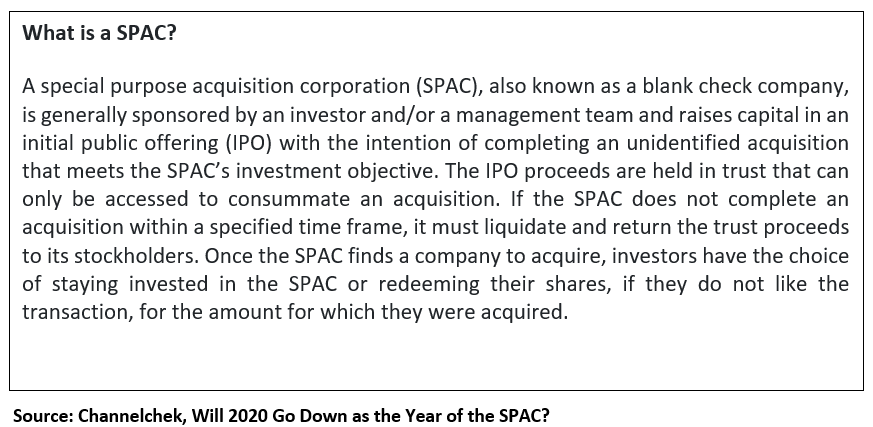
Former House Speaker Paul Ryan knows a lot about being a candidate. The former Speaker of The House was Mitt Romney’s vice-presidential running mate. He won elections for The House of Representatives eight times by defeating challenger Jeffrey C. Thomas in 2000, 2002, 2004, and 2006 elections. In the 2008 election, Ryan defeated Democrat Marge Krupp. He just announced he’s creating a special purpose acquisition company (SPAC). The IPO shell will be among the latest in the torrent of SPACS popping up this year. Paul Ryan will soon be aggressively looking for an acquisition candidate as part of his newly formed business.


Organization of the SPAC

Ryan is expected to serve as chairman of the soon to be formed Executive Network Partnering Corp. (ENPC).  ENPC will look to attract roughly $300 million in an initial public offering (based on demand).


The new vehicle’s ticker symbol will be ENPC. Relative to traditional shell IPO vehicles, ENPC will provide longer-term incentives for its stakeholders and scaled-down fees for underwriters. Founders of ENPC won’t be permitted to sell any of their shares for three years after any merger. Similar vehicles allow for sale when shares trade above a certain level or after a year from closing.


SEC Filing

ENPC is expected to file documents with the Securities and Exchange Commission in the coming days. This filing will outline the structure specifics. They’ve chosen the acronym CAPS to refer to the vehicle whose terms are supposed to be more investor-focused. The underlying reason for choosing “CAPS” is it is a palindrome for SPAC and can mean “capital which aligns and partners with a sponsor.”


More Competitive

Management competence and what their experience brings to getting a worthwhile deal completed is the main component investors look for when investing in this form of IPO. Terms are also high on the list of what should be analyzed before any monetary commitment.


Typically, SPAC founders are awarded shares equivalent to roughly 25% of what is raised when the initial IPO closes. As you might imagine, that becomes an above-average payday for their efforts. Under the expected ENPC terms, Ryan and the other creators will have the right to buy roughly 5% of the shares and then reap another 20% of the stock appreciation if share price increases by more than 10%.


They also plan to slash fees to Wall Street banking organizations. Evercore Inc. is the sole underwriter of the blank-check fund. They agreed to be paid 1% of the size of the vehicle; this is half of the usual 2% upfront of other SPACs. When a merger deal is struck, the same underwriters typically receive another 3.5%. With Paul Ryan’s SPAC, Evercore will get a separate, smaller advisory payment. ENPC is free to work with other advisers on any subsequent merger deal.


The Year of the SPAC

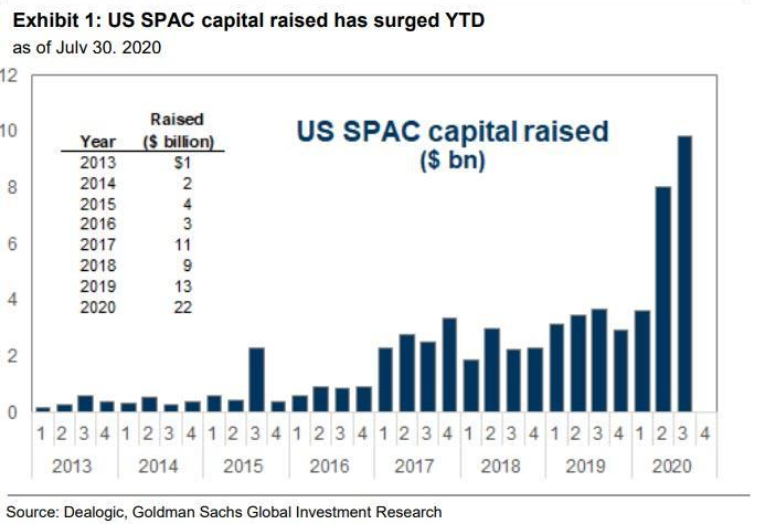
So far, in 2020, 75 new SPACs have been listed, with a total raised adding to $29.9 billion.  This is more than twice what was raised during all of last year. There is no telling when or why this pace may begin to slow, but over the past eight months, SPACs have already attained the highest volume ever in one year.  They have accounted for approximately 43% of IPO volume in 2020.


Earlier this Summer hedge fund billionaire William Ackman raised $4 billion for the largest SPAC ever created.  Last month, health-care-services provider MultiPlan, Inc. announced it was merging with a blank-check company run by Michael Klein in the largest transaction ever at $11 billion.  


Take-Away

The appetite for investors eligible to participate in a SPAC is still very high. The sheer number of “blank check” companies being formed is starting to push their founders to provide more to investors and negotiate better deals with banks and other service providers and consultants. “Big names,” including Paul Ryan, who sits on the board of FOX Corp., which owns The Wall Street Journal and other large media outlets, help bring attention to their intended deals.


Suggested Reading:

Special Purpose Acquisition Corporations (SPAC) Attracting Investors

Can AI Skyborg Technology Create Unpredictable Yet Consistent Military Aircraft?

Are Dual Class Stocks a Mistake for Investors?


Each event in our popular Virtual Road Shows Series has maximum capacity of 100 investors online. To take part, listen to and perhaps get your questions answered, see which virtual investor meeting intrigues you here.


Sources:

Will 2020 Go Down as the Year of the SPAC?

https://en.wikipedia.org/wiki/Paul_Ryan

Paul Ryan Becomes Board Member of FOX News Corp.

Former
House Speaker Ryan to Chair Blank Check Company

Wall Street Banks Are Cashing in on the Boom in Blank-Check Companies