Energy Stock Price Moves Have Led to Higher Dividend Yields


Dividends and the Appeal of Energy Stocks


Energy stocks have had a tough 2020.  The Energy Select Sector SPDR (XLE) is down 46% in 2020 versus a 5% increase in the S&P 500 Composite Index.  The decline has meant that many energy stocks now offer dividend yields above 5%, an attractive rate compared to low bond yields.  Energy stocks have always been a volatile group subject to the cyclicality associated with energy price booms and busts.  Clearly, we are in the middle of a bust cycle with West Texas Intermediate (WTI) oil prices having fallen 40% year to date.  The cure to a bust cycle comes when producers stop drilling so that supply and demand realign, and energy prices rise.  For energy companies able to withstand short-term cash flow issues, management will often maintain existing dividend levels in anticipation of improving cash flow.  That seems to be the case for energy companies like Chevron and Exxon Mobil, which have maintained their dividend and currently have dividend yields of 6% and 9%, respectively.  Other energy companies such as Royal Dutch Shell and BP Amoco have decided to cut their dividend and put that capital into developing renewable assets and other non-energy investments.

The different paths taken by the major oil companies has profound implications for investors.  If the drop in energy prices is part of a normal boom/bust cycle created over drilling, high-dividend-yielding energy stocks are attractive investments.  Many of the high-yield energy companies have ample liquidity and strong balance sheets that will allow them to maintain dividend levels for many years of low energy prices. The high yield, combined with the prospect of a rising stock price associated with the end of the bust cycle, could provide investors with large total returns. If, on the other hand, lower energy prices reflect a fundamental shift in oil prices, these stocks may ultimately be forced to throw in the towel and cut the dividend.  Those companies will be behind their competitors in shifting their attention towards other investments.


The case for energy stocks

  • Supply is responding.  Drilling in the United States, which is the largest producer of oil, has screeched to a halt.  Baker Hughes reports that there were 254 rigs drilling in the United States as of September 11, 2020.  That is down from 886 rigs from a year ago.  The Energy (EIA) reports that U.S. crude oil production is down to 10,000 barrels per day from a level of 13,000 BPD at the beginning of the year.
  • Bankruptcies are increasing.  Drilling that was lost due to companies reducing capital expenditures will return if oil prices improve.  Drilling associated with companies that have declared bankruptcy will not return quickly.  Haynes and Boone report a steady increase in the number of energy company bankruptcies since 2019 in response to lower energy prices.
  • Demand will respond when the pandemic passes.  Part of the loss of energy demand is associated with weak global economic conditions due to COVID – 19.  As the spread of the virus abates through the development of a vaccine, it is reasonable to believe that the demand for oil will return.
  • High returns can be made in a declining
    industry.
      Charles Sizemore, chief investment officer of Sizemore Capital Management, compared the industry to the tobacco industry of 20 to 30 years ago.  Tobacco stocks provided strong returns to investors even as the industry shrank as the larger players maintained their dividends and acquired smaller players.


The case against energy stocks

  • Demand is fundamentally changing.  Unlike past energy price cycles, this bust cycle is being caused by a fundamental shift in consumer habits that do not favor oil.  The growth in renewable energy has decreased the demand for oil to power generators.  The growth in electric vehicles could represent a similar shift away from oil demand to produce gasoline.  Business airline travel and daily commuting may never be the same as the world shifts towards video conferencing and away from in-person sales.
  • Supply is fundamentally changing.  The cost of producing oil has become less expensive due to technological improvements in drilling and extraction.  OPEC and its allies realize that the shale boom in the United States will not go away at oil prices above $50/BBL and has increased production even though it knows that will drive oil prices lower.  Saudi Arabia has shown a new willingness to punish its allies that do not comply with production reduction targets.


Conclusion

As is usually the case, the truth probably lies somewhere in the middle.  There have been fundamental changes in both the supply and demand sides of the energy equation.  At the same time, temporary, abnormal events have amplified the impact of fundamental changes on energy pricing.  We anticipate improved oil prices but do not hold out much hope for a return to the days of oil prices above $60 per BBL.


Suggested Content:

Is
American Energy Dominance Relying on Immaculate Areas?

InPlay Oil C-Suite Series (Video)

Natural
Gas Storage Imbalances and Higher Prices


Subscribe to Channelchek’s YouTube Channel

Each event in our popular Virtual Road Shows Series has a maximum capacity of 100 investors online. To take part, listen to and perhaps get your questions answered, see which virtual investor meeting intrigues you here.


Source:

https://www.inquirer.com/business/dividends-yields-10-year-treasury-etf-vanguard-pimco-20200309.html, Erin Arvedlund, March 9, 2020

https://finance.yahoo.com/news/big-oil-goes-looking-career-040154761.html, Javier Blas, Bloomberg, September 14, 2020

https://money.usnews.com/investing/stock-market-news/slideshows/the-best-energy-stocks-to-buy-this-year, Ellen Chang, U.S. News, August 4, 2020

https://www.haynesboone.com/-/media/Files/Energy_Bankruptcy_Reports/Oil_Patch_Bankruptcy_Monitor, Haynes and Boone, August 31, 2020


Comstock Mining (LODE) – Completes Sale of Lucerne While Retaining Economic Exposure

Tuesday, September 15, 2020

Comstock Mining (LODE)

Completes Sale of Lucerne While Retaining Economic Exposure

Comstock Mining Inc is a mining company with a focus on gold and silver deposits in the Comstock and Silver City mining districts in Nevada. Its operations are divided into two segments, namely mining and real estate. Its mining projects include The Lucerne Resource area, the Dayton Resource area, the Spring Valley exploration target, the Northern Extension, Northern Targets and Occidental areas. The Real Estate segment involves land, real estate rental properties and a hotel, restaurant & bar provided by the Gold Hill Hotel located in Gold Hill, Nevada just south of Virginia City and the Daney Ranch, located just south of Silver City. The majority revenues are generated from the real estate segment.

Mark Reichman, Senior Research Analyst, Noble Capital Markets, Inc.

Refer to the full report for the price target, fundamental analysis, and rating.

    Sale of Lucerne completed. Comstock Mining closed the sale of its Lucerne property to Tonogold Resources, Inc. (OTC: TNGL, Not Rated). Consideration, much of which has been realized, includes $7.1 million in cash, $6.1 million in convertible preferred stock, and a $4.475 million, 12% notes receivable that is due and payable on September 20, 2021. Tonogold assumed $6.7 million in future lease and reclamation obligations.

    Sharing in Lucerne’s success.  Comstock retained a 1.5% net smelter return (NSR) royalty on Lucerne and a lease option agreement for Tonogold to use Comstock’s American Flat processing facility to process material from the mine which could generate additional revenue assuming the mine goes into production. Therefore, Comstock is able to share in the success of a project that is being funded and …


This Company Sponsored Research is provided by Noble Capital Markets, Inc., a FINRA and S.E.C. registered broker-dealer (B/D).

*Analyst certification and important disclosures included in the full report. NOTE: investment decisions should not be based upon the content of this research summary.  Proper due diligence is required before making any investment decision. 

Eagle Bulk Shipping (EGLE) – CEO Interview Highlights Active Management Strategy and Fleet Renewal Program

Tuesday, September 15, 2020

Eagle Bulk Shipping (EGLE)

CEO Interview Highlights Active Management Strategy and Fleet Renewal Program.

Eagle Bulk Shipping Inc. is a US-based drybulk owner-operator focused on the Supramax/Ultramax mid-size asset class, which ranges from 50,000 and 65,000 deadweight tons in size; these vessels are equipped with onboard cranes allowing for the self-loading and unloading of cargoes, a feature which distinguishes them from the larger classes of drybulk vessels and provides for greatly enhanced flexibility and versatility- both with respect to cargo diversity and port accessibility. The Company transports a broad range of major and minor bulk cargoes around the world, including coal, grain, ore, pet coke, cement, and fertilizer. Eagle operates out of three offices, Stamford (headquarters), Singapore, and Hamburg, and performs all aspects of vessel management in-house including: commercial, operational, technical, and strategic.

Poe Fratt, Senior Research Analyst, Noble Capital Markets, Inc.

Refer to the full report for the price target, fundamental analysis, and rating.

    Recent CEO Interview focused on the active fleet management strategy, fleet renewal program and solid financial position. Strong corporate governance was also highlighted as a positive. Investors can review the full interview with CEO Gary Vogel, including Q&A, on our research portal at channelchek.com.

    The active fleet management, or cargo-centric, strategy embraces dry bulk market volatility to generate TCE outperformance and temper periodic weakness. Versus the adjusted BSI index, the active fleet management strategy has generated above average TCE rates and created ~$37 million of incremental EBITDA over the past year.

    Fleet renewal program is ongoing.  The sale of Goldeneye, an 18-year old Supramax, improved the fleet profile and generated proceeds of $5 million. Also, the scrubber program enhanced the fleet and adds a potential competitive advantage if fuel spreads widen again …


This research is provided by Noble Capital Markets, Inc., a FINRA and S.E.C. registered broker-dealer (B/D).

*Analyst certification and important disclosures included in the full report. NOTE: investment decisions should not be based upon the content of this research summary.  Proper due diligence is required before making any investment decision. 

Release – Novus Therapeutics Announces Acquisition of Anelixis Therapeutics


Novus Therapeutics Announces Acquisition of Anelixis Therapeutics


Acquisition includes lead clinical-stage compound AT-1501, a next generation anti-CD40L antibody, in development for organ and cellular transplantation, autoimmune diseases, and neurodegenerative diseases

Senior management team with extensive drug development and commercialization experience, including Dr. David-Alexandre “DA” C. Gros as CEO and Dr. Steven Perrin as President and CSO, to lead Novus

Company completes private placement financing with proceeds of $108 million to be used to advance AT-1501 Phase 2 clinical trials in up to four indications

Conference call tomorrow at 8:30 a.m. EDT


IRVINE, Calif. & BOSTON–(BUSINESS WIRE)–Sep. 14, 2020– Novus Therapeutics, Inc. (“Novus”) (NASDAQ: NVUS) today announced it has completed the acquisition of Anelixis Therapeutics, Inc. (“Anelixis”), a privately held clinical stage biotechnology company developing a next generation anti-CD40 Ligand (CD40L) antibody as a potential treatment for organ and cellular transplantation, autoimmune diseases, and neurodegenerative diseases. Concurrent with the acquisition of Anelixis, Novus entered into a definitive agreement for the sale of non-voting convertible preferred stock (the “Preferred Stock”) in a private placement to a group of institutional accredited investors led by BVF Partners L.P., with participation from Cormorant Asset Management, Ecor1 Capital, Logos Capital, Fidelity Management and Research Company, Adage Capital Partners L.P., Woodline Partners LP, Ridgeback Capital, Janus Henderson Investors, and Samsara BioCapital, as well as additional investors. The private placement is expected to result in gross proceeds to Novus of approximately $108 million before deducting placement agent and other offering expenses. The proceeds from the private placement will be used to fund the Company’s operations, including to advance Phase 2 clinical trials of AT-1501, a humanized IgG1 anti-CD40L antibody with high affinity for CD40L, in renal transplantation, islet cell transplantation, autoimmune nephritis, and amyotrophic lateral sclerosis (ALS).

“We are excited about AT-1501 and the potential to develop and commercialize the next generation anti-CD40L antibody, a well-validated target with broad therapeutic possibilities,” said Keith A. Katkin, Chairman of the Board of Directors of Novus. “After exploring a range of strategic options to maximize shareholder value, we believe this acquisition represents the greatest value creation opportunity for Novus stockholders, and we are confident that we have the management and scientific leadership team to fully realize this opportunity for patients in need of new treatment options.”

Leadership & Organization

In addition to the strategic acquisition and private placement, Novus announced its Board of Directors has previously appointed David-Alexandre “DA” C. Gros, M.D. to serve as Chief Executive Officer and Director. Dr. Gros joins Novus from Imbria Pharmaceuticals Inc., where he served as Co-Founder, Chief Executive Officer and Director. Prior to Imbria, Dr. Gros was President and Chief Operating Officer of Neurocrine Biosciences, Inc., Chief Business and Principal Financial Officer of Alnylam Pharmaceuticals, Inc., and Chief Strategy Officer of Sanofi, S.A. Before Sanofi, Dr. Gros held leadership positions in healthcare investment banking at Centerview Partners, LLC, and Merrill Lynch, Pierce, Fenner & Smith, Inc., and in healthcare consulting at McKinsey & Company. Dr. Gros earned a Doctor of Medicine from Johns Hopkins University School of Medicine, a Master of Business Administration from Harvard Business School, and a Bachelor of Arts from Dartmouth College.

“I am both thrilled and humbled to join the Novus management team and Board during this new phase of the company’s evolution, as we prepare to initiate multiple Phase 2 trials for AT-1501” said Dr. Gros. “Through this acquisition and financing, we now have the scientific, organizational and financial resources to build upon a deep historical understanding of the CD40/CD40L pathway, as well as Anelixis’ preclinical and Phase 1 data, to address the needs of people undergoing organ or cellular transplantation, or living with autoimmune and neurodegenerative diseases.”

Joining Dr. Gros on the Novus management team and Board of Directors is Steven Perrin, Ph.D., Founder and Chief Executive Officer of Anelixis, who will take on the role of President and Chief Scientific Officer. Dr. Perrin brings 20 years of drug development experience to Novus, having held R&D positions at the Hoechst-Ariad Genomics Center, Aventis Pharmaceuticals, Inc., and Biogen Idec, Inc. Over the past decade, Dr. Perrin has worked with the ALS Therapy Development Institute to develop the world’s largest ALS drug development program, bridging preclinical and clinical programs. Dr. Perrin received a Ph.D. in biochemistry from Boston University Medical Center, where he also started his career as Associate Professor of Medicine, and a Bachelor of Science from Boston College.

“The activation of CD40/CD40L signaling is critical to mediating antibody and cellular inflammatory response. We are developing antibodies to inhibit the activation of this pathway with the hope of offering new treatment modalities for people living with conditions such as autoimmune nephritis and ALS, or those requiring a potentially life-saving transplant,” said Dr. Perrin. “I have dedicated my career to developing better medicines for these patients and their families, and I look forward to working with the team to advance these clinical programs.”

Concurrent with the acquisition, former Anelixis Chairman of the Board Walter Ogier has been appointed to the Novus Board of Directors. Mr. Ogier has more than 30 years of experience developing therapeutic medical products ranging from pharmaceuticals to medical devices, stem and immune cell therapies, and gene therapies. He has served in multiple CEO roles including Genetix Pharmaceuticals, Inc. (now bluebird bio, Inc.) and Acetylon Pharmaceuticals, Inc., which Celgene Corporation acquired in 2016. In addition to Novus, he serves as a director of Biothera Pharmaceuticals, Inc., Thetis Pharmaceuticals, LLC, and Nemucore Medical Innovations, Inc., and as Board advisor to Kodikaz Therapeutic Solutions, Inc., and ME Therapeutics, Inc.

Novus Board members will also include Keith A. Katkin, Chairman of the Board; Gary A. Lyons; and John S. McBride. The company will continue to maintain its executive offices in Irvine, Calif. and will have research and development facilities in Boston, Mass.

About the Transactions

The acquisition of Anelixis was structured as a stock-for-stock transaction whereby all of Anelixis’ outstanding equity interests were exchanged in a merger for a combination of shares of Novus common stock and shares of Preferred Stock. Concurrently with the acquisition of Anelixis, Novus entered into definitive agreements for a PIPE investment with existing and new investors to raise approximately $108 million in which the investors will be issued shares of Preferred Stock at a price of approximately $500 per share (or, $0.50 per share on an as-converted-to-common basis). The PIPE offering is expected to close on September 14, 2020. Subject to stockholder approval, each share of Preferred Stock will, at the option of the holder, be convertible into 1,000 shares of common stock, subject to certain beneficial ownership limitations set by each holder. The acquisition was approved by the Board of Directors of Novus and the equity holders of Anelixis.

Ladenburg Thalmann & Co. Inc. is serving as exclusive financial advisor and Gibson, Dunn & Crutcher LLP is serving as legal counsel to Novus. Goodwin Procter LLP is serving as legal counsel to Anelixis. SVB Leerink is serving as financial advisor and lead placement agent for the private placement, and Noble Life Science Partners, a division of Noble Capital Markets, Inc., is acting as co-placement agent.

Additional details are available in an updated corporate presentation that can be found online at www.novustherapeutics.com.

Webcast Details

Novus will host an audio webcast on Tuesday, September 15, 2020, at 8:30 a.m. EDT to discuss the acquisition. The live audio webcast will be accessible through a direct link and the investor section of www.novustherapeutics.com. To access via phone, please dial (833) 614-1390 (toll-free) or (914) 987-7111 (international) and provide the conference ID 4046285. Please visit the investor section of the Novus website at www.novustherapeutics.com for the archived webcast and for more information on the acquisition.

About AT-1501

AT-1501 is a humanized IgG1 anti-CD40L antibody with high affinity for CD40L, a well-validated target with broad therapeutic potential. The CD40/CD40L pathway plays a central role in generating pro-inflammatory responses in autoimmune disease, allograft transplant rejection, and neuroinflammation. In a Phase 1 safety study of healthy volunteers and patients with ALS, AT-1501 was well tolerated at all doses tested.

About Novus Therapeutics

Novus Therapeutics, Inc. is a clinical stage biotechnology company using its expertise in targeting the CD40L pathway to develop potential treatments for people requiring an organ or cell-based transplant, and for people with autoimmune and neurodegenerative disease. Novus is headquartered in Irvine, Calif. For more information, please visit the company’s website at www.novustherapeutics.com.

Follow Novus Therapeutics on social media: @Novus_Thera and LinkedIn.

Notice of Issuance of Inducement Grants

Pursuant to their employment agreements, Drs. Gros and Perrin have been awarded options to purchase a total of 18,279 and 7,857 shares of Preferred Stock, respectively, subject to time-based vesting (the “Inducement Grants”). The Inducement Grants have an exercise price of $500 per share of Preferred Stock, which is equal to the price at which the Preferred Stock is being offered and sold in the PIPE financing and represents (on an as-converted basis) a premium of approximately 30% over the last reported closing price of the Novus common stock prior to grant. The Inducement Grants have been approved by the Novus Board of Directors and the Compensation Committee of the Board of Directors. The Inducement Grants will be issued outside of the Company’s stockholder-approved equity incentive plans as an inducement grant in accordance with Nasdaq Listing Rule 5635(c)(4).

Forward-Looking Statements

This press release contains forward-looking statements that involves substantial risks and uncertainties. Any statements about the company’s future expectations, plans and prospects, including statements about its strategy, future operations, development of its product candidates, and other statements containing the words “believes,” “anticipates,” “plans,” “expects,” “estimates,” “intends,” “predicts,” “projects,” “targets,” “looks forward,” “could,” “may,” and similar expressions, constitute forward-looking statements within the meaning of the Private Securities Litigation Reform Act of 1995, although not all forward-looking statements include such identifying words. Forward-looking statements include, but are not limited to statements regarding: risks related to market conditions; expectations regarding the timing for the commencement of future clinical trials; expectations regarding the success of clinical trials; the rate and degree of market acceptance and clinical utility of the company’s products; the company’s estimates regarding expenses and cash runway; and the impact of the ongoing coronavirus pandemic. Actual results may differ materially from those indicated by such forward-looking statements as a result of various factors. These risks and uncertainties, as well as other risks and uncertainties that could cause the company’s actual results to differ significantly from the forward-looking statements contained herein, are discussed in our quarterly 10-Q, annual 10-K, and other filings with the SEC, which can be found at www.sec.gov. Any forward-looking statements contained in this press release speak only as of the date hereof and not of any future date, and the company expressly disclaims any intent to update any forward-looking statements, whether as a result of new information, future events or otherwise.

View source version on businesswire.com: https://www.businesswire.com/news/home/20200914005852/en/

Amanda Sellers
[email protected]
301.332.5574

Source: Novus Therapeutics, Inc.

 

Defense Spending in the Crosshairs


Can the U.S. Continue to Afford the Current Level of Defense Spending?


According to the Stockholm International Peace Research Institute, the level of spending by the U.S. Department of Defense is similar in size to the next ten largest nations’ combined annual military spending and is larger than all but two dozen countries’ GDP. The U.S. Department of Defense budget will be near $700 billion in 2021. And this figure does not include many items, such as the $243 billion estimated to be spent on veterans. The U.S currently accounts for approximately 36% of the world’s defense expenditures. Presently the DoD budget represents one-half of all Federal government discretionary spending. Can the U.S. continue to afford this level of defense spending?

Budget Breakdown

Spending at the DoD actually accounts for only a portion, albeit the largest portion, of spending on “security” for the U.S. Expenditures at the Department of Homeland Security and Veterans Administration, as well as other agencies, are related but are not part of the DoD budget. The DoD budget can be divided into two key parts: base spending and Overseas Contingency Operations (OCO), which originated as a means of funding wars outside of the base budget. In 2020, the DoD budget authorization was $721.5 billion and included $69 billion of OCO spending. OCO spending has its critics, as over the years both Congress and the President have at times adopted more, and at times less, expansive definitions of OCO expenditures to accommodate the strategic, budgetary, and political needs of the moment. What is notable, however, is that since FY2001, DoD funding designated for OCO has averaged 17% of the department’s total budget authority, up from just 6% during the conflict in Vietnam.

The budget can be further broken out into its constituent parts. There are four main areas of spending: military personnel, which accounted for about 20% of the 2020 budget, although if you include benefits and the costs of civilians of the military payroll, this increases to over 39%, Operations and Maintenance, 40%, Procurement, 21%, and Research & Development, 14%. Unless the number of active duty members shrinks, it is unlikely that personnel costs decline. Weapons systems are more and more complex, use exotic materials, and must be able to function in environments like outer space. Could be another area tough to find budget savings. R&D is similar as researchers continue to need to seek out cutting edge technologies and weapons systems in order to stay ahead of the U.S’s peer adversaries.

Room for Reductions

Cutting the DoD budget has proven difficult over time. One only needs to revisit base closures to see how potential cost-cutting can be held back by political considerations. Obviously, a quick way to reduce the cost of defense would be to end the spending that drives OCO expenditures. Some of this is for funding the wars on terror and some for other causes, but in terms of just reducing current spending, this would be a quick means.

Take-Away

Looking at history, one can see that over time, with a couple of brief exceptions, defense spending has been on a rising trend since 1950, when the DoD budget was just over $100 billion in 2019 dollars to where we are today. However, as a percentage of GDP, 2020 Defense spending will be around 3.3% of normalized (i.e., non-COVID) GDP, a level well below the 4-6% of GDP range for most of the past 40 years.


 Suggested Reading:

A.I. and Skyborg Will Create Huge Tech Winners

Unmanned Momentum Continues with Recent $35 Million Award

Virtual Power Plants and Tesla Car Batteries


Enjoy Premium Channelchek Content at No Cost


Each event in our popular Virtual Road Shows Series has a maximum capacity of 100 online investors. To take part, listen to and perhaps get your questions answered, see which virtual investor meeting intrigues you here.


 

Sources:

https://www.pgpf.org/sites/default/files/0053_defense-comparison.pdf

https://www.mapsofworld.com/answers/defence/top-10-countries-with-largest-armies/

https://en.wikipedia.org/wiki/United_States_Armed_Forces

https://www.americanprogress.org/issues/security/reports/2020/05/06/484620/pentagons-fiscal-year-2021-budget-meets-u-s-national-security-needs/

https://breakingdefense.com/2020/09/heritage-to-congress-pass-a-defense-appropriations-bill/

https://www.heritage.org/sites/default/files/2019-08/IB4992.pdf

https://fas.org/sgp/crs/natsec/R44519.pdf


Coeur Mining (CDE) – Increasing Estimates; Upgrading to Outperform

Monday, September 14, 2020

Coeur Mining (CDE)

Increasing Estimates; Upgrading to Outperform

Coeur Mining Inc is a metals producer focused on mining precious minerals in the Americas. It is involved in the discovery and mining of gold and silver and generates the vast majority of revenue from the sale of these precious metals. The operating mines of the company are palmarejo, rochester, wharf, and kensington. Its projects are located in the United States, Canada and Mexico, and North America.

Mark Reichman, Senior Research Analyst, Noble Capital Markets, Inc.

Refer to the full report for the price target, fundamental analysis, and rating.

    Increasing estimates.  Following a review of our third quarter estimates, we are increasing our 2020 EPS and EBITDA estimates to $0.07 and $191.8 million from $0.05 and $190.6 million, respectively. Additionally, we have raised our 2021 EPS and EBITDA estimates to $0.28 and $279.9 million from $0.23 and $251.9 million, respectively. Our increased estimates reflect gross margin improvement due to higher commodity prices and reductions in some expense items, including amortization.

    Constructive metals price outlook.  In our view, the outlook for gold and silver prices remains favorable albeit with anticipated volatility. We think gold prices in the range of $1,750 to $2,000 and silver in the mid-$20s appear durable and we believe the macroeconomic outlook could support an upward trend with …


This research is provided by Noble Capital Markets, Inc., a FINRA and S.E.C. registered broker-dealer (B/D).

*Analyst certification and important disclosures included in the full report. NOTE: investment decisions should not be based upon the content of this research summary.  Proper due diligence is required before making any investment decision. 

Gevo, Inc. (GEVO) – Virtual Roadshow Should Highlight Improved Visibility

Monday, September 14, 2020

Gevo, Inc. (GEVO)

Virtual Roadshow Should Highlight Improved Visibility

Gevo Inc is a renewable chemicals and biofuels company engaged in the development and commercialization of alternatives to petroleum-based products based on isobutanol produced from renewable feedstocks. Its operating segments are the Gevo segment and the Gevo Development/Agri-Energy segment. By its segments, it is involved in research and development activities related to the future production of isobutanol, including the development of its biocatalysts, the production and sale of biojet fuel, its Retrofit process and the next generation of chemicals and biofuels that will be based on its isobutanol technology. Gevo Development/Agri-Energy is the key revenue generating segment which involves the operation of the Luverne Facility and production of ethanol, isobutanol and related products.

Poe Fratt, Senior Research Analyst, Noble Capital Markets, Inc.

Refer to the full report for the price target, fundamental analysis, and rating.

    Join today’s virtual roadshow with Gevo, Inc. (GEVO) @ 3:30PM EST. You can register for free at register.gotowebinar.com to hear from Pat Gruber, CEO. The interview should reinforce the recent business update that indicated that recent capital raises have reduced uncertainty and progress continues in moving forward on designing and financing the renewable fuel projects.

    Current cash of ~$81 million creates near-term funding visibility.  Recent capital raises of $46 million from an equity offering and $16 million from warrant exercises have enhanced funding visibility. The added cash boost creates more visibility in funding the critical design and engineering work, including permitting, necessary to fully develop the initial three production plants to project …


This Company Sponsored Research is provided by Noble Capital Markets, Inc., a FINRA and S.E.C. registered broker-dealer (B/D).

*Analyst certification and important disclosures included in the full report. NOTE: investment decisions should not be based upon the content of this research summary.  Proper due diligence is required before making any investment decision. 

Travelzoo (TZOO) – Initiating Coverage; A Compelling Play On The Travel Industry Recovery

Monday, September 14, 2020

Travelzoo (TZOO)

Initiating Coverage; A Compelling Play On The Travel Industry Recovery

Travelzoo is a US-based company which acts as a publisher of travel and entertainment offers. The company informs a varied number of members in Asia Pacific, Europe, and North America, as well as millions of website users, about the best travel, entertainment and local deals available from various companies. It provides travel, entertainment, and local businesses in a flexible manner to the various customer. The company operates in three geographic segments namely Asia Pacific, Europe, and North America. Travelzoo derives its revenue through advertising fees including listing fees paid by travel, entertainment, and local businesses to advertise their offers on company’s media properties. Most of the company’s revenue is derived from the North America.

Michael Kupinski, Director of Research, Noble Capital Markets, Inc.

Refer to the full report for the price target, fundamental analysis, and rating.

    A different kind of travel company. Travelzoo is a media company wedded to the travel industry. We anticipate a long tail travel advertising recovery, which should take shape later this year. Unlike business travel, which may be forever changed by Covid, Travelzoo is a compelling advertising recovery play on leisure travel. We believe that there is pent up demand for leisure travel given a strong favorable responses to travel vouchers with price promotions and no change fees.

    Financially capable of weathering the crisis.  As of June 30, the company had $25.5 million in cash and virtually no debt. The company benefited from an influx of cash from the sale of travel vouchers. We believe that the company will swing toward free cash flow in the fourth quarter and build upon its strong financial position in 2021 and 2022 …


This Company Sponsored Research is provided by Noble Capital Markets, Inc., a FINRA and S.E.C. registered broker-dealer (B/D).

*Analyst certification and important disclosures included in the full report. NOTE: investment decisions should not be based upon the content of this research summary.  Proper due diligence is required before making any investment decision. 

Great Lakes Dredge & Dock (GLDD) – New Low Bids Pending Award Should Boost Backlog

Monday, September 14, 2020

Great Lakes Dredge & Dock (GLDD)

New Low Bids Pending Award Should Boost Backlog

Great Lakes Dredge & Dock Corp is a provider of dredging services in the United States. The company only’s operating segments is Dredging. Dredging involves the enhancement or preservation of navigability of waterways or the protection of shorelines through the removal or replenishment of soil, sand or rock. Its projects portfolio includes Coastal Restoration, Coastal Protection, Port expansion, and others.

Poe Fratt, Senior Research Analyst, Noble Capital Markets, Inc.

Refer to the full report for the price target, fundamental analysis, and rating.

    New low bids could trigger awards of $102 million. Over the past month, low apparent bids of $102 million have been posted to government web sites. The largest chunk of work was posted late last week on the DoD web site. GLDD was awarded a $52.90 million firm-fixed-price contract for maintenance and new dredging in Charleston, South Carolina, with an estimated completion date of August 2022.

    In addition, several other low bids have been posted. They are South Atlantic Regional work in four harbors, including Brunswick, Morehead City, Savannah, and Wilmington $14.66 million, Shore Protection Project (SPP) in Brevard County for $10.6 million with options, Mobile Harbor channel deepening and widening – Phase 1 for $8.30 million, and Fernandian Harbor work in Nassau County, Florida for $4.32 million. On August 10th, a low bid of $15.5 million on work at Freeport (TX) Harbor was opened.

    Combined with awards announced in mid-August that totaled ~$118 million, the new low bids pending award should help stabilize backlog in 3Q2020.  In mid-August, new awards for $118 million were announced. The work includes a total of six projects, including four maintenance awards for $78.6 million and two coastal protection awards for $39.2 million. In total, the new awards and low bids approach …


This Company Sponsored Research is provided by Noble Capital Markets, Inc., a FINRA and S.E.C. registered broker-dealer (B/D).

*Analyst certification and important disclosures included in the full report. NOTE: investment decisions should not be based upon the content of this research summary.  Proper due diligence is required before making any investment decision. 

Beaver Creek Virtual Summit 2020 Topics of Interest


Thoughts Heading into the 2020 Precious Metals Summit


In 2019, nearly 1,100 persons attended the annual Precious Metals Summit at the Beaver Creek Resort in Colorado. Over 180 companies and 262 buy-side firms were also represented. This year the conference will be virtual, and indications are attendance and participation may surpass last year’s. Noble Capital Markets will be represented at the Summit by Senior Mining Analyst Mark Reichman, along with the expected increased attendance. The summit provides an opportunity to meet with management teams in one-on-one settings and includes programs featuring panel discussions, interviews, and presentations. While the conference name is a bit of a misnomer since companies in attendance include producers of predominantly base metals as well, it is considered a premier venue for identifying up-and-coming junior mining companies, encompassing explorers, developers, and producers.

A Brief Look at Mining Stock Performance and Metals Prices

Year-to-date through September 11, the VanEck Vectors Gold Miners (GDX) and Junior Gold Miners (GDXJ) were up 40.6% and 37.6%, respectively. More broadly, mining companies, as measured by the XME, are down 18.2% compared to price appreciation of 3.4% for the broader market as measured by the S&P 500 index. Gold and silver futures prices increased 25.6% and 48.5%, respectively. With respect to base metals, copper and zinc futures prices increased 8.0% and 6.9%, respectively, while lead futures prices declined by 1.7%. Precious metals investors who left the conference last year with some promising investment ideas, along with conviction that gold and silver prices were headed higher, likely found the event worthwhile.

Key Topics for This Year

While the political and macroeconomic environment will be on investors’ minds as they influence metals prices, discussions with management will likely focus on company-specific value drivers and risks. Given the strength in gold and silver prices and corporate valuations, attention may focus on M&A and, for producers, free cash flow generation and uses of cash. The recent resignation of Rio Tinto’s Chief Executive Officer following the company’s destruction of a 46,000-year-old sacred Aboriginal site in Australia might also elicit more conversations around social license and other environmental, social, and governance topics. Beyond the usual interest in M&A, the conference may draw new investors that are interested in secular themes, including electrification and the pivot away from fossil fuels to renewables. Therefore, producers of metals, including copper, nickel, palladium, and silver, that are critical to battery and clean energy technologies are likely to be popular.

Conclusion

Due to growing interest in metals critical to battery and renewable energy technologies, the conference organizers may want to consider rebranding the conference to draw and better reflect a broader range of participants. In the past, The Precious Metals Summit was geared more toward junior mining companies with an emphasis on explorers and developers, while the Gold Forum Americas, generally held immediately after in Denver, was perceived as the venue for larger precious metals mining companies. In recent years, there has been some overlap. Rebranding the Precious Metals Summit to encompass more than just precious metals, i.e., Precious Metals and More, could be a way to draw a sharper distinction between the two conferences.

While industry-specific conferences are helpful for investors, ChannelChek is positioned as a broader resource for micro and small-cap investors. Along with independent company and industry research, ChannelChek’s product suite includes C-Suite video interviews, virtual roadshows, timely articles, and company-specific data sets, all at no cost to the subscriber. While many of the mining companies covered by Noble Capital Markets will be attending the Precious Metals Summit, investors can find more information about them on Channelchek in addition to our analyst’s latest insights.


Suggested Content:

Video, Comstock Mining C-Suite Interview

Video, Golden Predator C-Suite Interview

Video, Sierra Metals Virtual Roadshow Replay


Subscribe to Channelchek’s YouTube Channel


Sources:

2020 Precious Metals Summit Beaver Creek (Virtual), Event Home Page, Precious Metals Summit Conferences, LLC, 2020.

A Mining Company Blew
Up A 46,000-Year-Old Aboriginal Site. Its CEO is Resigning
, NPR, Merrit Kennedy, September 11, 2020.

Denver Gold Group Presents The 32nd Annual Gold Forum
Americas / XPL-DEV 2020
, Home Page, Gold Forum Americas, 2020.


JOLTS Report Suggests More Risk-Taking


Job Market Stats Suggest More Clarity, More Clarity Suggests More Economic Activity


Earlier this year, after both individuals and companies in the U.S. began to grasp that North America is not immune to the lockdowns and distancing experienced overseas, and both groups took steps to protect and prolong their financial positions. Companies that had infrastructure plans to enhance operations or production put those orders on hold. Many withdrew from signing agreements for services such as marketing, investor relations, hiring, and hiring. Some went as far as suspending existing agreements. Individuals acted in a similar fashion. Plans that included financial commitments like buying a car, starting a small business, or changing jobs were paused while households waited for greater clarity.

Small signs have been emerging recently that companies in many industries are now cautiously open to investing in their future. Spending includes new hires, infrastructure, and marketing. The consumer has been slower to enter into commitments. New car sales are down 20%, retail sales seem contingent on stimulus pay, and overall frugality remains the trend. However, there is a recent indication that individuals are willing to play it less than safe. The indication isn’t in consumption or other retail sales; it’s in a section of the Bureau of Labor Statistics (BLS) report on unemployment. A table that usually gets little attention.


JOLTS

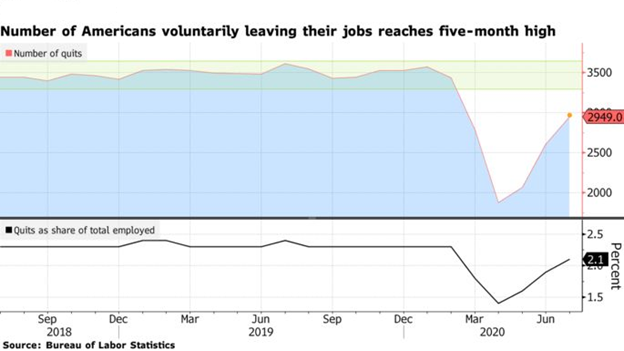
The job openings and labor turnover survey (JOLTS) is conducted monthly by the BLS to help measure job vacancies. The labor department’s definition of vacancies is positions that have become available, the companies are looking for candidates to fill the openings that could start within 30 days. A section of this monthly survey is at a five-month high as of July. This could indicate that U.S. workers feel renewed optimism and understanding to a large enough extent that they are willing to take risks with their financial stability.


The Numbers

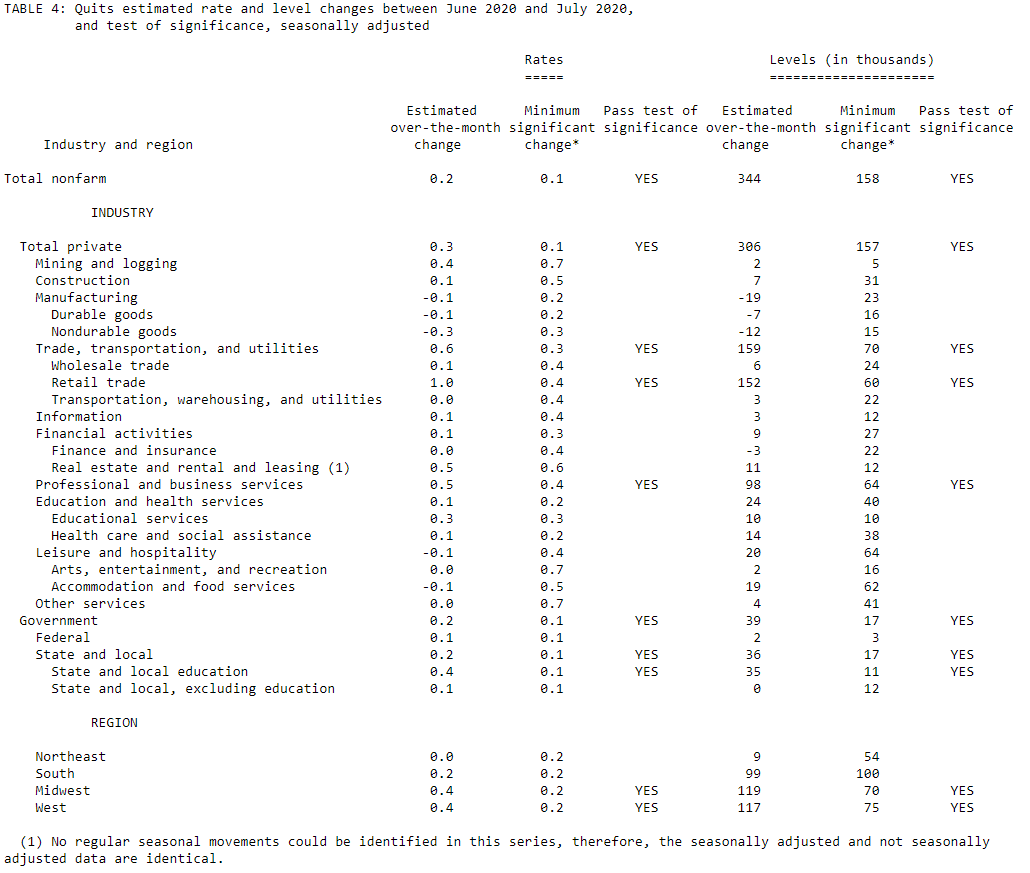
The report released on September 9 shows that nearly 3 million people quit their job in July. This is a large increase of 344,000 over June.  What’s most impressive is the number of job leavers as a share of total U.S. employees rose to 2.1%; this is close, but still below, the 2.3% that was prevalent previously while the unemployment rate was near historic lows.

The improvement in confidence demonstrated by people’s willingness to resign is not the same across industries or regions. Those holding positions in mining, real estate, and business services were most likely to quit their jobs.  Workers in positions in the fields of hospitality and manufacturing were less likely to resign compared to the prior month.


SOURCE: Bureau of Labor Statistics, Job Openings, and Labor Turnover Survey, September 9, 2020.


Devil’s Advocate

As with any set of economic statistics, a lot is impacting the number of quits each month. Certainly, there are many factors. During this year, when workers are perhaps more concerned about health risks in their work environments, or unrest in their towns, one would presume this would motivate and add to resignations. Digging into the data and reviewing the nature of the positions where resignations are highest, it suggests that health, civil unrest, and even childcare are not significant factors. Although an argument can be made that these concerns are motivators in retail quits, it doesn’t explain office professionals who are not likely to have higher childcare issues than they have most summers. Moreover, utility workers, those in retail, real estate professionals, and mine workers are in positions less likely to be impacted than those showing reduced quits such as manufacturing, finance, and food services.

In the past, an increase in resignations overall or in the industry suggested an increase in bargaining power (demand for positions increase or supply of workers decreased). This has not been the case for the industries with the greatest pickup in quits.

Peter Morici, an economist and professor emeritus at the University of Maryland, believes the quits should be viewed as a sign of progress in the job market; his reasoning is any concerns workers may hold are not new for July, yet resignations materially rose. He believes Americans are learning to live with the virus, so the increase in the rate of quitting foretells more career and personal confidence than prior months.


Take-Away

As individual workers and companies learn better to assess the current environment and the options available, they become more likely to make decisions. As with many other areas of life and business, postponing a decision or standing still should also be viewed as a decision.  That decision should be given as much review as making a move. Doing nothing is often riskier than continuing to move in ways that will help your future. Individuals and or corporate management should always remain mindful that they’re continually in competition. Those they are in competition with are moving in ways that they believe will give them an advantage. There will be costs to those focusing too closely on those things already under better control and not opportunities that they have put on hold.

The next BLS report that will include JOLTS for the month of August will be released on October 6.

Paul Hoffman

Managing Editor, Channelchek


Suggested Reading:

The Risk of Economic Confidence Waning

Will There be an Explosion in New Acquisitions

Equity Markets Give a Lesson in Behavioral Psychology


View our full schedule of Virtual Road Shows and sign up for one here.


Sources:

JOLTS Definitions

Consumer Sentiment Dropped as Stimulus Checks Ran Out

Amazon Update, How We’re Responding to the Crisis

March 21, 2020 email from Jeff Bezos

BLS JOLTS

Is it Safe to Shop

Car Sales Down 20%


Picture:  Wolf of Wall Street (quitting scene)

Higher Inventories Cause Large Oil Prices Decline


Excess Oil Inventory May Take Even Longer to Work Off


West Texas Intermediate oil prices fell 8% on Tuesday, dropping from $39 per barrel to $36.30/BBL.  Tuesday’s close was the lowest oil price close in three months.  The decline caps off a difficult ten-day period that started with oil prices entering the month of September at $42.76/BBL.  There is not a single reason for the decline but a series of announcements that point to oil supply increasing and demand rising at a slower rate than previously thought.

Inventories are rising. The American Petroleum Institute reported on Tuesday that U.S. crude stockpiles unexpectedly rose last week.  The country’s crude stockpiles rose by 3 million barrels in the week ending September 4, almost twice that expected by analysts.  The rise was the first increase in seven weeks. The higher inventories were confirmed on Thursday when the U.S. Energy Information Administration indicated that U.S. commercial crude inventories increased by 2.0 million.  Analysts had expected a 1.0 million decrease.  The EIA reports that inventories are running 14% above the trailing five-year average for this time of year.  The inventory buildup comes at an unfortunate time, with the summer driving season coming to an end.

OPEC is getting tired of production cuts.  On September 5, Saudi Arabia lowered its official selling price for October.  Remember that OPEC and allies agreed to a 9.7 million barrel per day cut to supply on May 1.  The reductions were decreased by almost 1 million bpd in June and another 1 million in August.  OPEC and allies meet on September 17 to discuss a continuation of production cuts. Saudi Arabia’s willingness to accept lower oil prices in October may be a sign that it is tiring of cutting production.  If true, the outcome of the next OPEC meeting may result in increased supply at a time when demand is becoming more uncertain.

The future of oil demand for vehicles may be coming into question. GM announced a 10-year alliance with Nikola Corp to build an electric truck. The alliance puts them in direct competition with Tesla and shows that the major car manufacturers do not plan to sit idle as Tesla attempts to gain market share.  GM is not alone among major auto manufacturers in announcing plans to develop electric vehicles.  Announcements like these may be a sign that the age of electric vehicles may be coming sooner than previously anticipated.

A global economic recovery coming from a Covid-19 vaccine may be further away. Countries in all parts of the world are reporting increased cases of Covid-19 as they prepare for an expected second wave of cases coming this fall.  On September 8, AstraZeneca announced that a vaccine study had been put on hold due to a suspected serious reaction in one of the participants.  The halt of a vaccine study is raising new questions about the ability of countries to open their economies.

China may be done restocking its inventories. China has been increasing oil imports through the summer.  The increase stopped in August, with China importing 11.23 bpd versus 12.13 bpd in July.  Warren Patterson, global head of commodities at ING, indicates that China restocked inventories and that Chinese buying appears to be absent from the market at the moment.

Oil prices turned negative in April after the market was hit by a double shot of OPEC production increases and pandemic-induced demand destruction.  Higher oil prices recovered over the summer due to OPEC production cuts and signs that economies were reopening.  Recent data seems to indicate that the optimism of the summer was misplaced.  With storage levels lower than in the spring, it’s unlikely that the market will see the oil price drop witnessed in April.  Instead, there could be a prolonged period of low prices as the market works off excess inventory slowly.

Take-Away

Not one, but a series of events, announcements, and seasonal norms caused oil prices to drop. There are a number of trends on the horizon that are also concerning in a world sitting near inventory capacity.

Suggested Reading:

Is American Energy Dominance Relying on Immaculate Areas?

More Frequent Travel Could Be the Actual Aftermath of the Pandemic

Natural Gas Storage Imbalances and Higher Prices


 Monday September 14 – 3:30PM EDT

Join Gevo CEO, Patrick Gruber for this exclusive corporate presentation, followed by a Q & A session moderated by Poe Fratt, Noble’s Senior Research Analyst, featuring questions taken from the audience. Registration is free, but attendance is limited to 100.
Register
Now


Sources:

https://www.cnbc.com/2020/09/08/oil-drops-to-multi-month-low-on-demand-fears.html?__twitter_impression=true&recirc=taboo, Pippa Stevens, CNBC, September 8, 2020

https://www.cnbc.com/2020/09/10/oil-markets-coronavirus-pandemic.html, Reuters, September 9, 2020

https://finance.yahoo.com/news/crude-oil-adjusting-weakening-fundamentals-115438419.html, Oke Hansen, FX Empire, September 10, 2020

https://www.marketwatch.com/story/oil-down-sharply-as-us-driving-season-comes-to-end-2020-09-08, Myra P. Saefong and William Watts, MarketWatch, September 8, 2020

https://www.foxbusiness.com/markets/oil-prices-tank-as-demand-drop-nears, Jonathan Garber, FoxBusiness, September 8, 2020

https://oilprice.com/Energy/Crude-Oil/Surprise-Crude-Build-Forces-Oil-Prices-Lower.html, Irina Slav, OilPrice.com, September 10, 2020


Comstock Mining (LODE) – Pelen Purchase Option Could Enhance LODE’s Growing Royalty Portfolio

Thursday, September 10, 2020

Comstock Mining (LODE)

Pelen Purchase Option Could Enhance LODE’s Growing Royalty Portfolio

Comstock Mining Inc is a mining company with a focus on gold and silver deposits in the Comstock and Silver City mining districts in Nevada. Its operations are divided into two segments, namely mining and real estate. Its mining projects include The Lucerne Resource area, the Dayton Resource area, the Spring Valley exploration target, the Northern Extension, Northern Targets and Occidental areas. The Real Estate segment involves land, real estate rental properties and a hotel, restaurant & bar provided by the Gold Hill Hotel located in Gold Hill, Nevada just south of Virginia City and the Daney Ranch, located just south of Silver City. The majority revenues are generated from the real estate segment.

Mark Reichman, Senior Research Analyst, Noble Capital Markets, Inc.

Refer to the full report for the price target, fundamental analysis, and rating.

    Lease extension and purchase option. LODE executed an assignable lease agreement with the Sutro Tunnel Company that includes patented mining claims and exploration rights in the Gold Hill and Virginia City Mining District in Storey County, NV and includes properties that are part of the Lucerne mining properties and a portion of the mineral exploration lease with Tonogold Resources (OTC: TNGL, Not Rated). The lease has an initial term of 5 years but is renewable for 15 years or longer and includes a 4% net smelter royalty payable to Sutro, along with minimum monthly payments. Recall that Sutro is owned by Pelen LLC, of which Comstock owns 25% and now has a three-year option to acquire the remaining 75% interest for $3.75 million if exercised within one year, with an increasing purchase price in the second and third years, with 50% of the option payments cumulatively applied to the purchase price. Assuming LODE exercises its purchase option, which we think is likely, it would be entitled to a 5.5% net smelter royalty on the associated properties.

    Tonogold commences initial drilling program.  Tonogold’s initial drilling program commenced this month and will test the 3-kilometer strike length of the main Comstock Lode. The program will have a two-tier focus, including drilling above and below the Sutro Tunnel and targeting areas where historic records indicate the potential for high-grade intercepts. The initial program is expected to take …


This Company Sponsored Research is provided by Noble Capital Markets, Inc., a FINRA and S.E.C. registered broker-dealer (B/D).

*Analyst certification and important disclosures included in the full report. NOTE: investment decisions should not be based upon the content of this research summary.  Proper due diligence is required before making any investment decision.