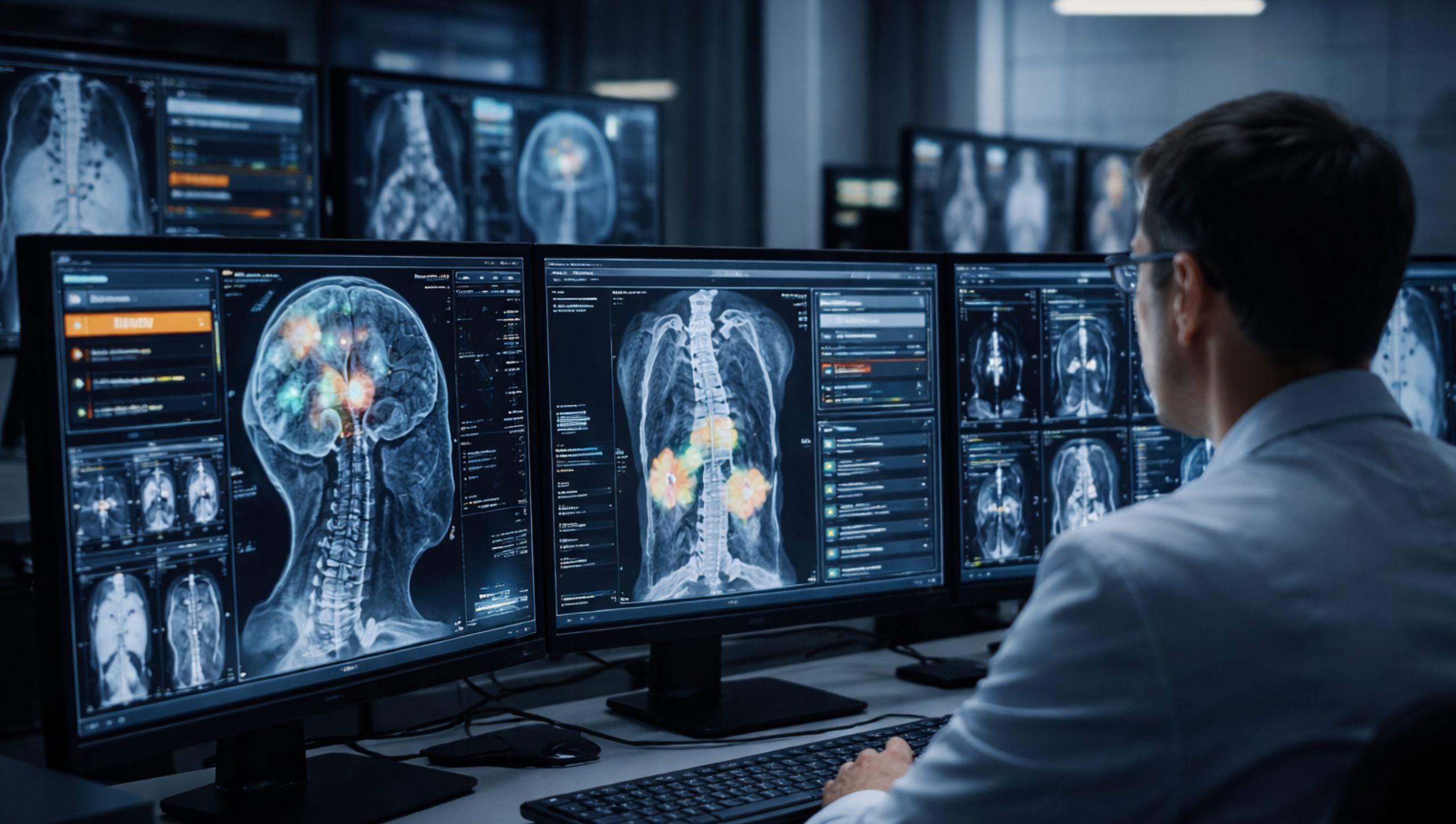
RadNet (NASDAQ: RDNT) is making a decisive move in healthcare AI. The Los Angeles-based outpatient imaging leader announced it has acquired Paris-based Gleamer SAS, integrating the business into its DeepHealth digital subsidiary. The all-cash deal, valued at up to €230 million including a post-closing milestone, positions DeepHealth as what the company describes as the largest provider of radiology clinical AI solutions worldwide.
For investors, the transaction underscores how artificial intelligence is shifting from pilot projects to scaled deployment across diagnostic imaging.
Gleamer brings more than 700 customer contracts across 44 countries and a cloud-first AI portfolio spanning musculoskeletal, breast, lung and neurologic applications. Its solutions include FDA-cleared and CE-marked products designed to support radiologists in screening, detection and workflow prioritization.
DeepHealth, RadNet’s digital health arm, already offers AI-enabled imaging tools across breast, chest, neuro, prostate and thyroid care. Combined, the companies report more than 2,700 customer contracts globally, a portfolio of 26 FDA-cleared and 22 CE-marked devices, and coverage across MR, CT, X-ray, mammography and ultrasound.
That breadth matters in a market where imaging volumes continue to rise while radiologist shortages persist worldwide.
RadNet CEO Dr. Howard Berger framed the deal around workflow automation—particularly in high-volume modalities like X-ray, ultrasound and mammography—where AI-enabled prioritization and draft reporting may help maintain access and efficiency.
Gleamer has operated under a SaaS model, generating annual recurring revenue (ARR) from subscription-based contracts. The company reported a compound annual ARR growth rate exceeding 90% from 2022 through 2025 and expects to reach approximately $30 million in ARR in 2026.
RadNet indicated that, on a combined basis, DeepHealth and Gleamer anticipate ARR approaching or exceeding $140 million by the end of 2026. ARR is a non-GAAP metric representing contracted recurring revenue and excludes one-time implementation and hardware sales.
For public market investors, recurring revenue visibility is increasingly central to valuation in health tech and AI-enabled platforms. The addition of Gleamer enhances DeepHealth’s cloud-native revenue base and expands its European footprint at a time when regulatory-cleared AI tools are gaining broader institutional adoption.
Beyond external sales, RadNet intends to deploy Gleamer’s AI capabilities across its own imaging network, which spans multiple U.S. states and performs millions of exams annually.
X-ray accounts for nearly 25% of RadNet’s imaging volume. The company expects AI-enabled triage and draft reporting tools to support productivity gains and workflow standardization, with deployment targeted by the third quarter of 2026.
Management has emphasized that benefits could include improved resource utilization and cost efficiencies. As with all integration efforts, realization of these outcomes depends on execution and adoption across clinical teams.
The acquisition arrives amid accelerating consolidation in healthcare AI, as imaging platforms seek both modality breadth and geographic reach. Hospitals and outpatient providers are increasingly evaluating enterprise-wide AI solutions rather than single-use tools.
By combining Gleamer’s automated reporting capabilities—already deployed in Europe—with DeepHealth’s imaging informatics platform, RadNet is aiming to deliver an integrated operating system approach across the radiology workflow.
Investors should view the transaction as part of a broader capital allocation strategy: pairing RadNet’s stable outpatient imaging cash flows with scalable digital health assets that carry higher growth profiles.
As AI moves from experimental deployments to embedded clinical infrastructure, scale, regulatory clearance and recurring revenue models are becoming competitive differentiators. RadNet’s latest acquisition suggests the next phase of radiology AI will be defined less by innovation alone—and more by integration at enterprise scale.