New Data Indicates Inflationary Recession

Image Credit: Tom Fisk (Pexels)

Inflation Still Surprisingly Strong and Economy Weak

Two important numbers were released on the last day of September. One was based on old news but significant in its finality; it’s the final revision to GDP for the second quarter. The next is viewed as the Fed’s preferred inflation gauge, the PCE deflator. The final GDP number will make it more difficult for public officials or pundits to suggest we can avoid a recession in 2022, and the second did not give any hope that the Fed will have any reason to change course on tightening.

A Recession By Any Other Name

Gross domestic product (GDP) is the indicator that reflects the amount of output produced quarterly in a country. In the U.S., the Bureau of Economic Analysis (BEA) releases two estimates of quarterly GDP, known as the advance and preliminary estimates, in the two months before the release of the final number. So until the final number prints, the number GDP measure is subject to revision.

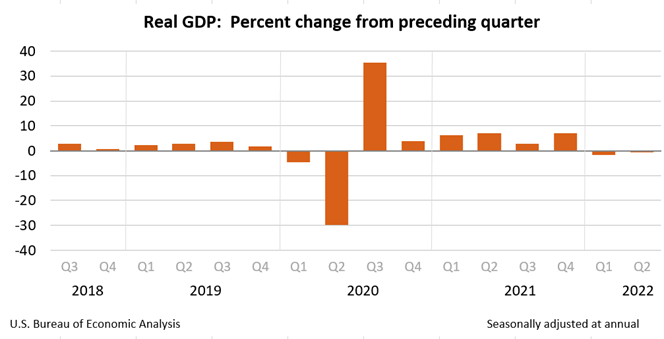
On September 30, 2022, the Final GDP report for the second quarter was released by the BEA. The report shows that GDP decreased at an annual rate of 0.6 percent in the second quarter of 2022 (table 1). This decline in economic output follows a decline of 1.6% in the first quarter of 2022.

Do two-quarters of a receding economy, based on GDP, indicate the U.S. is in the recessionary part of the business cycle? Most textbooks would agree with that definition. However, there is a Business Cycle Dating Committee within the National Bureau of Economic Research (NBER) that determines and labels where the nation is within the economic cycles; they have not made any declaration.

So far, in 2022, the economy has not experienced any economic growth. If the six months of contraction is eventually deemed an official recession, it will thus far have been a shallow one, characterized by strong employment.

Price Increases Higher than Expected

Inflation is still on many investor’s radar. The Fed is targeting reducing inflation to its 2% target. The inflation measure they use for this target is the PCE Deflator. That measure was released this morning, and it validates the aggressive actions being taken by the Federal Reserve. And suggests the Fed has a lot more work to do.

The personal consumption expenditures price index (PCE), which the Fed targets at 2%, rose 6.2% in August from a year earlier, the Commerce Department reported. Underlying inflation, as measured by a core reading that excludes food and energy prices, rose 4.9% from 4.7% previously.

These numbers are well in excess of the Fed’s target and seemingly trending upward. Expectations are the Fed will provide up to another 150 bp increase (1.50%) over the coming months. This would cause the Fed Funds rate to trade near 5%. There is nothing in today’s release that would likely cause expectations to change.

Stagflation?

High inflation and negative growth have many repeating the word “stagflation”. Stagflation has one more element missing, which is high unemployment. The current economic conditions in the U.S. include high demand for workers, this shortage actually helps feed into the inflation the Fed is trying to tame.

Take Away

The economy contracted slightly in the second quarter of 2022. The decline in production was smaller than measured during the first quarter. Federal Reserve policymakers saw one more reason to keep applying the economic brake pedal by taking money out of the economy, increasing upward rate pressures. The Fed caused rates to rise from 40-year lows faster than any time since the 1980s.

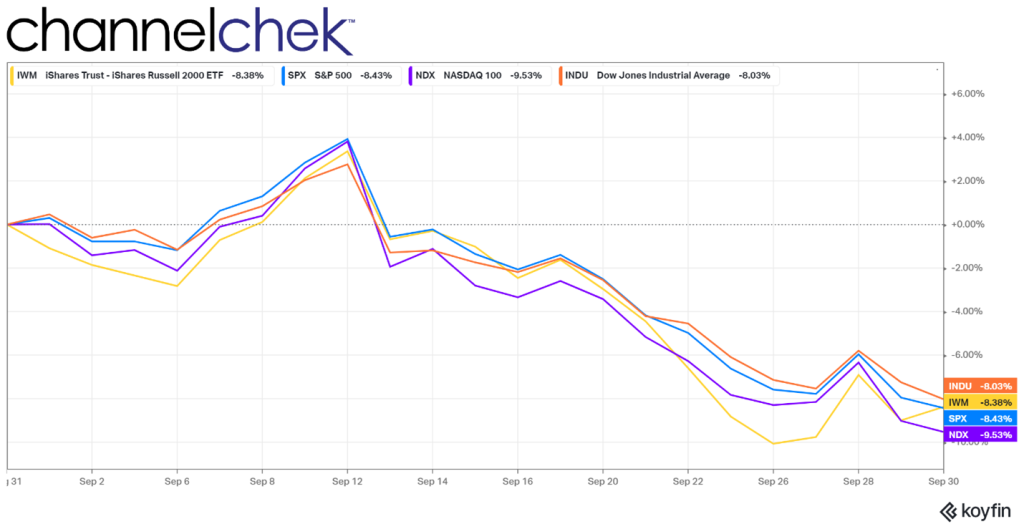
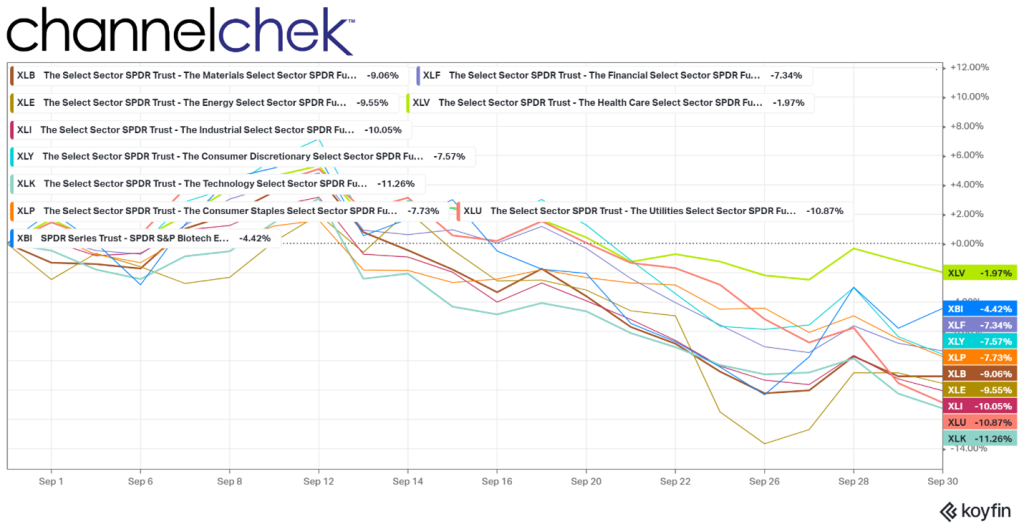
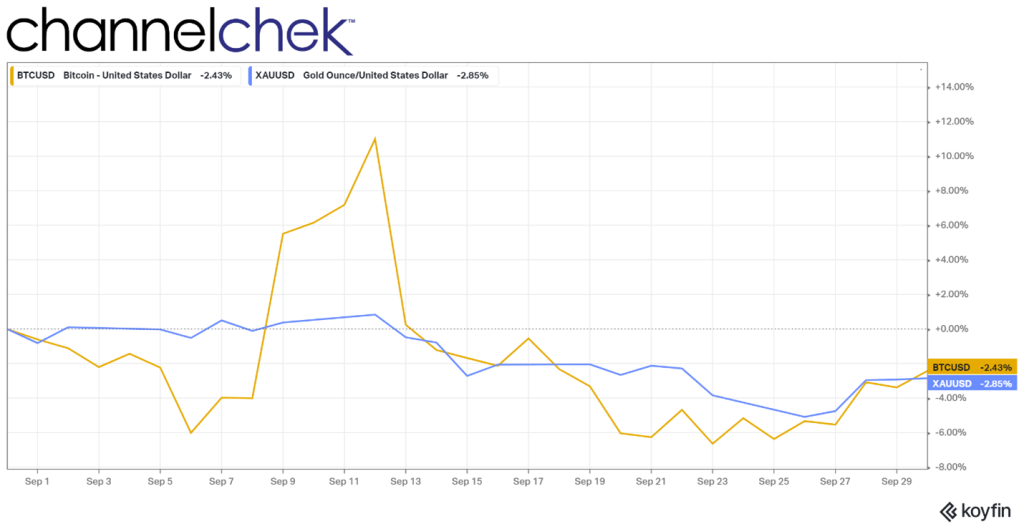
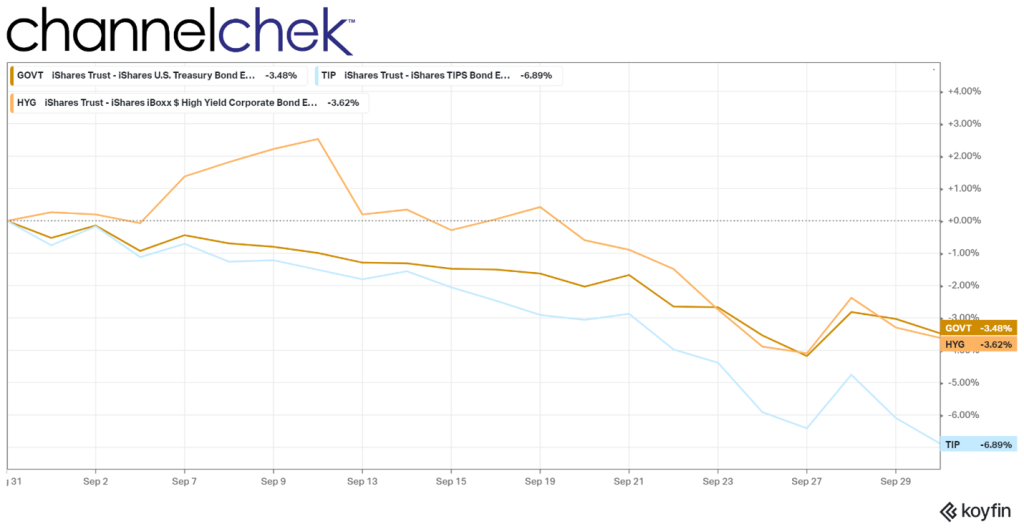
Stock market participants are factored into the Fed’s policy only to the extent that market moves may impact inflation or employment. The markets (stocks, bonds, real estate, gold) are negative on the year. There are some who suggest the Fed will use this as a signal to alter policy, if the Fed bowed to any of the markets listed here, the sign of weakness might actually cause a market collapse in stocks and bonds.

Paul Hoffman

Managing Editor, Channelchek

Sources

https://www.bea.gov/news/2022/gross-domestic-product-third-estimate-gdp-industry-and-corporate-profits-revised-2nd

https://www.bea.gov/news/2022/personal-income-and-outlays-august-2022-and-annual-update

https://finance.yahoo.com/news/fed-seen-keeping-big-rate-131814754.html

https://www.stlouisfed.org/on-the-economy/2014/may/do-revisions-to-gdp-follow-patterns

https://www.learningmarkets.com/who-decides-when-we-are-in-a-recession

https://www.bls.gov/news.release/empsit.nr0.htm

Will the Fed Yield on Raising Yields?

Image Credit: QuoteInspector.com (Flickr)

Foundational Changes in Stocks and Bonds

It’s a small world, and as we’ve seen, if something happens with one trading partner, it impacts them all.

Rapid moves and turnarounds in the U.S. Treasury market, considered the bedrock of all other markets, have increased the volatility in equity markets, commodities trading, and, more directly to, currency exchange rates across the globe. The uncertainty has caused investment capital to gravitate to U.S. markets; however, prolonged gyrations, especially in “risk-free” U.S. Treasuries, could put many investors on the sidelines and weaken asset prices globally.

The U.S./U.K. Example

At the end of 2021, the ten-year U.S. Treasury note was yielding 1.5%. Earlier this week a ten-year U.S. Treasury (backed by the same entity that backs the U.S. Currency) rose to yield 4%. That’s a 270% rise in the yield – for bondholders, prices of bonds decline as yields rise. So while the stock market frets over what a Federal Reserve increase in rates may do for equities, bond market investors can usually pull out a calculator and get a fairly precise answer as to how bonds will reprice. If the reaction is radically different, an important foundation is lost. The reaction has been unpredictable.

While the ten-year did hit 4% this week, after lingering around 3.50% the prior week, the yield abruptly dropped after news from across the Atlantic that England’s central bank, the Bank of England (BOE), was taking steps to halt rate increases, effectively implementing quantitative easing. The BOE buying bonds puts pound sterling into their economy and adds to inflation pressures. The immediate reaction was for rates to come down, there, in the U.S., and in other economies that have been tightening. This provided a feeling of relief from equity markets, as it was a sign that the central banks may one by one abandon their plans to fight inflation, choosing instead to fuel it.

The BOE’s move to buy bonds “on whatever scale is necessary” to stabilize its bond market, a move that followed large tax cuts last week by the U.K. government, despite double-digit inflation, many believe indicates a possible problem with a major financial institution or pension fund.

The world’s markets don’t trade in a vacuum. The sudden reversal in the U.K. to stop interest rate hikes and perhaps lower rates brought a positive tone to stocks and bonds in U.S. markets, each having historically challenging years. The conversation in the U.S. is that the Fed may have to pause its own aggressive direction. This would be either because increased rates would further strengthen the dollar, or because the U.S. may have its own underlying time bomb(s), institutions that would fail or bubbles that could burst.

The rallies in the U.S. stock and bond markets gained momentum after the BOE move as the Chicago Mercantile Exchange (CME) data showed reduced expectations of a terminal or neutral Fed Funds rate of 5%, with expectations now for the policy rate to top out around 4.25-4.5%.

Take Away

While the Fed taking its foot off the brake pedal would be a remarkable turnaround after Chairman Powell’s efforts to be clear about his intent to tighten, the reasons for the CME data shift are twofold. First, the Fed won’t be able to keep aggressively raising rates ad simultaneously reducing bond holdings (shrink its balance sheet), because the strong U.S. dollar is disrupting global markets. Secondly, as mentioned before, checking the health of major institutions, housing, and pension funds in the U.S. may be prudent before administering more economic medicine.

Uncertainty has the effect of investors pulling assets out of markets and businesses acting with more caution. Hopefully, clarity, one way or the other, soon presents itself so volatility is reduced and investors can better understand the playing field. 

Paul Hoffman Managing Editor, Channelchek

Sources

https://www.barrons.com/market-data/stocks/cme

https://www.wsj.com/articles/investors-fear-bond-market-turmoil-is-entering-a-new-phase-11664443801?mod=hp_lead_pos3

Understanding Money as the Lubricant for Wealth

Image Credit: John Guccione (Pexels)

Why Does Money Exist?

Imagine a world without money. With no way to buy stuff, you might need to produce everything you wear, eat or use unless you could figure out how to swap some of the things you made for other items.

Just making a chicken sandwich would require spending months raising hens and growing your own lettuce and tomatoes. You’d need to collect your own seawater to make salt.

You wouldn’t just have to bake the bread for your sandwich. You’d need to grow the wheat, mill it into flour and figure out how to make the dough rise without store-bought yeast or baking powder.

And you might have to build your own oven, perhaps fueled by wood you chopped yourself after felling some trees. If that oven broke, you’d probably need to fix it or build another one yourself.

Even if you share the burden of getting all this done with members of your family, it would be impossible for a single family to internally produce all the goods and provide all the services everyone is used to enjoying.

To maintain anything like today’s standard of living, your family would need to include a farmer, a doctor and a teacher. And that’s just a start.

This article was republished  with permission from The Conversation, a news site dedicated to sharing ideas from academic experts. It represents the research-based findings and thoughts of M. Saif Mehkari, Associate Professor of Economics, University of Richmond.

Specializing and Bartering

Economists like me believe that using money makes it a lot easier for everyone to specialize, focusing their work on a specific activity.

A farmer is better at farming than you are, and a baker is probably better at baking. When they earn money, they can pay others for the things they don’t produce or do.

As economists have known since David Ricardo’s work in the 19th century, there are gains for everyone from exchanging goods and services – even when you end up paying someone who is less skilled than you. By making these exchanges easy to do, money makes it possible to consume more.

People have traded goods and services with one kind of money or another, whether it was trinkets, shells, coins and paper cash, for tens of thousands of years.

People have always obtained things without money too, usually through barter. It involves swapping something, such as a cookie or a massage, for something else – like a pencil or a haircut.

Bartering sounds convenient. It can be fun if you enjoy haggling. But it’s hard to pull off.

Let’s say you’re a carpenter who makes chairs and you want an apple. You would probably find it impossible to buy one because a chair would be so much more valuable than that single piece of fruit. And just imagine what a hassle it would be to haul several of the chairs you’ve made to the shopping mall in the hopes of cutting great deals through barter with the vendors you’d find there.

Paper money is far easier to carry. You might be able sell a chair for, say, $50. You could take that $50 bill to a supermarket, buy two pounds of apples for $5 and keep the $45 in change to spend on other stuff later. Another advantage money has over bartering is that you can use it more easily to store your wealth and spend it later. Stashing six $50 bills takes up less room than storing six unsold chairs.

Nowadays, of course, many people pay for things without cash or coins. Instead, they use credit cards or make online purchases. Others simply wave a smartwatch at a designated device. Others use bitcoins and other cryptocurrencies. But all of these are just different forms of money that don’t require paper.

No matter what form it takes, money ultimately helps make the trading of goods and services go more smoothly for everyone involved.

Is a Rail Strike an Economic Train Wreck or an Opportunity?

Image Credit: Katherine Johnson (Flickr)

Any Rail Strike Would Surely Cause Transitory Inflation

There is something I taught myself years ago as a young trader on Wall Street. I appreciate this “skill” less and less as the years go on, but it has served me well. When news breaks, my mind shifts to asking, “for what sectors is this bullish and for what sectors is this bearish?” No attachment except money movement. There will be time for personal involvement with the event after the market closes. The news of a train strike that may begin on Friday is a good example. My investor mind was quick to try and determine what companies would benefit and also which could be hurt. I have no control over whether or not it happens, but I may be able to add to portfolio returns from it.  Meanwhile, at home, I’m stocking up on a few of the items often shipped by rail.

Below is some helpful information about this segment of the freight and shipping industry.

Background

Rail workers may go out on strike as early as Friday, September 16.

In the U.S. the Rail network runs almost 140,000 miles. Freight rail is an $80-billion industry operated by seven Class I railroads (railroads with operating revenues of $490 million or more), and 22 regional and 584 local/short line railroads.

More than 167,000 are employed across the U.S. It’s a safer and often more efficient means of shipping as it uses less energy and rides on a more cost-effective and safer infrastructure than trucking.

Heavy freight such as coal, lumber, metals, and liquids going long distances are likely to travel by rail or some combination of truck, rail, water, or pipeline. The rail network accounts for approximately 28% percent of U.S. freight movement by ton-miles (the distance and weight freight travels). So, by weight, 28% of what is shipped within the U.S. may get stalled in the event of a strike. This would significantly add to any supply chain issues currently being experienced. 

Unlike roadways, U.S. freight railroads are owned by private organizations that are responsible for their own maintenance and improvements.

What Would be Impacted

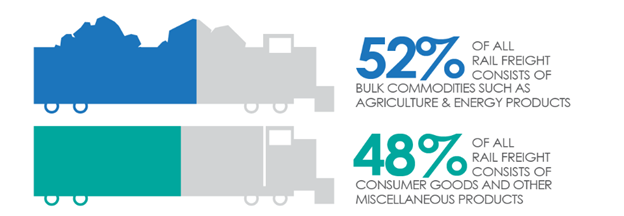
In all, 52 percent of rail freight cars carry bulk commodities such as agriculture and energy products, automobiles and components, construction materials, chemicals, equipment, food, metals, minerals, paper, and pulp. The remaining 48 percent onboard is generally being shipped in packaging that allows it to easily be moved onboard a plane, van, or other non-bulk carrier.

Source: Federal Railroad Administration

A rail strike would stop a high percentage of the transportation of food, lumber, coal, oil and other goods across the U.S.

Current Status

Rail stocks like Union Pacific ($UNP) and CSX ($CSX) are underperforming the market this week as rail workers’ unions continue to negotiate for higher pay and benefits. The unionized workers have the legal go-ahead to strike at the end of the week if no agreement is reached. This could impact all major U.S. railroads and cripple the supply chain on many raw materials until the dispute is settled. An immediate but temporary impact would be material shortages that would push prices up, largely at the producer level. These shortages should be resolved when the strike ends as increased price pressures should come back down. But the short-lived inflation will be additive to final goods prices for a period of time.

Eight of 12 labor unions have reached tentative agreements with railroad carriers. However, there are still disagreements over vacation, sick days, and attendance policies.

A “cooling off” period expires Friday, at which time workers can strike.

A freight rail shutdown would be expected to cost the U.S. economy around $2 billion per day, according to the Association of American Railroads. It would especially hit the energy sector hard as rail is the number one mode of transportation used by coal producers, according to the Energy Information Administration (EIA).

Take Away

A rail strike would hit multiple sectors as it could stop the transportation of food, lumber, coal, and other goods across the country. Much of what is shipped by train can’t easily be shipped by the already overburdened trucking industry.

A strike, if any, would put upward pressure on lumber, energy, and food prices. Assuming the strike gets resolved, these transit-related higher price pressures should prove to be transitory. As individuals, whether or not there is a strike is beyond our ability to change. If there is an industry sector or company that stands to improve earnings or a sector that may suffer losses, there should be no investor guilt in positioning investments in a way where the investor may prosper.

Paul Hoffman

Managing Editor, Channelchek

Sources

https://railroads.dot.gov/rail-network-development/freight-rail-overview#:

https://www.bts.gov/sites/bts.dot.gov/files/docs/browse-statistical-products-and-data/pocket-guide-transportation/224731/pocket-guide-2019.pdf

https://www.barrons.com/articles/railroad-strike-truck-stocks-51663161990

Will the Dollar and Securities Markets Sink When the War Ends?

Image Credit: Andre Furtado

The Story of War and Peace in the Currency Markets

There is a story of war and peace in the contemporary currency markets. It has a main plot and many subplots. As yet, the story is without end. That may come sooner than many now expect.

The narrator today has a more challenging job than the teller of the story about neutral, Entente, and Central Power currencies during World War I. (See Brown, Brendan “Monetary Chaos in Europe” chapter 2 [Routledge, 2011].)

Today’s Russia war (whether the military conflict in Ukraine or the EU/US-Russia economic war) is not so all-pervasive in global economic and monetary affairs, though it is doubtless prominent. The monetary setting of the story today is much more nuanced than in World War I when the prevailing expectation was that peace would mark the start of a journey where key currencies eventually returned to their prewar gold parities.

In the 1914–18 conflict, any sudden news of a possible end to the conflict—as with the peace notes of President Woodrow Wilson in December 1916—would cause a sharp fall of the neutral currencies (Swiss franc, Dutch guilder, Spanish peseta), a big rise in the German mark and Austrian-Hungarian crown, and lesser rises in sterling and the French franc. Today, in principle, a sudden emergence of peace diplomacy would most plausibly send the euro and British pound higher on the one hand and the Canadian dollar, US dollar, and Swiss franc lower on the other hand.

Mutual exhaustion and military stalemate are a combination from which surprise diplomatic moves to end war can emerge. These circumstances apply today.

Ukraine is falling into an economic abyss—much of its infrastructure reportedly destroyed and its government is resorting to the money printing press to pay its soldiers (see Kenneth Rogoff et al., “Macroeconomic Policies for Wartime Ukraine,” Center for Economic and Policy Research, August 12, 2022). General economic aid from Western donors (as against military aid) is running far short of promises. All these pictures of Russian munitions stores on fire may or may not have excited some potential donors, but they have not heralded any breakthrough.

The human toll—both amongst military personnel and civilians—fans Moscow propaganda that the US and UK are willing to conduct their proxy war against Russia down to the life of the last Ukrainian soldier.

Meanwhile there are these presumably leaked stories in the Washington Post about how President Volodymyr Zelensky betrayed the Ukrainian people by not sharing with them in late 2021 and early 2022 the US intelligence alerts about a looming Russian invasion. According to the stories, many Ukrainians resent that they were not warned by their government and do not accept its shocking excuses (for example, to prevent a flight of capital out of the country).

Is all this preparing ground for a possible power shift in Kiev that might favor an early diplomatic solution even in time for President Joe Biden to claim credit ahead of the midterms? Western Europe will be spared some pain this winter if the initial ceasefire agreement includes a provision that Moscow desist from turning off the gas pipelines.

The purpose here is not to predict the war’s outcome but to describe a peace scenario that is within the mainstream and to map out how the rising likelihood of its realization would influence currency markets.

The main channel of influence on currencies would be the course of the EU/US-Russia economic war. A ceasefire would excite expectations of big relief to the natural gas shortage in Western Europe.

Prices there for natural gas would plunge. In turn, that would lift consumer and business spirits, now depressed by feared astronomic gas bills and even gas rationing this winter. Massive programs to relieve fuel poverty, financed by monetary inflation, would stop in their tracks. The European Central Bank (ECB) could move resolutely to tighten monetary conditions as the depression fears faded.

We could well imagine that the peace scenario would mean the European economies in 2023 would rebound from a winter downturn. That would coincide with the US economy sinking into recession as the “Powell disinflation” works its way through—including continued bubble bursting in the tech space and residential construction sector plus a possible private equity bust.

A big rise of the euro under the peace scenario, though likely, is not a slam-dunk proposition. Russia might delay turning the gas pipelines back on until there is an assurance about its central bank’s frozen deposits in Western Europe. There has been chatter from the top of the Organisation for Economic Co-operation and Development (OECD) down that a reparations commission would sequester these.

More broadly, it could be that most European households are not cutting back their spending to the extent assumed in the consensus economic forecasts. Many individuals may have never believed that the high natural gas prices would persist beyond this winter. Then they faced, in effect, a transitory rather than permanent tax rise. Economic theory suggests that such transitory taxes, paid in this case to North American natural gas producers, have much less impact than permanent ones on spending.

There are still the deep ailments of the euro. How can the ECB ever normalize monetary conditions when so much of the monetary base is backed by loans and credits to weak sovereigns and banks (see Brendan Brown, “ECB’s Long Journey into Currency Collapse Just Got a Lot Shorter,” Mises Wire, July 23, 2022)?

In principle, the US dollar, and even more so the Canadian dollar, would lose from peace as they have gained from war. Both have obtained fuel from the boom in their issuing country’s energy sector. In neither country has there been aggregate real income loss due to the economic war—in fact, there has been a gain in the case of Canada. A further positive for the US dollar has been the boom in the US armaments sector—and this should continue beyond a ceasefire.

Peace will not deflect Europe from seeking to diversify its energy supplies away from Russia and to North American gas and to renewables. But we can imagine that in the long-run, Germany could have a comparative advantage in the renewable space; and North America could lose potential sales outside Europe to Russian gas at discounted prices. Russia is widely expected to prioritize a vamped-up construction program for LNG (liquid natural gas) terminals. These will enable the export of its natural gas to world markets.

Bottom line: peace is likely to be a negative for the US dollar. But transcending this influence is the huge issue of how and when US monetary inflation regains virulence.

About the Author:

Brendan Brown is a founding partner of Macro Hedge Advisors (www.macrohedgeadvisors.com) and senior fellow at Hudson Institute. He is an international monetary and financial economist, consultant, and author, his roles have included Head of Economic Research at Mitsubishi UFJ Financial Group and is also a Senior Fellow of the Mises Institute. Brendan authored Europe’s Century of Crises under Dollar Hegemony: A Dialogue on the Global Tyranny of Unsound Money with Philippe Simonnot.

The article was republished with permission from The Mises Institute. The original version can be found here.