What Americans Really Think of Cryptocurrency

Image Credit: Duncan Rawlinson (Flickr)

Does the News Chatter Surrounding Cryptocurrencies Match the Interest in the Asset Class?

Over the 14 years since bitcoin sprung to life, expectations have ranged from overwhelming enthusiasm over its possibilities to fear of the risks inherent in an, as yet, not integrated payment method. A recent 50% run up in bitcoin has refired up the believers, but the most heard about crypto is still valued at less than half of its high point. Issues beyond volatility that cause some to disregard cryptocurrencies as a payment method are regulatory threats, the environmental cost of mining, and failed exchanges. During the week March 13-19, Pew Research Center conducted a survey measuring usage, confidence, and investment success. The survey is important for those paying attention to crypto as it cuts through our personal opinions and offers less biased statistics.

Survey Says…

Most Americans, 88% have heard of cryptocurrency. Almost 40% of those that are aware of crypto told surveyors they are not at all confident in the reliability and safety of crypto, with an additional 36% not very confident. Of the results for those that responded that they are extremely confident the result is 4%, and 2% as very confident.   Of those that have heard of it, 18% say they are somewhat confident.

Digital technology is shown to be less embraced with age. Although the current concern for crypto is high, some age groups have a greater concern than others. This is reflected in that those 50 and older who know about cryptocurrency and are more inclined to say 85% they are not confident in its reliability and safety. Compare this to those adults 49 and younger, where the figure drops to 66%.   

Does sex play a role in skepticism toward cryptocurrencies? 80% of women say they are not confident in it, compared with 71% of men out of the 88% that have heard of crypto.

Does experience lead to acceptance, or acceptance lead to experience? For those that invested in one or more digital currencies, 20% say they are extremely or very confident that it is safe and reliable. For those that have no experience investing in it, the slice drops to 2%. It is worth understanding that of the group that has had experience with crypto, 43% still  responded that they are not very or not at all confident in it.

Cryptocurrency Usage in the U.S.

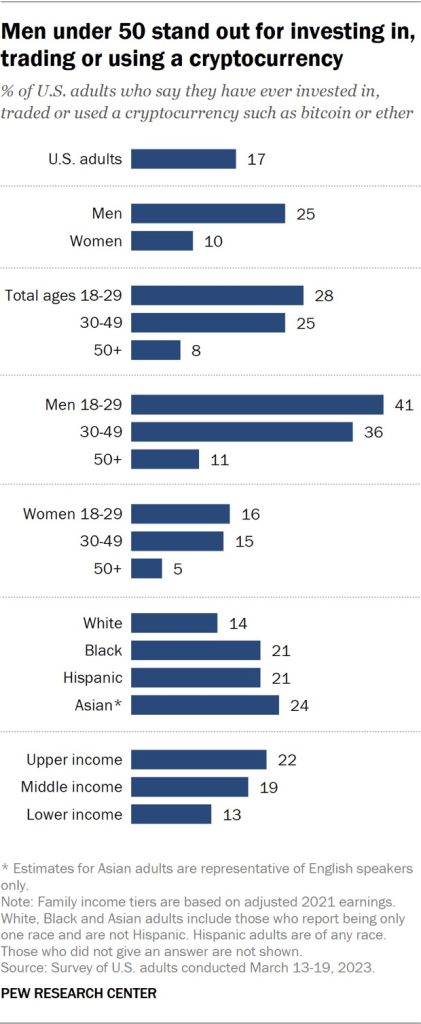
Younger males are more likely to use cryptocurrency compared with men 50 and older and women overall. The number of men 18-29 that have used crypto is more than double that of woman of the same age, 41% of men ages 18 to 29 compared with 16% of women in the same age range.

Adults with upper incomes that have used crypto totaled 22%, with middle incomes slightly less at 19%. Lower incomes that have ever invested in, traded or used cryptocurrency compared at 13%.  

Few that have invested in or transacted using cryptocurrency used it for the first time within the past year. Pew Research asked when they first used cryptocurrency, 74% of those who have ever invested in, traded, or used cryptocurrency say they did for the first time one to five years ago. Only 16% say they first did this within the past year, and 10% more than five years ago.

For college graduates, 25% and those with some college experience, 20% showed they were more likely than those with just a high school education or less, 10% to answer that their cryptocurrency investments hurt their personal finances.

Results of Investment

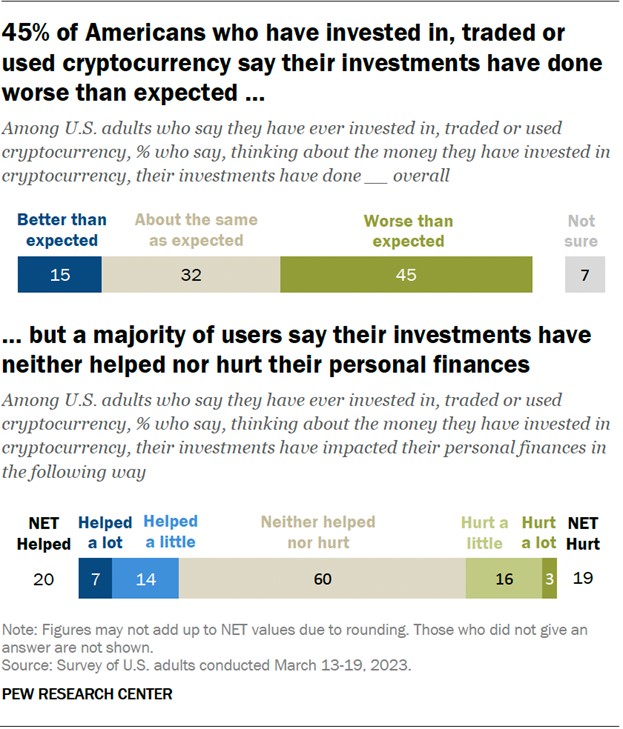
Of those that have invested in crypto, 15% say their investments have done better than expected, 32% say they have done about the same as expected and 7% are unsure. 19% of cryptocurrency users say the investments have hurt their personal finances at least a little.

Most users, 45% indicated their investments performed worse than expected.

Measuring the impact the speculation had on users’ personal finances, three-in-five users (60%) say that they have neither helped nor hurt. Roughly equal shares say that these investments have helped (20%) or hurt (19%) their finances. Just 7% say cryptocurrency has helped their finances a lot and 3% say it has hurt a lot. ­

Take Away

There seems to be far more noise reporting cryptocurrencies than activity or actual usage. This could mean a number of things. One could read into this that the asset’s potential when the fear lifts are high and the potential includes a large percentage of those that are now keeping away. The argument suggests that the ongoing dramatic headlines are warranted since once the potential is realized, there could be much greater movement than we have already seen. Bitcoin had once gone from pennies to $68,000 $USD. Another reason for so much news coverage for an asset class that is favored is it is still novel, so we are all evaluating the asset class as investors; since we’re showing interest or intrigue, news services will report on it to gain audience. If we turn our attention elsewhere, that is then what we will hear more about.

It is truly a speculative asset class with little history. While some are betting everything on crypto, far more are currently just spectators on the sidelines. The hype and attention it is currently receiving may not match actual investor interest.

Paul Hoffman

Managing Editor, Channelchek

Source

https://www.pewresearch.org/wp-content/uploads/2023/04/sr_2023.4.10_crypto_topline.pdf

 Will the Binance Legal Action Crown the CFTC as the Crypto-Police

Image Credit: CoinDesk (Flickr)

What Binance’s US Lawsuit Says About the Future for Cryptocurrency Regulation

The world’s largest cryptocurrency exchange, Binance, has been hit with a lawsuit by US regulator the Commodity Futures Trading Commission (CFTC). This is not the first time a cryptocurrency exchange has been charged by a regulator. But this particular case involves a regulator that does not directly oversee cryptocurrencies. This indicates how regulators – particularly those in the US – hope to clamp down on the cryptocurrency industry.

The CFTC’s lawsuit alleges that Binance violated US derivatives laws by offering its derivative trading services to US customers without registering with the right market regulators. It says Binance has prioritised commercial success over regulatory compliance.

The CFTC has also levied charges against Binance’s founder and CEO, Changpeng Zhao (known as CZ) and former chief compliance officer Samuel Lim. They are charged with taking steps to violate US laws, including directing US-based “VIP customers” to open Binance accounts under the name of shell companies. The regulator has pointed to chat messages as evidence of CZ and Sim’s knowledge of various criminal groups using the exchange.

People visit Binance nearly 15 million times a week to trade on the over 300 cryptocurrencies it offers in more than 1,600 different markets. CZ is an outspoken advocate for cryptocurrencies and regularly tweets about the industry and his company. He even tweeted a link to his initial response to the recent CFTC charges, which he called “unexpected and disappointing”. Promising full responses in due time, he said:

Upon an initial review, the complaint appears to contain an incomplete recitation of facts, and we do not agree with the characterization of many of the issues alleged in the complaint.

Last year CZ’s tweets arguably contributed to the collapse of FTX, one of his company’s main rivals. Binance saw its market share grow following FTX’s collapse.

So, this charge – against not only a crypto giant but also the company of an outspoken industry advocate – has created further upheaval in a market that has already suffered multiple crises in the last year. Investors withdrew a reported US$1.6 billion (£1.3 billion) from Binance within days of the CFTC’s announcement of its charges. These outflows could continue if US regulators tighten their squeeze on crypto companies further, causing major players like Binance to shift focus to other jurisdictions.

Creeping Oversight

The CFTC aims to “protect the public from fraud, manipulation, and abusive practices related to the sale of commodity and financial futures and options, and to foster open, competitive, and financially sound futures and option markets”. Previous actions by this regulator in 2021 against Tether and Bitfinex resulted in major fines and a loss of credibility for the crypto industry.

But a statement published at the time by one of the CFTC’s five commissioners, Dawn Stump, pointed out that the CFTC doesn’t actually have responsibility for regulating cryptocurrencies. She warned that these fines might “cause confusion about the CFTC’s role in this area”. She said the action was based on defining stablecoins (a type of cryptocurrency) as a commodity, but: “we should seek to ensure the public understands that we do not regulate stablecoins and we do not have daily insight into the businesses of those who issue such”.

These latest charges against Binance focus on its activities in derivatives – financial contracts that are linked to the value of an asset such as oil or, in this case, cryptocurrencies. This is a market the CFTC does regulate.

Another US financial regulator, the Securities and Exchange Commission (SEC), has also been ramping up its crypto oversight activities. As well as focusing on the Initial Coin Offering market, it saw a 50% increase in enforcement actions against digital asset companies last year compared to 2021.

Crypto Market Changes

So, Binance is up against two powerful US financial regulators. Some experts have warned that “significant regulatory action could prompt Binance to increasingly shift its business operations beyond the United States”. Certainly, the fact that Binance held a 92% share of the crypto market at the end of 2022 means it facilitates many transactions and offers a lot of liquidity to traders around the world, including in the US.

A trader’s capacity to find competitive prices when buying and selling, as well as sources of liquidity (or other people to trade with) would be affected by the loss of or pull back of one of the world’s top ten crypto exchanges. This would be bad news for retail and institutional investors who could be confronted with a smaller and potentially more expensive market as a result.

And even if the complaints and investigations by the CFTC and SEC take a while to conclude, as is likely, the US legislature may step in before that. A report published by the Financial Times days after the CFTC announcement alleges that Binance has hidden links to China for many years. A statement issued by the the exchange to the FT said this is not “an accurate picture of Binance’s operations” and that the paper’s sources were “citing ancient history (in crypto terms)”.

But recent actions against Chinese tech company Huawei and social media platform Tiktok indicate political leaders are keen to crack down on Chinese companies’ access to US technology systems and customer data. So any similar concerns could lead US politicians to start acting in this area as well.

This article was republished with permission from The Conversation, a news site dedicated to sharing ideas from academic experts. It represents the research-based findings and thoughts of Andrew Urquhart, Professor of Finance & Financial Technology, ICMA Centre, Henley Business School, University of Reading and Hossein Jahanshahloo, Assistant Professor in Finance, Cardiff University.

The Microstrategy Plan for Bitcoin is to Hold “Forever”

Image Credit: Marco Verch (Flickr)

Bitcoin’s Largest Corporate Owner Sold But Remains a net Buyer

“Bitcoin is the exit strategy,” says Michael Saylor, the Executive Chairman overseeing Microstrategy (MSTR), a company he founded. The comment was to a question in a Twitter Space interview with Eric Weiss of Bitcoin Roundtable. During this insightful interview, it becomes clear that the enterprise analytics company stands behind its commitment to the cryptocurrency and is investing in the ecosystem in other ways. Saylor also addressed his recent sale of 704 bitcoin, explaining it created tax benefits that serve stockholders.

The Company is a Bitcoin Maximalist

Bitcoin owners are “Either traders, technocrats, or maximalists.” Explained Saylor in the podcast-style interview.

Accordingly, Saylor says, traders don’t have any opinion on it long-term other than it’s an asset that moves enough to trade. Holding times may be minutes or months.

Technocrats view bitcoin as a digital monetary network like Google or Facebook. It’s a big tech network to them, so if they are bullish on big tech, they will hold bitcoin. And they may try to time their investments based on economic trends.

Maximalists view bitcoin as an instrument of economic empowerment that is just good for the human race. If you’re a maximalist, you don’t try to time it, and you have a much longer time horizon. While the technocrats are looking out 3-5 years, and they think that’s long, maximalists are looking out 10-100 years. Part of that is believing this is good for the human race.

“We’re maximalists, we think bitcoin is more than a digital monetary network; we think it is the digital monetary network. It’s good for the human race, and anything we can do in order to encourage adoption of bitcoin, and help with the adoption, is going to be good for the world.” Saylor while discussing Microstrategy.

Saylor’s company is the largest owner of bitcoin, costing Microstrategy a little more than $4 billion, the crypto assets are now valued just above $2 billion. Saylor says how we acquire bitcoin is less market-driven, as this is permanent capital that flows into the bitcoin ecosystem. Permanent capital that becomes part of the Microstrategy enterprise. Capital that is ongoing and may be held as a base forever.

In Response to December Selling

Michael Saylor recently took some criticism for selling 704 bitcoin after previously repeating he won’t sell bitcoin. He put the confusion to rest by explaining the benefit to stockholders of tax loss harvesting. With crypto the selling is treated as property so you can take the capital loss, “so we have some capital gains we pay taxes on, and then we have some capital, losses in bitcoin, so by selling the bitcoin, and taking the capital loss, we’re able to use that to offset some capital gains.” He added, it’s very tax efficient for the corporation.” Which is good for shareholders.

Lightning Network

Lightning allows “lightning-fast” blockchain payments without worrying about block confirmation times. Payment speed measured in milliseconds to seconds.Security is enforced by blockchain smart-contracts without creating an on-blockchain transaction for individual payments.

Microstrategy has said they will be offering bitcoin Lightning solutions in the first quarter of 2023. This tech investment in the growth of Microstrategy is another way Saylor and company support the bitcoin ecosystem.“If bitcoin is the underlying base layer, I think that Lightning is money over IP.” He said it’s an open permissionless protocol to let eight million people move money and monetary assets at the speed of light.

“We want to make it possible for any enterprise to spin up Lighting infrastructure in an afternoon” and onboard thousands of employees or customers, Saylor explained. “We want to plug it into enterprise technology and make it a marketing strategy for any forward-thinking CMO.”

Areas that MicroStrategy is exploring for Lightning services include online content monetization, enterprise marketing, web paywalls, and internal corporate controls. Every chief marketing officer should be able give away satoshis –– Bitcoin’s smaller denomination unit –– as incentive for customers

Take Away

Bitcoin still has its perma-bulls. Michael Saylor of Microstrategy is solidly in that category. He is not necessarily bullish on other crypto or digital currencies, bitcoin is the digital currency in his mind, and he intends for the ongoing holding of bitcoin and growth of the company in other ways that support its adoption.

Paul Hoffman

Managing Editor, Channelchek

Sources

https://twitter.com/i/spaces/1mrGmkzmmbDxy?s=20

https://cointelegraph.com/news/microstrategy-bitcoin-purchase-divides-the-crypto-community

https://www.microstrategy.com/en/investor-relations

Would it Be Possible at This Point to Ban Non-CBDC Crypto?

Image Credit: ByBit (Flickr)

Senate Banking Committee Chairman Could Support Difficult Crypto Ban

Most new and revolutionary innovations go through growing pains – and at times fraud and deceit. Cryptocurrency and all the ancillary services are no different. One common reaction to some crypto problems is for legislators or regulators to swoop in and show they are protecting citizens from the newly discovered dangers. The cryptocurrency market is now 13 years young and not yet mature. This is evidenced by the meltdown of crypto exchange FTX, which has just placed the entire crypto industry in the crosshairs of the head of the Senate Banking Committee as well as others in Washington. Will crypto survive?

Killing Crypto?

With swirling allegations of fraud, misuse of customer funds, and negligence, the bankruptcy of cryptocurrency exchange FTX has caused lawmakers to try to take action to protect US citizens from activity that largely takes place outside of the States. The chairman of the Senate Banking Committee went as far as to suggest a total ban on cryptocurrencies.

When asked on NBC’s Meet the Press this past weekend whether regulation only gives legitimacy to crypto, rather than a ban, Senate Banking Committee Chair Sherrod Brown said that an immediate course of action is to have the Treasury Department embolden federal agencies such as the Securities and Exchange Commission (SEC) and Commodity Futures Trading Commission (CFTC).

 “We want them to do what they need to do,” the Senator said, “at the same time, maybe banning it—although banning it is very difficult because it will go offshore, and who knows how that will work.”  

Banning crypto would be difficult. Most transactions in the world’s digital currencies and tokens take place outside of the US, including major platforms such as Binance and Deribit.

Does Regulation Help?

While crypto is becoming a topic of scrutiny among lawmakers, the push to regulate digital assets has in some ways served as a safer opening for institutional investors to involve themselves in the asset class. A ban would seem catastrophic to publicly traded, US based Coinbase (COIN), and also halt some investment but could be largely ineffective, chasing transactions offshore. “One in six American households own crypto, a domestic ban at this stage would only lead to more FTX-like situations where Americans are forced to interact with off-shore exchanges that have no regulatory oversight,” a Coinbase spokesperson told investment publication Barron’s, adding, “Congress should focus on passing workable, comprehensive federal crypto legislation that protects consumers, enables innovation, and bolsters American competitiveness.”

A ban in place since 2021 on mining or trading cryptocurrencies in China has not prevented the country from being number two worldwide in crypto mining with 20% of the market share. The country also is ranked 10th in terms of transactions.

Take Away

New investment products have ups and downs. Regulations are clearly on their way in the crypto asset class, but an outright ban would seem to be more lip service from the Senate Banking Committee chair than something that may be implemented. The asset class has now become so entrenched in portfolios of so many in the US, including retirees, and so available outside US jurisdictions that it would seem that any measure to protect investors would be regulatory and implemented slowly.

Paul Hoffman

Managing Editor, Channelchek

Sources

https://www.barrons.com/articles/bitcoin-prices-crypto-markets-today-51670584352?mod=article_inline

https://www.barrons.com/articles/sherrod-brown-cryptocurrency-ban-ftx-sec-51671471539

Meet the Press

https://www.deribit.com/