Uses for Blockchain Beyond Crypto are Growing

Christian Bucad (Flickr)

Why Blockchain Could Mean Fewer Hassles for Students and Workers Proving their Credentials

Microcredentials — attestations of proficiency in a specific skill or knowledge base that are certified by an authority — can provide evidence of a person’s skills to employers.

While microcredentials are becoming more popular, the concept is hardly new: A driver’s license or the St. John Ambulance certificate could be considered as microcredentials, attesting respectively to a person’s driving skill or their competency in administering first aid.

Blockchain technology is appropriate for microcredential implementation. Blockchain can best be described as a digital ledger that records information that can be shared among a community of users. Bitcoin and other crypto-currencies are the best-known examples of blockchain, but blockchain has uses beyond financial transactions.

Student records stored in blockchain for security limit access only to legitimate users, such as institutional administrators and potential employers selected by students or job seekers. Traditionally, institutions own and control certifications like degrees, but that could shift with “digital degrees” and microcredentials that rely on blockchain.

Verifying Accomplishments

Besides providing effective security and privacy for users, blockchain can also facilitate the maintenance and dissemination of the credentials, while ensuring that access is readily available for students under their control.

Because of its immutability, blockchain can be used to attest to and verify students’ accomplishments. This is important for students seeking to have their credits recognized, whether because they are studying to obtain new professional accreditation, studying in multiple institutions or because they are moving for study or employment.

Blockchain is distributed, meaning that multiple copies of the same information are stored on different computers. So, blockchain is not controlled by any central authority and the “blocks” in the “chain,” linked chronologically, are shared in a P2P (peer-to-peer) network, which can be accessed from any node or point on the network.

These blocks are immutable, as any change to the original leaves the first iteration intact and accessible.

When students or job seekers want to have credits transferred between institutions, gatekeepers — for example, post-secondary institutions or employers — typically insist on receiving copies of diplomas and degrees directly from each institution. As more students gain credentials from multiple institutions, this process becomes increasingly untenable.

Students need to control this process and blockchain can provide a solution.

Securely Validates Learning

In 2019, McMaster University announced it was awarding “digital degrees” using blockchain to Faculty of Engineering students after the university implemented microcredentials using blockchain to securely validate students’ learning.

Some post-secondary institutions are implementing pilot projects with eCampus Ontario and industry partners to award microcredentials using blockchain.

Microcredentials are now offered by post-secondary institutions, sometimes in partnership with corporations to target labor market needs. These may come in the form of “digital badges.” Digital badges are easily verifiable testaments to when, where and how skills have been mastered. Metadata in digital badges allows viewers to click on the badge to learn things like criteria for earning the badge, the date it was issued or when it expires.

Maintaining Privacy of Data

Certification by blockchain begins when a trusted institution issues the microcredential and creates a blockchain. The student then sends a public key password to the institution, requesting a transcript be sent to a potential employer.

The institution then adds a block onto the blockchain and sends the micro-credential, which is verified and forwarded to the potential employer. The learners can keep private keys to their credentials in an offline digital wallet.

Maintaining the privacy of the data is essential. With blockchain, the ownership of the microcredential rests with the individual, not the institution.

Blockchain supports more control for students and has the capability of further democratizing education. It empowers students to maintain control of their now-secure credentials and allows them to be confident their acquired skills and knowledge will be valued.

Potential Concerns

However, there are some ethical and logistical concerns. Right now, when a person seeks to transfer credits through traditional channels, they can choose which documents or certifications to share with employers: mistakes or aspects of one’s past credentials and experience deemed less salient or undesirable can be addressed or ignored.

But blockchain is immutable and this immutability can cause its own problems when mistakes cannot be erased.

Students cannot omit blocks from the chain that they do not feel are appropriate or that could damage their reputation. So, how can they create different narratives for diverse purposes or highlight and/or hide different experiences? What happens if someone wants or needs to start anew? Is there a right to forget?

What if a student loses their key? The New York Times reports that lost passwords have locked millionaires out of their bitcoin fortunes. Will students and workers fare any better when it comes to academic and professional records? Who will respond to these problems within institutions?

These are questions post-secondary institutions and our society at large will increasingly need to navigate.

This article was republished with permission from The Conversation, a news site dedicated to sharing ideas from academic experts. It represents the research-based findings and thoughts of Rory McGreal, Professor and UNESCO/ICDE Chair in Open Educational Resources, Athabasca University.
Planned Changes for a Greener Blockchain Leaves Uncertainties

Image Credit: Edwin Chewin (Flickr)

The Ethereum Merge Could Kick Off a Transformation in Crypto’s Battered Reputation

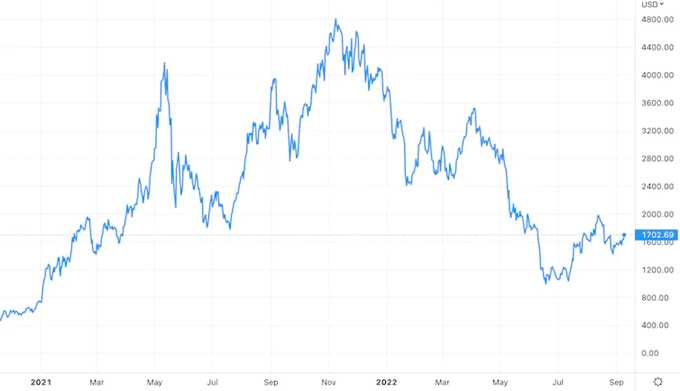
Cryptocurrencies might still be a very long way from their highs of 2021, but some of the major ones have staged some decent recoveries in the past couple of months. Notably ether (ETH), the second largest cryptocurrency after bitcoin, is trading at almost $US1,700 (£1,463) at the time of writing, having dropped as low as $US876 in mid-June.

Ether, which was created by Canadian/Russian programmer Vitalik Buterin, is the cryptocurrency used for transactions on Ethereum, the leading platform on which developers can applications using blockchain technology.

Blockchains are online ledgers that run without been controlled by any single company. Much of these applications revolve around smart contracts, which are automated contracts that remove the need for intermediaries such as lawyers and are seen as having huge potential for the future.

Ether Price ($US)

Source: Trading View

One of the main catalysts for ether’s rebound has been the Ethereum merge, a huge project to change the way the underlying blockchain operates. Where transactions on Ethereum are currently validated using an energy-intensive system known as proof-of-work (PoW), in which lots of very powerful computers compete to solve complex mathematical puzzles, from around September 15 it will shift to a new system known as proof of stake (PoS).

PoS basically means that transactions on the blockchain will be validated not by all these computations but by a network of investors whose commitment is demonstrated by the fact that they own at least 32 ether (yours for about $US54,000).

The idea is that this gives them an economic incentive to enhance the security of the network, and are therefore very unlikely to try and sabotage it. Whereas bitcoin transactions all depend on PoW, lots of newer cryptocurrencies use PoS, including Ethereum rivals such as Solana and Cardano.

Going Green

When the Ethereum merge takes place, power consumption on the blockchain will be reduced by 99%. Since it is currently the most used blockchain in terms of transactions, this will save a huge amount of electricity each year, corresponding to Chile’s power consumption.

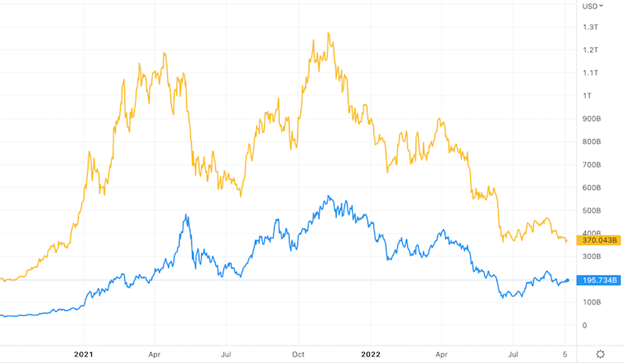
As a result of the merge, some analysts expect ether to overtake bitcoin as the leading crypto in terms of the total value of all the coins (in crypto circles this is referred to as the “flippening”). Ether is currently worth just over US$204 billion, while bitcoin is worth US$396 billion.

Bitcoin vs Ether

Bitcoin = yellow, Ether = blue. Trading View

Until now, cryptocurrencies and bitcoin in particular have suffered from a bad reputation. Bitcoin was initially conceived with the egalitarian goal of allowing investors access to a financial system with no need for banks and with money that isn’t controlled by countries. It has been championed for its ability to enable billions of people without bank accounts to transact online, and to facilitate things like microfinance and ultra-cheap cross-border trading.

Yet bitcoin has come to be associated with environmental degradation and criminal activities. The mainstream media has endlessly linked the leading cryptocurrency – and by extension the whole space – with money laundering, online drug dealing, Ponzi schemes and exchange hacking.

Netflix documentaries have further reinforced this negative public image. Recent scandals in the crypto world, such as the fall of Ethereum rival Luna and the bankruptcy of Celsius and other crypto lenders, have not helped either.

One major consequence has been that major financial institutions like investment banks and pension funds have been cautious of ploughing money into this space, despite the leap forward in technology that blockchains represent.

But if the most widely adopted crypto platform successfully shifts to PoW in the coming days, many believe that this will overcome the biggest institutional objection and see much more money flowing into the space (there are already early signs, such as Fidelity’s new crypto fund for retail investors). This is likely to accelerate the global regulatory framework that would minimise undesirable activities.

By closing down the environmental objections to crypto, other advantages to ether are likely to come to the fore. The merge will offer a return to investors in the form of rewards in exchange for locking up their money for a period of time (“staking”).

Although you need to stake 32 ether to become one of the network’s validators, numerous companies have set up systems to enable smaller investors to pool their money so that they can participate. For example, Binance, the world’s largest crypto exchange, offers investors 6% annual percentage yield for pooled staking on ether.

Staking will therefore create a win-win situation with guaranteed returns and a very liquid system that makes it easy for people to move their money in and out of ether. This will further enhance the appeal of ether and PoS cryptos in general.

This could help to accentuate other positives around crypto, another of which is humanitarian donations. When Russia invaded Ukraine, for instance, the Ukrainian government called for donations in bitcoin and ether to support its efforts against invaders. This quickly attracted substantial amounts of money.

Tonga was similarly successful with a campaign after its volcanic eruption earlier this year. By being able to cross borders easily and cheaply, cryptocurrencies are the ideal vehicle for international donations.

Lingering Uncertainties

All that said, it is uncertain how the Ethereum blockchain will function after the merge in terms of transaction speeds and costs. One major problem with Ethereum in the past has been that transactions have been ludicrously expensive, sometimes running to thousands of US dollars at peak times in 2021.

The developers of the Ethereum Foundation do not expect the merge to make a big difference in these respects (currently “gas” fees are averaging between $US1 and $US4 per transaction depending on which platform you are using). Much more important is likely to be another shift in ethereum’s journey to “Ethereum 2.0” known as sharding, which is due to happen in 2023.

We will also have to wait and see how smooth the merge is. Synchronisation and update bugs could see problems such as validators disconnected from the blockchain. Negative stories like these could see investors staying away for fear of instability. But on the whole, while the merge will not be a miraculous event, it could help improve the image of cryptocurrencies and attract institutional and retail investors. At a time when sustainable investing is increasingly high priority, the ether merge and its attractive returns have the potential to put ether at the top of the list.

This article was republished  with permission from The Conversation, a news site dedicated to sharing ideas from academic experts. It represents the research-based findings and thoughts of Jean-Philippe Serbera, Senior Lecturer in Banking And Financial Markets, Sheffield Hallam University.