
Allegiant and Sun Country Clear a Major Merger Hurdle

Allegiant Travel Company (NASDAQ: ALGT) and Sun Country Airlines (NASDAQ: SNCY) cleared a critical regulatory hurdle this morning, announcing the early termination of the Hart-Scott-Rodino antitrust waiting period — meaning the U.S. Department of Justice has signed off on Allegiant’s proposed acquisition of Sun Country without objection. The milestone moves one of the more strategically compelling small-cap airline consolidations in years meaningfully closer to the finish line.

The deal, originally announced in January 2026, is structured as a $1.5 billion cash-and-stock transaction that offered Sun Country shareholders a premium of nearly 20% over the stock’s last close before the announcement. With DOJ clearance now secured, the primary remaining conditions are approval from the U.S. Department of Transportation and a shareholder vote from both companies. Closing is targeted for the second or third quarter of 2026.

Both carriers occupy a niche that the major airlines have largely ignored — leisure travelers flying from small and mid-sized cities to vacation destinations. Allegiant, based in Las Vegas, has built its entire model around non-stop routes linking secondary markets to resort towns. Sun Country, operating out of Minneapolis, runs a hybrid model combining scheduled passenger service, charter operations, and an Amazon cargo business that generated record full-year revenue of $1.13 billion in 2025 — its fifth consecutive profitable year.

Together, the combined carrier would serve roughly 22 million annual customers, operate across nearly 175 cities, and cover more than 650 routes with a fleet of 195 aircraft. Neither airline competes heavily for the same routes, which likely explains why the DOJ review resolved quickly and without required divestitures — a favorable signal for deal certainty.

At the time of the deal announcement, Allegiant carried a market cap of approximately $1.37 billion and Sun Country traded below $700 million — both firmly in small-cap territory. This transaction is a reminder that some of the most structurally sound consolidation plays in the market are happening below the radar of mainstream financial media, which remains fixated on mega-cap M&A.

The leisure travel segment has proven more resilient than traditional scheduled carriers across multiple economic cycles. Consumers continue to prioritize experiences and affordable vacation travel, and both Allegiant and Sun Country have built disciplined, asset-light models well-suited to capitalize on that demand. Sun Country’s diversified revenue streams — cargo, charter, and scheduled service — add a layer of earnings stability to the combined entity that pure-play passenger carriers often lack.

The DOT’s interim exemption approval is the next significant milestone, followed by formal shareholder votes at both companies. Neither hurdle is considered unusually high risk at this stage, and most observers expect the transaction to close on schedule. Allegiant has flagged the combination as accretive to earnings power and expects meaningful cost synergies from consolidating operations, maintenance programs, and corporate overhead.

For small-cap investors tracking consolidation trends in the airline sector, the Allegiant-Sun Country merger is a case study in how smaller carriers are quietly reshaping the competitive landscape — one nonstop leisure route at a time.
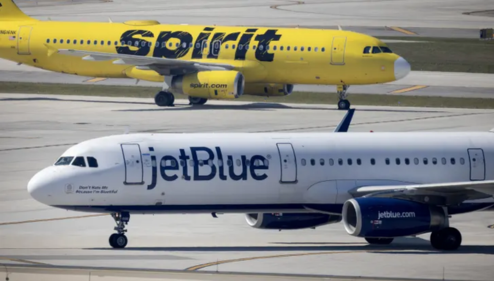
JetBlue’s Daring $3.8 Billion Quest to Buy Spirit Crashes Into Regulatory Turbulence

JetBlue Airways’ audacious attempt to significantly reshape the U.S. airline industry by acquiring the ultra-low-cost carrier Spirit Airlines has crashed into an insurmountable regulatory barrier. After a nearly two-year battle, the two carriers terminated their $3.8 billion merger agreement in the face of steadfast federal antitrust opposition.

The deal’s demise represents a stinging setback for JetBlue, which had contested the U.S. Justice Department in federal court over whether buying Spirit would reduce competition and raise fares. A federal judge ultimately blocked the transaction, siding with the Biden administration’s view that it would “harm cost-conscious travelers who rely on Spirit’s low fares.”

While JetBlue initially appealed the ruling as required by the merger terms, both airlines acknowledged the increasingly slim odds of reviving the deal. With the Justice Department firmly opposed and the regulatory obstacles too high, new JetBlue CEO Joanna Geraghty conceded “the probability of getting the green light anytime soon is extremely low.”

Geraghty, tasked with righting JetBlue’s operational struggles, defended the rationale as an bold plan to “shake up the industry status quo.” However, the regulatory headwinds proved too intense to complete what would have been the airline sector’s most transformative merger since 2013.

The termination marks an abrupt reversal from just months ago when JetBlue convinced Spirit shareholders to reject a lower buyout bid from Frontier Airlines. Spirit was positioned to receive a $2.9 billion cash payout before the deal disintegrated in court.

Instead, Spirit will get a relatively modest $69 million breakup fee from the termination, though its shareholders had already pocketed $425 million in prepayments from JetBlue.

Walking away leaves each airline to fend for itself in a market dominated by the “Big Four” carriers controlling over 80% of seat capacity. The stakes are elevated for the oft-struggling Spirit, grappling with operational issues like an engine defect that will ground dozens of jets for inspections.

With JetBlue’s acquisition off the table, Spirit must fortify its shaky balance sheet and consistently turn a profit as a standalone ultra-low-cost carrier (ULCC). CEO Ted Christie affirmed initiatives underway to “bolster profitability and elevate the guest experience.” Spirit expects better-than-expected Q1 revenue amid robust demand, and is refinancing debt.

However, funding constraints and cost pressures cloud Spirit’s outlook. Aviation experts caution the ULCC model faces an uphill climb in an inflationary environment squeezing margins. Without JetBlue’s resources, Spirit’s growth ambitions may stall as rivals build scale.

For JetBlue, the road is also turbulent as it contends with operations struggles, financial headwinds and pressure from activists. The Spirit deal was viewed as a potential catalyst accelerant for overhauling its business model. Without that lever, JetBlue may be forced to double down on existing lines or revisit other acquisition targets.

The regulatory blockade has raised the bar for any future industry consolidation. The Biden administration signaled it will vehemently contest any merger resembling a reduction of competition. Airlines contemplating deals should anticipate similar anti-trust scrutiny.

In the near-term, blocking the JetBlue-Spirit tie-up preserves ultra-low fare offerings in markets they serve. But whether those discounted seats endure remains uncertain as unconventional airlines face economic pressures.

What was envisioned as a game-changing shift in industry power dynamics has stalled indefinitely. The two airlines must now chart separate paths forward – for better or for worse.