Comtech Telecommunications Corp. engages in the design, development, production, and marketing of products, systems, and services for advanced communications solutions in the United States and internationally. It operates in three segments: Telecommunications Transmission, Mobile Data Communications, and RF Microwave Amplifiers. The Telecommunications Transmission segment provides satellite earth station equipment and systems, over-the-horizon microwave systems, and forward error correction technology, which are used in various commercial and government applications, including backhaul of wireless and cellular traffic, broadcasting (including HDTV), IP-based communications traffic, long distance telephony, and secure defense applications. The Mobile Data Communications segment provides mobile satellite transceivers, and computers and satellite earth station network gateways and associated installation, training, and maintenance services; supplies and operates satellite packet data networks, including arranging and providing satellite capacity; and offers microsatellites and related components. The RF Microwave Amplifiers segment designs, develops, manufactures, and markets satellite earth station traveling wave tube amplifiers (TWTA) and broadband amplifiers. Its amplifiers are used in broadcast and broadband satellite communication; defense applications, such as telecommunications systems and electronic warfare systems; and commercial applications comprising oncology treatment systems, as well as to amplify signals carrying voice, video, or data for air-to-satellite-to-ground communications. The company serves satellite systems integrators, wireless and other communication service providers, broadcasters, defense contractors, military, governments, and oil companies. Comtech markets its products through independent representatives and value-added resellers. The company was founded in 1967 and is headquartered in Melville, New York.
Joe Gomes, Managing Director – Generalist Analyst, Noble Capital Markets, Inc.
Joshua Zoepfel, Research Associate, Noble Capital Markets, Inc.
Refer to the full report for the price target, fundamental analysis, and rating.
Convergence. Yesterday, Comtech announced Al Yah Satellite Communications Company PJSC (Yahsat), the United Arab Emirates’ flagship satellite solutions provider, awarded the Company $29 million to deliver communications technologies and location services that will operate on Yahsat’s Thuraya 4-NGS satellite constellation.
Details. Comtech will design, develop, install, integrate, and test communications and location-based technologies for Yahsat’s Location Tracking Services Platform and User Terminals. Comtech’s offerings will help enable blended satellite and terrestrial technologies communications and enhanced location-based services for end users of Yahsat’s network.
Equity Research is available at no cost to Registered users of Channelchek. Not a Member? Click ‘Join’ to join the Channelchek Community. There is no cost to register, and we never collect credit card information.
This Company Sponsored Research is provided by Noble Capital Markets, Inc., a FINRA and S.E.C. registered broker-dealer (B/D).
*Analyst certification and important disclosures included in the full report. NOTE: investment decisions should not be based upon the content of this research summary. Proper due diligence is required before making any investment decision.
On May 11 the Covid National Emergency Will Be Declared Over – Are You in the Right Stocks?
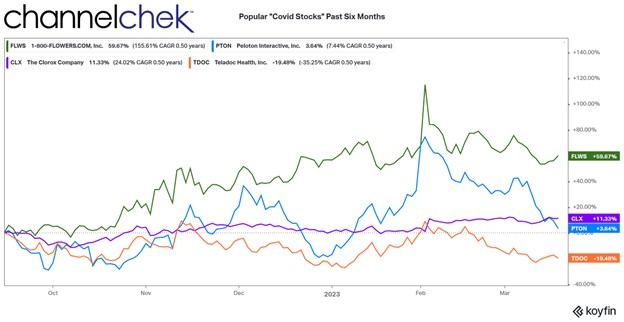
Were there any companies that had lasting benefits from the shutdowns and lockdowns in response to the pandemic? During the first two years of the 2020s, pandemic consumer behavior caused sports equipment makers, communications, ecommerce, and healthcare companies to be favorites of investors. As investors then pivoted and began to look for the “post-covid” trade, many of these high-flyers, including Peleton (PTON), Teledoc (TDOC), Chlorox (CLX) and others, no longer held the advantage they had, and sold off. The focus then turned to energy, leisure, and other segments that had been decimated during forced lockdowns and fear. While some once strong sectors and segments faltered, some ecommerce companies, that were experiencing growth going into the pandemic, received a huge, albeit challenging, boost during the changed economy. The astute ones took the opportunity to grow deeper roots.
Online businesses are one segment where many companies maintained their bulge from the Covid lockdowns. The following insights are largely from a roadshow I attended, supplemented by research by Noble Capital Markets on Channelchek.com. While this isn’t the only ecommerce business that has retained substantial benefits from the pandemic, it is a company that can serve as a template as to what to look for when doing your own fundamental analysis.
Toll free numbers (eight hundred numbers) for decades helped consumers overcome the reluctance to incur long-distance phone charges when needing help ordering from a mail order company. At the same time they saved the company from time-consuming collect calls. Introduced in 1967, it was a win-win technology that was quickly adopted and allowed broader reach.
From very humble beginnings an entrepreneur who still heads the company grew a 14-store flower shop based on Long Island by amassing enough financing to acquire 1-800-FLOWERS (FLWS), an ailing store based in Texas. His company instantly became a national brand through the use of this toll-free technology.
The company today is worth over $621 million and has not forgotten that they are a technology-based retailer. Their product is also not narrowly defined as flowers, but instead gifts for special occasions and people who are special to you. FLWS is a successful online retailer, willing to engage pertinent technology, learn from it, adapt that which works, and commercialize it to maintain a competitive edge in the ecommerce segment. This includes automation which helps offset post-pandemic era wage increases; artificial intelligence, which can help customers customize a notecard with a poem; and of course all that helps online retail build customers.
The pandemic allowed FLOWERS to double the size of its file of customers. On the revenue side, the company went from $1.2 billion in 2019, then quickly grew and peaked at $2.2 billion by March of 2022. They have been able to keep much of this revenue gain, and it isn’t going backward. This is because the ecommerce trend was already in place, but the pandemic helped accelerate the use and permanent adoption by individuals that are now in the habit of thinking online when it comes to special occasion gifts. This trend continues, even as the overall economy is showing cracks.
The negative for FLOWERS, like other retailers operating during the pandemic period, was grappling with supply chain issues and dramatically higher shipping costs. The cost of having a container shipped has now dropped significantly. FLWS, during the worst period, had worked to keep more than ample inventory of non-perishables since the supply-chain was not reliable. As a result, they are still working off more expensive inventory, which has the effect of a higher cost of goods sold, this shows up on financials as narrower profit margins. The working off of this more expensive inventory and replenishing it with goods with lower shipping costs should serve to expand profit margins going forward, even if revenue remains neutral.
Ecommerce
How might this this apply to other ecommerce companies? Flowers has innovative management that is not afraid to experiment with technology and adapt to their business those which helps save them money or reach more customers. A good way to discern this is by attending industry conferences such as NobleCon19 in December or attending roadshows as I did to meet FLWS management.
Another characteristic that this company had, that is admirable, is an acceleration of users during the pandemic that may not have otherwise decided to buy online. The company makes good use of this larger root system and stays in touch with the customers using its expanded list, sharing thoughts on other offerings.
An interesting situation of 1(800)-FLOWERS.com that may exist with others is the changed cost of shipping and inventory. This negative, which is still unwinding, provides a declining cost of goods sold for a period of time. This could translate into higher earnings, depending on other market and business factors – this could get the attention of investors. It’s important to note that once inventories are worked off, margins would stabilize, and lower-cost inventories would no longer contribute to net earnings.
Take Away
Meeting with management, in this case at a road show sponsored by Noble Capital Markets (see calendar here), or at a large investor conference such as NobleCon (Information provided here) helps provide insight into a company itself, an evaluation of management, plus ideas of what to look for in related companies. I wouldn’t expect CNBC or Bloomberg to spend as much time discussing a $621 million company as they spend on AAPL or MSFT, nor would I expect that the average investor can have breakfast with Elon Musk of Tesla or Mark Zuckerberg of META, and get to know their plans, their company, and current industry factors that they are challenged with.
If you are serious about discovering what’s beyond CNBC, Stocktwits, and Yahoo Finance, I recommend attending a meet-the-management style road show and if you can, an investment conference that showcases industries you are interested in.
The Fear of Mass Unemployment Due to Artificial Intelligence and Robotics Is Unfounded
People are arguing over whether artificial intelligence (AI) and robotics will eliminate human employment. People seem to have an all-or-nothing belief that either the use of technology in the workplace will destroy human employment and purpose or it won’t affect it at all. The replacement of human jobs with robotics and AI is known as “technological unemployment.”
Although robotics can turn materials into economic goods in a fraction of the time it would take a human, in some cases using minimal human energy, some claim that AI and robotics will actually bring about increasing human employment. According to a 2020 Forbes projection, AI and robotics will be a strong creator of jobs and work for people across the globe in the near future. However, also in 2020, Daron Acemoglu and Pascual Restrepo published a study that projected negative job growth when AI and robotics replace human jobs, predicting significant job loss each time a robot replaces a human in the workplace. But two years later, an article in The Economist showed that many economists have backtracked on their projection of a high unemployment rate due to AI and robotics in the workplace. According to the 2022 Economist article, “Fears of a prolonged period of high unemployment did not come to pass. . . . The gloomy narrative, which says that an invasion of job-killing robots is just around the corner, has for decades had an extraordinary hold on the popular imagination.” So which scenario is correct?
Contrary to popular belief, no industrialized nation has ever completely replaced human energy with technology in the workplace. For instance, the steam shovel never put construction workers out of work; whether people want to work in construction is a different question. And bicycles did not become obsolete because of vehicle manufacturing: “Consumer spending on bicycles and accessories peaked at $8.3 billion in 2021,” according to an article from the World Economic Forum.
Do people generally think AI and robotics can run an economy without human involvement, energy, ingenuity, and cooperation? While AI and robotics have boosted economies, they cannot plan or run an economy or create technological unemployment worldwide. “Some countries are in better shape to join the AI competition than others,” according to the Carnegie Endowment for International Peace. Although an accurate statement, it misses the fact that productive economies adapt to technological changes better than nonproductive economies. Put another way, productive people are even more effective when they use technology. Firms using AI and robotics can lower production costs, lower prices, and stimulate demand; hence, employment grows if demand and therefore production increase. In the unlikely event that AI or robotic productive technology does not lower a firm’s prices and production costs, employment opportunities will decline in that industry, but employment will shift elsewhere, potentially expanding another industry’s capacity. This industry may then increase its use of AI and robotics, creating more employment opportunities there.
In the not-so-distant past, office administrators did not know how to use computers, but when the computer entered the workplace, it did not eliminate administrative employment as was initially predicted. Now here we are, walking around with minicomputers in our pants pockets. The introduction of the desktop computer did not eliminate human administrative workers—on the contrary, the computer has provided more employment since its introduction in the workplace. Employees and business owners, sometimes separated by time and space, use all sorts of technological devices, communicate with one another across vast networks, and can be increasingly productive.
I remember attending a retirement party held by a company where I worked decades ago. The retiring employee told us all a story about when the company brought in its first computer back in the late ’60s. The retiree recalled, “The boss said we were going to use computers instead of typewriters and paper to handle administrative tasks. The next day, her department went from a staff of thirty to a staff of five.” The day after the department installed computers, twenty-five people left the company to seek jobs elsewhere so they would not “have to learn and deal with them darn computers.”
People often become afraid of losing their jobs when firms introduce new technology, particularly technology that is able to replicate human tasks. However, mass unemployment due to technological innovation has never happened in any industrialized nation. The notion that AI will disemploy humans in the marketplace is unfounded. Mike Thomas noted in his article “Robots and AI Taking Over Jobs: What to Know about the Future of Jobs” that “artificial intelligence is poised to eliminate millions of current jobs—and create millions of new ones.” The social angst about the future of AI and robotics is reminiscent of the early nineteenth-century Luddites of England and their fear of replacement technology. Luddites, heavily employed in the textile industry, feared the weaving machine would take their jobs. They traveled throughout England breaking and vandalizing machines and new manufacturing technology because of their fear of technological unemployment. However, as the textile industry there became capitalized, employment in that industry actually grew. History tells us that technology drives the increase of work and jobs for humans, not the opposite.
We should look forward to unskilled and semiskilled workers’ upgrading from monotonous work because of AI and robotics. Of course, AI and robotics will have varying effects on different sectors; but as a whole, they are enablers and amplifiers of human work. As noted, the steam shovel did not disemploy construction workers. The taxi industry was not eliminated because of Uber’s technology; if anything, Uber’s new AI technology lowered the barriers of entry to the taxi industry. Musicians were not eliminated when music was digitized; instead, this innovation gave musicians larger platforms and audiences, allowing them to reach millions of people with the swipe of a screen. And dating apps running on AI have helped millions of people fall in love and live happily ever after.
About the Author
Raushan Gross is an Associate Professor of Business Management at Pfeiffer University. His works includeBasic Entrepreneurship, Management and Strategy, and the e-book The Inspiring Life and Beneficial Impact of Entrepreneurs.
ISG (Information Services Group) (Nasdaq: III) is a leading global technology research and advisory firm. A trusted business partner to more than 700 clients, including more than 75 of the world’s top 100 enterprises, ISG is committed to helping corporations, public sector organizations, and service and technology providers achieve operational excellence and faster growth. The firm specializes in digital transformation services, including automation, cloud and data analytics; sourcing advisory; managed governance and risk services; network carrier services; strategy and operations design; change management; market intelligence and technology research and analysis. Founded in 2006, and based in Stamford, Conn., ISG employs more than 1,300 digital-ready professionals operating in more than 20 countries—a global team known for its innovative thinking, market influence, deep industry and technology expertise, and world-class research and analytical capabilities based on the industry’s most comprehensive marketplace data. For additional information, visit www.ISG-One.com
Joe Gomes, Managing Director – Generalist Analyst, Noble Capital Markets, Inc.
Joshua Zoepfel, Research Associate, Noble Capital Markets, Inc.
Refer to the full report for the price target, fundamental analysis, and rating.
Continuing the Trend. Like the previous quarter, the momentum for ISG has been positive in terms of demand for the Company’s digital services along with cost optimization services as companies are continuing to navigate a volatile economic environment. In addition, the Company had $108 million in recurring revenue for the year, exceeding the Company’s goal of $100 million, which brings along higher margins.
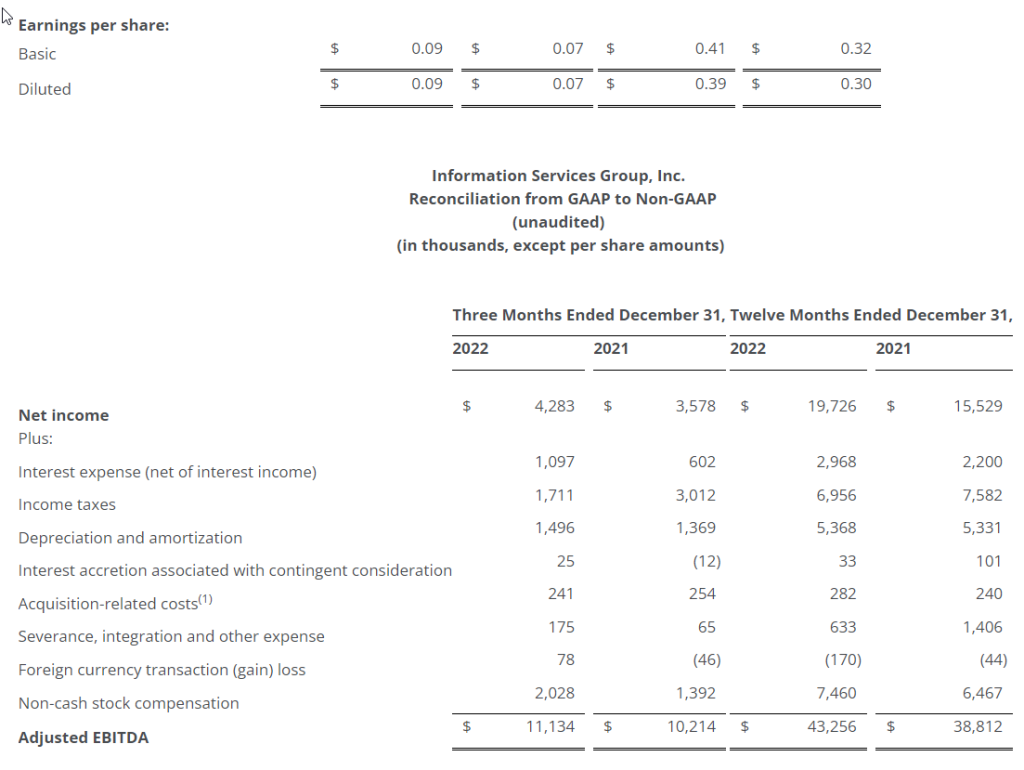
4Q Results. ISG reported revenues for the fourth quarter were a record $74.2 million, up 7% from $69.6 million in the prior year, and up 11% in constant currency. We estimated revenue at $71.0 million. Net income was a record $4.3 million, or diluted EPS of $0.09, compared to $3.6 million, or $0.07 per fully diluted share, in the prior year. Adjusted EBITDA was at a record $11.1 million, up 9% from the prior-year fourth quarter.
Equity Research is available at no cost to Registered users of Channelchek. Not a Member? Click ‘Join’ to join the Channelchek Community. There is no cost to register, and we never collect credit card information.
This Company Sponsored Research is provided by Noble Capital Markets, Inc., a FINRA and S.E.C. registered broker-dealer (B/D).
*Analyst certification and important disclosures included in the full report. NOTE: investment decisions should not be based upon the content of this research summary. Proper due diligence is required before making any investment decision.
Comtech Telecommunications Corp. engages in the design, development, production, and marketing of products, systems, and services for advanced communications solutions in the United States and internationally. It operates in three segments: Telecommunications Transmission, Mobile Data Communications, and RF Microwave Amplifiers. The Telecommunications Transmission segment provides satellite earth station equipment and systems, over-the-horizon microwave systems, and forward error correction technology, which are used in various commercial and government applications, including backhaul of wireless and cellular traffic, broadcasting (including HDTV), IP-based communications traffic, long distance telephony, and secure defense applications. The Mobile Data Communications segment provides mobile satellite transceivers, and computers and satellite earth station network gateways and associated installation, training, and maintenance services; supplies and operates satellite packet data networks, including arranging and providing satellite capacity; and offers microsatellites and related components. The RF Microwave Amplifiers segment designs, develops, manufactures, and markets satellite earth station traveling wave tube amplifiers (TWTA) and broadband amplifiers. Its amplifiers are used in broadcast and broadband satellite communication; defense applications, such as telecommunications systems and electronic warfare systems; and commercial applications comprising oncology treatment systems, as well as to amplify signals carrying voice, video, or data for air-to-satellite-to-ground communications. The company serves satellite systems integrators, wireless and other communication service providers, broadcasters, defense contractors, military, governments, and oil companies. Comtech markets its products through independent representatives and value-added resellers. The company was founded in 1967 and is headquartered in Melville, New York.
Joe Gomes, Managing Director – Generalist Analyst, Noble Capital Markets, Inc.
Joshua Zoepfel, Research Associate, Noble Capital Markets, Inc.
Refer to the full report for the price target, fundamental analysis, and rating.
2Q23 Results. Revenue of $133.7 million was up 2.0% sequentially, within guidance, and is the fifth consecutive quarter of growth. Y-o-Y revenue was up 11.1%. We were at $133.5 million. Adjusted EBITDA totaled $11.3 million, versus $9.8 million in 2Q22. We were at $11 million. Comtech reported a net loss of $6.5 million, or a loss of $0.23 per share, compared to a net loss of $23.5 million, or $0.89 per share last year. Adjusted EPS was $0.09 versus $0.18. We had forecast a net loss of $3.2 million, or a loss of $0.12 per share and adjusted EPS of $0.15.
Strong Bookings. Bookings remained strong in the fiscal second quarter at $167.5 million, up from $102.9 million in the year ago period. Quarter-end backlog was $702 million, up from $668.2 million at the end of the first quarter, and a level last seen in July 2019.
Equity Research is available at no cost to Registered users of Channelchek. Not a Member? Click ‘Join’ to join the Channelchek Community. There is no cost to register, and we never collect credit card information.
This Company Sponsored Research is provided by Noble Capital Markets, Inc., a FINRA and S.E.C. registered broker-dealer (B/D).
*Analyst certification and important disclosures included in the full report. NOTE: investment decisions should not be based upon the content of this research summary. Proper due diligence is required before making any investment decision.
Reports fourth-quarter GAAP revenues of $74 million,an all-time quarterly high, exceeding guidance and including a negative FX impact of $3.2 million
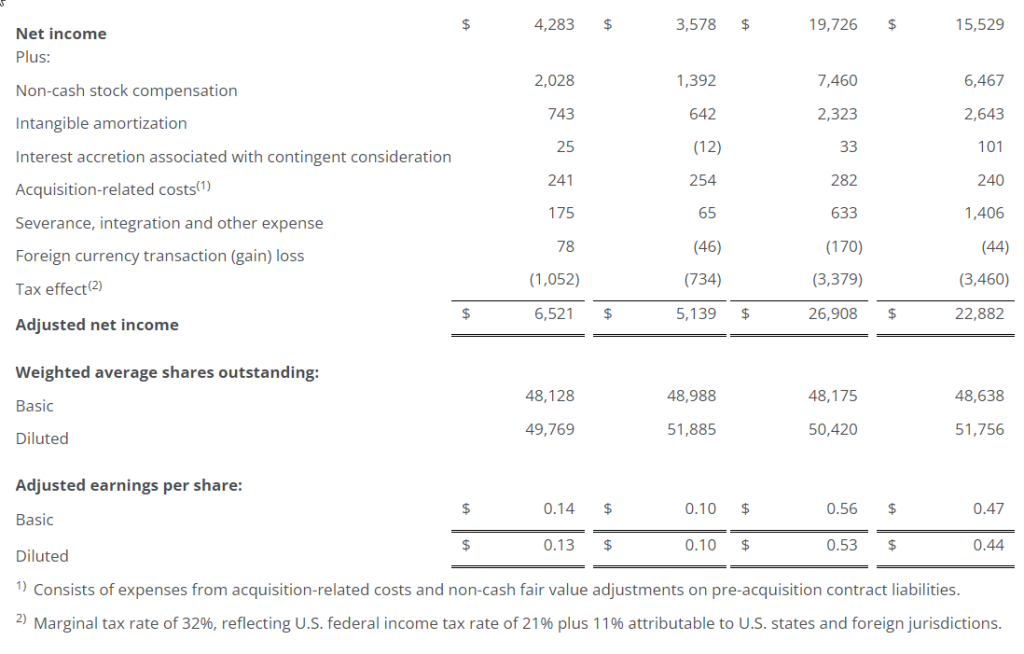
Reports fourth-quarter net income of $4 million, GAAP EPS of $0.09 and adjusted EPS of $0.13, all fourth-quarter records
Reports record fourth-quarter adjusted EBITDA of $11 million, exceeding guidance
Achieves record full-year results: GAAP revenues of $286 million, up 8% in constant currency; operating income of $29 million, up 17%; net income of $20 million, up 27%; adjusted net income of $27 million, up 18%, GAAP EPS of $0.39, up 30%; adjusted EPS of $0.53, up 20%; adjusted EBITDA of $43 million, up 11%
Declares first-quarter dividend of $0.04 per share, payable March 31, 2023, to shareholders of record as of March 20, 2023
As previously announced, amends credit agreement to include more favorable terms, an extended maturity date, elimination of $4.3 million of mandatory annual principal payments, and conversion to an all-revolving credit facility with $140 million of borrowing capacity
Sets first-quarter guidance: revenues between $73 million and $75 million and adjusted EBITDA between $10 million and $11 million
STAMFORD, Conn.–(BUSINESS WIRE)– Information Services Group (ISG) (Nasdaq: III), a leading global technology research and advisory firm, today announced record financial results for the fourth quarter and full year ended December 31, 2022.
“ISG delivered our best quarterly and full-year performance in our 17-year history—on every key financial metric,” said Michael P. Connors, chairman and CEO. “Fourth-quarter revenue and profitability reached record highs, led by double-digit operating growth in the Americas and Europe as client demand for efficiency and optimization escalates. Our suite of client solutions in digital transformation, cost optimization, research, workplace and governance services, supported by our successful ISG NEXT operating model, is a winning combination.”
Some clients, especially those in industries and geographies facing the toughest market conditions, are turning to ISG to help them optimize their IT and operating environments, Connors said. “Clients trust ISG for our unmatched combination of data, insights, expertise, tools and solutions to help streamline their technology and operating environments, reinvest in continuous transformation and get the most out of the collaboration between people and technology,” he said.
Fourth-Quarter 2022 Results
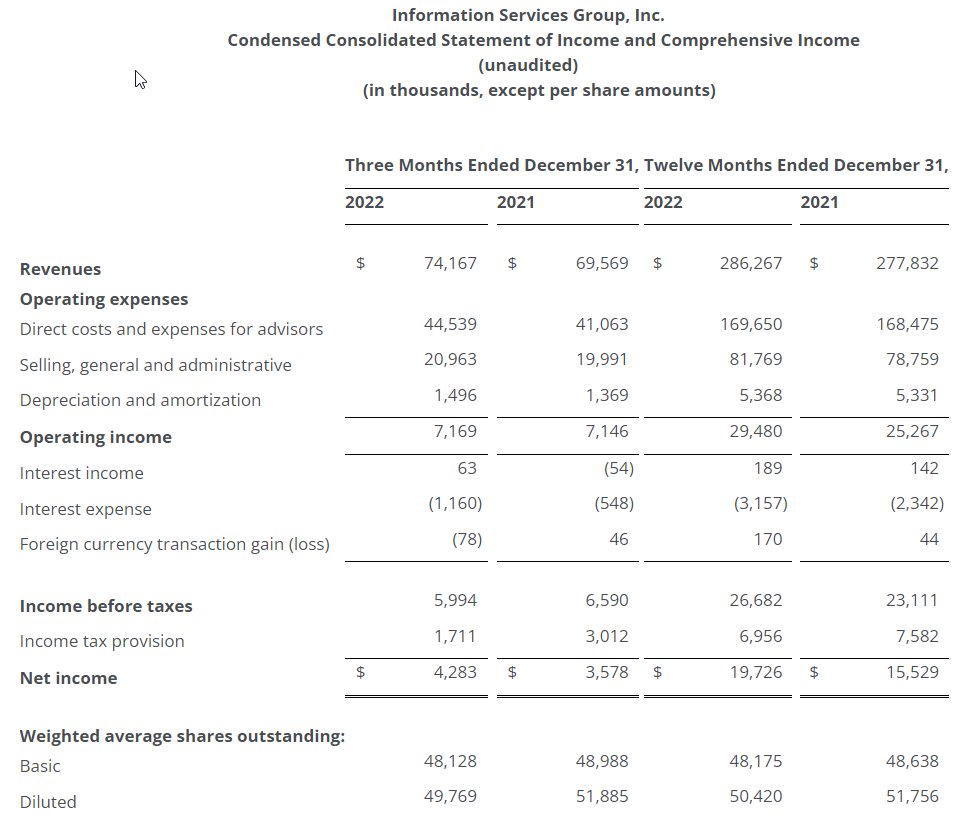
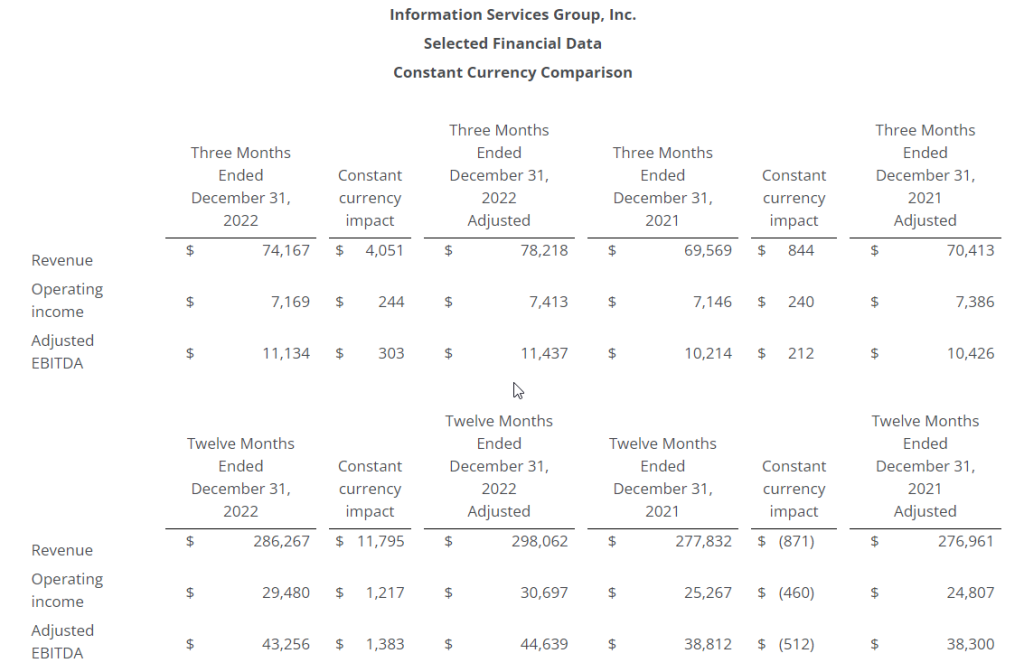
Reported revenues for the fourth quarter were a record $74.2 million, up 7 percent from $69.6 million in the prior year, and up 11 percent in constant currency. Currency translation negatively impacted reported revenues by $3.2 million versus the prior year. Reported revenues were $43.6 million in the Americas, up 12 percent; $23.9 million in Europe, up 1 percent on a reported basis and up 12 percent in constant currency; and $6.7 million in Asia Pacific, down 4 percent on a reported basis and up 5 percent in constant currency, all versus the prior year.
ISG reported fourth-quarter operating income of $7.2 million, flat versus the prior year. Reported fourth-quarter net income was a record $4.3 million, up 20 percent, compared with net income of $3.6 million in the prior year. Fully diluted earnings per share was a record $0.09, compared with $0.07 per fully diluted share in the prior year. Net income margin (calculated by dividing net income by reported revenues) increased to 5.8 percent, from 5.1 percent in the fourth quarter of 2021.
Adjusted net income (a non-GAAP measure defined below under “Non-GAAP Financial Measures”) for the fourth quarter was $6.5 million, or a record $0.13 per share on a fully diluted basis, compared with adjusted net income of $5.1 million, or $0.10 per share on a fully diluted basis, in the prior year’s fourth quarter.
Fourth-quarter adjusted EBITDA (a non-GAAP measure defined below under “Non-GAAP Financial Measures”) was a record $11.1 million, up 9 percent from the prior-year fourth quarter. Adjusted EBITDA margin (a non-GAAP measure calculated by dividing adjusted EBITDA by reported revenues) was 15 percent, up 33 basis points from the prior year.
Full-Year 2022 Results
Reported revenues for the full-year were a record $286.3 million, up 3 percent versus the prior-year, and up 8 percent in constant currency. Currency translation negatively impacted reported revenues by $12.7 million versus 2021. Reported revenues were $166.7 million in the Americas, up 4 percent; $89.9 million in Europe, flat on a reported basis and up 12 percent in constant currency; and $29.7 million in Asia Pacific, up 8 percent on a reported basis and up 16 percent in constant currency, all versus the prior year.
ISG reported record full-year operating income of $29.5 million, up 17 percent from $25.3 million in the prior year. The firm also reported record net income and fully diluted earnings per share of $19.7 million and $0.39, respectively, versus net income of $15.5 million and earnings per share of $0.30 in the prior year. Net income margin (calculated by dividing net income by reported revenues) increased to 6.9 percent, from 5.6 percent in the same period last year.
Adjusted net income (a non-GAAP measure defined below under “Non-GAAP Financial Measures”) for the full year was a record $26.9 million, or $0.53 per share on a fully diluted basis, compared with adjusted net income of $22.9 million, or $0.44 per share on a fully diluted basis, in the prior year.
Full-year adjusted EBITDA (a non-GAAP measure defined below under “Non-GAAP Financial Measures”) reached a record $43.3 million, up 11 percent from the prior year. Adjusted EBITDA margin (a non-GAAP measure calculated by dividing adjusted EBITDA by reported revenues) was a record 15 percent, up more than 110 basis points from the prior year.
Other Financial and Operating Highlights
ISG generated $6.6 million of cash from operations in the fourth quarter, compared with $2.5 million in the prior year, and $11.1 million for the full year. The firm’s cash balance totaled $30.6 million at December 31, 2022, up from $19.7 million at September 30, 2022.
During the fourth quarter, ISG paid dividends of $2.0 million, paid down $1.1 million of debt and drew down $9.0 million on its revolving credit agreement with the funds used for the acquisition of Change 4 Growth and for general operating purposes. As of December 31, 2022, ISG had $79.2 million in debt outstanding, compared with $74.5 million at the end of the fourth quarter last year. The firm’s gross-debt-to-adjusted-EBITDA ratio (a non-GAAP measure calculated by dividing outstanding debt by adjusted EBITDA) was 1.8 times, a record low for year end.
“Our strong operating results allowed us to return $23.6 million of capital to our shareholders in the form of dividends and share repurchases in 2022,” Connors said. “It also allowed us to amend our existing credit agreement, converting it to an all-revolver facility, with more favorable terms and an extended maturity date.”
Amended Credit Agreement
As previously announced, on February 22, 2023, ISG successfully amended the credit agreement that the firm originally entered into on March 10, 2020. The amended agreement provides $140 million of borrowing capacity at more favorable terms, converts the previous term and revolving loan into an all-revolving credit facility, eliminates $4.3 million of mandatory annual principal payments under the previous agreement, and extends the maturity date of the previous agreement by three years, to February 2028.
2023 First-Quarter Revenue and Adjusted EBITDA Guidance
“For the first quarter, ISG is targeting revenues of between $73 million and $75 million – including 200 basis points of FX headwinds – and adjusted EBITDA of between $10 million and $11 million. We will continue to monitor the macroeconomic environment, including the impact of FX, inflation and other factors, and adjust our business plans accordingly.”
Quarterly Dividend
The ISG Board of Directors declared a first-quarter dividend of $0.04 per share, payable on March 31, 2023, to shareholders of record as of March 20, 2023.
Conference Call
ISG has scheduled a call for 9 a.m., U.S. Eastern Time, Friday, March 10, 2023, to discuss the company’s fourth-quarter results. The call can be accessed by dialing +1 833-470-1428; or, for international callers, by dialing +1 929-526-1599. The access code is 356636. A recording of the conference call will be accessible on ISG’s website (www.isg-one.com) for approximately four weeks following the call.
Forward-Looking Statements
This communication contains “forward-looking statements” which represent the current expectations and beliefs of management of ISG concerning future events and their potential effects. Statements contained herein including words such as “anticipate,” “believe,” “contemplate,” “plan,” “estimate,” “target,” “expect,” “intend,” “will,” “continue,” “should,” “may,” and other similar expressions, are “forward-looking statements” under the Private Securities Litigation Reform Act of 1995. These forward-looking statements are not guarantees of future results and are subject to certain risks and uncertainties that could cause actual results to differ materially from those anticipated. Those risks relate to inherent business, economic and competitive uncertainties and contingencies relating to the businesses of ISG and its subsidiaries including without limitation: (1) failure to secure new engagements or loss of important clients; (2) ability to hire and retain enough qualified employees to support operations; (3) ability to maintain or increase billing and utilization rates; (4) management of growth; (5) success of expansion internationally; (6) competition; (7) ability to move the product mix into higher margin businesses; (8) general political and social conditions such as war, political unrest and terrorism; (9) healthcare and benefit cost management; (10) ability to protect ISG and its subsidiaries’ intellectual property or data and the intellectual property or data of others; (11) currency fluctuations and exchange rate adjustments; (12) ability to successfully consummate or integrate strategic acquisitions; (13) outbreaks of diseases, including coronavirus, or similar public health threats or fear of such an event; and (14) engagements may be terminated, delayed or reduced in scope by clients. Certain of these and other applicable risks, cautionary statements and factors that could cause actual results to differ from ISG’s forward-looking statements are included in ISG’s filings with the U.S. Securities and Exchange Commission. ISG undertakes no obligation to update or revise any forward-looking statements to reflect subsequent events or circumstances.
Non-GAAP Financial Measures
ISG reports all financial information required in accordance with U.S. generally accepted accounting principles (GAAP). In this release, ISG has presented both GAAP financial results as well as non-GAAP information for the three and twelve months ended December 31, 2022, and December 31, 2021. ISG believes that evaluating its ongoing operating results will be enhanced if it discloses certain non-GAAP information. These non-GAAP financial measures exclude non-cash and certain other special charges that many investors believe may obscure the user’s overall understanding of ISG’s current financial performance and the Company’s prospects for the future. ISG believes that these non-GAAP measures provide useful information to investors because they improve the comparability of the financial results between periods and provide for greater transparency of key measures used to evaluate the Company’s performance.
ISG provides adjusted EBITDA (defined as net income plus interest, taxes, depreciation and amortization, foreign currency transaction gains/losses, non-cash stock compensation, interest accretion associated with contingent consideration, acquisition-related costs, and severance, integration and other expense), adjusted net income (defined as net income plus amortization of intangible assets, non-cash stock compensation, foreign currency transaction gains/losses, interest accretion associated with contingent consideration, acquisition-related costs, and severance, integration and other expense, on a tax-adjusted basis), adjusted net income per diluted share, adjusted EBITDA margin, gross-debt-to-adjusted-EBITDA ratio and selected financial data on a constant currency basis which are non-GAAP measures that the Company believes provide useful information to both management and investors by excluding certain expenses and financial implications of foreign currency translations, which management believes are not indicative of ISG’s core operations. These non-GAAP measures are used by ISG to evaluate the Company’s business strategies and management’s performance.
We evaluate our results of operations on both an as reported and a constant currency basis. The constant currency presentation, which is a non-GAAP financial measure, excludes the impact of year-over-year fluctuations in foreign currency exchange rates. We believe providing constant currency information provides valuable supplemental information regarding our results of operations, thereby facilitating period-to-period comparisons of our business performance and is consistent with how management evaluates the Company’s performance. We calculate constant currency percentages by converting our current and prior-periods local currency financial results using the same point in time exchange rates and then compare the adjusted current and prior period results. This calculation may differ from similarly titled measures used by others and, accordingly, the constant currency presentation is not meant to be a substitution for recorded amounts presented in conformity with GAAP, nor should such amounts be considered in isolation.
Management believes this information facilitates comparison of underlying results over time. Non-GAAP financial measures, when presented, are reconciled to the most closely applicable GAAP measure. Non-GAAP measures are provided as additional information and should not be considered in isolation or as a substitute for results prepared in accordance with GAAP. A reconciliation of the forward-looking non-GAAP estimates contained herein to the corresponding GAAP measures is not being provided, due to the unreasonable efforts required to prepare it.
About ISG
ISG (Information Services Group) (Nasdaq: III) is a leading global technology research and advisory firm. A trusted business partner to more than 900 clients, including more than 75 of the world’s top 100 enterprises, ISG is committed to helping corporations, public sector organizations, and service and technology providers achieve operational excellence and faster growth. The firm specializes in digital transformation services, including automation, cloud and data analytics; sourcing advisory; managed governance and risk services; network carrier services; strategy and operations design; change management; market intelligence and technology research and analysis. Founded in 2006, and based in Stamford, Conn., ISG employs 1,600 digital-ready professionals operating in more than 20 countries—a global team known for its innovative thinking, market influence, deep industry and technology expertise, and world-class research and analytical capabilities based on the industry’s most comprehensive marketplace data. For more information, visit www.isg-one.com.
ISG (Information Services Group) (Nasdaq: III) is a leading global technology research and advisory firm. A trusted business partner to more than 700 clients, including more than 75 of the world’s top 100 enterprises, ISG is committed to helping corporations, public sector organizations, and service and technology providers achieve operational excellence and faster growth. The firm specializes in digital transformation services, including automation, cloud and data analytics; sourcing advisory; managed governance and risk services; network carrier services; strategy and operations design; change management; market intelligence and technology research and analysis. Founded in 2006, and based in Stamford, Conn., ISG employs more than 1,300 digital-ready professionals operating in more than 20 countries—a global team known for its innovative thinking, market influence, deep industry and technology expertise, and world-class research and analytical capabilities based on the industry’s most comprehensive marketplace data. For additional information, visit www.ISG-One.com
Joe Gomes, Managing Director – Generalist Analyst, Noble Capital Markets, Inc.
Joshua Zoepfel, Research Associate, Noble Capital Markets, Inc.
Refer to the full report for the price target, fundamental analysis, and rating.
4Q22 Results. ISG reported record fourth quarter revenue of $74.2 million, up from $69.6 million in the year ago period. FX negatively impacted revenue by $3.2 million. We had estimated $71 million. Fourth quarter net income was $4.3 million, GAAP EPS was $0.09, and adjusted EPS was $0.13. Adjusted EBITDA was $11.1 million, a 9% increase year-over-year. We forecasted net income of $4.45 million, EPS of $0.09, adjusted EPS of $0.13, and adjusted EBITDA of $10.6 million.
Segment Results. Reported revenues were $43.6 million in the Americas, up 12%; $23.9 million in Europe, up 1% on a reported basis and up 12% in constant currency; and $6.7 million in Asia Pacific, down 4% on a reported basis and up 5% in constant currency, all versus the prior year.
Equity Research is available at no cost to Registered users of Channelchek. Not a Member? Click ‘Join’ to join the Channelchek Community. There is no cost to register, and we never collect credit card information.
This Company Sponsored Research is provided by Noble Capital Markets, Inc., a FINRA and S.E.C. registered broker-dealer (B/D).
*Analyst certification and important disclosures included in the full report. NOTE: investment decisions should not be based upon the content of this research summary. Proper due diligence is required before making any investment decision.
Blackboxstocks, Inc. is a financial technology and social media hybrid platform offering real-time proprietary analytics and news for stock and options traders of all levels. Our web-based software employs “predictive technology” enhanced by artificial intelligence to find volatility and unusual market activity that may result in the rapid change in the price of a stock or option. Blackbox continuously scans the NASDAQ, New York Stock Exchange, CBOE, and all other options markets, analyzing over 10,000 stocks and up to 1,500,000 options contracts multiple times per second. We provide our users with a fully interactive social media platform that is integrated into our dashboard, enabling our users to exchange information and ideas quickly and efficiently through a common network. We recently introduced a live audio/video feature that allows our members to broadcast on their own channels to share trade strategies and market insight within the Blackbox community. Blackbox is a SaaS company with a growing base of users that spans 42 countries; current subscription fees are $99.97 per month or $959.00 annually. For more information, go to: www.blackboxstocks.com .
Joe Gomes, Managing Director – Generalist Analyst, Noble Capital Markets, Inc.
Joshua Zoepfel, Research Associate, Noble Capital Markets, Inc.
Refer to the full report for the price target, fundamental analysis, and rating.
New Partnership. On Friday, Blackboxstocks announced a partnership with Boosted.ai to enhance artificial intelligence within the Blackbox platform. The platform will be leveraging the partnership to provide actionable alerts for both day trading and long term investment strategies. The partnership will provide Blackboxstocks’ retail investors with sophisticated investment tools and strategies that were previously only available to institutional investors. We view the partnership as beneficial to the Blackbox platform for both new and existing users, along with being an additive to potential marketing to garner new users.
Who Is Boosted.ai? Boosted.ai helps institutional investors energize their equity portfolios with artificial intelligence. Through its point-and-click AI software – Boosted Insights – Boosted.ai assists asset managers in finding opportunities for their funds. Boosted Insights uses machine learning to empower fund managers to augment their investment process to source new ideas, manage risk, and create alpha.
Equity Research is available at no cost to Registered users of Channelchek. Not a Member? Click ‘Join’ to join the Channelchek Community. There is no cost to register, and we never collect credit card information.
This Company Sponsored Research is provided by Noble Capital Markets, Inc., a FINRA and S.E.C. registered broker-dealer (B/D).
*Analyst certification and important disclosures included in the full report. NOTE: investment decisions should not be based upon the content of this research summary. Proper due diligence is required before making any investment decision.
Modern fabrication tools such as 3D printers can make structural materials in shapes that would have been difficult or impossible using conventional tools. Meanwhile, new generative design systems can take great advantage of this flexibility to create innovative designs for parts of a new building, car, or virtually any other device.
But such “black box” automated systems often fall short of producing designs that are fully optimized for their purpose, such as providing the greatest strength in proportion to weight or minimizing the amount of material needed to support a given load. Fully manual design, on the other hand, is time-consuming and labor-intensive.
Now, researchers (MIT) have found a way to achieve some of the best of both of these approaches. They used an automated design system but stopped the process periodically to allow human engineers to evaluate the work in progress and make tweaks or adjustments before letting the computer resume its design process. Introducing a few of these iterations produced results that performed better than those designed by the automated system alone, and the process was completed more quickly compared to the fully manual approach.
The results are reported this week in the journal Structural and Multidisciplinary Optimization, in a paper by MIT doctoral student Dat Ha and assistant professor of civil and environmental engineering Josephine Carstensen.
The basic approach can be applied to a broad range of scales and applications, Carstensen explains, for the design of everything from biomedical devices to nanoscale materials to structural support members of a skyscraper. Already, automated design systems have found many applications. “If we can make things in a better way, if we can make whatever we want, why not make it better?” she asks.
“It’s a way to take advantage of how we can make things in much more complex ways than we could in the past,” says Ha, adding that automated design systems have already begun to be widely used over the last decade in automotive and aerospace industries, where reducing weight while maintaining structural strength is a key need.
“You can take a lot of weight out of components, and in these two industries, everything is driven by weight,” he says. In some cases, such as internal components that aren’t visible, appearance is irrelevant, but for other structures, aesthetics may be important as well. The new system makes it possible to optimize designs for visual as well as mechanical properties, and in such decisions, the human touch is essential.
As a demonstration of their process in action, the researchers designed a number of structural load-bearing beams, such as might be used in a building or a bridge. In their iterations, they saw that the design has an area that could fail prematurely, so they selected that feature and required the program to address it. The computer system then revised the design accordingly, removing the highlighted strut and strengthening some other struts to compensate, and leading to an improved final design.
The process, which they call Human-Informed Topology Optimization, begins by setting out the needed specifications — for example, a beam needs to be this length, supported on two points at its ends, and must support this much of a load. “As we’re seeing the structure evolve on the computer screen in response to initial specification,” Carstensen says, “we interrupt the design and ask the user to judge it. The user can select, say, ‘I’m not a fan of this region, I’d like you to beef up or beef down this feature size requirement.’ And then the algorithm takes into account the user input.”
While the result is not as ideal as what might be produced by a fully rigorous yet significantly slower design algorithm that considers the underlying physics, she says it can be much better than a result generated by a rapid automated design system alone. “You don’t get something that’s quite as good, but that was not necessarily the goal. What we can show is that instead of using several hours to get something, we can use 10 minutes and get something much better than where we started off.”
The system can be used to optimize a design based on any desired properties, not just strength and weight. For example, it can be used to minimize fracture or buckling, or to reduce stresses in the material by softening corners.
Carstensen says, “We’re not looking to replace the seven-hour solution. If you have all the time and all the resources in the world, obviously you can run these and it’s going to give you the best solution.” But for many situations, such as designing replacement parts for equipment in a war zone or a disaster-relief area with limited computational power available, “then this kind of solution that catered directly to your needs would prevail.”
Similarly, for smaller companies manufacturing equipment in essentially “mom and pop” businesses, such a simplified system might be just the ticket. The new system they developed is not only simple and efficient to run on smaller computers, but it also requires far less training to produce useful results, Carstensen says. A basic two-dimensional version of the software, suitable for designing basic beams and structural parts, is freely available now online, she says, as the team continues to develop a full 3D version.
“The potential applications of Prof Carstensen’s research and tools are quite extraordinary,” says Christian Málaga-Chuquitaype, a professor of civil and environmental engineering at Imperial College London, who was not associated with this work. “With this work, her group is paving the way toward a truly synergistic human-machine design interaction.”
“By integrating engineering ‘intuition’ (or engineering ‘judgement’) into a rigorous yet computationally efficient topology optimization process, the human engineer is offered the possibility of guiding the creation of optimal structural configurations in a way that was not available to us before,” he adds. “Her findings have the potential to change the way engineers tackle ‘day-to-day’ design tasks.”
Tesla’s “Investor Day” Reveals that Opportunities Exist in Ancillary EV Businesses
Investors may have absorbed more ideas from Elon Musk at Tesla’s Investor Day about related opportunities outside of Telsa (TSLA) than in the company itself. The founder was not as forthcoming as expected; however, he did confirm Tesla’s plans to build a fifth car assembly plant in Mexico. He also made reference to a next-gen vehicle and rolled out a $ 1-a-day subscription for owners in some regions for unlimited charging. Autonomous driving updates along with safety numbers were revealed, and how and why Tesla is going to solidify its supply chain and provide itself uninterrupted battery-grade lithium was of particular interest to investors in the metals and mining industries.
Musk on Metals and Mines
It was thought that both those attending in person and those streaming would be treated to a Tesla plan to acquire a mining operation in North or South America amid rampant demand for the material crucial to battery EVs. To respond to the speculation, Musk said the EV manufacturer is “mulling” the takeover of a miner. The miner most often discussed in relation to Tesla is Sigma Lithium Corp. (SGML).
What was more concrete on the battery manufacturing supply chain issue, is it was made clear Tesla is more focused on refining lithium than on mining it. The CEO of the most valuable car company in the world said the “limiting factor” is refining lithium, not actually finding it, as no country has a monopoly on deposits.
Not all investors and analysts can make it to the PDAC Mineral Exploration and Mining Conference in Toronto. In order for our subscribers to stay in the loop, Noble Capital Markets will be attending PDAC conference meetings and then interviewing select executives. This will be captured on video for the exclusive benefit of Channelchek subscribers (no cost). Learn more about the Channelchek Takeaway Series at PDAC.
Tesla has already broken ground on what will be a lithium refinery in Texas, it plans to start output within 12 months. According to a presentation by Drew Baglino, SVP of Tesla’s Powertrain and Energy Engineering department, the EV giant wants to process lithium concentrates into battery-grade lithium chemicals at the refinery in Texas.
As for the EV battery metal nickel, it’s only needed for “aircraft, long-range cars or trucks,” Musk said. “The vast majority of heavy lifting” of EV batteries will be iron-based batteries, and there’s plenty of iron in the world, he said.
The EV Industry Unfolding
Automakers are increasingly pushing into partnerships and ownership of the mining of commodities needed for their end product. Those that vertically integrate early will have their pick among the miners that are a better fit – and potentially priced before demand accelerates. Recently the car company Stellantis took a 14% stake in a subsidiary of McEwen Mining (MUX) that produces copper. And General Motors is said to be negotiating a stake in Vale SA’s base metals unit. In January, GM conditionally okayed a $650-million pact with Lithium Americas (LACCA) to develop a US lithium deposit.
Take Away
Telsa’s Investor Day included updates on autonomous cars and presentations that showed off the company executives, but it didn’t leave a buzz in the EV industry.
It was confirmed that EV manufacturers are eying companies that produce the ingredients they need for their cars to have power. Investors may want to explore producers of lithium, copper, cobalt, and nickel. Especially those closest to EV battery manufacturing facilities.
Blackboxstocks, Inc. is a financial technology and social media hybrid platform offering real-time proprietary analytics and news for stock and options traders of all levels. Our web-based software employs “predictive technology” enhanced by artificial intelligence to find volatility and unusual market activity that may result in the rapid change in the price of a stock or option. Blackbox continuously scans the NASDAQ, New York Stock Exchange, CBOE, and all other options markets, analyzing over 10,000 stocks and up to 1,500,000 options contracts multiple times per second. We provide our users with a fully interactive social media platform that is integrated into our dashboard, enabling our users to exchange information and ideas quickly and efficiently through a common network. We recently introduced a live audio/video feature that allows our members to broadcast on their own channels to share trade strategies and market insight within the Blackbox community. Blackbox is a SaaS company with a growing base of users that spans 42 countries; current subscription fees are $99.97 per month or $959.00 annually. For more information, go to: www.blackboxstocks.com .
Joe Gomes, Managing Director – Generalist Analyst, Noble Capital Markets, Inc.
Joshua Zoepfel, Research Associate, Noble Capital Markets, Inc.
Refer to the full report for the price target, fundamental analysis, and rating.
CEO Form 4. On February 27th, the SEC released a Form 4 filing by CEO Gust Kepler that reported Mr. Kepler’s purchase of 1,130,002 BLBX shares on February 23rd at a price of $3 per share. The purchased increased Mr. Kepler’s direct common stock holding to 3,462,070 shares. According to the Company, this was a private transaction not conducted on an exchange. Mr. Kepler also owned 3,269,998 Series A Preferred shares as of December 27, 2022 that can be converted into common shares.
Investor Reaction. On Monday, BLBX shares rose 47% to close at $0.81 on 16.8 million shares traded. Normal average daily volume is 554,000 shares and the last time BLBX shares traded consistently in the $3 level was back in 2021, excluding a one-time spike in the share price in April 2022.
Equity Research is available at no cost to Registered users of Channelchek. Not a Member? Click ‘Join’ to join the Channelchek Community. There is no cost to register, and we never collect credit card information.
This Company Sponsored Research is provided by Noble Capital Markets, Inc., a FINRA and S.E.C. registered broker-dealer (B/D).
*Analyst certification and important disclosures included in the full report. NOTE: investment decisions should not be based upon the content of this research summary. Proper due diligence is required before making any investment decision.
Will Tesla Investors be Inspired or Disappointed on March 1 (Investor Day)?
Tesla’s Investor Day is March 1st. The lead-up to these events is usually filled with speculation of how the founder, Elon Musk, may surprise EV fans and the investment community. Tesla’s (TSLA) innovations and unique marketing and distribution have made it the most valuable car company in the world. Part of that marketing is the mystique and confidence Musk brings whenever he has an audience. The company is also inspiring as it is less than 20 years in the making and is leading a revolution in how automobiles are built, driven, and fueled.
As plans are kept under wraps, most of the rumors as to what to expect fall in the category of speculation. Below are some of the most likely ideas from past announcements from Tesla and across the internet since the meeting date was announced.
Battery Production
Sourcing raw materials for batteries to make certain new EVs have all the needed components is becoming a concern among car manufacturers.
News has leaked of a proposed $3.6 billion Giga factory to produce up to 100 Gwh of batteries. The factory is expected to be in Nevada and eventually be used to assemble the Tesla semi when production eventually starts.
Tesla is expected to build a processing facility to make lithium hydroxide from spodumene concentrate in Corpus Christie, Texas. The location is good for shipping, and it is close to sources of sulfuric acid from the oil industry. This would be the first lithium hydroxide production facility in the U.S. If true, it would help Tesla fulfill the raw material sourcing requirements of the Inflation Reduction Act to qualify its cars for the $7,500 federal tax credit.
Those deals are at market prices; Tesla would reap the profits from processing the spodumene concentrate into hydroxide, but the bulk of the profit from the material supply accrues to the mining company. Tesla has hinted previously of plans to enter the lithium mining business.
The $25,000 EV
First mentioned in 2020, Tesla’s proposed $25,000 car earned the nickname “fluffy pillow” after Musk showed a picture of an object covered by a blanket that many thought resembled a large pillow. The project was put on hold in early 2022 when Musk said Tesla had too much on its plate.
Tesla’s existing best sellers, the Model 3 and Model Y, have been around for a while, a new model, whether it is the truck or an affordable entry level car would freshen up the line-up.
New Factory
Tesla’s production goals put it at or near capacity. The current factory capacity is listed as 1.9 million vehicles per year. The current goal is six million cars a year by 2026. This would require the expansion of existing plants and then some. A new factory takes three years to design, construct, and get rolling. So planning would have to start now. Musk is more likely to build a new plant than change his production goals.
Thoughts from across the internet suggest this could be in Indonesia or Mexico. Cars built in Mexico could qualify for the $7500 tax credit to purchasers.
Capital Raise
To accomplish the above requires money. Currently, there is construction in progress building out Tesla’s German and Texas factories. Billions more would be needed to implement other plans.
There is as of recent reporting, $22 billion in cash on Tesla’s balance sheet. This is a snapshot of quarter-end and not an accurate representation of the company’s finances. Offsetting this large number is $15 billion in trade payables and $7 billion in accrued payables, much of which is due soon.
Tesla may have to go to the market to raise cash for projects that will be presented on March 1st.
About Tesla Day
The investor event will be live-streamed from Tesla’s Gigafactory in Texas, with some of the company’s institutional and retail investors attending in person. According to Tesla’s press release, investors will be able to see its most advanced production line as well as discuss long-term expansion plans, the generation 3 platform, and capital allocation.
What Sectors Outperformed the Market after the PCE Inflation Shock?
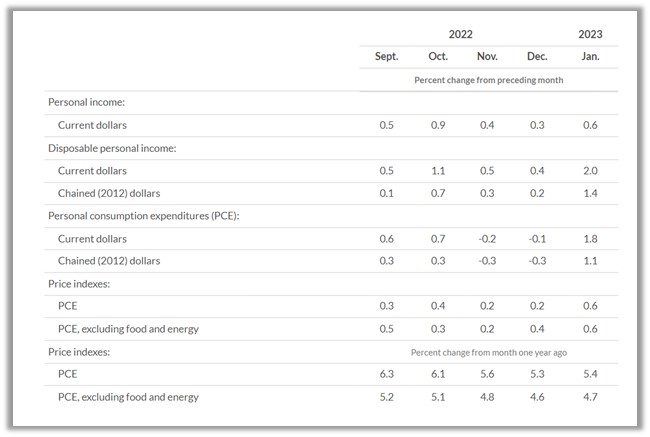
When an investor inquires, “What stocks do well with high inflation?” they are often asking, “What sectors do well with rising interest rates?,” because inflation expectations often drive rate moves. The text book response usually given are: consumer staples, banks and financials, and commodities. The PCE indexes are considered the Fed’s preferred indicator of inflation trends. The PCE surprised markets on the high side when released on February 24th. What can investors now expect from higher-than-forecast inflation?
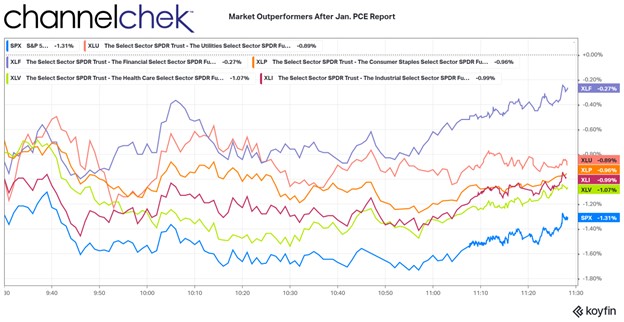
Rather than look at old information on what outperforms the overall market when inflation expectations rise, I thought it would be informative and more useful to see what is outperforming under current 2023 conditions and climate. The chart below and the remainder of this simple study is a snapshot three hours after the news settled in among investors (11:30am ET, February 24th).
There were five S&P sectors that outperformed the S&P 500 a few hours after the inflation number showed an almost across-the-board acceleration in price increases. At this point, the S&P 500 had already fallen 1.31%.
Beating the S&P larger index, but the worst of the five outperformers was Health Care (XLV). The Health sector is considered to be a necessity that consumers find a means to pay for regardless of cost. Within the sector there are companies providing goods and services that are more embraced by investors than others. Within the XLV, many stocks were green after the report.
Outperforming the Health Care sector were stocks making up the Industrial Sector (XLI). This includes large industrial manufacturers like John Deere, General Electric, and Caterpillar. Many of these companies have contracts well out into the future that assures business. What is not ordinarily assured is the cost of manufacturing which can go up with inflation. A number of the top holdings in XLI barely budged on the morning – GE was up .08%, Honeywell was down .18%, and UPS was down just .20%.
Almost even with the Industrial Sector was Consumer Staples (XLP). As with Health Care and to a lesser degree Industrials this sector is where money moves to during inflationary periods. Consumers may be postpone a new car purchase, but they’ll keep their buying habits unchanged for products produced by Colgate, Coca-Cola, Proctor and Gamble, or cigarette manufacturers.
Performing second best after the inflation numbers was the Utility sector (XLU). Again this follows the mindset that consumers can only cutback on water, electricity, and natural gas so much. It is more likely that cutbacks would come in other areas like entertainment, or technology. Technology was the worst performing sector.
The top performer, although still modestly negative, was the Financial sector. This includes insurance, banks and credit card companies, as well as investment firms. Banks, particularly those with a higher percentage of traditional banking business, benefit from a steepening yield curve. Banks use cash as their product line. They borrow short from customers, and lend longer term. As the yield curve steepens, their net income can be expected to rise. This may explain why two of the top three holdings were positive after the report, JP Morgan (JPM), and Wells Fargo (WFC). Brokerage firms also may benefit as accounts uninvested balances can be a source of revenue as financial firms earn interest on them. Rising rates means every balance they can earn on creates additional income.
Larger Index Observations
As indicated earlier, technology was the worst-performing sector. This causes the tech heavy Nasdaq to far underperform the other major indexes. The best performing a few hour after the open was the Dow Industrials, which is comprised of just 30 industrial stocks, many paying consistent dividends. The second best performer, beating both the Dow and S&P 500 was the Russell 2000 Small-Cap index. Small-cap stocks tend to be less affected when borrowing costs change, and tend to have more of their end customers located domestically. The U.S.-based customers is an advantage to smaller stocks when rising rates cause rising dollar values. A rising dollar makes goods or services from the U.S. more expensive overseas.
Take Away
The textbook reply to questions related to rising rates, inflation, and sector rotation in stocks held up after the surprise PCE index increase. Banks, and necessities like heat and consumer goods outperformed. Also small-cap stocks did not disappoint, they also held up better than the overall large cap universe.
One difficulty small and even microcap investors face is that information is less available on many of these companies. And there are a lot of them, including in the sectors that outperform with inflation. One easy way to find which smaller companies are rising to the top is Channelchek’s Market Movers tab. This can be viewed throughout the trading day by clicking here for the link.