AI and Skyborg Technology Will Create Huge Tech Winners

Can AI Skyborg Technology Create Unpredictable Yet Consistent Military Aircraft?

The word Skyborg conjures up images of Arnold and the Terminator movies. An artificial neural network-based conscious group mind and artificial general superintelligence system attempting to take over the world. (OK, technically in the movies it’s Skynet, not Skyborg.) So, what is Skyborg? And what are its implications for U.S. Defense?

According to the Air Force Research Laboratory, “Skyborg is an autonomy-focused capability that will enable the Air Force to operate and sustain low-cost, teamed aircraft that can thwart adversaries with quick, decisive actions in contested environments.” A key element of the program is the “loyal wingman” concept whereby one manned aircraft can control multiple unmanned aircraft, allowing for unmatched combat capability per dollar by lowering barriers to entry for industry and allowing continuous hardware and software innovation. Notably, however, Air Force policy dictates that people are always responsible for lethal decision-making. Therefore, Skyborg will not replace human pilots, but rather, Skyborg will provide human pilots with key data to support rapid, informed decisions.

To fast track this potential game changing capability, Skyborg was designated as a Vanguard program in 2019 by the Air Force. The Skyborg program topped the Air Force’s 2021 $3.2 billion Unfunded Priority List, illustrating the significance the Air Force is placing on the program. In 2021, the Air Force is expected to spend over $157 million on its three Vanguard programs, with an additional $25 million for Skyborg on the Unfunded Priorities List. By fiscal 2023, the Air Force expects to deliver the first operational versions of Skyborg.

Air Force Research Lab aerospace systems directorate engineer Matt Duquette explained the scope of the system: “Skyborg is a vessel for AI technologies that could range from rather simple algorithms to fly the aircraft and control them in airspace to the introduction of more complicated levels of AI to accomplish certain tasks or subtasks of the mission.” A major issue to solve is getting the AI up to speed. Skyborg requires more advanced systems than are currently available on the market. The system not only has to be more sophisticated than any AI available now but also has to be developed for a world that understands how it works. If the AI is too predictable, it is easy to beat, rendering it useless in a combat setting.

A key element of the Skyborg program is “attributable” unmanned aircraft. Attributable UASs blur the line between a reusable UAS (think an MQ-9 Reaper) and a single-use cruise missile. “Even though we call Skyborg an attributable aircraft, I think we’ll think of them more like reusable weapons,” says Will Roper, assistant secretary of the Air Force for acquisition, technology, and logistics. What this means in practice is that the new generation UASs will be reused until the end of service life, when they could then be turned into targets, or, depending on the mission, the UAS could go on a one-way mission if the pilot determined the target was important enough. This will result in a steady stream of UAS purchases by the Air Force.

Attributable aircraft costs are coming in in the less than $5 million per unit range. They compared this with the world’s most advanced fighter jet, the Lockheed Martin F-35, which costs around $100 million per jet. Four of these in formation means almost half a billion dollars of hardware in the air. Losing just one fighter is costly for the US Air Force’s budget, to say nothing about the potential human cost. Using attributable aircraft can potentially save millions providing enormous flexibility to the Air Force budget at a time when every dollar truly counts.

Skyborg will represent a significant upgrade in force projection. At a cost of a few million dollars per unit, the autonomous drones are more easily replaceable and could form a central role in the USAF’s air power. The F-35 is billed as a force-multiplier; when partnered with an UAS it could get a new capability boost.

If we needed another reason to look at AI technology or aerospace contractors as investments ready to take flight, here it is.


Suggested Reading:

Unmanned Momentum Continues with Recent $35 Million Award

Virtual Power Plants and Tesla Car Batteries

The Case for Silver

Enjoy Premium Channelchek Content at No Cost

Each event in our popular Virtual Road Shows Series has maximum capacity of 100 online investors. To take part, listen to and perhaps get your questions answered, see which virtual investor meeting intrigues you here.

SIERRA METALS REPORTS SOLID SECOND QUARTER 2020 PRODUCTION RESULTS

SIERRA METALS REPORTS SOLID SECOND QUARTER 2020 PRODUCTION RESULTS INCLUDING STRONG PRODUCTION FROM BOLIVAR, DESPITE THE IMPACT OF THE COVID-19 PANDEMIC


Toronto, ON – July 15, 2020Sierra Metals Inc. (TSX: SMT) (BVL: SMT) (NYSE AMERICAN: SMTS) (“Sierra Metals” or “the Company”) is pleased to report second-quarter 2020 production results featuring the strong operational performance at its Bolivar Mine.

Results are from Sierra Metals’ three underground mines in Latin America: The Yauricocha polymetallic mine in Peru, and the Bolivar copper and Cusi silver Mines in Mexico.

Second Quarter 2020 Production Highlights

  • Copper production of 9.7 million pounds; in-line with Q2 2019
  • Silver production of 0.6 million ounces; a 32% decrease from Q2 2019
  • Gold production of 2,762 ounces; a 9% increase from Q2 2019
  • Zinc production of 13.7 million pounds; a 17% decrease from Q2 2019
  • Lead production of 6.4 million pounds; a 21% decrease from Q2 2019
  • Copper equivalent production of 22.7 million pounds; a 10% decrease from Q2 2019
  • Production at Yauricocha and Bolivar impacted in April and May due to the government-imposed shutdowns to contain the advancement of COVID-19.
  • Cusi remained under care and maintenance throughout the quarter

Quarterly throughput from the Yauricocha and Bolivar Mines was negatively impacted by the shutdowns announced by the Peruvian and the Mexican Governments to contain the advancement of the COVID-19 pandemic. Both the mines, while maintaining essential activities, operated at reduced capacities for the April and May months. These restrictions were relaxed for mining companies in June (as announced in our Press Release dated June 5, 2020), and the Company began to recall its furloughed employees and started ramping up the operations to full capacity. The Cusi mine remained under care and maintenance throughout the quarter, due to its proximity to urban communities.

Consolidated production of copper remained in-line at 9.7 million pounds, silver decreased 32% to 0.6 million ounces, lead decreased 21% to 6.4 million pounds, zinc declined 17% to 13.7 million pounds, and gold increased 9% to 2,762 ounces compared to Q2 2019. Consolidated silver production dropped since there was no production at Cusi during the quarter, while gold production increased largely due to higher gold grades from the Bolivar Mine.

The Yauricocha Mine experienced a 20% reduction in throughput during Q2 2020 compared to Q2 2019, due to the afore-mentioned government-imposed state of emergency. The reduction in throughput was partially offset by higher head grades and higher silver and gold recoveries at Yauricocha, which resulted in a 15% decrease in copper equivalent pounds produced during Q2 2020 compared to Q2 2019.

At Bolivar, higher grades and recoveries were partially offset by the 5% decrease in throughput, resulting in a 24% increase in copper equivalent pounds produced during Q2 2020 compared to Q2 2019. A mere 5% decrease in throughput, despite the COVID-19 related shutdown, resulted from the increased plant capacity attributable to the expansion completed at the end of 2019.

Luis Marchese, President, and CEO of Sierra Metals, commented: “The Company had solid production results in the second quarter despite the negative implications of the shutdowns that occurred due to the COVID-19 pandemic.  At Yauricocha and Bolivar, the Company was able to maintain essential activities while fully complying with the government protocols during the state of emergency. I want to thank our workers at the mines for their dedication and efforts during these difficult times, which lead the Company to have remarkably high productivity levels. While Cusi remained in care and maintenance due to its proximity to urban centers, we are working through a process that will allow us to safely return workers to the mine and ramp up production.  Through the period of downtime, we reviewed our processes at each mine site, targeting improving efficiencies and identifying optimized exploration sequencing to add to our reserves and resources. As we ramp-up towards full capacity, we continue to adhere to strict health protocols protecting our operations, our employees, and the communities in which we operate.”


Consolidated Production Results
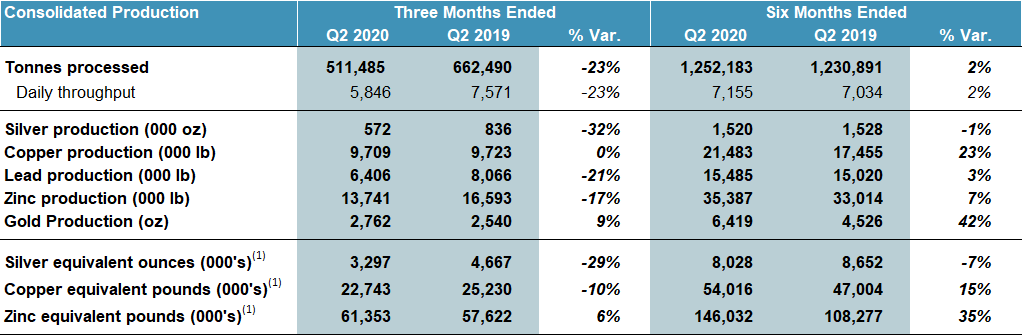
(1) Silver equivalent ounces and copper and zinc
equivalent pounds for Q2 2020 were calculated using the following realized
prices: $16.59/oz Ag, $2.40/lb Cu, $0.89/lb Zn, $0.76/lb Pb, $1,722/oz Au.
Silver equivalent ounces and copper and zinc equivalent pounds for Q1 2019 were
calculated using the following realized prices: $14.88/oz Ag, $2.75/lb Cu,
$1.20/lb Zn, $0.85/lb Pb, $1,323/oz Au. Silver equivalent ounces and copper and
zinc equivalent pounds for 6M 2020 were calculated using the following realized
prices: $16.58/oz Ag, $2.46/lb Cu, $0.91/lb Zn, $0.78/lb Pb, $1,654/oz Au.
Silver equivalent ounces and copper and zinc equivalent pounds for 6M 2019 were
calculated using the following realized prices: $15.23/oz Ag, $2.80/lb Cu,
$/1.22lb Zn, $0.90/lb Pb, $1,314/oz Au.


Yauricocha Mine, Peru

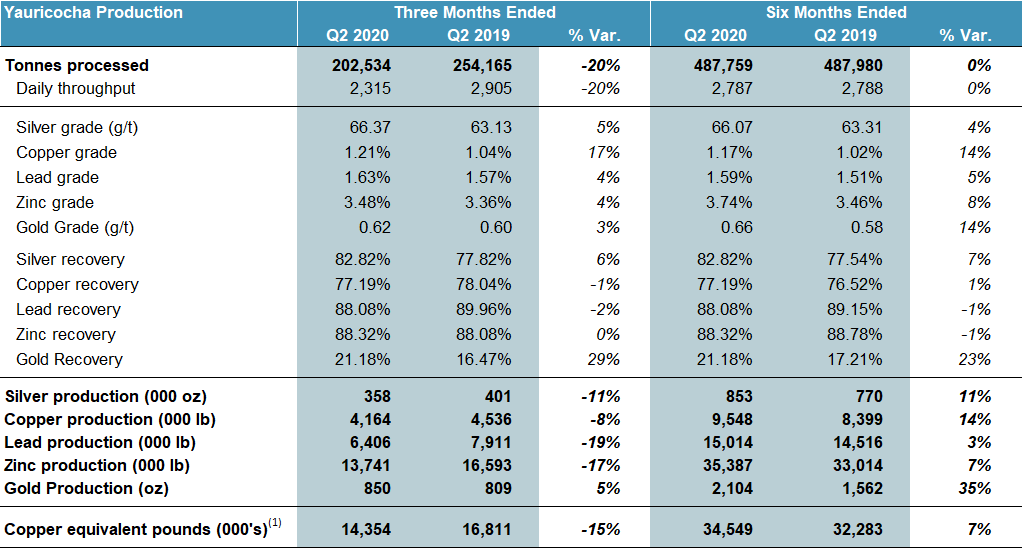
The Yauricocha Mine processed 202,534 tonnes during Q2 2020, which is a 20% decrease from Q2 2019. The decline resulted from the government-imposed state of emergency, which remained in force until June 4, 2020, when the Peruvian government announced the resumption of mining activities as part of phase two of its economic recovery plan. Gradually ramping up its operation, the mine achieved an average throughput of approximately 2,600 tpd in June. The average production for Q2 2020 was 2,315 tpd.  The Yauricocha mine has the operational flexibility to recover part of the lost production.

Higher head grades and higher silver and gold recoveries partially offset the impact of lower throughput resulting in a 15% decrease in copper equivalent metal production compared to Q2 2019. Copper and lead recoveries were slightly below the Q2 2019 recoveries, while zinc recoveries were in-line with Q2 2019. Head grades for all metals were higher due to the mining in the cuerpos chicos. Copper grades were particularly higher as a greater proportion of copper sulphides were processed versus polymetallic ore as compared to Q2 2019. Installation of the SK-240 cells and grade analyzers helped achieve higher silver and gold recoveries.

A summary of production from the Yauricocha Mine for Q2 2020 is provided below:
(1) Silver equivalent ounces and copper and zinc
equivalent pounds for Q2 2020 were calculated using the following realized
prices: $16.59/oz Ag, $2.40/lb Cu, $0.89/lb Zn, $0.76/lb Pb, $1,722/oz Au.
Silver equivalent ounces and copper and zinc equivalent pounds for Q1 2019 were
calculated using the following realized prices: $14.88/oz Ag, $2.75/lb Cu,
$1.20/lb Zn, $0.85/lb Pb, $1,323/oz Au. Silver equivalent ounces and copper and
zinc equivalent pounds for 6M 2020 were calculated using the following realized
prices: $16.58/oz Ag, $2.46/lb Cu, $0.91/lb Zn, $0.78/lb Pb, $1,654/oz Au.
Silver equivalent ounces and copper and zinc equivalent pounds for 6M 2019 were
calculated using the following realized prices: $15.23/oz Ag, $2.80/lb Cu, $/1.22lb
Zn, $0.90/lb Pb, $1,314/oz Au.


Bolivar Mine, Mexico

The Bolivar Mine processed 308,951 tonnes in Q2 2020, which is a mere 5% decrease from the Q2 2019 throughput, despite the impact of COVID-19. The average daily throughput realized during the quarter was 3,531 tpd. Head grades for copper, silver, and gold were 8%, 44%, and 28% higher, respectively, as compared to Q2 2019. Higher head grades and higher copper and silver recoveries, partially offset by lower throughput, resulted in a 24% increase in copper equivalent pounds produced during Q2 2020 compared to Q2 2019. In Q2 2020, copper production increased by 7% to 5,544,000 pounds, silver production increased 41% to 214,000 ounces, and gold production increased 21% to 1,912 ounces compared to Q2 2019.

Development and infrastructure improvements, which were on hold during Q2 2020, are planned to resume in the second half of the year in the effort to push throughput at Bolivar to 5,000 tpd by the end of 2020. Copper grades are expected to increase during the second half of the year, as mining is planned in the Mina de Fierro and Bolivar West zones.

A summary of production for the Bolivar Mine for Q2 2020 is provided below:
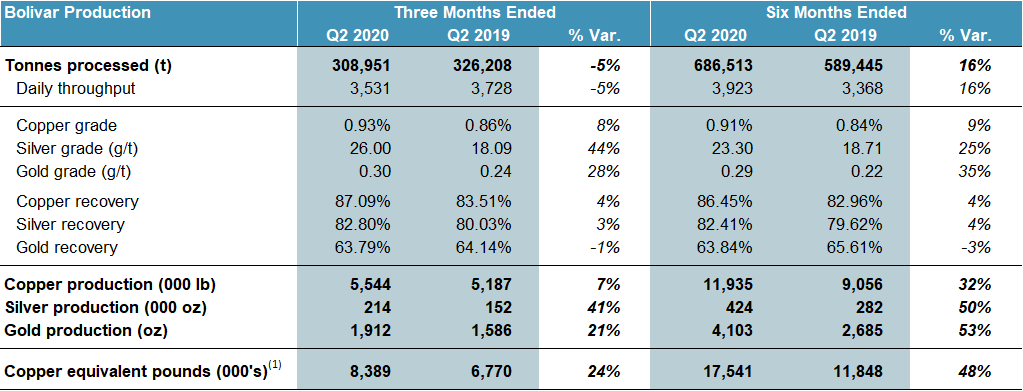
(1) Silver equivalent ounces and copper and zinc
equivalent pounds for Q2 2020 were calculated using the following realized prices:
$16.59/oz Ag, $2.40/lb Cu, $0.89/lb Zn, $0.76/lb Pb, $1,722/oz Au. Silver
equivalent ounces and copper and zinc equivalent pounds for Q1 2019 were
calculated using the following realized prices: $14.88/oz Ag, $2.75/lb Cu,
$1.20/lb Zn, $0.85/lb Pb, $1,323/oz Au. Silver equivalent ounces and copper and
zinc equivalent pounds for 6M 2020 were calculated using the following realized
prices: $16.58/oz Ag, $2.46/lb Cu, $0.91/lb Zn, $0.78/lb Pb, $1,654/oz Au.
Silver equivalent ounces and copper and zinc equivalent pounds for 6M 2019 were
calculated using the following realized prices: $15.23/oz Ag, $2.80/lb Cu,
$/1.22lb Zn, $0.90/lb Pb, $1,314/oz Au.


Cusi Mine, Mexico

The Cusi Mine remained in care and maintenance throughout the second quarter of 2020, due to the government-mandated shutdown to contain the advancement of COVID-19. As a result, there was no production from Cusi during the quarter. As announced in the press release dated June 18, 2020, this care and maintenance period has allowed the management team to complete an optimized view of the entire mine operation. Changes in the interpretation of the geological system have been made based on updated information from a stockwork tonnage system to a vein model system, which is expected to help better control and improve head grades, dilution and make better use of Cusi’s silver mineral resources.

Mine development is currently on-going at Cusi in a zone that will bypass the previously announced area of subsidence and provide access to higher-grade economic ore to provide feed for the mill. Production is expected to recommence after the mine development work is completed and once a process can be implemented at the mine to mitigate risk to employees at the site through a testing and quarantine methodology similar to the Company’s other operations.

The Company plans to drill an additional 1,000 meters to better understand the mineralization of the new high-grade silver zone in an area called Northeast – Southwest System of Epithermal Veins, as mentioned in the press release dated June 18, 2020.

The management team will continue to ramp throughput up to the targeted 1,200 tpd by the end of the year and will commence studies in the second half of the year for the potential expansion of Cusi.

A summary of production for the Cusi Mine for Q2 2020 is provided below:
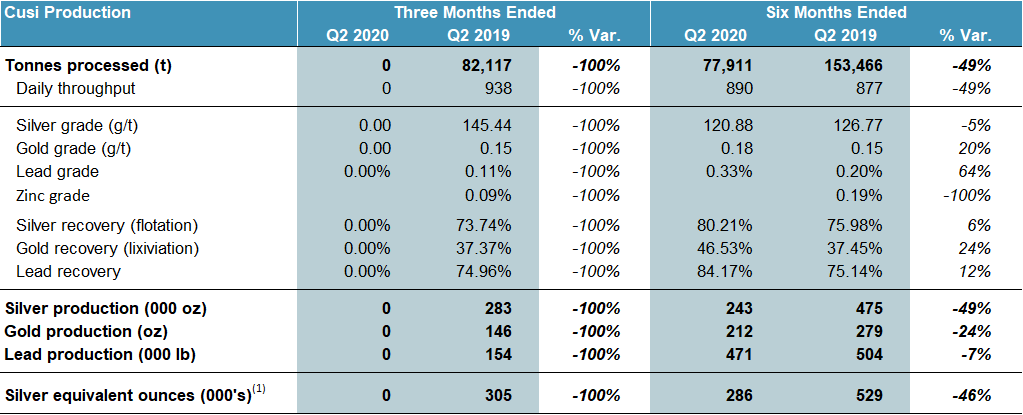
(1) Silver equivalent ounces and copper and zinc equivalent pounds for Q2 2020 were calculated using the following realized prices: $16.59/oz Ag, $2.40/lb Cu, $0.89/lb Zn, $0.76/lb Pb, $1,722/oz Au. Silver equivalent ounces and copper and zinc equivalent pounds for Q1 2019 were calculated using the following realized prices: $14.88/oz Ag, $2.75/lb Cu, $1.20/lb Zn, $0.85/lb Pb, $1,323/oz Au. Silver equivalent ounces and copper and zinc equivalent pounds for 6M 2020 were calculated using the following realized prices: $16.58/oz Ag, $2.46/lb Cu, $0.91/lb Zn, $0.78/lb Pb, $1,654/oz Au. Silver equivalent ounces and copper and zinc equivalent pounds for 6M 2019 were calculated using the following realized prices: $15.23/oz Ag, $2.80/lb Cu, $/1.22lb Zn, $0.90/lb Pb, $1,314/oz Au.


Quality Control

All technical data contained in this news release has been reviewed and approved by Americo Zuzunaga, FAusIMM CP (Mining Engineer) and Vice President of Corporate Planning is a Qualified Person and chartered professional qualifying as a Competent Person under the Joint Ore Reserves Committee (JORC) Australasian Code for Reporting of Exploration Results, Mineral Resources, and Ore Reserves.

Augusto Chung, FAusIMM CP (Metallurgist) and Consultant to Sierra Metals, is a Qualified Person and chartered professional qualifying as a Competent Person on metallurgical processes.


About Sierra Metals

Sierra Metals Inc. is a diversified Canadian mining company focused on the production and development of precious and base metals from its polymetallic Yauricocha Mine in Peru, and Bolivar and Cusi Mines in Mexico. The Company is focused on increasing production volume and growing mineral resources. Sierra Metals has recently had several new key discoveries and still has many more exciting brownfield exploration opportunities at all three Mines in Peru and Mexico that are within close proximity to the existing mines. Additionally, the Company also has large land packages at all three mines with several prospective regional targets providing longer-term exploration upside and mineral resource growth potential.

The Company’s Common Shares trade on the Bolsa de Valores de Lima and on the Toronto Stock Exchange under the symbol “SMT” and on the NYSE American Exchange under the symbol “SMTS”.

For further information regarding Sierra Metals, please visit www.sierrametals.com or contact:


Mike McAllister

V.P., Investor Relations
Sierra Metals Inc.
+1 (416) 366-7777

Email:
[email protected]  


Luis Marchese

CEO

Sierra Metals Inc.

+1(416) 366-7777

Continue to Follow, Like and Watch our progress:

Web: www.sierrametals.com | Twitter: sierrametals | Facebook: SierraMetalsInc | LinkedIn: Sierra Metals Inc
Instagramsierrametals


Forward-Looking Statements

This press release contains “forward-looking information” and “forward-looking statements” within the meaning of Canadian and U.S. securities laws (collectively, “forward-looking
information
“). Forward-looking information includes, but is not limited to, statements with respect to the date of the 2020 Shareholders’ Meeting and the anticipated filing of the Compensation Disclosure. Any statements that express or involve discussions with respect to predictions, expectations, beliefs, plans, projections, objectives, assumptions or future events or performance (often, but not always, using words or phrases such as “expects”, “anticipates”, “plans”, “projects”, “estimates”, “assumes”, “intends”, “strategy”, “goals”, “objectives”, “potential” or variations thereof, or stating that certain actions, events or results “may”, “could”, “would”, “might” or “will” be taken, occur or be achieved, or the negative of any of these terms and similar expressions) are not statements of historical fact and may be forward-looking information.

Forward-looking information is subject to a variety of risks and uncertainties, which could cause actual events or results to differ from those reflected in the forward-looking information, including, without limitation, the risks described under the heading “Risk Factors” in the Company’s annual information form dated March 30, 2020 for its fiscal year ended December 31, 2019 and other risks identified in the Company’s filings with Canadian securities regulators and the United States Securities and Exchange Commission, which filings are available at www.sedar.com and www.sec.gov, respectively.

The risk factors referred to above are not an exhaustive list of the factors that may affect any of the Company’s forward-looking information. Forward-looking information includes statements about the future and is inherently uncertain, and the Company’s actual achievements or other future events or conditions may differ materially from those reflected in the forward-looking information due to a variety of risks, uncertainties and other factors. The Company’s statements containing forward-looking information are based on the beliefs, expectations and opinions of management on the date the statements are made, and the Company does not assume any obligation to update such forward-looking information if circumstances or management’s beliefs, expectations or opinions should change, other than as required by applicable law. For the reasons set forth above, one should not place undue reliance on forward-looking information.


Sierra Metals (SMTS) – Better than Expected 2Q Production; Raising Estimates

Thursday, July 16, 2020

Sierra Metals (SMTS)(SMT:CA)

Better than Expected 2Q Production; Raising Estimates

As of April 24, 2020, Noble Capital Markets research on Sierra Metals is published under ticker symbols (SMTS and SMT:CA). The price target is in USD and based on ticker symbol SMTS. Research reports dated prior to April 24, 2020 may not follow these guidelines and could account for a variance in the price target.
Sierra Metals Inc is a precious and base metals producer in Latin America. The company acquires, explores, extracts, and produces mineral concentrates consisting of silver, copper, lead, zinc and gold in Mexico and Peru. Its activity includes the operation of the Yauricocha Mine in Peru, and the Bolivar and Cusi mines in Mexico. Yauricocha is an underground polymetallic mine using the sublevel block caving and cut-and-fill mining methods. Bolivar is a copper-silver-zinc-gold underground mine using room-and-pillar mining method. The majority of the revenue is earned by selling of the mineral concentrates to its customers in Peru.

Mark Reichman, Senior Research Analyst, Noble Capital Markets, Inc.

Refer to the full report for the price target, fundamental analysis, and rating.

    SMTS reports second quarter production results. Compared with the prior year period, second quarter production of copper was flat at 9.7 million pounds, while silver, lead and zinc decreased 31.6%, 20.6% and 17.2% to 572 thousand ounces, 6.4 million pounds and 13.7 million pounds, respectively. Gold production increased 8.7% to 2,762 ounces relative to the prior year period. Second quarter production was negatively impacted by government-mandated work constraints in Mexico and Peru. The decline in silver production was due to the Cusi mine being under care and maintenance. Despite the negative impact of COVID-related work restrictions, production levels were above our expectations due to a strong performance by the Bolivar mine.

    Updating estimates. We are increasing our 2020 and 2021 EPS estimates to $0.07 and $0.24 from $0.05 and $0.19, respectively. Our estimates reflect Cusi’s return to service in the third quarter and higher commodity prices. Recent strength in …


    Click to get the full report.

This Company Sponsored Research is provided by Noble Capital Markets, Inc., a FINRA and S.E.C. registered broker-dealer (B/D).

*Analyst
certification and important disclosures included in the full report. 
NOTE: investment decisions should not be based upon the content of
this research summary.  Proper due diligence is required before
making any investment decision.
 

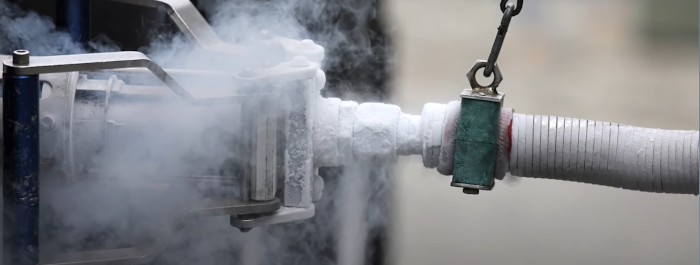
Covid-19 May be Killing the U.S. LNG Market

For How Long Will the World’s LNG projects Remain Frozen?

“…U.S. Energy firms alone are developing over 50 billion cubic feet per day (bcfd) of
new export capacity – more than all the worldwide consumption of LNG in 2019…”

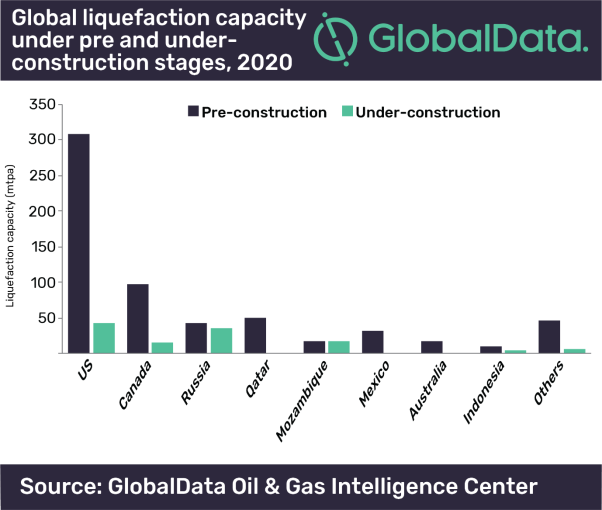
In recent months nearly half of the world’s Liquid Natural Gas (LNG) exporting projects have been delayed.  “Out of 45 major LNG export projects in pre-construction development globally, at least 20 – representing a capital outlay of some $292 billion – are now facing delays to their financing,” according to the Global Energy Monitor.  It is not unusual for multiple projects to be proposed to meet and compete for an identified need.  In fact, U.S. Energy firms alone are developing over 50 billion cubic feet per day (bcfd) of new export capacity – more than all the worldwide consumption of LNG in 2019, according to Refinitiv Eikon data.  As is often the case, not all projects will be completed.  Still, the pace of delays in LNG constructions is unprecedented.  So why are so many LNG terminals being delayed?  As is usually the case, the answer is multifaceted.


Global Economic Slowdown due to COVID is Sapping Demand. A global economic slowdown has decreased the demand for all fuels, including natural gas. 
Approximately 130 cargoes scheduled to be loaded between April and August at US LNG export terminals have been canceled by customers, according to Platts’ latest tally based on information from market sources. Power generation is down due to individuals working from home and avoiding out-of-home recreation.  This means less need for natural gas to power generators.  It also means less need for natural gas to heat businesses and commercial sites.  And less demand for natural gas means less demand for LNG cargoes.

Drop-in Oil and Gas Prices.  Oil and natural gas prices declined dramatically this spring.  A price war between Saudi Arabia and Russia cut oil prices in half, while a mild winter caused natural gas prices to decline.  Shipping LNG overseas only makes sense if the price differential between the two points is enough to cover the costs of liquifying, storing, shipping, and unliquifying the gas.  If energy prices drop, the differential often declines as well.  Costs, however, tend to be fixed, often above $2 per mcf.  In fact, when U.S. natural gas prices dropped below $2 per mcf, it cost more to ship the gas than it did to purchase the initial gas supply.  This has made the attractiveness of LNG less favorable than purchasing the gas domestically.

Too Many Projects.  As mentioned earlier, it is not unusual for multiple projects to be proposed to meet a single need.  These projects play a game of chicken until one project investor backs down and cancels.  That seems to be the situation in the case of proposed LNG projects. Soorya Tejomoortula, Oil and Gas Analyst at GlobalData, comments: “The global LNG sector was already witnessing an LNG supply glut and weak demand before the outbreak of COVID-19. The fall in gas prices and further weakening of LNG demand after the COVID-19 outbreak has accelerated this trend.

Growth of Renewable.  The growth of renewable energy sources for power generation has also sapped the demand for LNG and the willingness of purchasers to make long-term commitments.  LNG terminals cost billions of dollars and have long payback periods.  Developers seek out partners who will take on long-term outtake capacity to assure project profitability.  It is becoming increasingly difficult to find such partners, given an uncertain environment for natural gas.  “Investing in new fossil fuel infrastructure like liquefied natural gas (LNG) terminals is increasingly an economically unsound decision,” Andrew McDowell told Reuters in an email. The bank had announced in November that it would stop financing fossil fuel projects at the end of 2021.  Natural gas is commonly viewed as the premier fossil fuel to bridge the gas from coal to renewables.  Lately, that bridge is looking shorter.

Conclusion: The world energy market is dynamic.  Decades ago, LNG terminals were built to import gas into the United States.  In recent years, after the shale gas boom, exporting LNG terminals were built to ship gas overseas.  Lately, the pendulum has swung back to a point where the profitability of long-term U.S. gas exports is in question.  However, it would only take a resurgence in the global economy or a breakthrough in domestic gas production to make exporting natural gas profitable again.  

Suggested Content:

Energy Industry Report – Exploration and Production Second Quarter Review and Outlook

Ruling Out Nuclear Energy Now Could Be a Mistake

Video Interview with Indonesia Energy Corp.

Enjoy Premium Channelchek Content at No Cost

https://www.reuters.com/article/us-climate-change-gas/global-lng-projects-jeopardized-by-climate-concerns-pandemic-delays-report-idUSKBN247303, Matthew Green, Reuters, July 6, 2020

https://www.spglobal.com/platts/en/market-insights/latest-news/natural-gas/062320-freeport-lng-delays-target-for-sanctioning-fourth-liquefaction-train-until-at-least-2021, S&P Global Platts, June 23, 2020

https://finance.yahoo.com/news/did-covid-kill-lng-natural-092358695.html

https://oilmanmagazine.com/covid-19-triggers-delays-in-projects-and-investment-decisions-in-global-lng-liquefaction-sector/, Oilman Editor, Oilman Magazine, May 13, 2020

https://www.gasworld.com/covid-19-triggers-delays-in-lng-projects/2019106.article, Joanna Sampson, Gas World, May 15, 2020

https://theenergymix.com/2020/07/07/global-gas-bubble-has-nearly-half-of-new-lng-projects-facing-pandemic-delays-nervous-investors/, The Energy Mix, July 7, 2020

https://www.csis.org/blogs/energy-headlines-versus-trendlines/how-much-does-us-lng-cost-europe, Niko Tsafos, CSIS, July 5, 2019

Is the TV Rollup Strategy Over?

Will Broadcast Mergers and Acquisitions Surge?

It can be numbing how dramatically industries change in a decade. The fast-paced merger and acquisition (M&A) environment caused broadcast groups to become significantly larger. A Broadcast group ten years ago had, on average, 84 TV stations. The average has climbed dramatically, and today, the largest broadcast groups have an average of 147 TV stations.

As streaming services online grew, competition for TV advertising revenue became heated. One area of sales growth for the TV industry is retransmission revenue. These are fees that a station charges the cable operator to carry the local broadcast signal. The agreements extended to alternative video providers, including streaming services and satellite providers. To gain bargaining power to protect this growing revenue stream from television networks, which charge the stations to carry its programming, and from the large cable and satellite providers, and multiple video program distributors (MVPDs), broadcast groups needed to get bigger. This caused a surge of mergers and acquisitions of TV stations.

M&A Guidelines

There is a limit on how many television stations a company can own. The FCC limits the number of television households a broadcaster can cover, arbitrarily set at 39%. Broadcasters could skirt those limits by owning UHF frequency stations. These are stations that could be found on over the air channels ranging from channels 14 to 83.  The FCC counted the only ½ of the television households covered with a UHF signal. The theory was that UHF over the air signals were weaker and, for the most part, did not cover the entire area. Forget that cable and satellite providers that retransmit the UHF stations cover the entire area. Consequently, a broadcaster could theoretically cover 78% of total US households if 100% of the stations were UHF. The FCC lacked the Political will to lift the 39% ownership cap, even though it could not find enough reasons to justify the current cap. It decided to keep the UHF discount rule, even though that rule doesn’t hold water. This provided enough cover for broadcasters to continue the M&A wave and extend the reach of US Television households beyond 39%.

Current Conditions

Where do we stand now? Is this frequency of TV Station Sales sustainable? Will acquisition prices come down or go up as the available pool of acquisition targets diminish? Will the FCC lift ownership restrictions, which could reignite M&A activity? If television station acquisitions are not likely, where will broadcasters seek growth?

In short, the M&A of TV Stations can not continue at the pace enjoyed over the past ten years. Most station groups are near the ownership cap. For instance, the top 5 station group owners are at an average of 29.6% of their allowed 39% FCC coverage. Nexstar, the largest TV broadcaster, has already hit the 39% mark. As a result, it is likely that we are in the final stretch of M&A activity in Television, for now. At least until, and if, the FCC would lift ownership caps. This does not appear likely given the political environment in Washington

The top 30 TV station groups own approximately 1,234 US TV stations, and of that, 68% are owned by the top ten largest broadcasters. The two larger group owners with room to grow under the ownership caps are Gray Television and E.W. Scripps currently with 17% and 22% of US TV household coverage, respectively. But there are fewer attractive targets, save Graham Holdings and the broadcast segment of Meredith. Following those station groups, there is a long tail of owners with only a handful of stations. 

Notably, the revenue of those station groups is significantly smaller, averaging $117.5 million, which implies that acquisitions would not significantly move the needle for a larger group owner. Why is that important? In the go-go M&A environment of the 2005 to 2015 era, public market cash flow multiples expanded significantly. Acquired stations and station group cash flow multiples increased from 7.5 to a high of roughly 9 in 2019.  While 2020 has been an extraordinary year, deal multiples have come down to roughly seven this year.

Looking Forward

So what about acquisitions moving forward? It appears that there will be acquisitions of less-significant companies that hold smaller market TV stations. Smaller market TV stations typically do not have favorable growth profiles, do not get meaningful retransmission fees, or may not benefit from a huge upswing in Political advertising. While a broadcaster may benefit from acquired clauses that step up the target television station to its current Retransmission rate, but that assumes that the acquirer has a deal with the cable provider in the area of the acquired televisions station. With FCC ownership caps, the lack of availability of large companies for sale, and the stretched balance sheets of some larger broadcasters that recently acquired stations, it appears likely that station multiples will trend lower and that the age of the booming TV Station M&A is coming to an end.

TV station groups throw off a lot of cash flow. As such, it is possible that a non-industry player may look to TV ownership as a platform for its other business lines. Think Amazon buying Nexstar, for instance. Such a move would jump-start Amazon’s recent decision to enter the market with Live TV and linear programming. Acquisition targets for large station group owners likely will diverge, some focusing on original programming and other OTT and Digital platforms. So, just because there are a limited number of TV stations for sale, don’t think that the broadcast industry M&A is dead. It is likely that the industry will transform itself over the next ten years, much as it did over the past 10. 


Source:

Amazon Prime Videos’ Move To Go
Linear

Will there be an
Explosion of New Acquisitions?

Self-Directed
Investors Get Unexpected Benefit from Lockdown

Join Great Lakes Dredge & Dock CEO & President, Lasse Petterson and SVP & CFO, Mark Marinko for this exclusive corporate presentation, followed by a Q & A session moderated by Poe Fratt, Noble’s senior research analyst, featuring questions taken from the audience. Registration is free, but attendance is limited to 100.
Register
Now
  |  View
All Upcoming Road Shows

(No Cost) Virtual Road Show Series –
Wednesday, July 15th @ 11am EDT

Endeavour Silver (EXK) – EXK Unveils Final Terronera Preliminary Feasibility Study

Wednesday, July 15, 2020

Endeavour Silver (EXK)(EDR:CA)

EXK Unveils Final Terronera Preliminary Feasibility Study

As of April 24, 2020, Noble Capital Markets research on Endeavour Silver is published under ticker symbols (EXK and EDR:CA). The price target is in USD and based on ticker symbol EXK. Research reports dated prior to April 24, 2020 may not follow these guidelines and could account for a variance in the price target.
Endeavour Silver Corp is a precious metal mining company. The company is primarily engaged in silver mining and owns three high-grade, underground, silver-gold mines in Mexico. Its other business activities include acquisition, exploration, development, extraction, processing, refining and reclamation. The company is organized into four operating mining segments, Guanacevi, Bolanitos, El Cubo, and El Compas, which are located in Mexico as well as Exploration and Corporate segments. Its Exploration segment consists of projects in the exploration and evaluation phases in Mexico and Chile.

Mark Reichman, Senior Research Analyst of Natural Resources, Noble Capital Markets, Inc.

Refer to the full report for the price target, fundamental analysis, and rating.

    Highlights of the study. The final preliminary feasibility study (PFS) highlights enhanced project economics, including cumulative after-tax free cash flow of $217.4 million and a 30% internal rate of return based on silver and gold prices of $15.97 and $1,419 per ounce, respectively. The previous study released in 2018 forecast cumulative after-tax free cash flow of $193.2 million and a 23.5% IRR. Part of the difference is due to a 6.7% increase in processing capacity to 1,600 tons per day. Expected life of mine payable silver and gold ounces produced increased 6.8% and 22.4%, respectively, relative to the 2018 study.

    Next steps. Endeavour will proceed with a feasibility study over the next 12 months to bolster confidence in the project and enhance access to financing alternatives. Once a development decision is made, the project could …


    Click to get the full report

This research is provided by Noble Capital Markets, Inc., a FINRA and S.E.C. registered broker-dealer (B/D).

*Analyst
certification and important disclosures included in the full report. 
NOTE: investment decisions should not be based upon the content of
this research summary.  Proper due diligence is required before
making any investment decision.
 

Indonesia Energy Corp (INDO) – First Investor Conference Call Highlights Growth Opportunities

Wednesday, July 15, 2020


Indonesia Energy Corp (INDO)

First Investor Conference Call Highlights Growth Opportunities


Indonesia Energy Corp Ltd is an oil and gas exploration and production company focused on Indonesia. It holds two oil and gas assets through its subsidiaries in Indonesia: one producing block (the Kruh Block) and one exploration block (the Citarum Block). The Kruh Block is located to the northwest of Pendopo, Pali, South Sumatra. The Citarum Block is located to the south of Jakarta.

Michael Heim, Senior Research Analyst, Noble Capital Markets, Inc.

Refer to the full report for the price target, fundamental analysis, and rating.

    INDO management held their first ever conference call with the investment community. The company brought the full slate of its management team located both in Jakarta and California, including the Founder & CEO, President, Chief Investment Officer, COO and Chief Development Officer. The call mainly outlined its previously-announced drilling plans, but there were a few new items of interest.

    Drilling plans on track. The company is moving “full steam ahead” with its drilling plans despite lower oil prices. The company is finalizing bidding the drilling process and expects to drill the first of six oil wells in the Kruh Block in September. Each well will take …


Click to get the full report.

This Company Sponsored Research is provided by Noble Capital Markets, Inc., a FINRA and S.E.C. registered broker-dealer (B/D).

*Analyst
certification and important disclosures included in the full report. 
NOTE: investment decisions should not be based upon the content of
this research summary.  Proper due diligence is required before
making any investment decision.
 

Harte-Hanks (HRTH) – Why Switching Its Listing Can Create An Opportunity For Investors

Wednesday, July 15, 2020

Harte-Hanks Inc. (HRTH)

Why Switching Its Listing Can Create An Opportunity For Investors

Harte-Hanks is a marketing services company that provides multichannel marketing solutions as well as consulting, data analytics, and strategic assessment. The company’s offerings focus on business-to-business, retail, finance, and automotive segments through digital, social, mobile, and print media offerings. Harte-Hanks strives to develop better customer relationships through its marketing and analytical services for clients. The majority of its revenue is derived from its marketing services in the retail, technology, and consumer brand segments.

Michael Kupinski, Director of Research, Noble Capital Markets, Inc.

Refer to the full report for the price target, fundamental analysis, and rating.

    Switches listing to OTC. The company moved to the OTCQX market under the stock symbol HRTH from a NYSE listing as it faced delisting due to market cap requirements on the NYSE. We believe that the OTCQX is a good choice for the company given that the exchange has high reporting standards and could be a good stepping stone to a future NASDAQ listing, if, as we expect, the company continues on its turnaround.

    Fundamentals appear intact. We believe that the Covid mitigation efforts have had a relatively modest impact on its over all business. We anticipate that Adj. EBITDA will be positive in coming quarters and for the full year 2020.


    Click to get the full report

This Company Sponsored Research is provided by Noble Capital Markets, Inc., a FINRA and S.E.C. registered broker-dealer (B/D).

*Analyst
certification and important disclosures included in the full report. 
NOTE: investment decisions should not be based upon the content of
this research summary.  Proper due diligence is required before
making any investment decision.
 

DLH Announces Executive Appointments

DLH Announces Executive Appointments

Atlanta, Georgia – July 13, 2020 – DLH Holdings Corp. (NASDAQ: DLHC) (“DLH” or the “Company”), a leading healthcare and human services provider to the federal government, today announced executive leadership appointments effective July 13, 2020. Jeanine Christian joins DLH as President, Social & Scientific Systems (“S3”), and Jacqueline Everett is appointed as DLH Chief Growth Officer.

In her role as President of the Company’s S3 operating unit, Ms. Christian succeeds Kevin Beverly and will lead operations focused on the Public Health and Life Sciences market. Having spent over 20 years in science-based organizations, she most recently led a team of over 300 scientists, clinicians, researchers, and data analysts whose mission it was to translate scientific discovery and technology advances into societal benefits for federal and state government, non-profit, academic, and commercial clients. Ms. Christian’s last role was Vice President & Business Line Manager of the Public Health Research Division with Battelle Memorial Institute. Prior to that, she directed various impactful research programs as a Senior Study Director at Westat. As S3 President, her responsibilities will include strategic direction of the operating unit, customer relationship management, program execution, human resources, and generating business growth.

Ms. Everett joins DLH as Chief Growth Officer. In this role, she will spearhead enterprise-wide business development activities, establishing the vision, direction, and strategy required to achieve the Company’s growth objectives. She brings over 25 years of successful experience in the government contracting industry, most recently as Vice President Business Development & Strategy with Leidos. Prior to that, she held business development leadership positions with DXC Technology, CSC and Serco.

“I am proud to announce these changes to our leadership structure, which we are confident will enable DLH to further capitalize on our highly-talented workforce, broad capabilities, and longstanding demand for the services we provide,” said DLH President and CEO Zach Parker. “Jeanine’s scientific expertise, customer relationships, effective leadership, and results-oriented approach to business make her a fantastic fit for DLH. At the same time, Jackie Everett is recognized throughout our industry as an accomplished, dynamic leader. Her drive, motivation, and experience are expected to enable DLH to execute our strategic vision. I am pleased that both are joining us at this critical time in our growth trajectory.

“I also want to thank Kevin Beverly for his leadership and for being an invaluable partner throughout the acquisition and integration of S3 into DLH. With Kevin at the helm, S3 grew to be a leading public health service organization providing solutions in clinical and biomedical research, epidemiology, health policy, and program evaluation. He will remain on board in an advisory role to support us in this transition; we are grateful for his many contributions and wish him all the best as he writes his next chapter.”

About DLH
DLH (NASDAQ:DLHC) serves federal government clients throughout the United States and abroad delivering technology enabled solutions in key health and human services programs. The Company’s seven core competencies include secure data analytics, clinical trials and laboratory services, case management, performance evaluation, system modernization, operational logistics and readiness, and strategic digital communications. DLH has over 1,950 employees serving numerous government agencies. For more information, visit the corporate website at www.dlhcorp.com.

Safe Harbor Statement under the Private Securities Litigation Reform Act of 1995:

This press release may contain forward-looking statements within the meaning of the Private Securities Litigation Reform Act of 1995. These statements relate to future events or DLH`s future financial performance.  Any statements that refer to expectations, projections or other characterizations of future events or circumstances or that are not statements of historical fact (including without limitation statements to the effect that the Company or its management “believes”, “expects”, “anticipates”, “plans”, “intends” and similar expressions) should be considered forward looking statements that involve risks and uncertainties which could cause actual events or DLH’s actual results to differ materially from those indicated by the forward-looking statements. These statements reflect our belief and assumptions as to future events that may not prove to be accurate. Our actual results may differ materially from such forward-looking statements made in this release due to a variety of factors. For a discussion of such risks and uncertainties which could cause actual results to differ from those contained in the forward-looking statements, see “Risk Factors” in the Company’s periodic reports filed with the SEC, including our Annual Report on Form 10-K for the fiscal year ended September 30, 2019, and subsequent filings we make with the SEC from time to time. The forward-looking statements contained herein are not historical facts, but rather are based on current expectations, estimates, assumptions and projections about our industry and business.  Such forward-looking statements are made as of the date hereof and may become outdated over time. The Company does not assume any responsibility for updating forward-looking statements, except as may be required by law.


INVESTOR RELATIONS
Contact: Chris Witty
Phone:  646-438-9385
Email:  [email protected]

Dyadic (DYAI) – Another Pharmaceutical Partnership is Established

Wednesday, July 15, 2020

Dyadic International Inc. (DYAI)

Another Pharmaceutical Partnership is Established

Dyadic International, Inc. is a global biotechnology company which is developing what it believes will be a potentially significant biopharmaceutical gene expression platform based on the industrially proven hyper productive engineered fungus Thermothelomyces heterothallica (formerly Myceliophthora thermophila), named C1.
The C1 microorganism, which enables the development and large scale manufacture of low cost proteins, has the potential to be further developed into a safe and efficient expression system that may help speed up the development, lower production costs and improve the performance of biologic vaccines and drugs at flexible commercial scales. Dyadic is using the C1 technology and other technologies to conduct research, development and commercial activities for the development and manufacturing of human and animal vaccines and drugs, such as virus like particles (VLPs) and antigens, monoclonal antibodies, Fab antibody fragments, Fc-Fusion proteins, biosimilars and/or biobetters, and other therapeutic proteins. Dyadic pursues research and development collaborations, licensing arrangements and other commercial opportunities with its partners and collaborators to leverage the value and benefits of these technologies in development and manufacture of biopharmaceuticals. In particular, as the aging population grows in developed and undeveloped countries, Dyadic believes the C1 technology may help bring biologic vaccines, drugs and other biologic products to market faster, in greater volumes, at lower cost, and with new properties to drug developers and manufacturers, and improve access and cost to patients and the healthcare system, but most importantly save lives.

Ahu Demir, Ph.D., Biotechnology Research Analyst, Noble Capital Markets, Inc.

Refer to the full report for the price target, fundamental analysis, and rating.

    Dyadic added one more pharma collaboration to it’s partnership portfolio. Dyadic has established multiple research collaborations assessing C1 technology to manufacture various biologic products including Fc-fusion proteins, monoclonal antibodies, Fabs, bi or tri-specifics, gene therapy, vaccines, and others. The company established an additional partnership with a top 5 pharmaceutical company.

    Favorable risk/reward profile. We believe these partnerships provide a favorable risk/reward profile for the C1 platform. Similar to others, this partnership is also a fully-funded research collaboration. The partners are responsible for the research costs evaluating C1 technology. These partnerships increase …


    Click to get the full report

This Company Sponsored Research is provided by Noble Capital Markets, Inc., a FINRA and S.E.C. registered broker-dealer (B/D).

*Analyst
certification and important disclosures included in the full report. 
NOTE: investment decisions should not be based upon the content of
this research summary.  Proper due diligence is required before
making any investment decision.
 

TherapeuticsMD (TXMD) – Expanded Patient Access of Annovera

Wednesday, July 15 2020

TherapeuticsMD Inc. (TXMD)

Expanded Patient Access of Annovera

(current) TherapeuticsMD, Inc. is a women’s healthcare company focused on developing and commercializing products targeted exclusively for women. It manufactures and distributes branded and generic prescription prenatal vitamins, as well as over-the-counter vitamins and cosmetics, under our vitaMedMD’ and BocaGreenMD’ brands. The company is currently developing advanced hormone therapy pharmaceutical products designed to alleviate the symptoms of and reduce the health risks resulting from menopause-related hormone deficiencies. It is also evaluating various other potential indications for our hormone technology, including oral contraception, preterm birth, vulvar and vaginal atrophy, and premature ovarian failure.

Ahu Demir, Ph.D., Biotechnology Research Analyst, Noble Capital Markets, Inc.

Refer to the full report for the price target, fundamental analysis, and rating.

    Expanding access to Annovera. TherapeuticsMD announced expansion of agreement with Nurx, the largest online practice for women’s health. Under this arrangement, Nurx will expand access to 300,000 patients across the country to TherapeuticsMD’s annual birth control ring Annovera.

    Meaningful development. Annovera net sales were $2.3 million in Q1 2020, the patient demand doubled compared to Q4 2019. In our opinion, Annovera’s access to Nurx patients will generate meaningful revenue for the company, in spite of Covid-19’s halt on …


    Click to get the full report

This research is provided by Noble Capital Markets, Inc., a FINRA and S.E.C. registered broker-dealer (B/D).

*Analyst
certification and important disclosures included in the full report. 
NOTE: investment decisions should not be based upon the content of
this research summary.  Proper due diligence is required before
making any investment decision.
 

E.W. Scripps (SSP) – Cashing In

Tuesday, July 14, 2020

E.W. Scripps Company (SSP)

Cashing In

The E.W. Scripps Co. (www.scripps.com) serves audiences and businesses through a growing portfolio of television, print and digital media brands. After approval of its acquisition of two Granite Broadcasting stations later this year, Scripps will own 21 local television stations as well as daily newspapers in 13 markets across the United States. It also runs an expanding collection of local and national digital journalism and information businesses including digital video news service Newsy. Scripps also produces television programming, runs an award-winning investigative reporting newsroom in Washington, D.C., and serves as the longtime steward of one of the nation�s largest, most successful and longest-running educational programs, Scripps National Spelling Bee. Founded in 1879, Scripps is focused on the stories of tomorrow.

Michael Kupinski, Director of Research, Noble Capital Markets, Inc.

Refer to the full report for the price target, fundamental analysis, and rating.

    Sale of Stitcher announced. The company announced the sale of its podcasting business, Stitcher, to Sirius XM for a total price (which includes earn outs) of $325 million, better than expected. The price includes $265 million in an upfront cash payment and $60 million in earn outs, spread over 2 years. Net proceeds are expected to be $210 million in the first year and $45 million over the next two years, which will be earmarked for debt reduction. The transaction is expected to close in Q3.

    Nexstar executes option. Nexstar announced plans to purchase WPIX TV from E.W. Scripps for predetermined price of $75 million. The transaction is expected to close in Q4. The company is expected to use the …


    Click to get the full report.

This research is provided by Noble Capital Markets, Inc., a FINRA and S.E.C. registered broker-dealer (B/D).

*Analyst
certification and important disclosures included in the full report. 
NOTE: investment decisions should not be based upon the content of
this research summary.  Proper due diligence is required before
making any investment decision.