Sierra Metals (SMTS)(SMT:CA) – Thoughts Ahead of Second Quarter Production and Financial Results

Monday, July 19, 2021

Sierra Metals (SMTS)(SMT:CA)
Thoughts Ahead of Second Quarter Production and Financial Results

As of April 24, 2020, Noble Capital Markets research on Sierra Metals is published under ticker symbols (SMTS and SMT:CA). The price target is in USD and based on ticker symbol SMTS. Research reports dated prior to April 24, 2020 may not follow these guidelines and could account for a variance in the price target.

Sierra Metals Inc is a precious and base metals producer in Latin America. The company acquires, explores, extracts, and produces mineral concentrates consisting of silver, copper, lead, zinc and gold in Mexico and Peru. Its activity includes the operation of the Yauricocha Mine in Peru, and the Bolivar and Cusi mines in Mexico. Yauricocha is an underground polymetallic mine using the sublevel block caving and cut-and-fill mining methods. Bolivar is a copper-silver-zinc-gold underground mine using room-and-pillar mining method. The majority of the revenue is earned by selling of the mineral concentrates to its customers in Peru.

Mark Reichman, Senior Research Analyst of Natural Resources, Noble Capital Markets, Inc.

Refer to the full report for the price target, fundamental analysis, and rating.

    Second quarter production and financial results. The company will release second quarter 2021 financial results after the market close on August 9 and will host an investor call on August 10 at 10:30 am ET. We expect the company to release second quarter production results this week after which we will update our financial estimates.

    Update on strategic review process.  At the latest, Sierra Metals expects to provide an update on its strategic review during its second quarter investor call on August 10. Recall that in January, Sierra Metals began a process to explore and evaluate potential strategic alternatives, including the sale of all or part of the company, a sale of some of the assets of the company, a merger or other …


This Company Sponsored Research is provided by Noble Capital Markets, Inc., a FINRA and S.E.C. registered broker-dealer (B/D).

*Analyst certification and important disclosures included in the full report. NOTE: investment decisions should not be based upon the content of this research summary.  Proper due diligence is required before making any investment decision. 

Eagle Bulk Shipping (EGLE) – 2021 EBITDA Estimate and Market Float Moving Higher

Monday, July 19, 2021

Eagle Bulk Shipping (EGLE)
2021 EBITDA Estimate and Market Float Moving Higher

Eagle Bulk Shipping Inc. is a US-based drybulk owner-operator focused on the Supramax/Ultramax mid-size asset class, which ranges from 50,000 and 65,000 deadweight tons in size; these vessels are equipped with onboard cranes allowing for the self-loading and unloading of cargoes, a feature which distinguishes them from the larger classes of drybulk vessels and provides for greatly enhanced flexibility and versatility- both with respect to cargo diversity and port accessibility. The Company transports a broad range of major and minor bulk cargoes around the world, including coal, grain, ore, pet coke, cement, and fertilizer. Eagle operates out of three offices, Stamford (headquarters), Singapore, and Hamburg, and performs all aspects of vessel management in-house including: commercial, operational, technical, and strategic.

Poe Fratt, Senior Research Analyst, Noble Capital Markets, Inc.

Refer to the full report for the price target, fundamental analysis, and rating.

    Moving 2021 EBITDA higher to reflect higher TCE rate assumptions and timing of acquisitions. Our 2021 EBITDA estimate moves higher to $216.9 million based on higher TCE rates of $20.7k/day. Higher TCE rates more than offset updated timing on the closing of acquisitions. After all acquisitions close, operating leverage will be high, with each $1.0k/day change in TCE rates impacting cash flow/EBITDA by $18.4 million, or ~$1.44/share.

    Recent sales by large shareholder is a positive event due to reduced overhang, higher public float and higher trading liquidity.  ATM equity offerings also expanding share count and public float. In June, GoldenTree Asset Management sold 1.95 million shares in a secondary offering priced at $46.50/share and reduced the ownership position from 3.0 million shares (22.6%) to 1.1 million shares (8.1%) …


This research is provided by Noble Capital Markets, Inc., a FINRA and S.E.C. registered broker-dealer (B/D).

*Analyst certification and important disclosures included in the full report. NOTE: investment decisions should not be based upon the content of this research summary.  Proper due diligence is required before making any investment decision. 

Bassett Furniture (BSET) – Raises Dividend, Increases Buyback Authorization

Monday, July 19, 2021

Bassett Furniture (BSET)
Raises Dividend, Increases Buyback Authorization

Bassett Furniture Industries Inc is a manufacturer, importer, and retailer of home furnishings products in the United States. It operates through the following segments: The Wholesale segment focuses on the design, manufacture, sourcing, sale, and distribution of furniture products. The Retail segment consists of company-owned stores. The Logistical Services segment offers shipping, delivery, and warehousing services.

Joe Gomes, Senior Research Analyst, Noble Capital Markets, Inc.

Refer to the full report for the price target, fundamental analysis, and rating.

    Dividend Increase. Basset’s Board of Directors approved a 12% increase in the quarterly dividend to $0.14 per share from a prior $0.125 per share. At the current price, the projected annual dividend of $0.56 per share equates to a 2.2% dividend yield. And this does not include the special dividend the Company often announces that has historically ranged in the $0.20-$0.35 per share range.

    Increases Buyback Authorization.  Bassett also increased its share repurchase authorization by $16 million to $20 million. Back in October 2018, Bassett had increased its authorization to $20 million, indicating the Company has repurchased $16 million of stock, or roughly 6.5% of the current market capitalization, since then. With the shares drifting lower since hitting a 52-week high of $37 in …


This Company Sponsored Research is provided by Noble Capital Markets, Inc., a FINRA and S.E.C. registered broker-dealer (B/D).

*Analyst certification and important disclosures included in the full report. NOTE: investment decisions should not be based upon the content of this research summary.  Proper due diligence is required before making any investment decision. 

Will Inflation be Transitory or Persistent?


Image Credit: Autorentals.com (Flickr)


When Will Investors Know if Inflation is Persistent, Not Transitory?


Is today’s high rate of Inflation transitory or persistent? This is the question the talking heads on TV are telling us we should be asking. It’s important to investors and non-investors alike, so let’s take a look.  Some forecasters expect that the past three months of notable increases in CPI are not the start of a long-term trend, but instead, a hiccup that will be short-lived. This camp includes the Federal Reserve Bank Chair, Jerome Powell. Other commenters are reading the tea leaves with much more concern. In their view, a flood of government spending and cheap money for all will continue to pull prices up.

The Consumer Price Inflation (CPI) statistics released last week are only the third data point well above the Fed 2% target. These three consecutive reports neither confirm an inflation spiral or show a slowing of price growth. So, although we know prices have risen, there are no hard conclusions if that will continue. How can we use these and other numbers to make investment decisions, borrowing decisions, and even spending decisions in our daily lives?


The two opposing views are typical when looking at the economic outcome of most unknowns. They’ll say, “on the one hand this, on the other hand, that,” In this case, on the one hand, prices are high because of built-up demand and pandemic-related shortages that will abate, and on the other hand, prices will continue up as there is ongoing cheap money available to spend to fulfill wants and whims. And then discussions also include all the other considerations, the basis months for the inflation is the early stages of the lockdown, people out of work, the bond market hasn’t panicked, etc. Seeing into the future with so many economic variables is rarely clear. And when there is a level of certainty, markets move fast to gobble up opportunity.

What We Did Learn Last Week

As reported Thursday, on a monthly basis, prices rose by 0.9% for the biggest single-month increase since June 2008. The core data (stripping out volatile items such as food and energy) reported US inflation grew from 3.8% over the previous 12 months in May to 4.5% running 12 months in June.

This third dramatic and higher increase provides a reason to lean toward betting on persistent inflation. Even when pulling out some of the more volatile items, consumer prices still soared last month. This challenges the view of most Fed members and others that high inflation during the US recovery will be temporary; so far, for a full quarter of 2021, they have been wrong.

Inflation had been largely absent for over a decade. A so-called reflation mindset started to blossom earlier this year as economies started to recover from the pandemic and inflation ticked higher. Investors moved cash to various areas to try and capitalize on the expected trend. Reflation investments tend to include assets that benefit from faster economic growth, price pressures or higher yields. Equities tend to benefit while fixed-rate bonds suffer. Specifically, in the stock market, small caps and cyclical sectors such as banks and energy producers are where investors look to gain more exposure. This year it also includes cruise operators, airlines, rental car places, and other “reopening” trades.

The enthusiasm for the “reflation trade” is not as popular as it was in late Spring. Some data supports those making a case that the reopening trade contributed to inflation in an unsustainable way. Lumber and other building product prices have since come down quite a bit from their highs, and home improvement sales are slumping. One-third of the price increases in June were from previously owned car price increases (10.5% increase over the previous month). Surely used car price increases won’t continue after the semiconductor shortage sorts itself out.

The Federal Reserve is officially in the transitory camp. Its stance is that as pent-up demand is fulfilled, global supply shortages ease and demand scales back. Inflation, they expect, will then fall back into their target range. This stance by itself helps keep the bond market from a strong reaction to the inflation reports. The bond market is forward-looking, with inflation expectations as its primary driver.

 What to Look For

Starting every day knowing that we are not smarter than the overall market is a prudent mindset. It helps us keep our “bets” in check while we lean toward and overweight in one direction or another rather than go in deep and run the risk of being wrong. If inflation continues well above 2% annualized and the economy shows signs of shrinking, it would be taken as a problem sign for the “transitory” camp. Additionally, if the supply shortages and pent-up demand wane and prices continue to escalate, the transitory argument will fall apart completely. Conversely, if economic numbers come in strong and the inflation pace slows, the “persistent” argument begins to fall apart. This would be good news for investors. Last week the Commerce Department reported retail sales were up 0.6% for June. This was above expectations and well above the 1.7% decline in May. This strong economic number gives a little more rope to both the persistent and the transitory arguments in this forecasting “tug-of-war.”  

Suggested Reading:


CPI Confirms Inflation Running Ahead of Interest Rates


Inflations Impact on Stocks


Sports and Esports M&A in High Gear


The New Space Race


Sources:

https://www.census.gov/retail/index.html


Stay up to date. Follow us:


Square’s Decentralized Finance Business


Image Credit: Chema Muñoz Rosa (Flickr)


Details of Square’s Bitcoin-based DeFi Platform Announcements


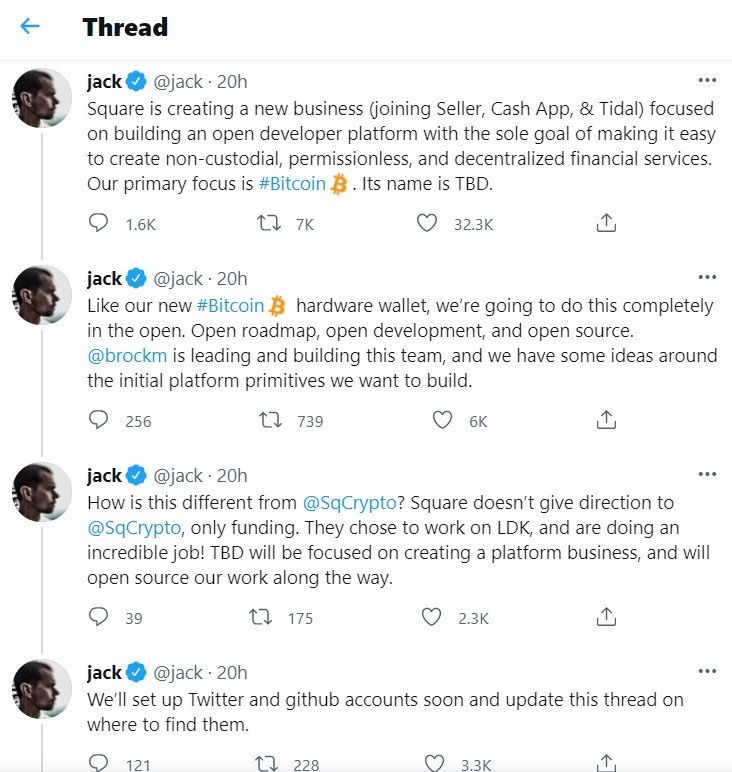
Square Inc. (SQ) CEO Jack Dorsey has made it known that Square is building a new division to focus on adding a DeFi service (decentralized finance) that will use the Bitcoin network.  The Twitter announcement on Friday (July 16) revealed Square’s plans for a new division to build an “open developer platform with the sole goal of making it easy to create non-custodial, permissionless, and decentralized financial services. Our primary focus is Bitcoin.”


Square Inc. and DeFi

Square Inc. was created just after the 2008-2009 financial crisis by entrepreneurs Jack Dorsey and Jim McKelvey. The technology company provides state-of-the-art merchant services including payment methods. Their platform is used by millions of small businesses to accept credit card payments, track sales and inventory, and secure financing. Defi or decentralized finance is a system for financial products to be made available on a public decentralized blockchain network. This allows them to be open for anyone to use, rather than needing an intermediary such as a bank. Unlike a bank or brokerage account, government-issued ID, Social Security number, or proof of address are not necessary for access. Succinctly, DeFi refers to a system by which software written on blockchains makes it possible for buyers, sellers, lenders, and borrowers to interact peer to peer or with a strictly software-based middleman.


Details

Dorsey made the announcement via his other company, Twitter. As head the division, Dorsey chose Mike Brock, who previously led a development team to integrate Bitcoin features for the Square cash app a few years back. Brock has open source experience through his work with enterprise open-source solutions provider Red Hat Inc. The new product is expected to heighten competition for Ethereum and their DeFi service.


Competition for Ethereum and Others

According to data from Defi Llama, Ethereum dominates the top 100 DeFi platforms in terms of locked value (TVL), with Aave topping the list with $9.09 billion in TVL. Binance also provides competition with platforms such as the eighth-ranked PancakeSwap, which has $3.76 billion in TVL. As for Bitcoin-based DeFi projects ranked on DeFi Llama is the Lightning Network, ranked at 103 with a TVL of $58.7 million. DeFi, especially DeFi based on Ethereum, shot up in 2021. Dune Analytics shows the total DeFi user base (measured by unique addresses) has grown from 1.1 million on January 1st to around 3 million in July.


Take-Away

The Bitcoin DeFi announcement follows up an earlier Tweet this month when Dorsey announced that Square Inc. will launch its own Bitcoin hardware wallet to provide assisted custody making the process easier for mainstream users. It remains to be seen whether this bolsters demand for Bitcoin-based DeFi and pulls from Ethereum’s momentum, or if this expanding market helps build usage, acceptance, and reliance on both Bitcoin and Ethereum based services while providing Square with a decentralized finance service for their customers.

Suggested Reading:


What are DAPPs (Decentralized Applications)?


Greener Alternatives to Bitcoin Mining


The Benefits of DeFi


Tweets, Tips, Taxes


Sources:

@Jack
Twitter
 

https://defillama.com/chain/Ethereum 

https://duneanalytics.com/hagaetc/eth2-0-deposits

https://cointelegraph.com/news/jack-dorsey-confirms-square-is-building-an-assisted-custody-btc-hardware-wallet

https://cointelegraph.com/news/defi-on-bitcoin-jack-dorsey-launches-new-square-division-to-make-it-easy

https://decrypt.co/76086/jack-dorsey-crypto-platform


Stay up to date. Follow us:


Squares Decentralized Finance Business


Image Credit: Chema Muñoz Rosa (Flickr)


Details of Square’s Bitcoin-based DeFi Platform Announcements


Square Inc. (SQ) CEO Jack Dorsey has made it known that Square is building a new division to focus on adding a DeFi service (decentralized finance) that will use the Bitcoin network.  The Twitter announcement on Friday (July 16) revealed Square’s plans for a new division to build an “open developer platform with the sole goal of making it easy to create non-custodial, permissionless, and decentralized financial services. Our primary focus is Bitcoin.”


Square Inc. and DeFi

Square Inc. was created just after the 2008-2009 financial crisis by entrepreneurs Jack Dorsey and Jim McKelvey. The technology company provides state-of-the-art merchant services including payment methods. Their platform is used by millions of small businesses to accept credit card payments, track sales and inventory, and secure financing. Defi or decentralized finance is a system for financial products to be made available on a public decentralized blockchain network. This allows them to be open for anyone to use, rather than needing an intermediary such as a bank. Unlike a bank or brokerage account, government-issued ID, Social Security number, or proof of address are not necessary for access. Succinctly, DeFi refers to a system by which software written on blockchains makes it possible for buyers, sellers, lenders, and borrowers to interact peer to peer or with a strictly software-based middleman.


Details

Dorsey made the announcement via his other company, Twitter. As head the division, Dorsey chose Mike Brock, who previously led a development team to integrate Bitcoin features for the Square cash app a few years back. Brock has open source experience through his work with enterprise open-source solutions provider Red Hat Inc. The new product is expected to heighten competition for Ethereum and their DeFi service.


Competition for Ethereum and Others

According to data from Defi Llama, Ethereum dominates the top 100 DeFi platforms in terms of locked value (TVL), with Aave topping the list with $9.09 billion in TVL. Binance also provides competition with platforms such as the eighth-ranked PancakeSwap, which has $3.76 billion in TVL. As for Bitcoin-based DeFi projects ranked on DeFi Llama is the Lightning Network, ranked at 103 with a TVL of $58.7 million. DeFi, especially DeFi based on Ethereum, shot up in 2021. Dune Analytics shows the total DeFi user base (measured by unique addresses) has grown from 1.1 million on January 1st to around 3 million in July.


Take-Away

The Bitcoin DeFi announcement follows up an earlier Tweet this month when Dorsey announced that Square Inc. will launch its own Bitcoin hardware wallet to provide assisted custody making the process easier for mainstream users. It remains to be seen whether this bolsters demand for Bitcoin-based DeFi and pulls from Ethereum’s momentum, or if this expanding market helps build usage, acceptance, and reliance on both Bitcoin and Ethereum based services while providing Square with a decentralized finance service for their customers.

Suggested Reading:


What are DAPPs (Decentralized Applications)?


Greener Alternatives to Bitcoin Mining


The Benefits of DeFi


Tweets, Tips, Taxes


Sources:

@Jack
Twitter
 

https://defillama.com/chain/Ethereum 

https://duneanalytics.com/hagaetc/eth2-0-deposits

https://cointelegraph.com/news/jack-dorsey-confirms-square-is-building-an-assisted-custody-btc-hardware-wallet

https://cointelegraph.com/news/defi-on-bitcoin-jack-dorsey-launches-new-square-division-to-make-it-easy

https://decrypt.co/76086/jack-dorsey-crypto-platform


Stay up to date. Follow us:


C-Suite Interview with Townsquare Media (TSQ) CEO Bill Wilson


Noble Capital Markets Senior Research Analyst Michael Kupinski sits down with Townsquare Media CEO Bill Wilson for this exclusive interview.

Research, News, and Advanced Market Data on TSQ


View all C-Suite Interviews

About Townsquare

Townsquare is a community-focused digital media, digital marketing solutions and radio company focused outside the Top 50 markets in the U.S. Our assets include Townsquare Interactive, a digital marketing services subscription business providing web sites, search engine optimization, social platforms and online reputation management for approximately 23,600 SMBs; Townsquare IGNITE, a proprietary digital programmatic advertising technology with an in-house demand and data management platform; and Townsquare Media, our portfolio of 322 local terrestrial radio stations in 67 cities with corresponding local news and entertainment websites and apps including legendary brands such as WYRK.com, WJON.com, and NJ101.5.com along with a network of national music brands including XXLmag.com, TasteofCountry.com, UltimateClassicRock.com and Loudwire.com. For more information, please visit www.townsquaremedia.com, www.townsquareinteractive.com, and www.townsquareignite.com.

Sports and Esports M&A in High Gear


Image Credit: K putt (Flickr)


Golden Age of Sports M&A to Take Place Over Next 24 Months


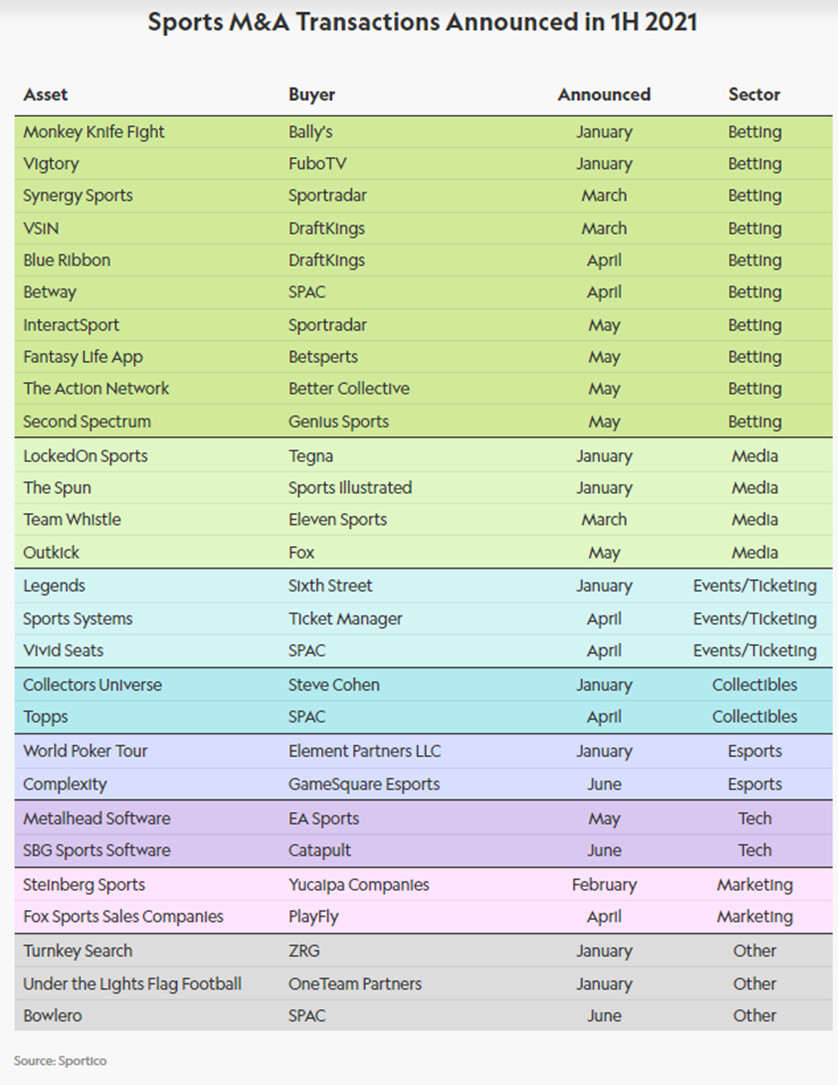
The first half of 2021 was particularly active for sports-related mergers and acquisitions. There were at least 10 deals announced within the sports betting and data category; a handful of large-scale transactions within collectibles (Topps, Collectors Universe, Goldin Auctions 2x), ticketing (Vivid Seats), events/experiential (Bowlero) and hospitality (Legends); and several smaller, more opportunistic acquisitions sprinkled across the ecosystem (The Spun, Locked On Sports Podcast Network). By comparison, one could count the number of deals announced in all of 2020 on two hands.

But dealmakers and private equity executives alike believe the second half will be even busier. In fact, Fifth Generation Sports CEO Chris Russo suggested the industry is likely headed into “the biggest bull market of sports M&A that [anyone] has ever seen.”


This article was originally published July 6, 2021 as part of the JohnWallStreet daily e-newsletter in Sportico. The e-newsletter is well respected in how it covers the business of sports. Cha


Our Take: H1 2021 may well be considered the beginning of sports M&A’s golden age, as several catalysts could drive transaction volume to even greater heights over the next 18 months. These include pent-up consumer demand (a result of the pandemic), the existence of three sectors ripe for consolidation (see: esports, sports betting, and collectibles) and the SPAC frenzy (a once-in-20-year phenomenon).


Coming out of social lockdown, the desire to live life again is high. It’s believed strong demand for live events will drive M&A opportunities. Experiential businesses were “hit really hard [over the last 15 months]. So, some [companies] are challenged [financially] and may need to sell,” Russo said. “People are also thinking about [creating] new retail experiences because of all the retail [businesses] that went belly up.” How much of that deal flow is M&A versus new business origination remains to be seen.

Enormous amounts of investment capital have been pumped into esports in recent years. But the disruption has not really led to consolidation within the business—at least not yet (save GameSquare Esports’ recent purchase of Jerry Jones’ Complexity Gaming). Russo suspects some could take place within the next 12-24 months, as businesses hurt by the absence of live events look to be swallowed up.

Sports betting was a particularly active M&A category in H1 2021. But there are a couple of reasons to think activity will accelerate. With nearly all of the large media outlets spoken for (in terms of content partnerships), operators will be looking for other ways to distinguish themselves. That could result in the acquisition of some marketing-tech companies and affiliate businesses. Of course, the process of picking off affiliate sites has already begun. We counted at least seven transactions involving sports betting affiliates over the last 18 months. The pending/potential legalization of mobile sports betting in large states, like New York and Florida (plus Canada), could also lead to some deals as operators look to quickly acquire users in those markets.


The fragmented collectibles business is ripe for consolidation. The industry now has a handful of big fish (see: SPAC-supported Topps, Steve Cohen-backed Collectors Holdings, Fanatics and Dapper Labs), but the majority of legacy collectibles-related companies still operate as mom-and-pop shops. Said Russo, “There is certainly potential for a lot of those [entities] to get rolled up or bought by some of the bigger players.” That would include companies looking to find their place in the digital collectibles world. It should be noted that Sportico reported Collectors Holdings agreed to purchase The Chernin Group-backed Goldin Auctions late last week.

One vertical unlikely to serve as a growth engine for M&A, however, is sports media. “When you think about sports media, a lot of the major deals have already been done (think: Fox RSNs),” Russo said. “There may be some smaller deals—we saw Outkick, The Spun and Locked On Sports Podcast Network all sold in H1 2021—but [there is unlikely to be] a whole lot happening in between.”

The large number of SPACs looking for a sports-themed company is expected to drive M&A activity, too (assuming the PIPE market holds it up). Remember, each SPAC that goes public needs to complete a business combination within two years (or return the money raised to shareholders and shutter the SPAC). As of June 24, Sportico’s SPAC tracker shows there are 113 sports-focused SPACs and/or SPACs led by sports executives currently planning an IPO (12), pricing an IPO (51) or seeking a target (50).

SPACs that get through (i.e., consummate a business combination) should also be acquisitive moving forward. “There’s a lot of pressure on SPAC companies, once they get de-SPAC’d, to grow quickly and buy things now that they have access to liquid currency,” Russo said. “If each of those companies buys two more [assets] each year, the amount of deals that will occur over the next 24 months will be astounding.”

SPAC acquisitions will be larger transactions (simply because that is the nature of SPACs and the public markets). But most of the deals that take place over the next 18 or so months—“roll-ups and niche buys,” Russo said—are likely to be of the middle-market variety (think: $25 million to $100 million). Strong demand and competitive marketplace dynamics could push asset valuations higher than they might otherwise be.

One of the reasons demand is expected to be so strong is because institutional investors only recently discovered that sports is a viable business. “The combination of COVID and a lot of investment activity just opened up everyone’s eyes that this is a category you can invest in. [Sports] might not provide the full upside you get from tech and venture. But you also don’t have the downside,” said a partner at one sports PE firm.

While we anticipate an active sports M&A market through the summer of 2023, team control transactions are likely to be few and far between. “For the most part, owners today want these teams to be legacy businesses that they pass down to their kids,” Russo said. The PE executive we spoke to agreed, before suggesting that limited partnership stake sales could ramp up as “people now accept they can invest in a team either through a fund or separately.”


Suggested Reading:


How Does the Esports Industry Make Money


Esports Investors are Now Better Able to Evaluate Performance Comparisons


Ad Tech – Back in the Saddle and Riding High


The Lifecycle of a SPAC


Special thanks to Sportico.

You can stay up to date on the business of sports by clicking their logo above.


Stay up to date. Follow us:


Euroseas Ltd. (ESEA) – Preferred Shares Converted and New Build Capex Update

Friday, July 16, 2021

Euroseas Ltd. (ESEA)
Preferred Shares Converted and New Build Capex Update

Euroseas Ltd. provides ocean-going transportation services worldwide. The company owns and operates containerships that transport dry and refrigerated containerized cargoes, including manufactured products and perishables; and drybulk carriers that transport iron ore, coal, grains, bauxite, phosphate, and fertilizers. As of March 31, 2017, it had a fleet of seven containerships; and six drybulk carriers, including three Panamax drybulk carriers, one Handymax drybulk carrier, one Kamsarmax drybulk carrier, and one Ultramax drybulk carrier. The company was founded in 2005 and is based in Maroussi, Greece.

Poe Fratt, Senior Research Analyst, Noble Capital Markets, Inc.

Refer to the full report for the price target, fundamental analysis, and rating.

    Strong stock price performance triggers conversion of preferred shares into common shares. ESEA recently notified Blackrock that it intended to issue a notice of redemption no earlier than July 9, 2021, and Blackrock converted the preferred shares into common shares at $14.05/share in June, as Preferred Friends Investment had earlier on June 15th. A total of 453k common shares were issued and the current share count is ~7.24 million shares.

    Updated timing of new builds.  Contracts signed for two Eco design fuel efficient 2,800 TEU containerships to be built at Hyundai Mipo Dockyard Co. in Korea at a total cost of ~$76 million. We estimate that a 10% deposit of $7.6 million will be paid in 3Q2021, with payments of $3.8 million in 2Q2022, $7.6 million in 3Q2022, $7.6 million in 4Q2022, $3.8 million in 1Q2023. Payments upon delivery of …


This research is provided by Noble Capital Markets, Inc., a FINRA and S.E.C. registered broker-dealer (B/D).

*Analyst certification and important disclosures included in the full report. NOTE: investment decisions should not be based upon the content of this research summary.  Proper due diligence is required before making any investment decision. 

Garibaldi Resources Corp (GGIFF)(GGI:CA) – Positive Indications from Initial SkyTEM Survey

Friday, July 16, 2021

Garibaldi Resources Corp (GGIFF)(GGI:CA)
Positive Indications from Initial SkyTEM Survey

Garibaldi Resources Corp is a Canadian-based junior exploration company. It is engaged in the acquisition, exploration, and evaluation of mineral properties located in Canada and Mexico. The company’s projects in Mexico include the La Patilla, the Rodadero, the Tonichi and the Iris project. Its projects in Canada include the PSP and King projects, The Cariboo Copper and Gold project, the Red Lion project, the Grizzly project, the Tora Tora project and the Black Gold project.

Mark Reichman, Senior Research Analyst of Natural Resources, Noble Capital Markets, Inc.

Refer to the full report for the price target, fundamental analysis, and rating.

    2021 exploration program. In May, Garibaldi outlined plans to expand the E&L nickel-copper-cobalt-precious-metal massive sulphide zone at Nickel Mountain, and identify new discoveries along the 15 kilometer strike-length between E&L and the nickel-copper outcrops identified at Mount Shirley in 2020. Garibaldi will also explore for Eskay Creek type gold-silver rich volcanogenic-massive-sulphide (VMS) mineralization in the Hazelton Group, which encompasses a significant portion of Garibaldi’s Palm Springs claims.

    Geophysical surveys.  The first stage of the 2021 program includes two airborne geophysical surveys. A Z-Axis Tipper Electromagnetic (ZTEM) survey will test the depth of the battery metal-rich E&L intrusion and survey for E&L type conductors along the northeast gabbro trend to Mount Shirley and cover the Palm Springs claim to detect conductors prospective for hosting Eskay Creek style …


This Company Sponsored Research is provided by Noble Capital Markets, Inc., a FINRA and S.E.C. registered broker-dealer (B/D).

*Analyst certification and important disclosures included in the full report. NOTE: investment decisions should not be based upon the content of this research summary.  Proper due diligence is required before making any investment decision. 

Release – International Consolidated Uranium Enters the U.S. Uranium Sector with Transformational Acquisition and Strategic Alliance with Energy Fuels


International Consolidated Uranium Enters the U.S. Uranium Sector with Transformational Acquisition and Strategic Alliance with Energy Fuels


– Acquires Portfolio of Projects in the U.S., including Three Past Producing Mines; Enters into Toll-Milling and Operating Agreements –

VANCOUVER, BC and LAKEWOOD, Colo.July 15, 2021 /CNW/ – International Consolidated Uranium Inc. (“CUR“) (TSXV: CUR) (OTCQB: CURUF) and Energy Fuels Inc. (NYSE American: UUUU) (TSX: EFR) (“Energy Fuels“) are pleased to announce that CUR has entered into a definitive asset purchase agreement (the “Purchase Agreement“) with certain wholly-owned subsidiaries of Energy Fuels (collectively, the “EF Parties“) whereby CUR will acquire a portfolio of conventional uranium projects located in Utah and Colorado (the “Projects“) from the EF Parties (collectively, the “Transaction“). In connection with the closing of the Transaction, the companies have also agreed to enter into toll-milling and operating agreements with respect to the Projects which positions CUR as a potential near-term US Uranium producer subject to an improvement in uranium market conditions and/or CUR entering into acceptable uranium supply agreements.

Transaction Highlights:

  • New Entrant into the U.S. Uranium Sector – The acquisition and alliance is expected to establish CUR as a new player in the U.S. uranium sector. The U.S. is currently the largest generator of nuclear power in the world and, by extension, the largest consumer of uranium. At the same time, domestic production of uranium is almost non-existent due to low prices and anti-competitive practices by foreign suppliers. In late 2020, the U.S. government approved the proposed establishment of a U.S. national strategic uranium reserve. Uranium mined by CUR, at one of the acquired Projects, and processed into natural uranium concentrates at Energy Fuels’ White Mesa Mill located near Blanding, Utah, is expected to qualify for the proposed reserve.
  • Unlocks the Value of Past Producing Mines, Permitted and Well-Positioned for Rapid Restart – The portfolio of Projects being acquired pursuant to the Transaction includes, among other assets, the following three permitted, past-producing mines in Utah, which are expected to be the immediate focus of CUR:
    • Tony M Mine – Located in the Henry Mountains area of southeastern Utah, the Project is a large-scale, fully-developed and permitted underground mine that operated most recently in 2008.
    • Daneros Mine – Located in the White Canyon District, the Project is a fully-developed and permitted underground mine that was most recently in production in 2013.
    • Rim Mine – Located in the East Canyon portion of the Uravan Mineral Belt, the Project is a fully-developed and permitted underground mine that was most recently in production in 2009.
  • Strategic Alliance with Energy Fuels, the Leading U.S. Uranium Producer – With the toll-milling agreement for production from the Projects to be executed on closing of the Transaction, CUR will become the only current U.S. uranium developer (other than Energy Fuels) with guaranteed access to Energy Fuels’ White Mesa Mill, which is the only permitted and operating conventional uranium mill in the U.S. Further, the operating agreements will allow the Projects to continue to be managed by the experienced team at Energy Fuels, ensuring a smooth transition.
  • Compelling Acquisition Terms and Structure – The consideration payable to Energy Fuels for the acquisition of the Projects and for securing the toll-milling and operating agreements includes US$2 million payable at closing, Cdn$6 million of deferred cash payable over time, Cdn$5 million of deferred cash payable on commencement of commercial production, and such number of CUR shares that results in Energy Fuels holding 19.9% of the outstanding CUR common shares immediately after closing. CUR will also pay Energy Fuels a management fee, along with a toll milling fee for ore produced at the Projects in the future.
  • Board of Directors Strengthened with Addition of Mark Chalmers. On closing, it is expected that Mark Chalmers, President and CEO of Energy Fuels, will join the CUR Board of Directors. Mr. Chalmers, a mining engineer by training, is a recognized leader in the uranium sector, both in the US and globally, and will bring decades of experience in uranium project development and mining to CUR.

Philip Williams, President and CEO of CUR commented, “We could not be more excited about today’s announcement. Our strategy has been to acquire uranium projects around the world, create critical mass, and target the acquisition of larger, more advanced projects. While the recently announced acquisition of the high-grade Matoush Project in Quebec was a big step forward for CUR, today’s acquisition and alliance with Energy Fuels represents a giant leap. In one transaction, we are entering the important U.S. uranium sector by acquiring past producing mines which are permitted and well positioned for a rapid restart when market conditions are right. And, with the toll-milling agreement for the Projects, we are now the only company other than Energy Fuels to have secured guaranteed access to the White Mesa Mill. This is a truly unique position for CUR. Add to that the operating agreements, which allow us to benefit from the decades of experience that the Energy Fuels team has with these projects, and the addition of Mark Chalmers to the board, and the benefits to CUR and its shareholders are substantial.”

Mark Chalmers commented, “This transaction has all the hallmarks of a true win-win for both parties. Energy Fuels currently holds the largest and highest quality portfolio of uranium production, development, and exploration projects in the U.S. The assets we are selling to CUR are proven U.S. uranium mines, and in fact production from these mines since 2006 has accounted for over 1,050,000 lbs of US uranium production, which would rank those mines as fifth among all current uranium producers in the US over those years. However, because Energy Fuels is focusing its attention on its core projects – the Nichols Ranch and Alta Mesa ISR properties and the Pinyon Plain, La Sal and other conventional properties, we do not believe markets have properly valued the Projects within our expansive portfolio of exceptional assets. We believe that, in order to realize the full value of our expansive portfolio, certain assets, such as the Projects, can be repositioned to the benefit of Energy Fuels and its shareholders, provided we find the right vehicle to unlock the value of these assets. In this transaction, we believe we have found that vehicle in CUR. Having known and worked with the team behind CUR for almost 15 years, I have watched keenly as they have gained market support for their consolidation strategy. This is why we have structured the transaction to provide Energy Fuels with significant exposure to the future share price performance of CUR through a 19.9% equity interest and speaks to our belief in and our commitment to these assets. My joining the CUR board, as well as Energy Fuels’ entering into the toll-milling and operating agreements for the Projects, should also be strong signals as to how important we view our alliance with CUR for these assets.”

Terms of the Asset Purchase Agreement

Pursuant to the Purchase Agreement, CUR will acquire from the EF Parties 100% of the Tony M, Daneros and Rim mines in Utah, as well as the Sage Plain property and eight DOE Leases in Colorado, for the following consideration:

  • the payment of US$2.0 million in cash, payable on closing of the Transaction;
  • the issuance of that number of CUR shares that results in Energy Fuels holding 19.9% of the outstanding CUR common shares immediately after closing of the Transaction;
  • the payment of Cdn$3.0 million in cash on or before the 18-month anniversary of closing of the Transaction;
  • the payment of an additional Cdn$3.0 million in cash on or before the 36-month anniversary of closing of the Transaction; and
  • the payment of up to Cdn$5.0 million in contingent cash payments tied to achieving commercial production at the Tony M Mine, the Daneros Mine and the Rim Mine.

The Purchase Agreement includes provision for the return of the Projects to Energy Fuels in the event that CUR does not make the deferred cash payments as described above.

Closing of the Transaction is subject to satisfaction of certain closing conditions including, among other things, CUR receiving approval of the TSX Venture Exchange. All securities issued in connection with the Agreement are subject to a hold period expiring four months and one day from the date of issuance.

The Strategic Alliance

The strategic alliance between CUR and Energy Fuels for the Projects involves three key components:

  1. The Toll-Milling Agreement – Under this agreement, the EF Parties will toll-mill ore mined from the Projects at the White Mesa Mill, subject to payment by CUR of a toll-milling fee and certain other terms and conditions.
  2. The Operating Agreements – Under these agreements, the EF Parties will provide ongoing services for a fee to maintain the Projects in good standing, as well as additional services as agreed to by the parties.
  3. The Investor Rights Agreement – Under this agreement, for so long as Energy Fuels’ equity ownership in CUR remains at or above 10%, it will be entitled to equity participation rights to maintain its pro rata equity ownership in CUR and to appoint one nominee to the CUR Board of Directors. Energy Fuels has also agreed to certain resale restrictions on the shares of CUR it will hold and to provide voting support in certain circumstances.

Strengthening the Board of Directors

In accordance with the terms of the investor rights agreement to be entered into on closing of the Transaction, for so long as Energy Fuels maintains its equity ownership in the common shares of CUR at or above 10%, Energy Fuels is entitled to nominate one member to the CUR Board of Directors. On closing of the Transaction, it is expected that Energy Fuels will nominate Mark Chalmers, its current President and CEO, to the CUR Board of Directors. Mr. Chalmers has spent nearly his entire career in the uranium industry, taking the role of President and Chief Executive Officer of Energy Fuels on February 1, 2018. He returned to Energy on July 1, 2016 after 15 years working in the uranium sector in the Southern Hemisphere. From 2011 to 2015, Mr. Chalmers served as Executive General Manager of Production for Paladin Energy Ltd., a uranium producer with assets in Australia and Africa, including the Langer Heinrich and Kayelekera mines where, as head of operations, he oversaw sustained, significant increases in production while reducing operating costs. He also possesses extensive experience in ISR uranium production, including management of the Beverley Uranium Mine owned by General Atomics (Australia), and the Highland Mine owned by Cameco Corporation (USA). Mr. Chalmers has also consulted to several of the largest players in the uranium supply sector, including BHP Billiton, Rio Tinto, and Marubeni and, until recently, served as the Chair of the Australian Uranium Council, a position he held for 10 years. Mr. Chalmers is a registered professional engineer and holds a Bachelor of Science in Mining Engineering from the University of Arizona.

The Tony M Mine

The Tony M Mine is located in eastern Garfield County, Utah approximately five miles north of Ticaboo, Utah and approximately 127 road miles west of the White Mesa Mill. The deposit currently forms part of the Henry Mountains Complex.

Uranium mineralization on the property is hosted by favorable sandstone of the Salt Wash Member of the Morrison Formation, a principal uranium host in the US. Mineralization primarily consists of coffinite with minor uraninite, which usually occurs in close association with vanadium mineralization.

The Tony M Mine was originally developed by Plateau Resources Ltd. (“Plateau“) in the late 1970s to provide a nuclear fuel supply to its parent company Consumers Power Company (Consumers) of Michigan. In 1984, operations were suspended.

In February 2007, Denison Mines Corp. (“Denison“) acquired the Tony M property and, following rehabilitation work and re-establishment of surface facilities in 2006, received the necessary operational permits for the reopening of the Tony M underground workings, after which it commenced mining activities in September 2007. Denison operated the mine from September 2007 to November 2008. The following table sets forth the historic production from the Tony M Mine by Plateau and Denison:

Tony M Historic Production

Company

Tons (000s)

%U3O8

Lbs U3O8 (000s)

Plateau (1979-1984)

237

0.12

569

Denison (2007-2008)

162

0.13

422

Totals

399

0.12

991

In 2008, the Tony M Mine was placed on care and maintenance, and in June 2012, Energy Fuels acquired all of Denison’s uranium properties in the United States, including the Henry Mountains Complex. Since acquiring the Henry Mountain Complex, Energy Fuels has not carried out any further exploration work nor conducted any further mine development at the Tony M Mine. The Tony M Mine is currently being maintained in a ready state with all required permits in place to resume operations as market conditions warrant.

In June 2012, Roscoe Postle Associates Inc. prepared a technical report entitled “Technical Report on the Henry Mountains Complex Uranium Property, Utah U.S.A.” for Energy Fuels, which detailed the mineral resource estimate set out in the table below for the Tony M Mine. This mineral resource estimate is considered to be a “historical estimate” for CUR as defined under NI 43-101 – Standards of Disclosure for Mineral Projects (“NI 43-101“). A Qualified Person has not done sufficient work to classify the historical estimate as a current Mineral Resource, and CUR is not treating the historical estimate as a current Mineral Resource. See below under “Technical Disclosure and Qualified Person”.

Tony M Mine Historical Mineral Resource Estimate

Category

Tons (000s)

%U3O8

Lbs U3O8 (000s)

Indicated

1,690

0.24

8,130

Inferred

860

0.16

2,750

Notes:


1.

Mineral Resources were classified in accordance with CIM Definition Standards.

2.

Cut-off grade is 0.10% eU3O8 over a minimum thickness of 2 ft. for the Tony M-Southwest deposit.

3.

Mineral Resources have not been demonstrated to be economically viable.

4.

All mine production by Plateau and Denison has been deducted.

Following closing of the Transaction, CUR intends to undertake a program to verify the historical estimate as a current mineral resource estimate and complete a preliminary economic assessment to quantify the cost, development activity and time required to bring the mine back into production.

The Daneros Mine

The Daneros Mine is located on the Colorado Plateau in San Juan County, Utah approximately 70 miles west of the White Mesa Mill. The property is in the Red Canyon portion of the White Canyon Mining District.

Major uranium deposits in the White Canyon District occur at or near the base of the Upper Triassic Chinle Formation, in fluvial channel deposits of the Shinarump Member, the basal member of the Chinle Formation. Uranium mineralization appears to be related to low-energy depositional environments in that uranium is localized in fluvial sandstones that lie beneath organic-rich lacustrine-marsh mudstone and carbonaceous delta-front sediments.

The Daneros Mine operated from 2009 until October 2012 when the mine was placed on standby. Initially, White Canyon Uranium Limited (“White Canyon“) brought the mine into production by sending millfeed to the White Mesa Mill under a toll-milling agreement with Denison. Daneros was White Canyon’s principal asset. Denison acquired White Canyon in June 2011 for AU$57 Million in cash and continued to operate the mine until its U.S. operations were acquired by Energy Fuels in June 2012. The following table sets forth the historic production from the Daneros Mine:

Daneros Historic Production

Project

Tons (000s)

%U3O8

Lbs U3O8 (000s)

Daneros (2010-2013)

120

0.26

628

Other Mines1

73

0.22

314

Notes:


1)

Other Mines include the Cove (Lark), Bullseye and Spook former mines.  These former mines are located on claims obtained as part of the Transaction.

In March 2018, Peters Geosciences produced a technical report entitled “Updated Report On The Daneros Mine Project, San Juan County, Utah, U.S.A.” for Energy Fuels, which detailed the mineral resource estimate set out in the table below for the Daneros Mine. This mineral resource estimate is considered to be a “historical estimate” for CUR as defined under NI 43-101. A Qualified Person has not done sufficient work to classify the historical estimate as a current Mineral Resource, and CUR is not treating the historical estimate as a current Mineral Resource. See below under “Technical Disclosure and Qualified Person”.

Daneros Mine Historical Mineral Resource Estimate

Project

Tons (000s)

%U3O8

Lbs U3O8 (000s)

Indicated

20

0.36

142

Inferred

7

0.37

52

Notes:


1)

Mineral Resources were classified in accordance with CIM Definition Standards.

2)

Mineral Resources are estimated at a cut-off grade of 0.23% eU3O8.

3)

Mineral Resources are estimated using a long-term uranium price of $55 per pound U3O8.

4)

A minimum thickness of 1 foot was used.

5)

Bulk density is 0.07143 ton/ft3 (14 ft3/ton).

6)

Mineral Resources are exclusive of Mineral Reserves and do not have demonstrated economic viability.

7)

Numbers may not add due to rounding.

The Daneros Mine remains fully permitted and well-positioned for restarting operations on an expeditious basis as market conditions warrant. Following closing of the Acquisition, CUR intends to perform surface drilling to verify the historical estimate as a current mineral resource estimate and connectivity of resources. Following mine restart, CUR expects to perform underground long hole drilling to determine the likely location of any mineral resources and where to drive mine headings to best access these resources.

Rim Mine

The Rim Mine is a permitted, formerly producing mine located 15 miles northeast of Monticello, Utah in San Juan County, approximately 62 road miles from the White Mesa Mill. The property consists of 26 unpatented lode mining claims, a private lease, and a Utah State Mineral Lease totaling about 1,100 acres. The mine has operated historically on a periodic basis starting in the mid-1960s. Mining last occurred in early 2008 by Denison and ceased in late 2010. Energy Fuels acquired the property in 2012 and has maintained it on care and maintenance since that time, such that it can be restarted with relatively little permitting or development costs as market conditions warrant.

A previous internal resource estimate by Energy Fuels (this estimate was not completed in accordance with the disclosure standards of NI 43-101), indicated that the project has high vanadium grades at 1.83% V2O5 and a ~9.15:1 uranium-to-vanadium ratio, and the table below sets out the previous resource estimate (using categories other than those set out in section 1.2 and 1.3 of NI 43-101). This estimate is considered to be a “historical estimate” for CUR as defined under NI 43-101. A Qualified Person has not done sufficient work to classify the historical estimate as a current Mineral Resource, and CUR is not treating the historical estimate as a current Mineral Resource. See below under “Technical Disclosure and Qualified Person”.

Rim Mine Historical Mineral Resource Estimate


Tons 
(000s)

%U3O8

Lbs U3O8 (000s)

%V2O5

Lbs V2O5 (000s)

Inferred

82

0.20

327

1.83

3,028

Notes:


1)

The historical estimates for RIM do not comply with CIM Definition Standards on Mineral Resources and Mineral Reserves as required by NI 43-101 and have no comparable resource classification.

2)

Mineral Resources are estimated at a cut-off grade of 0.10% U3O8.

3)

A minimum thickness of 3 feet was used.

Sage Plain  

The Sage Plain Property is located about 16 miles northeast of Monticello, Utah and approximately 54 road miles from the White Mesa Mill. The Sage Plain District (also referred to as the Egnar District or Summit Point District) is a portion of the greater Slick Rock District. It is the southwest continuation into Utah of the prolific Uravan Mineral Belt.

Uranium-vanadium deposits were first discovered in the Morrison Formation 32 miles north of the Sage Plain Project in the 1880s. Uranium and vanadium mineralization at the Sage Plain project is hosted in sandstones of the Salt Wash Member of the Morrison Formation, which is also the host unit for the uranium deposits at the Rim Mine, Tony M project and the DOE leases in western Colorado. The Morrison sediments accumulated as oxidized detritus in the fluvial environment. However, there were isolated environments where reduced conditions existed, such as oxbow lakes and carbon-rich point bars where the uranium precipitated. While Sage Plain is part of the Uravan Mineral Belt, it has a significantly higher ratio of V2O5:U3O8 in the rock than the deposits farther north. Vanadium may have been leached from the detrital iron-titanium mineral grains and subsequently deposited along with or prior to the uranium.

The project area is at the location of the historic Calliham Mine. The current Sage Plain landholdings consist of two fee mineral leases covering about 960 acres (Calliham and Crain) and a Utah State lease of 640 acres.

The Calliham Mine was in production from the 1970s to the early 1980s by Atlas Minerals. The Calliham Mine property was explored in the early 1970s by Hecla Mining Company. The Calliham lease was acquired by Atlas Minerals and went into production in March 1976. Atlas Minerals departed the uranium business in the region in the mid-1980s. The Calliham Mine and associated leases were acquired by Umetco Minerals (“Umetco“) in 1988 and operated briefly in 1990-1991 during a spike in vanadium prices. During Umetco’s tenure, the Calliham Mine produced 13,300 tons of ore averaging 0.21% U3O8 (~56,000 lbs. U3O8) and 1.29% V2O5 (~343,000 lbs. V2O5). This ore was milled at the White Mesa Mill near Blanding, Utah. All infrastructure from the historic mine has been removed and all permits have lapsed. The following table sets forth the historic production from the Calliham Mine:

Calliham Mine Historic Production

Operator

Tons (000s)

%U3O8

Lbs U3O8 (000s)

%V2O5

Lbs V2O5 (000s)

Atlas

209

0.15

605

0.90

3,773

Umetco

13

0.21

56

1.29

343

Total

221

0.15

661

0.93

4,116

In a technical report entitled “UPDATED TECHNICAL REPORT ON SAGE PLAIN PROJECT (Including the Calliham Mine)” dated March 18, 2015, the mineral resource estimate set out in the table below was published. This mineral resource estimate is considered to be a “historical estimate” for CUR as defined under NI 43-101. A Qualified Person has not done sufficient work to classify the historical estimate as a current Mineral Resource, and CUR is not treating the historical estimate as a current Mineral Resource. See below under “Technical Disclosure and Qualified Person”.

Calliham/Crain Historical Mineral Resource Estimate


Tons (000s)

%U3O8

Lbs U3O8 (000s)

%V2O5

Lbs V2O5 (000s)

Measured

240

0.16

772

1.32

6,349

Indicated

13

0.10

26

0.77

199

Inferred

10

0.13

25

0.94

188

Notes:


1)

Grades and tonnages shown as diluted amounts.

2)

Vanadium grades are based on assays where known, otherwise estimated at the average V2O5:U3O8 ratios for the individual properties used by previous operators based on core assay data and past production.

3)

Mineral Resources were classified in accordance with CIM Definition Standards.

The DOE Leases

The DOE leases are located in the historically productive Uravan Mineral Belt portion of MesaMontrose, and San Miguel Counties, Colorado. The tracts are designated C-SR-12, C-SR-16A, C-AM-19, C-AM-19A, C-AM-20, C-CM-24, C-G-26, and C-G-27. The leases are located 80-175 road miles from the White Mesa Mill. New 10-year leases for these lease tracts were executed by Energy Fuels on January 6, 2020.

Technical Disclosure and Qualified Person

The scientific and technical information contained in this news release was reviewed and approved by Dean T. Wilton, CPG-7659, who is a “Qualified Person” (as defined in NI 43-101). 

Each of the above estimates are considered to be “historical estimates” as defined under NI 43-101 for CUR, and have been sourced as follows:

  1. Tony M Mine: reported by Energy Fuels in a Technical Report entitled “Technical Report on the Henry Mountains Complex Uranium Property, Utah U.S.A.” prepared by William E. RoscoeDouglas H. Underhill, and Thomas C. Pool of Roscoe Postle Associates, Inc., dated June 27, 2012;
  2. Daneros Mine: reported by Energy Fuels in a Technical Report entitled “Updated Report on the Daneros Mine Project, San Juan County, Utah, U.S.A.”, prepared by Douglas C. Peters, C. P. G., of Peters Geosciences, dated March 2, 2018;
  3. Rim Mine: reported by Energy Fuels in an internal company report entitled “Rim Resource Evaluation” prepared by Energy Fuels dated June 14, 2018; and
  4. Sage Plain Project: reported by Energy Fuels in a Technical Report entitled “Updated Technical Report on Sage Plain Project (Including the Calliham Mine)”, prepared by Douglas C. Peters, CPG of Peters Geosciences, dated March 18, 2015.

In each instance, other than with respect to Rim, the historical estimate is reported using the categories of Mineral Resources and Mineral Reserves as defined by the Canadian Institute CIM Definition Standards for mineral reserves, and mineral reserves that are incorporated by reference into National Instrument 43-101, and these “historical estimates” are not considered by CUR to be current. The historical estimates for Rim do not comply with CIM Definition Standards on Mineral Resources and Mineral Reserves as required by NI 43-101 and have no comparable resource classification. In each instance, the reliability of the historical estimate is considered reasonable, but a Qualified Person has not done sufficient work to classify the historical estimate as a current Mineral Resource and CUR is not treating the historical estimate as a current Mineral Resource. The historical information provides an indication of the exploration potential of the properties but may not be representative of expected results.

For the Tony M Mine, as disclosed in the above noted technical report, the historical mineral resources were estimated by Denison using the contour method and were audited by Scott Wilson RPA in the 2009 Technical Report (Underhill and Roscoe, 2009). CUR would need to review and verify the scientific information and conduct an analysis and reconciliation of production data in order to verify the Tony M historical estimate as a current Mineral Resource.

For the Daneros Mine, as disclosed in the above noted technical report, the historical estimate was prepared by Energy Fuels using a wireframe model of the mineralized zone based on an outside bound of a 0.05% eU3O8 grade cutoff at a minimum thickness of 1 foot. CUR would need to conduct surface drilling to confirm resources and connectivity of resources in order to verify the Daneros historical estimate as a current Mineral Resource.

For the Rim Mine, as disclosed in the above noted internal report, the historical estimate was prepared internally by Energy Fuels using the inverse distance squared interpolation method and checked by the nearest neighbor (polygonal) method. CUR would need to conduct an exploration program, including twinning of historical drill holes in order to verify the RIM historical estimate as a current Mineral Resource.

For the Sage Plain Project, as disclosed in the above noted technical report, the historical estimate was prepared by Peters Geosciences using modified polygonal method. CUR would need to conduct an exploration program, including twinning of historical drill holes in order to verify the Sage Plain historical estimate as a current Mineral Resource.

About Energy Fuels Inc.

Energy Fuels is a leading U.S.-based uranium mining company, supplying U3O8 to major nuclear utilities. Energy Fuels also produces vanadium from certain of its projects, as market conditions warrant, and is ramping up to commercial production of rare earth carbonate in 2021. Its corporate offices are in Lakewood, Colorado, near Denver, and all of its assets and employees are in the United States. Energy Fuels holds three of America’s key uranium production centers: the White Mesa Mill in Utah, the Nichols Ranch ISR Project in Wyoming, and the Alta Mesa ISR Project in Texas. The White Mesa Mill is the only conventional uranium mill operating in the U.S. today, has a licensed capacity of over 8 million pounds of U3O8 per year, has the ability to produce vanadium when market conditions warrant, as well as REE carbonate from various uranium-bearing ores. The Nichols Ranch ISR Project is on standby and has a licensed capacity of 2 million pounds of U3O8 per year. The Alta Mesa ISR Project is also on standby and has a licensed capacity of 1.5 million pounds of U3O8 per year. In addition to the above production facilities, Energy Fuels also has one of the largest NI 43-101 compliant uranium resource portfolios in the U.S. and several uranium and uranium/vanadium mining projects on standby and in various stages of permitting and development. The primary trading market for Energy Fuels’ common shares is the NYSE American under the trading symbol “UUUU,” and Energy Fuels’ common shares are also listed on the Toronto Stock Exchange under the trading symbol “EFR.” Energy Fuels’ website is www.energyfuels.com.

About International Consolidated Uranium

International Consolidated Uranium Inc. (TSXV: CUR) is well financed to execute its strategy of consolidating and advancing uranium projects around the globe. The Company has acquired a 100% interest or has entered into option agreements to acquire a 100% interest in seven uranium projects, in AustraliaCanada, and Argentina, each with significant past expenditures and attractive characteristics for development. CUR has entered into option agreements with Mega Uranium Ltd. (TSX: MGA) to acquire a 100% interest in the Ben Lomond and Georgetown uranium projects in Australia; with IsoEnergy Ltd. (TSXV: ISO) to acquire a 100% interest in the Mountain Lake uranium project in Nunavut, Canada; with a private individual to acquire a 100% interest in the Moran Lake uranium and vanadium project in Labrador, Canada; and with U3O8 Corp. (TSXV: UWE.H) to acquire a 100% interest in the Laguna Salada uranium and vanadium project in Argentina. CUR has also acquired a 100% interest in the Dieter Lake uranium project and entered into an agreement to acquire a 100% interest in the Matoush uranium project, both in Quebec, Canada. The option agreement with IsoEnergy for Mountain Lake and the option agreement with U3O8 Corp. for Laguna Salada both remain subject to regulatory approval.

Neither TSX Venture Exchange nor its Regulations Services Provider (as that term is defined in policies of the TSX Venture Exchange) accepts responsibility for the adequacy or accuracy of this release.

Cautionary Statement Regarding Forward-Looking Information.

This news release contains “forward-looking information” within the meaning of applicable Canadian and U.S. securities legislation. “Forward-looking information” includes, but is not limited to, statements with respect to activities, events or developments that CUR and Energy Fuels expect or anticipate will or may occur in the future including: any expectation that the Transaction will be completed; any expectation as to the accuracy of mineral resource estimates; any expectation with respect to any permitting, development or other work that may be required to bring any of the Projects into production; any expectation that any of the Projects can be brought back into production rapidly or expeditiously; any expectations as to future exploration potential for any of the Projects; any expectation as to the outcome or success of any proposed programs for any of the Projects; any expectation that the proposed strategic alliance will be successful or that the transition of ownership of the Projects will be smooth; any expectation that the Transaction will be a win-win transaction for both CUR and Energy Fuels; any expectation that the Transaction will result in the market properly valuing the Projects; any expectation as to the future performance of CUR’s shares and the value of Energy Fuel’s share position in CUR; any expectation that Energy Fuels will maintain its share position in CUR in the longer term; any expectation that market conditions will warrant future production from any of the Projects; any expectation that any future production payments will become due and payable and be paid; any expectation that the TSXV will approve the Transaction; any expectation that the proposed uranium reserve will be established and the terms and conditions of the proposed uranium reserve; and any expectation that any uranium produced from the Projects will be eligible for the proposed uranium reserve. Generally, but not always, forward-looking information and statements can be identified by the use of words such as “plans”, “expects”, “is expected”, “budget”, “scheduled”, “estimates”, “forecasts”, “intends”, “anticipates”, or “believes” or the negative connotation thereof or variations of such words and phrases or state that certain actions, events or results “may”, “could”, “would”, “might” or “will be taken”, “occur” or “be achieved” or the negative connotation thereof. This information involves known and unknown risks, uncertainties and other factors that may cause actual results or events to differ materially from those anticipated in such forward-looking information. Factors that could cause actual results to differ materially from those anticipated in these forward-looking statements include risks associated with: the failure to close the Transaction; potential conflicts of interest between CUR and Energy Fuels; the costs associated with bringing any of the Projects back into production; permitting and regulatory delays; litigation risks; competition from others; market factors, including future demand for and prices realized from the sale of uranium and vanadium; the proposed uranium reserve never being established or the uranium reserve if established not benefitting the Projects; government actions that could restrict or eliminate the ability to mine on public lands, such as through the creation or expansion of national monuments or through mineral withdrawals; and the policies and actions of foreign governments, which could impact the competitive supply of and global markets for uranium and vanadium. Forward-looking statements contained herein are made as of the date of this news release, and CUR and Energy Fuels disclaim, other than as required by law, any obligation to update any forward-looking statements whether as a result of new information, results, future events, circumstances, or if management’s estimates or opinions should change, or otherwise. There can be no assurance that forward-looking statements will prove to be accurate, as actual results and future events could differ materially from those anticipated in such statements. Accordingly, the reader is cautioned not to place undue reliance on forward-looking statements. CUR and Energy Fuels assume no obligation to update the information in this communication, except as otherwise required by law.

SOURCE Energy Fuels Inc.
For further information: International Consolidated Uranium Inc.: Philip Williams, President and CEO, +1 778 383 3057, [email protected]; Energy Fuels: Curtis Moore, VP of Marketing & Corporate Development, (303) 974-2154, [email protected]

Release – Ocugen, Inc. Announces Initiation of Rolling Submission to Health Canada for COVAXIN


Ocugen, Inc. Announces Initiation of Rolling Submission to Health Canada for COVAXIN™

 

MALVERN, Pa., July 15, 2021 (GLOBE NEWSWIRE) — Ocugen, Inc. (NASDAQ: OCGN), a biopharmaceutical company focused on discovering, developing and commercializing gene therapies to cure blindness diseases and developing a vaccine to save lives from COVID-19, today announced that it had initiated a rolling submission to Health Canada for COVAXIN™, the company’s candidate vaccine against COVID-19, which it is co-developing with Bharat Biotech International Ltd. for the U.S. and Canadian markets. This follows the release by Bharat Biotech of Phase 3 clinical trial results, which demonstrated efficacy and safety in nearly 25,800 adults.
The rolling submission process was recommended and accepted under the Minister of Health’s Interim Order Respecting the Importation, Sale and Advertising of Drugs for Use in Relation to COVID-19 and transitioned to a New Drug Submission for COVID-19, which permits companies to submit safety and efficacy data and information as they become available. Often referred to as a rolling review, this allows Health Canada to start its review right away, as information continues to come in, to accelerate the overall review process. Ocugen initiated the rolling submission through its affiliate, Vaccigen, Ltd. Health Canada will make a decision upon review of the evidence submitted that supports its safety, efficacy and quality.

“We thank Health Canada for their upcoming review of COVAXIN™ and look forward to working with them so that we can offer the possibility of another safe and effective option to be used in their fight against COVID-19 and its Delta variant,” said Dr. Shankar Musunuri, Chairman of the Board, Chief Executive Officer and Co-Founder of Ocugen.

About COVAXIN 
COVAXIN™, a COVID-19 vaccine by Bharat Biotech, was developed in collaboration with the Indian Council of Medical Research (ICMR) – National Institute of Virology (NIV). COVAXIN™ is a highly purified and inactivated vaccine that is manufactured using a?vero?cell manufacturing platform with an excellent safety track record, having been used to develop more than 300 million doses of its inactivated vaccines.?It is a two-dose vaccine given four weeks apart.

In addition to generating strong immune response against multiple antigens, COVAXIN™ is designed to generate memory T cell responses, for its multiple epitopes, indicating longevity and a rapid antibody response to future infections. Phase 3 clinical trial data demonstrates efficacy and safety against COVID-19 and its Delta variant. COVAXIN™ is packaged in multi-dose vials that can be stored at 2-8?C.?

Based on the more than 30 million doses supplied in India and other countries, COVAXIN™ has an excellent safety record. COVAXIN™ is currently being administered under emergency use authorizations in 13 countries, and applications for emergency use authorization are pending in more than 60 additional countries. COVAXIN™ is considered an investigational drug in Canada and the United States and has not been approved or authorized for use in those countries.

About?Ocugen, Inc.
Ocugen, Inc. is a biopharmaceutical company focused on discovering, developing, and commercializing gene therapies to cure blindness diseases and developing?a vaccine to?save lives from COVID-19. Our breakthrough modifier gene therapy platform has the potential to treat multiple retinal diseases with one drug – “one to many” and our novel biologic product candidate aims to offer better therapy to patients with underserved diseases such as wet age-related macular degeneration, diabetic macular edema, and diabetic retinopathy.?We are co-developing Bharat Biotech’s COVAXIN™ vaccine candidate for COVID-19 in the U.S. and Canadian markets.?For more information, please visit www.ocugen.com.

Cautionary Note on Forward-Looking Statements 
This press release contains forward-looking statements within the meaning of The Private Securities Litigation Reform Act of 1995, which are subject to risks and uncertainties. We may, in some cases, use terms such as “predicts,” “believes,” “potential,” “proposed,” “continue,” “estimates,” “anticipates,” “expects,” “plans,” “intends,” “may,” “could,” “might,” “will,” “should” or other words that convey uncertainty of future events or outcomes to identify these forward-looking statements. Such forward-looking statements include information about qualitative assessments of available data, potential benefits, expectations for clinical trials, and anticipated timing of clinical trial readouts and regulatory submissions. This information involves risks and uncertainties that could cause actual results to differ materially from those expressed or implied by such statements. Risks and uncertainties include, among other things, the uncertainties inherent in research and development, including the ability to meet anticipated clinical endpoints, commencement and/or completion dates for clinical trials, regulatory submission dates, regulatory approval dates and/or launch dates, including the risk that such dates are not met due to impacts from the ongoing COVID-19 pandemic, as well as risks associated with preliminary and interim data, including the possibility of unfavorable new clinical trial data and further analyses of existing clinical trial data; the risk that the results of in-vitro studies will not be duplicated in human clinical trials; the risk that clinical trial data are subject to differing interpretations and assessments, including during the peer review/publication process, in the scientific community generally, and by regulatory authorities; whether and when data from Bharat Biotech’s clinical trials will be published in scientific journal publications and, if so, when and with what modifications; whether we will be able to provide the U.S. Food and Drug Administration (FDA) with sufficient additional information regarding the design of and results from preclinical and clinical studies of COVAXIN™, which have been conducted by Bharat Biotech in India in order for those trials to support a biologics license application (BLA); the size, scope, timing and outcome of any additional trials or studies that we may be required to conduct to support a BLA; any additional chemistry, manufacturing and controls information that we may be required to submit the timing of our BLA filing; whether and when a BLA for COVAXIN™ will be submitted to the FDA; whether and when a BLA may be approved by the FDA or an application for authorization under interim order for emergency use may be approved by Health Canada, which approvals will depend on myriad factors, including making a determination as to whether the vaccine candidate’s benefits outweigh its known risks and determination of the vaccine candidate’s efficacy and, if approved, whether it will be commercially successful; whether developments with respect to COVID-19 pandemic will affect the regulatory pathway available for vaccines in the United States, Canada or other jurisdictions; manufacturing capabilities or capacity, including whether sufficient doses of COVAXIN™ can be manufactured within our projected time periods; market demand for COVAXIN™ in the United States or Canada; decisions by the FDA or Health Canada impacting labeling, manufacturing processes, safety and/or other matters that could affect the availability or commercial potential of COVAXIN™ in the United States or Canada, including development of products or therapies by other companies. These and other risks and uncertainties are more fully described in our periodic filings with the Securities and Exchange Commission (SEC), including the risk factors described in the section entitled “Risk Factors” in the quarterly and annual reports that we file with the SEC. Any forward-looking statements that we make in this press release speak only as of the date of this press release. Except as required by law, we assume no obligation to update forward-looking statements contained in this press release whether as a result of new information, future events or otherwise, after the date of this press release.

Ocugen Contact:
Ken Inchausti
Head, Investor Relations & Communications
+1 484 237 3398
[email protected]

Please submit investor-related inquiries to: [email protected]

Seanergy Maritime (SHIP) – Lease Closed – Lowering Numbers to Reflect Rate Pullback

Thursday, July 15, 2021

Seanergy Maritime (SHIP)
Lease Closed – Lowering Numbers to Reflect Rate Pullback

Seanergy Maritime Holdings Corp., an international shipping company, provides marine dry bulk transportation services through the ownership and operation of dry bulk vessels. Seanergy Maritime Holdings Corp. is the only pure-play Capesize shipping company listed in the US capital markets. Seanergy provides marine dry bulk transportation services through a modern fleet of 10 Capesize vessels, with total capacity of approximately 1,748,581 dwt and an average fleet age of about 9.8 years. The Company is incorporated in the Marshall Islands with executive offices in Athens, Greece and an office in Hong Kong. The Company’s common shares trade on the Nasdaq Capital Market under the symbol “SHIP” and class A warrants under “SHIPW”.

Poe Fratt, Senior Research Analyst, Noble Capital Markets, Inc.

Refer to the full report for the price target, fundamental analysis, and rating.

    Lease financing closed and new charter announced. A new lease on the Hellaship and Partnership was secured for $30.9 million with a Chinese firm on attractive terms of Libor plus 350 basis points. After delivery in August, the Worldship will chartered for 12-16 months at $31.75k/day.

    No change in financing stance.  Post financings related to acquisitions for ~$160 million and sale for ~$12 million, pro forma cash should approximate $45-$50 million in 3Q2021, with one Cape will remain unencumbered. While the recent transactions will require cash of ~$6 million, financial flexibility should remain good and we believe that no additional equity will be issued despite the F-3 filing …


This research is provided by Noble Capital Markets, Inc., a FINRA and S.E.C. registered broker-dealer (B/D).

*Analyst certification and important disclosures included in the full report. NOTE: investment decisions should not be based upon the content of this research summary.  Proper due diligence is required before making any investment decision.