Bombshells from Musk Dorsey and Wood at Bitcoin Conference


Image: B-Word Conference


Elon Musk, Jack Dorsey, and Cathie Wood Drop Bombshells at Bitcoin Conference


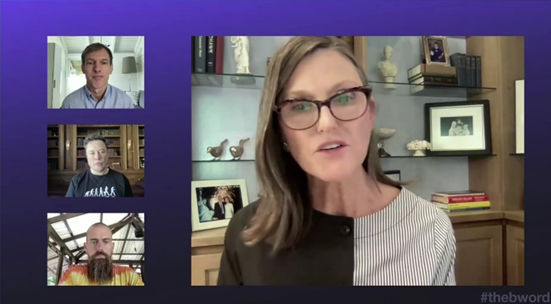
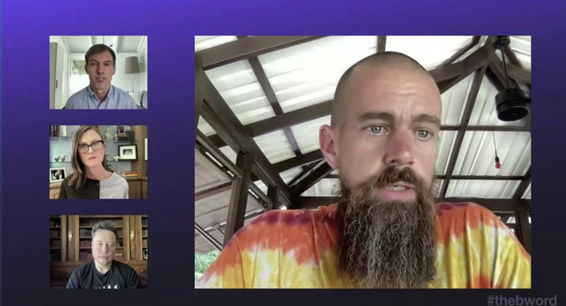
Prices surged on crypto assets as the B-Word Conference which included Elon Musk, Jack Dorsey, and Cathie Wood together discussing the future, revealed forward-thinker insights on the future of finance. Prices of cryptos surged, even before the conference got underway. They followed through as Musk, Dorsey and Wood from Ark Invest revealed their understanding of crypto’s strengths and the current monetary systems weaknesses.

The B-Word Conference was not all about the live interaction between the three “A-Team” presenters, but it was their’s that caused the Etherium spike, added interest in Dogecoins future, and other market shaping buzz. With Elon Musk, a co-founder of Paypal (also founder of SpaceX and Tesla), Jack Dorsey the CEO of Square (also Twitter), and Cathie Wood the founder, and CEO of Ark Invest, attendees may have come away with investment ideas on finance, energy, and the internet. Here are highlights thoughts that could shape the world’s financial future:


Elon Musk

-Views Bitcoin as an information system for labor allocation, he says it (information) exists in different bank mainframes around the world, but not in a centralized place. In his mind Bitcoin resolves this scattered system.

-Sees positive trend in crypto-mining energy use.

-With diligence will resume Bitcoin payment for Tesla purchases.

-He owns Etherium, Doge, as well as Bitcoin.

-Baseload for 24-hour mining can not be met with wind and solar. Musk believes modern nuclear power plants are safe and endorses them as the measure to resolve gap energy issues.

-Dogecoin community draws him because it is irreverent and has great memes.

-Musk says when it comes to survival, sometimes the simplest answer is the most likely. He said a friend told him the most ironic answer is the most likely. But thought, perhaps the most entertaining is the most likely. If true (according to Elon) the most ironic and entertaining “winner” would the crypto that started as a joke to make fun of crypto currency.


Cathie Wood

-Mentored under Art Laffer and collaborated on a paper with him in 2014 on a rules-based monetary system. Laffer at first was unsure of Bitcoin, then understood the disruptive economics implied, and identified the misunderstanding of cryptos in general.

-Bitcoin is a better means of exchange. Store of account value is primary use, especially stablecoins.

-Apps built to support Bitcoin have value.

-Leading crypto could be as large as U.S. Monetary base, or $8 trillion. Purchasing power will grow over time with acceptance.

-Good hedge against confiscation of wealth which can take place in a myriad of ways.

-Hedge against purchasing power destructivity of inflation.

-Broadbased utility for economic system that will increase proliferation of renewables.

-Economically empowers 4.3 billion people living under hostile regimes. Bitcoin’s “noble and social good” extends beyond the typical ESG mindset.

-Finds Bitcoin developers understand their place in history. They are inspired by a noble mission and sense of purpose to be impactful in monetary history.


Jack Dorsey

-Worldwide remittance system solved because you don’t have to go through intermediaries.

-Powerful, secure, and strong because you don’t have to rely on the state.

-Bitcoin is resilient enough to overcome obstacles, governmental, acceptance, technical challenges.

-Bank ACH system is archaic.

-Attracted to Bitcoin because of irreverence, believes it will become more accessible and endure.

-Called Bitcoin the “native currency” for the internet.


Take-Away

The B-Word Conference which was
detailed yesterday morning on Channelchek had many more than these three Bitcoin experts sharing their thoughts. The topics ranged from the most basic to some very intense or technical subjects. The three “thought leaders” Musk, Dorsey, and Wood, are important as two of the three are helping to shape the future, while Wood represents investor buy-in and funding.


Suggested Reading:


Is the Bitcoin FOMO Trade Unwinding


Can Wall Street Giants Put Crypto on the Menu?


Decentralized Finance, is it the Future?


Who Gets to Participate in Private Offerings?


Source:

https://www.thebword.org/c/track-2-Bitcoin-As-A-Tool-For-Economic-Empowerment


Stay up to date. Follow us:


Release – Comtech Names Judy Chambers to Board of Directors


Comtech Names Judy Chambers to Board of Directors


New Director Adds Extensive Financial Expertise and Further Diversifies the Board

Three Longstanding Directors to Retire as Part of Ongoing Board Refreshment

MELVILLE, N.Y.–(BUSINESS WIRE)–Jul. 22, 2021–

July 22, 2021 Comtech Telecommunications Corp. (NASDAQ: CMTL), a global leading provider of next-generation 911 emergency systems and secure wireless communications technologies, announced today that Judy Chambers, Managing Principal of Meketa Investment Group, has been appointed to Comtech’s Board of Directors, effective at the start of Comtech’s fiscal year 2022 which begins August 1, 2021. She will serve as Chair of the Board’s Nominating and Governance Committee, which oversees the Company’s corporate governance practices and processes, including its inclusiveness and diversity efforts.

Fred Kornberg, Comtech’s Chairman and CEO, said, “We are delighted to welcome Judy to the Board. She brings 30 years of business and leadership experience and deep financial knowledge from a career in corporate finance and investment advisory, and we look forward to benefitting from her outstanding capabilities and valuable perspective as well as her experience fostering equality, inclusion and diversity. She will make a significant contribution to our Board as we create and deliver sustained value for our shareholders and all our stakeholders.”

Judy Chambers is a Managing Principal, and member of the Board of Directors of 
Meketa Investment Group, an investment consulting and advisory firm with over 
$1.5 trillion of assets under advisement. She serves on the 
Board of Trustees of the 
Community Service Society of New York, a nonprofit focused on alleviating income inequality, is Chair of the 
Advisory Board of the Robert Toigo Foundation, which promotes stronger stakeholder returns in the financial industry through inclusion and diversity. Judy also serves on the 
Advisory Board of the Jazz Foundation of America. Judy holds a B.A. from 
Duke University and an M.B.A. from the 
Kellogg School of Management at 
Northwestern University.

Separately, 
Comtech announced the retirements of directors  Edwin KantorIra Kaplan and Robert Paul from the Comtech Board following the Company’s fiscal 2021 annual meeting, which is anticipated to occur in 
December 2021. Upon conclusion of the annual meeting, existing Board member and Chairman of the Audit Committee,  Lawrence Waldman, will become Lead Independent Director and the size of Comtech’s Board will be reduced to five members, four of whom will be independent.

Mr. Kornberg added, “On behalf of the Board, I want to express my profound thanks to Ed, Ira and Bob for their years of invaluable service and contributions to 
Comtech and our shareholders. Across 
Comtech, we take seriously our responsibilities as an essential provider for the safety and security of communities and advancing economic opportunity for everyone. To this end, the Board is committed to maintaining the right mix and balance of skills, experience, diversity and viewpoints through ongoing Board refreshment. Following the appointments of four independent directors in the past several years, our longstanding directors are able to retire with the utmost confidence in the continued stewardship of our company.”

About Comtech

Comtech Telecommunications Corp. is a leading provider of next-generation 911 emergency systems and critical wireless communication technologies to commercial and government customers around the world. Headquartered in 
Melville, New York and with a passion for customer success, 
Comtech designs, produces and markets advanced and secure wireless solutions to customers in more than 100 countries. For more information, please visit www.comtechtel.com.

Forward-Looking Statements

Certain information in this press release contains statements that are forward-looking in nature and involve certain significant risks and uncertainties. Actual results could differ materially from such forward-looking information. The Company’s 
Securities and Exchange Commission filings identify many such risks and uncertainties. Any forward-looking information in this press release is qualified in its entirety by the risks and uncertainties described in 
Securities and Exchange Commission filings.

PCMTL

Media Contact
Kekst CNC
[email protected] / [email protected]
(212) 521-4800

Investor Contact
Michael Porcelain
(631) 962-7005
[email protected]

Source: 
Comtech Telecommunications Corp.

Release – CanAlaska Mobilizes for West Athabasca Diamond Project


CanAlaska Appoints New Vice President Exploration


Kimberlite Indicator Mineral Sampling to Target Basal Tills

Sampling Down-Ice of More Than 300 Circular Magnetic Anomalies

Vancouver, British Columbia–(Newsfile Corp. – July 22, 2021) – CanAlaska Uranium Ltd. (TSXV: CVV) (OTCQB: CVVUF) (FSE: DH7N) (“CanAlaska” or the “Company”) is pleased to announce it has mobilized a crew to begin kimberlite indicator mineral (KIM) sampling down-ice of its West Athabasca Diamond Project areas. The Company holds 51,654 hectares (129,135 acres) of claims encompassing over 300 circular magnetic anomalies in the Athabasca Basin of Saskatchewan. The project is located north and northeast of the past-producing Cluff Lake Uranium Mine (Figure 1).

Figure 1

The objective of this sampling program is to complement the 2018 DeBeers’ till sampling program, which was tightly restricted to eskers inside the claim boundaries. These eskers are relatively short, sinuous and sharp-crested features that sit on top of glacial outwash deposits. As a result, the sampled eskers unlikely eroded the local bedrock or basal tills, and therefore may not have sampled the potential kimberlite material possibly associated with these circular anomalies. This new KIM till sampling program will focus in close proximity to Athabasca Group outcrop locations in order to find and acquire basal till samples that contain material possibly associated with these magnetic anomalies.

In 2011, a high-quality regional magnetic and radiometric airborne survey was completed over the Athabasca Basin which resulted in identification of small, round magnetic anomalies that resemble the size and character of anomalies generally associated with kimberlite pipes elsewhere. Based on this observation, the West Athabasca claims were staked in 2015 and later optioned to DeBeers in 2016. DeBeers conducted a high-resolution low-amplitude aeromagnetic survey that defined 695 discrete singular and cluster anomalies like those shown in Figure 2 for the William River Block. Seven of the anomalies were identified as accessible for summer drilling and nine holes were completed in the fall of 2016. DeBeers drill tested the margins of seven magnetic anomalies out of the more than 300 that had been defined as priority. No kimberlite was intersected but three of the holes identified a thin magnetic mud of possible biogenic origin at the base of the till near the bedrock top. Only summer accessible targets were drill tested since a vast majority of the magnetic anomalies exist under lakes or muskeg.


Figure 2

In support of kimberlite emplacement potential, the singular and cluster anomalies follow a general southwest-northeast orientation in proximity to a known deep-crustal domain-boundary structure known as the Grease River Shear Zone (“GRSZ”) (Figure 1). The association of the cluster orientations in relation to this structure provides an interesting emplacement and target scenario. On a more regional scale, this area of the Athabasca Basin is underlain by the Rae Province, a thick Archean crust.

CanAlaska CEO, Cory Belyk, comments, “The team has done an excellent job of re-evaluating the potential of our West Athabasca Diamond Project. The more than 300 discrete circular magnetic anomalies of the size and character of kimberlite pipes suggest these anomalies need to be considered further. Locating KIMs in basal tills that may better represent bedrock sources located up-ice would be an encouraging outcome from this program and significantly upgrade diamond discovery potential in this region.”

About CanAlaska Uranium

CanAlaska Uranium Ltd. (TSXV: CVV) (OTCQB: CVVUF) (FSE: DH7N) holds interests in approximately 214,000 hectares (530,000 acres), in Canada’s Athabasca Basin – the “Saudi Arabia of Uranium.” CanAlaska’s strategic holdings have attracted major international mining companies. CanAlaska is currently working with Cameco and Denison at two of the Company’s properties in the Eastern Athabasca Basin. CanAlaska is a project generator positioned for discovery success in the world’s richest uranium district. The Company also holds properties prospective for nickel, copper, gold and diamonds. For further information visit www.canalaska.com.

The qualified technical person for this news release is Dr. Karl Schimann, P.Geo., CanAlaska director and Senior Exploration Consultant.

On behalf of the Board of Directors
“Peter Dasler”
Peter Dasler, M.Sc., P.Geo.
President
CanAlaska Uranium Ltd.

Contacts:

Cory Belyk, Executive VP and CEO
Tel: +1.604.688.3211 x 306
Email: [email protected]

Peter Dasler, President
Tel: +1.604.688.3211 x 138
Email: [email protected]

Neither TSX Venture Exchange nor its Regulation Services Provider (as that term is defined in the policies of the TSX Venture Exchange) accepts responsibility for the adequacy or accuracy of this release.

Forward-looking information

All statements included in this press release that address activities, events or developments that the Company expects, believes or anticipates will or may occur in the future are forward-looking statements. These forward-looking statements involve numerous assumptions made by the Company based on its experience, perception of historical trends, current conditions, expected future developments and other factors it believes are appropriate in the circumstances. In addition, these statements involve substantial known and unknown risks and uncertainties that contribute to the possibility that the predictions, forecasts, projections and other forward-looking statements will prove inaccurate, certain of which are beyond the Company’s control. Readers should not place undue reliance on forward-looking statements. Except as required by law, the Company does not intend to revise or update these forward-looking statements after the date hereof or revise them to reflect the occurrence of future unanticipated events.

Release – Avivagen Announces Strategic Changes to Support Growth in Asia and South America


Avivagen Announces Strategic Changes to Support Growth in Asia and South America


  • Addition of Mr. Lesley Nernberg brings technical sales and marketing expertise to Asia expansion efforts
  • Termination of distribution agreement with São Paulo-based Look Chemicals creates opportunity for accelerated adoption of OxC-betaTM Livestock in Brazil

Ottawa, ON /Business Wire/ July 22, 2021/ Avivagen Inc. (TSXV:VIV, OTCQB:VIVXF) (“Avivagen”), a life sciences corporation focused on developing and commercializing products for livestock, companion animal and human applications that safely enhances feed intake and supports immune function, thereby supporting general health and performance, has announced new strategic measures to support continued growth in Asia and Brazil.

Avivagen has retained the services of Mr. Lesley Nernberg as a technical sales and marketing consultant, focused on accelerating the adoption of OxC-betaTM Livestock in Asia. He has held important technical sales and operation management positions with multiple well-known multinational animal nutrition companies such as ADM, Diamond V and Biomin, with a focus on marketing feed additives and complete feed across Asia. Based in Thailand, Mr. Nernberg holds a graduate degree in animal science and nutrition from the University of Manitoba and has established himself as an expert in the livestock feed additive industry in Asia over the past nine years. In particular, Mr. Nernberg will focus primarily on Vietnam, Indonesia and South Korea.

Avivagen also today announced the termination of its Brazilian OxC-betaTM Livestock distribution agreement with São Paulo-based Look Chemicals Importacao E Exportacao LTDA. Advanced discussions with potential new distribution partners are currently underway in order to support the company’s growth ambitions in the world’s third-largest feed production market.

“We have experienced considerable success in a number of Asian markets to date, and the addition of an accomplished, respected and connected expert like Mr. Nernberg will help us further establish OxC-betaTM as a leading health-promoting option for producers throughout the region,” says Kym Anthony, CEO of Avivagen Inc. “We’re also very excited about the potential for new agreements to support our continued and accelerated growth in Brazil. We thank Look Chemicals for their support during our entry into this important production market.”

About OxC-beta™ Technology and OxC-beta™ Livestock
Avivagen’s OxC-beta™ technology is derived from Avivagen discoveries about ?-carotene and other carotenoids, compounds that give certain fruits and vegetables their bright colours. Through support of immune function, the technology provides a non-antibiotic means of promoting health and growth. OxC-beta™ Livestock is a proprietary product shown to be an effective and economic alternative to the antibiotics commonly added to livestock feeds. The product is currently available for sale in the United States, Philippines, Mexico, Taiwan, New Zealand, Thailand, Brazil, Australia and Malaysia.

Avivagen’s OxC-beta™ Livestock product is safe, effective and could fulfill the global mandate to remove all in-feed antibiotics as growth promoters. Numerous international livestock trials with poultry and swine using OxC-beta™ Livestock have proven that the product performs as well as, and, sometimes, in some aspects, better than in-feed antibiotics.

About Avivagen
Avivagen is a life sciences corporation focused on developing and commercializing products for livestock, companion animal and human applications that, by safely supporting immune function, promote general health and performance. It is a public corporation traded on the TSX Venture Exchange under the symbol VIV and is headquartered in Ottawa, Canada, based in partnership facilities of the National Research Council of Canada. For more information, visit www.avivagen.com. The contents of the website are expressly not incorporated by reference in this press release.

Forward Looking Statements
This news release includes certain forward-looking statements that are based upon the current expectations of management. Forward-looking statements involve risks and uncertainties associated with the business of Avivagen Inc. and the environment in which the business operates. Any statements contained herein that are not statements of historical facts may be deemed to be forward-looking, including those identified by the expressions “aim”, “anticipate”, “appear”, “believe”, “consider”, “could”, “estimate”, “expect”, “if”, “intend”, “goal”, “hope”, “likely”, “may”, “plan”, “possibly”, “potentially”, “pursue”, “seem”, “should”, “whether”, “will”, “would” and similar expressions.

Statements set out in this news release relating to discussions with potential new distribution partners in Brazil, new agreements that might arise from such discussions and the possibility for continued and accelerated growth in Brazil as well as the possibility for OxC-beta™ Livestock to replace antibiotics in livestock feeds as growth promoters are forward-looking statements. These forward-looking statements are subject to a number of risks and uncertainties that could cause actual results or events to differ materially from current expectations. For instance, discussions with potential new distribution partners may not result in an agreement, any new agreement with a distribution partner in Brazil may not result in growth for Avivagen in Brazil, Avivagen’s products may not gain market acceptance or regulatory approval in new jurisdictions or for new applications and may not be widely accepted as a replacement for antibiotics as growth promoters in livestock feeds due to many factors, many of which are outside of Avivagen’s control. Readers are referred to the risk factors associated with the business of Avivagen set out in Avivagen’s most recent management’s discussion and analysis of financial condition available at www.SEDAR.com. Except as required by law, Avivagen assumes no obligation to update the forward-looking statements, or to update the reasons why actual results could differ from those reflected in the forward-looking statements.

Neither TSX Venture Exchange nor its Regulation Services Provider (as that term is defined in the policies of the TSX Venture Exchange) accepts responsibility for the adequacy or accuracy of this release.

For more information:
Avivagen Inc.
Drew Basek
Director of Investor Relations
100 Sussex Drive, Ottawa, Ontario, Canada K1A 0R6 Phone: 416-540-0733
E-mail: [email protected]

Kym Anthony
Chief Executive Officer
100 Sussex Drive, Ottawa, Ontario, Canada K1A 0R6 Head Office Phone: 613-949-8164
Website: www.avivagen.com
Copyright © 2021 Avivagen Inc. OxC-beta™ is a trademark of Avivagen Inc.

Release – Entravisions Colorado News Team Wins 22 Emmy Awards


Entravision’s Colorado News Team Wins 22 Emmy Awards


SANTA MONICA, Calif.–(BUSINESS WIRE)– Entravision Communications Corporation (NYSE: EVC), a leading global media and marketing technology company, today announced the following:

WHAT:

Entravision’s news team serving the Univision affiliate in Colorado, KCEC-TV, was awarded 22 Emmy awards in 6 categories, presented by the 35th Annual Heartland Regional Emmy® Awards, a regional chapter of the National Academy of Television Arts and Sciences. Entravision provides news programming and sales and marketing services for KCEC-TV, which is owned by Univision Communications, Inc. Entravision’s news team was recognized in the following categories:

 
AWARDS: Hard News Report – No Time Limit
Carlos Moreno & Juan Arellano
 
Continuing Coverage
Rafael Contreras, Isela Gonzalez, Carlos Moreno, Yamile Arango Ospina, Claudia Marcela Chavez, Eduardo Flores Rodriguez, Cesar Sabogal, Fernando Ordaz, Linda Guerrero, Juan Cardenas, Juan Pablo Gomez, & Joniel Omana
 
Societal Concerns
Carlos Morena, Eduardo Flores Rodriguez, Cesar Sabogal & Joniel Omana
 
Promotion: Program
Rosangela Payan & Angel Castellanos
 
Talent: Anchor
Linda Guerrero
 
Talent: Reporter – Live
Carlos Moreno
 
QUOTE: “We are thrilled to have won 22 Emmys across 6 different categories, a true testament to our highly committed news organization and teams,” said Juan Carlos Gutierrez, Entravision’s Regional News Director for Univision Colorado, Kansas and Nevada. “These awards continue to validate that our excellent news coverage connects with, and is valued by, the Colorado Latino communities we serve.”

About Entravision Communications Corporation

Entravision is a diversified global media, marketing and technology company serving clients throughout the United States and in 32 countries across Latin America, Europe, and Asia. Entravision has 54 television stations and is the largest affiliate group of the Univision and UniMás television networks, and 48 Spanish-language radio stations that feature nationally recognized, award-winning talent. Our dynamic digital portfolio includes Entravision Digital, which serves SMBs in high-density U.S. Latino markets and provides cutting-edge mobile programmatic solutions and demand-side platforms that allow advertisers to execute performance campaigns using machine-learned bidding algorithms, along with Cisneros Interactive, a leader in digital advertising solutions in the Latin American and U.S. Hispanic markets representing major technology platforms, and MediaDonuts, a leader in programmatic digital solutions in Southeast Asia. Shares of Entravision Class A Common Stock trade on The New York Stock Exchange under the ticker symbol: EVC. Learn more about all of our media, marketing and technology offerings at entravision.com or connect with us on LinkedIn and Facebook.

Contact for Entravision:
Kimberly Esterkin
Addo Investor Relations
[email protected]
310-829-5400

Source: Entravision Communications Corporation

Vectrus (VEC) – Operating Environment Remains Healthy Favorable Risk Reward

Thursday, July 22, 2021

Vectrus (VEC)
Operating Environment Remains Healthy; Favorable Risk/Reward

Vectrus Inc is a U.S.-based company that provides services to the U.S. government. It operates as one segment and offer facility and logistics services and information technology and network communications services. The information technology and network communications capabilities consist of communications systems operations and maintenance, management and service support, systems installation and activation, system-of-systems engineering and software development, and mission support for the department of defense. The facility and logistics service include airfield management, ammunition management, civil engineering, communications, emergency services, life support activities, public works, security, transportation operations and others.

Joe Gomes, Senior Research Analyst, Noble Capital Markets, Inc.

Refer to the full report for the price target, fundamental analysis, and rating.

    New Awards. Last week, Vectrus announced it had received two additional task orders under the AFCAP V $6.4 billion ID/IQ contract. The new firm-fixed price awards are valued at $40 million. These two additional task orders build on the Company’s AFCAP wins that were announced in the first quarter, demonstrating Vectrus’ ability to support the contingency and humanitarian requirements under AFCAP V, in our view.

    Iraq Now Under Vectrus.  It appears operational responsibility for Iraq has finally transferred over to Vectrus under the LOGCAP V award. The worldwide pandemic slowed the transition process down substantially, but with Iraq transferred Vectrus could finally begin to realize more of the LOGCAP V award promise. We view the transition positively …


This research is provided by Noble Capital Markets, Inc., a FINRA and S.E.C. registered broker-dealer (B/D).

*Analyst certification and important disclosures included in the full report. NOTE: investment decisions should not be based upon the content of this research summary.  Proper due diligence is required before making any investment decision. 

Aurania Reports that Drilling at Tsenken N1 Provides Evidence of a Link with the Tiria-Shimpia Target


Aurania Reports that Drilling at Tsenken N1 Provides Evidence of a Link with the Tiria-Shimpia Target


Toronto, Ontario, July 21, 2021 – Aurania Resources Ltd. (TSXV: ARU) (OTCQB: AUIAF) (Frankfurt: 20Q) (“Aurania” or the “Company”) reports that review of drill core shows that the fault system which links the Tsenken target with the Tiria-Shimpia target, moved periodically throughout the development of the sedimentary basin, providing a pumping mechanism for metal-bearing fluids that deposited sediment-hosted zinc-silver at Tiria-Shimpia and copper-silver at Tsenken.  Further scout drilling at Tsenken N1 is focusing on sediment-hosted copper-silver adjacent to this fault system that extends 45 kilometres from the copper area in the south to the zinc zone in the north in the central part of the Company’s Lost Cities – Cutucu Project (“Project”) in southeastern Ecuador.

Professor Gregor Borg, an expert on sediment-hosted copper systems, who has worked both in the Central African Copperbelt and the European Kupferschiefer, recently visited site to review the exploration programs and drill core from Tsenken and Tiria-Shimpia.

Professor Borg commented, “I have not seen many mineralized systems that extend 45 kilometres along a fault system as we see in the central part of Aurania’s Lost Cities Project.  The change from copper-centric in the Tsenken area to zinc-rich in the Tiria-Shimpia target is consistent metal zoning that is evident in the Kupferschiefer.  I came away from my second review of Aurania’s sedimentary copper exploration program as convinced as I was on my first visit that the red-bed basin is highly fertile and has very good potential for sediment-hosted copper. We optimized some of the concepts on the basis of the features that we saw in the drill core, and I have encouraged the exploration team to keep drilling.”

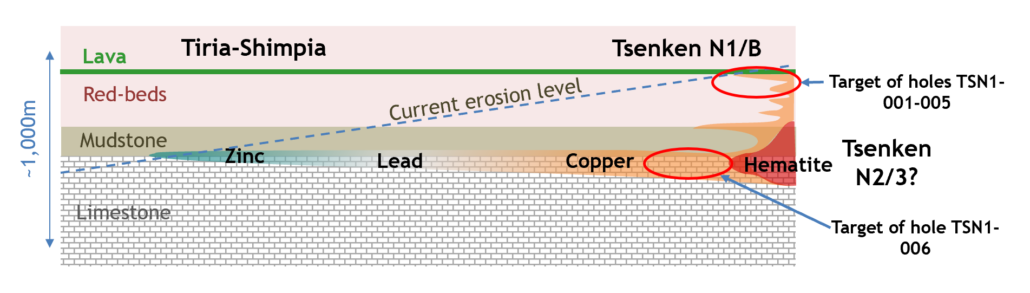
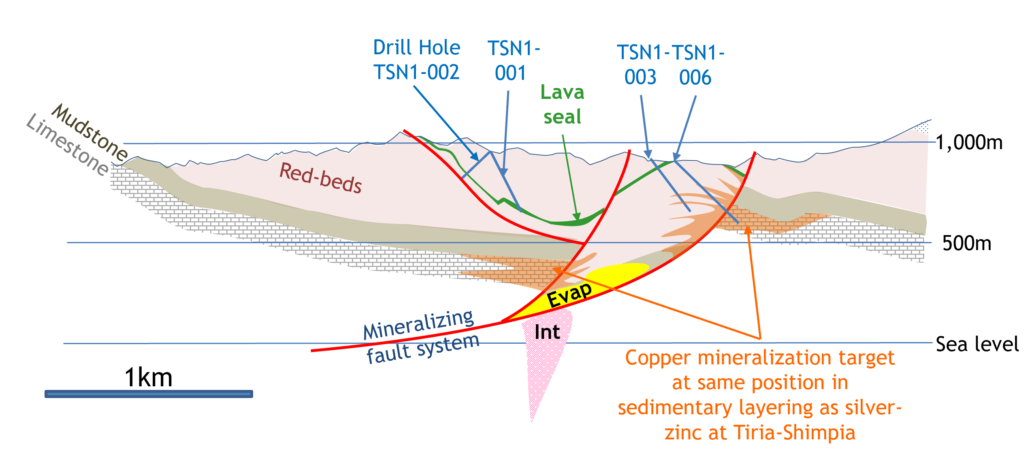
Five drill holes have been completed at Tsenken N1 and hole 6 is underway – the objective being to explore the same sedimentary layer in the Tsenken area that contains zinc-silver in the Tiria-Shimpia area as illustrated in Figure 1.

Figure 1.  Vertical profile illustrating the target concept for the current drill hole, TSN1-006.  The target is copper in the same sedimentary unit in the Tsenken area as contains zinc-silver in the Tiria-Shimpia area.  This target is brought to relatively shallow depth on a geological fault as illustrated in Figure 2.

Geological Detail of Tsenken N1 Drilling

Five drill holes, for a total of 2,184 metres (“m”), have been drilled in the Tsenken N1 target area and hole 6 is underway.  The sedimentary layers targeted in hole 6 have been elevated to within a few hundred metres of surface, as illustrated in Figure 2, by faults that are known to have provided pathways for the metal-bearing fluids.

Drill results received to date are not economically significant but do show a clear trend with contained copper increasing towards the east: drill hole TSN1-002 – the westernmost – having no copper, hole TSN1-001 having 0.23% over 1m and hole TSN1-003 – the easternmost – having two mineralized zones; the upper sedimentary layer with 1m at 0.47% copper and the lower with 0.15% copper over 2.6m.  Observations from the drill core show that the fault system was active at the time of accumulation of the red-beds in the Tsenken area and field mapping and satellite imagery show that this fault system extends into the Tiria-Shimpia area where it is linked with zinc-silver mineralization.

Holes TSN1-004 and TSN1-005 were collared further north, closer to Tiria-Shimpia and results will be reported when available.

Figure 2.  Vertical profile interpretation through the Tsenken N1 area showing the location of drill holes 1, 2 and 3 that tested for sediment-hosted copper-silver in red-beds beneath a lava seal.  Hole 6 is testing for expected sediment-hosted copper in a similar position in the sedimentary layering as the silver-zinc mineralization at Tiria-Shimpia is located.  The fault system shown in red is suspected to have fed copper into the sediments in a similar way that it did zinc-silver into the Tiria-Shimpia area.  (Evap. is evaporite (salt) and Int. is intrusive such as a porphyry).

Drilling at Tiria-Shimpia

A second drill rig has completed the first hole at Tiria-Shimpia and the second scout drilling hole is underway.

Sample Analysis & Quality Assurance / Quality Control (“QAQC”)

Laboratories: The samples were prepared for analysis at MS Analytical (“MSA”) in Cuenca, Ecuador, and the analyses were done in Vancouver, Canada.

Sample preparation: The rock samples were jaw-crushed to 10 mesh (crushed material passes through a mesh with apertures of 2 millimetres (“mm”)), from which a one-kilogram sub-sample was taken.  The sub-sample was crushed to a grain size of 0.075mm and a 200 gram (“g”) split was set aside for analysis.

Analytical procedure:  Approximately 0.25g of rock pulp underwent four-acid digestion and analysis for 48 elements by ICP-MS.  For the over-limit samples, those that had a grade of greater than 1% copper, zinc and lead, and 100g/t silver, 0.4 grams of pulp underwent digestion in four acids and the resulting liquid was diluted and analyzed by ICP-MS.

QAQC: Aurania personnel inserted a certified standard pulp sample, alternating with a field blank, at approximate 20 sample intervals in all sample batches. Aurania’s analysis of results from its independent QAQC samples showed the batches reported on above, lie within acceptable limits.  In addition, the labs reported that the analyses had passed their internal QAQC tests.

Qualified Person

The geological information contained in this news release has been verified and approved by Jean-Paul Pallier, MSc.  Mr. Pallier is a designated EurGeol by the European Federation of Geologists and a Qualified Person as defined by National Instrument 43-101, Standards of Disclosure for Mineral Projects of the Canadian Securities Administrators.

About Aurania

Aurania is a mineral exploration company engaged in the identification, evaluation, acquisition and exploration of mineral property interests, with a focus on precious metals and copper in South America.  Its flagship asset, The Lost Cities – Cutucu Project, is located in the Jurassic Metallogenic Belt in the eastern foothills of the Andes mountain range of southeastern Ecuador.

Information on Aurania and technical reports are available at www.aurania.com and www.sedar.com, as well as on Facebook at https://www.facebook.com/auranialtd/, Twitter at  https://twitter.com/auranialtd, and LinkedIn at https://www.linkedin.com/company/aurania-resources-ltd-.

For further information, please contact:

Carolyn Muir

VP Investor Relations

Aurania Resources Ltd.

(416) 367-3200

[email protected]

Dr. Richard Spencer

President

Aurania Resources Ltd.

(416) 367-3200

[email protected]

Neither the TSX Venture Exchange nor its Regulation Services Provider (as that term is defined in the policies of the TSX Venture Exchange) accepts responsibility for the adequacy or accuracy of this release.

Forward-Looking Statements

This news release may contain forward-looking information that involves substantial known and unknown risks and uncertainties, most of which are beyond the control of Aurania. Forward-looking statements include estimates and statements that describe Aurania’s future plans, objectives or goals, including words to the effect that Aurania or its management expects a stated condition or result to occur. Forward-looking statements may be identified by such terms as “believes”, “anticipates”, “expects”, “estimates”, “may”, “could”, “would”, “will”, or “plan”. Since forward-looking statements are based on assumptions and address future events and conditions, by their very nature they involve inherent risks and uncertainties. Although these statements are based on information currently available to Aurania, Aurania provides no assurance that actual results will meet management’s expectations. Risks, uncertainties and other factors involved with forward-looking information could cause actual events, results, performance, prospects and opportunities to differ materially from those expressed or implied by such forward-looking information. Forward looking information in this news release includes, but is not limited to Aurania’s objectives, goals or future plans, statements, exploration results, potential mineralization, the corporation’s portfolio, treasury, management team and enhanced capital markets profile, the estimation of mineral resources, exploration, timing of the commencement of operations and estimates of market conditions. Factors that could cause actual results to differ materially from such forward-looking information include, but are not limited to, failure to identify mineral resources, failure to convert estimated mineral resources to reserves, the inability to complete a feasibility study which recommends a production decision, the preliminary nature of metallurgical test results, delays in obtaining or failures to obtain required governmental, regulatory, environmental or other project approvals, political risks, inability to fulfill the duty to accommodate indigenous peoples, uncertainties relating to the availability and costs of financing needed in the future, changes in equity markets, inflation, changes in exchange rates, fluctuations in commodity prices, delays in the development of projects, capital and operating costs varying significantly from estimates and the other risks involved in the mineral exploration and development industry, the effects of COVID-19 on the business of the Company including but not limited to the effects of COVID-19 on the price of commodities, capital market conditions, restrictions on labour and international travel and supply chains, and those risks set out in Aurania’s public documents filed on SEDAR. Although Aurania believes that the assumptions and factors used in preparing the forward-looking information in this news release are reasonable, undue reliance should not be placed on such information, which only applies as of the date of this news release, and no assurance can be given that such events will occur in the disclosed time frames or at all. Aurania disclaims any intention or obligation to update or revise any forward-looking information, whether as a result of new information, future events or otherwise, other than as required by law.

Today’s Drug Policies are Part of a Long History


Image Credit: Ignacio Ferre Pérez (Flickr)


When Did Humans Start Experimenting With Alcohol and Drugs?


Humans constantly alter the world. We burn fields, turn forests into farms, and breed plants and animals. But humans don’t just reshape our external world – we engineer our internal worlds, and reshape our minds.

One way we do this is by upgrading our mental “software”, so to speak, with myths, religion, philosophy and psychology. The other is to change our mental hardware – our brains. And we do that with chemistry.

Today, humans use thousands of psychoactive compounds to alter our experience of the world. Many derive from plants and fungi, others we manufacture. Some, like coffee and tea, increase alertness; others, like alcohol and opiates, decrease it.Psychiatric drugs affect mood, while psychedelics alter reality.

We alter brain chemistry for all kinds of reasons, using substances recreationally, socially, medicinally, and ritually. Wild animals sometimes eat fermented fruit, but there’s little evidence that they eat psychoactive plants. We’re unusual animals in our enthusiasm for getting drunk and high. But when, where and why did it all start?


High on Life in the Pleistocene

Given humanity’s love of drugs and alcohol, you might assume getting high is an ancient, even prehistoric tradition. Some researchers have suggested prehistoric cave paintings were made by humans experiencing altered states of consciousness. Others, perhaps inspired more by hallucinogens than hard evidence, suggest that drugs triggered the evolution of human consciousness. Yet there’s surprisingly little archaeological evidence for prehistoric drug use.

African hunter-gathers – Bushmen, Pygmies and the Hadzabe people – likely live their lives in ways similar to ancestral human cultures. The most compelling evidence for the use of drugs by such early humans is a potentially hallucinogenic plant, kaishe, used by Bushmen healers, which supposedly makes people “go mad for a while”. Yet how much Bushmen historically used drugs is debated, and otherwise, there’s little evidence for drug use in hunter-gatherers.

The implication is that, despite Africa’s diverse plants and fungi, early humans used drugs rarely, maybe to induce trances during rituals, if at all. Perhaps their lifestyle meant they rarely felt the need for escape. Exercise, sunlight, nature, time with friends and family – they’re powerful antidepressants. Drugs are also dangerous; just as you shouldn’t drive drunk, it’s risky to get high when lions lurk in the bush, or a hostile tribe waits one valley over.

Out of Africa

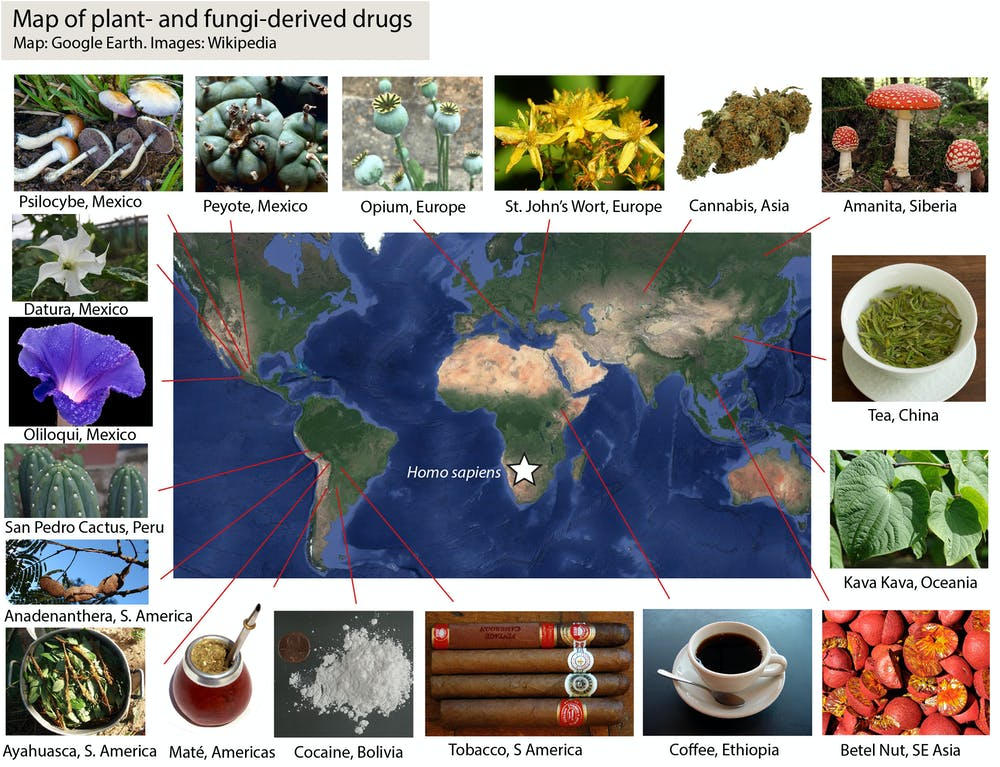
Migrating out of Africa 100,000 years ago, humans explored new lands and encountered new substances. People discovered opium poppies in the Mediterranean, and cannabis and tea in Asia.


Author Provided Map


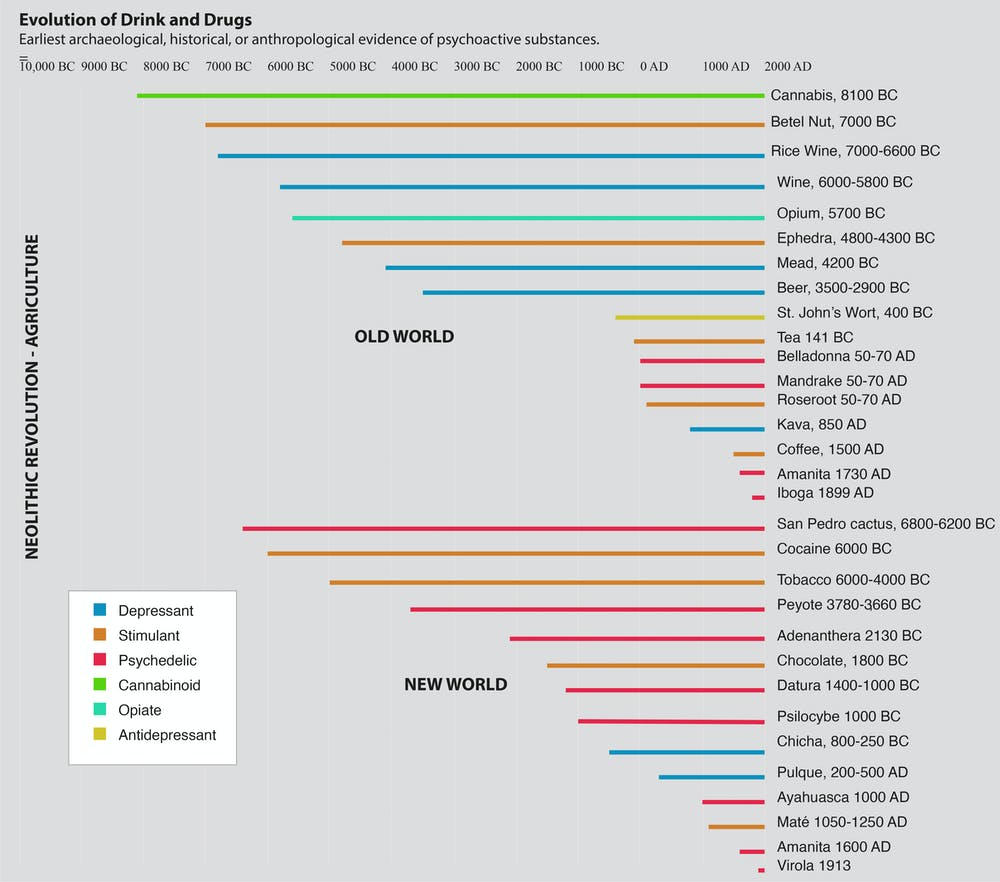
Archaeologists have found evidence of opium use in Europe by 5,700 BC. Cannabis seeds appear in archaeological digs at 8,100 BC in Asia, and the ancient Greek historian Herodotus reported Scythians getting high on weed in 450 BC. Tea was brewed in China by 100 BC.

It’s possible our ancestors experimented with substances before the archaeological evidence suggests. Stones and pottery preserve well, but plants and chemicals decay quickly. For all we know, Neanderthals could have been the first to smoke pot. But archaeology suggests the discovery and intensive use of psychoactive substances mostly happened late, after the Neolithic Revolution in 10,000 BC, when we invented farming and civilization.


Evidence suggests human drug use came after the Neolithic Revolution, Author provided

The American Psychonauts

When hunters trekked across the Bering Land Bridge 30,000 years ago into Alaska and headed south, they found a chemical cornucopia. Here, the hunters discovered tobacco, coca and maté. But for some reason, indigenous Americans were especially fascinated with psychedelics.

American psychedelics included peyote cactus, San Pedro cactus, morning-glory, Datura, Salvia, Anadenanthera, Ayahuasca, and over 20 species of psychoactive mushrooms. It was a pre-Columbian Burning Man. Indigenous Americans also invented the nasal administration of tobacco and hallucinogens. They were the first to snort drugs – a practice Europeans later borrowed.


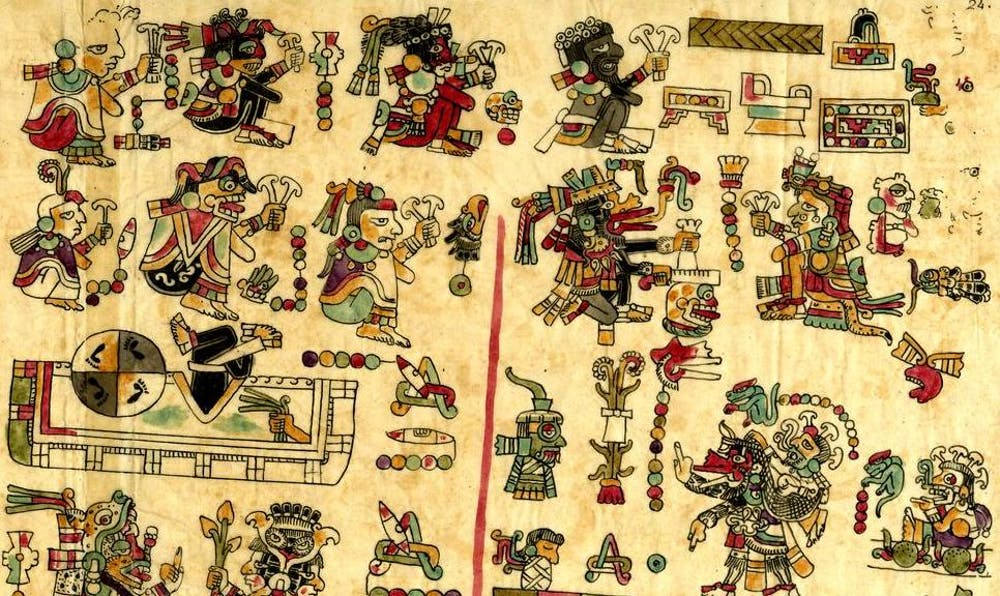
 A Mixtec Codex showing the ceremonial use of mushrooms. British Museum, CC BY-NC-SA

This American psychedelic culture is ancient. Peyote buttons have been carbon-dated to 4,000 BC, while Mexican mushroom statues hint at Psilocybe use in 500 BC. A 1,000 year-old stash found in Bolivia contained cocaine, Anadenanthera and ayahuasca – and must’ve been one hell of a trip.

Inventing Alcohol

A huge step in the evolution of debauchery was the invention of agriculture because farming made booze possible. It created a surplus of sugars and starches which, mashed and left to ferment, magically transformed into potent brews.

Humans invented alcohol many times independently. The oldest booze dates to 7,000 BC, in China. Wine was fermented in the Caucasus in 6,000 BC; Sumerians brewed beer in 3,000 BC. In the Americas, Aztecs made pulque from the same agaves used today for tequila; Incas brewed chicha, a corn beer.

While in America, psychedelics appear to have been particularly important, Eurasian and African civilizations seem to have preferred alcohol. Wine was central to ancient Greek and Roman cultures, was served at Plato’s Symposium and at the Last Supper, and remains incorporated in the Jewish Seder and Christian communion rituals.


Civilization and Intoxication

Archaeology suggests alcohol and drugs date back millennia to early agricultural societies. But there’s little evidence early hunter-gatherers used them. That implies something about agricultural societies and the civilizations they gave rise to promoted substance use. But why?

It’s possible large civilizations simply drive innovation of all kinds: in ceramics, textiles, metals – and psychoactive substances. Perhaps alcohol and drugs also promoted civilization – drinking can help people socialize, altered perspectives encourage creativity, and caffeine makes us productive. And it may just be safer to get drunk or high in a city than the savannah.

A darker possibility is that psychoactive substance use developed in response to civilization’s ills. Large societies create large problems – wars, plagues, inequalities in wealth and power – against which individuals are relatively powerless. Perhaps when people couldn’t change their circumstances, they decided to change their minds.


This article was republished with permission from The Conversation, a news site
dedicated to sharing ideas from academic experts. It represents the
research-based findings and opinions of 
Nicholas R. Longrich Senior
Lecturer in Evolutionary Biology and Paleontology, University of Bath.


Suggested
Reading:


Will Federal Law Surrounding Cannabis be Changed?


Cannabis Customers Served by Ice Cream Truck Delivery Model


The NFL and Big Companies are Changing their Thinking on Cannabis


Robotics and AI are being Tapped by Cannabis Growers


Stay up to date. Follow us:


Virtual Roadshow with TAAL Distributed Information Technologies (TAALF) President Chris Naprawa


TAAL Distributed Information Technologies President Chris Naprawa makes a formal corporate presentation. Afterwards, he is joined by Noble Capital Markets Senior Research Analyst Joe Gomes for a Q & A session featuring questions asked by the live audience throughout the event.

Research, News, and Advanced Market Data on TAALF (OTCQX)


Register for TAAL’s Bi-Weekly Newsletter


Information on upcoming live virtual roadshows

About TAAL Distributed Information Technologies Inc.

TAAL Distributed Information Technologies Inc. delivers value-added blockchain services, providing professional-grade, highly scalable blockchain infrastructure and transactional platforms to support businesses building solutions and applications upon the BitcoinSV platform, and developing, operating, and managing distributed computing systems for enterprise users.

Todays Drug Policies are Part of a Long History


Image Credit: Ignacio Ferre Pérez (Flickr)


When Did Humans Start Experimenting With Alcohol and Drugs?


Humans constantly alter the world. We burn fields, turn forests into farms, and breed plants and animals. But humans don’t just reshape our external world – we engineer our internal worlds, and reshape our minds.

One way we do this is by upgrading our mental “software”, so to speak, with myths, religion, philosophy and psychology. The other is to change our mental hardware – our brains. And we do that with chemistry.

Today, humans use thousands of psychoactive compounds to alter our experience of the world. Many derive from plants and fungi, others we manufacture. Some, like coffee and tea, increase alertness; others, like alcohol and opiates, decrease it.Psychiatric drugs affect mood, while psychedelics alter reality.

We alter brain chemistry for all kinds of reasons, using substances recreationally, socially, medicinally, and ritually. Wild animals sometimes eat fermented fruit, but there’s little evidence that they eat psychoactive plants. We’re unusual animals in our enthusiasm for getting drunk and high. But when, where and why did it all start?


High on Life in the Pleistocene

Given humanity’s love of drugs and alcohol, you might assume getting high is an ancient, even prehistoric tradition. Some researchers have suggested prehistoric cave paintings were made by humans experiencing altered states of consciousness. Others, perhaps inspired more by hallucinogens than hard evidence, suggest that drugs triggered the evolution of human consciousness. Yet there’s surprisingly little archaeological evidence for prehistoric drug use.

African hunter-gathers – Bushmen, Pygmies and the Hadzabe people – likely live their lives in ways similar to ancestral human cultures. The most compelling evidence for the use of drugs by such early humans is a potentially hallucinogenic plant, kaishe, used by Bushmen healers, which supposedly makes people “go mad for a while”. Yet how much Bushmen historically used drugs is debated, and otherwise, there’s little evidence for drug use in hunter-gatherers.

The implication is that, despite Africa’s diverse plants and fungi, early humans used drugs rarely, maybe to induce trances during rituals, if at all. Perhaps their lifestyle meant they rarely felt the need for escape. Exercise, sunlight, nature, time with friends and family – they’re powerful antidepressants. Drugs are also dangerous; just as you shouldn’t drive drunk, it’s risky to get high when lions lurk in the bush, or a hostile tribe waits one valley over.

Out of Africa

Migrating out of Africa 100,000 years ago, humans explored new lands and encountered new substances. People discovered opium poppies in the Mediterranean, and cannabis and tea in Asia.


Author Provided Map


Archaeologists have found evidence of opium use in Europe by 5,700 BC. Cannabis seeds appear in archaeological digs at 8,100 BC in Asia, and the ancient Greek historian Herodotus reported Scythians getting high on weed in 450 BC. Tea was brewed in China by 100 BC.

It’s possible our ancestors experimented with substances before the archaeological evidence suggests. Stones and pottery preserve well, but plants and chemicals decay quickly. For all we know, Neanderthals could have been the first to smoke pot. But archaeology suggests the discovery and intensive use of psychoactive substances mostly happened late, after the Neolithic Revolution in 10,000 BC, when we invented farming and civilization.


Evidence suggests human drug use came after the Neolithic Revolution, Author provided

The American Psychonauts

When hunters trekked across the Bering Land Bridge 30,000 years ago into Alaska and headed south, they found a chemical cornucopia. Here, the hunters discovered tobacco, coca and maté. But for some reason, indigenous Americans were especially fascinated with psychedelics.

American psychedelics included peyote cactus, San Pedro cactus, morning-glory, Datura, Salvia, Anadenanthera, Ayahuasca, and over 20 species of psychoactive mushrooms. It was a pre-Columbian Burning Man. Indigenous Americans also invented the nasal administration of tobacco and hallucinogens. They were the first to snort drugs – a practice Europeans later borrowed.


 A Mixtec Codex showing the ceremonial use of mushrooms. British Museum, CC BY-NC-SA

This American psychedelic culture is ancient. Peyote buttons have been carbon-dated to 4,000 BC, while Mexican mushroom statues hint at Psilocybe use in 500 BC. A 1,000 year-old stash found in Bolivia contained cocaine, Anadenanthera and ayahuasca – and must’ve been one hell of a trip.

Inventing Alcohol

A huge step in the evolution of debauchery was the invention of agriculture because farming made booze possible. It created a surplus of sugars and starches which, mashed and left to ferment, magically transformed into potent brews.

Humans invented alcohol many times independently. The oldest booze dates to 7,000 BC, in China. Wine was fermented in the Caucasus in 6,000 BC; Sumerians brewed beer in 3,000 BC. In the Americas, Aztecs made pulque from the same agaves used today for tequila; Incas brewed chicha, a corn beer.

While in America, psychedelics appear to have been particularly important, Eurasian and African civilizations seem to have preferred alcohol. Wine was central to ancient Greek and Roman cultures, was served at Plato’s Symposium and at the Last Supper, and remains incorporated in the Jewish Seder and Christian communion rituals.


Civilization and Intoxication

Archaeology suggests alcohol and drugs date back millennia to early agricultural societies. But there’s little evidence early hunter-gatherers used them. That implies something about agricultural societies and the civilizations they gave rise to promoted substance use. But why?

It’s possible large civilizations simply drive innovation of all kinds: in ceramics, textiles, metals – and psychoactive substances. Perhaps alcohol and drugs also promoted civilization – drinking can help people socialize, altered perspectives encourage creativity, and caffeine makes us productive. And it may just be safer to get drunk or high in a city than the savannah.

A darker possibility is that psychoactive substance use developed in response to civilization’s ills. Large societies create large problems – wars, plagues, inequalities in wealth and power – against which individuals are relatively powerless. Perhaps when people couldn’t change their circumstances, they decided to change their minds.


This article was republished with permission from The Conversation, a news site
dedicated to sharing ideas from academic experts. It represents the
research-based findings and opinions of 
Nicholas R. Longrich Senior
Lecturer in Evolutionary Biology and Paleontology, University of Bath.


Suggested
Reading:


Will Federal Law Surrounding Cannabis be Changed?


Cannabis Customers Served by Ice Cream Truck Delivery Model


The NFL and Big Companies are Changing their Thinking on Cannabis


Robotics and AI are being Tapped by Cannabis Growers


Stay up to date. Follow us:


Release – Aurania Reports that Drilling at Tsenken N1 Provides Evidence of a Link with the Tiria-Shimpia Target


Aurania Reports that Drilling at Tsenken N1 Provides Evidence of a Link with the Tiria-Shimpia Target


Toronto, Ontario, July 21, 2021 – Aurania Resources Ltd. (TSXV: ARU) (OTCQB: AUIAF) (Frankfurt: 20Q) (“Aurania” or the “Company”) reports that review of drill core shows that the fault system which links the Tsenken target with the Tiria-Shimpia target, moved periodically throughout the development of the sedimentary basin, providing a pumping mechanism for metal-bearing fluids that deposited sediment-hosted zinc-silver at Tiria-Shimpia and copper-silver at Tsenken.  Further scout drilling at Tsenken N1 is focusing on sediment-hosted copper-silver adjacent to this fault system that extends 45 kilometres from the copper area in the south to the zinc zone in the north in the central part of the Company’s Lost Cities – Cutucu Project (“Project”) in southeastern Ecuador.

Professor Gregor Borg, an expert on sediment-hosted copper systems, who has worked both in the Central African Copperbelt and the European Kupferschiefer, recently visited site to review the exploration programs and drill core from Tsenken and Tiria-Shimpia.

Professor Borg commented, “I have not seen many mineralized systems that extend 45 kilometres along a fault system as we see in the central part of Aurania’s Lost Cities Project.  The change from copper-centric in the Tsenken area to zinc-rich in the Tiria-Shimpia target is consistent metal zoning that is evident in the Kupferschiefer.  I came away from my second review of Aurania’s sedimentary copper exploration program as convinced as I was on my first visit that the red-bed basin is highly fertile and has very good potential for sediment-hosted copper. We optimized some of the concepts on the basis of the features that we saw in the drill core, and I have encouraged the exploration team to keep drilling.”

Five drill holes have been completed at Tsenken N1 and hole 6 is underway – the objective being to explore the same sedimentary layer in the Tsenken area that contains zinc-silver in the Tiria-Shimpia area as illustrated in Figure 1.

Figure 1.  Vertical profile illustrating the target concept for the current drill hole, TSN1-006.  The target is copper in the same sedimentary unit in the Tsenken area as contains zinc-silver in the Tiria-Shimpia area.  This target is brought to relatively shallow depth on a geological fault as illustrated in Figure 2.

Geological Detail of Tsenken N1 Drilling

Five drill holes, for a total of 2,184 metres (“m”), have been drilled in the Tsenken N1 target area and hole 6 is underway.  The sedimentary layers targeted in hole 6 have been elevated to within a few hundred metres of surface, as illustrated in Figure 2, by faults that are known to have provided pathways for the metal-bearing fluids.

Drill results received to date are not economically significant but do show a clear trend with contained copper increasing towards the east: drill hole TSN1-002 – the westernmost – having no copper, hole TSN1-001 having 0.23% over 1m and hole TSN1-003 – the easternmost – having two mineralized zones; the upper sedimentary layer with 1m at 0.47% copper and the lower with 0.15% copper over 2.6m.  Observations from the drill core show that the fault system was active at the time of accumulation of the red-beds in the Tsenken area and field mapping and satellite imagery show that this fault system extends into the Tiria-Shimpia area where it is linked with zinc-silver mineralization.

Holes TSN1-004 and TSN1-005 were collared further north, closer to Tiria-Shimpia and results will be reported when available.

Figure 2.  Vertical profile interpretation through the Tsenken N1 area showing the location of drill holes 1, 2 and 3 that tested for sediment-hosted copper-silver in red-beds beneath a lava seal.  Hole 6 is testing for expected sediment-hosted copper in a similar position in the sedimentary layering as the silver-zinc mineralization at Tiria-Shimpia is located.  The fault system shown in red is suspected to have fed copper into the sediments in a similar way that it did zinc-silver into the Tiria-Shimpia area.  (Evap. is evaporite (salt) and Int. is intrusive such as a porphyry).

Drilling at Tiria-Shimpia

A second drill rig has completed the first hole at Tiria-Shimpia and the second scout drilling hole is underway.

Sample Analysis & Quality Assurance / Quality Control (“QAQC”)

Laboratories: The samples were prepared for analysis at MS Analytical (“MSA”) in Cuenca, Ecuador, and the analyses were done in Vancouver, Canada.

Sample preparation: The rock samples were jaw-crushed to 10 mesh (crushed material passes through a mesh with apertures of 2 millimetres (“mm”)), from which a one-kilogram sub-sample was taken.  The sub-sample was crushed to a grain size of 0.075mm and a 200 gram (“g”) split was set aside for analysis.

Analytical procedure:  Approximately 0.25g of rock pulp underwent four-acid digestion and analysis for 48 elements by ICP-MS.  For the over-limit samples, those that had a grade of greater than 1% copper, zinc and lead, and 100g/t silver, 0.4 grams of pulp underwent digestion in four acids and the resulting liquid was diluted and analyzed by ICP-MS.

QAQC: Aurania personnel inserted a certified standard pulp sample, alternating with a field blank, at approximate 20 sample intervals in all sample batches. Aurania’s analysis of results from its independent QAQC samples showed the batches reported on above, lie within acceptable limits.  In addition, the labs reported that the analyses had passed their internal QAQC tests.

Qualified Person

The geological information contained in this news release has been verified and approved by Jean-Paul Pallier, MSc.  Mr. Pallier is a designated EurGeol by the European Federation of Geologists and a Qualified Person as defined by National Instrument 43-101, Standards of Disclosure for Mineral Projects of the Canadian Securities Administrators.

About Aurania

Aurania is a mineral exploration company engaged in the identification, evaluation, acquisition and exploration of mineral property interests, with a focus on precious metals and copper in South America.  Its flagship asset, The Lost Cities – Cutucu Project, is located in the Jurassic Metallogenic Belt in the eastern foothills of the Andes mountain range of southeastern Ecuador.

Information on Aurania and technical reports are available at www.aurania.com and www.sedar.com, as well as on Facebook at https://www.facebook.com/auranialtd/, Twitter at  https://twitter.com/auranialtd, and LinkedIn at https://www.linkedin.com/company/aurania-resources-ltd-.

For further information, please contact:

Carolyn Muir

VP Investor Relations

Aurania Resources Ltd.

(416) 367-3200

[email protected]

Dr. Richard Spencer

President

Aurania Resources Ltd.

(416) 367-3200

[email protected]

Neither the TSX Venture Exchange nor its Regulation Services Provider (as that term is defined in the policies of the TSX Venture Exchange) accepts responsibility for the adequacy or accuracy of this release.

Forward-Looking Statements

This news release may contain forward-looking information that involves substantial known and unknown risks and uncertainties, most of which are beyond the control of Aurania. Forward-looking statements include estimates and statements that describe Aurania’s future plans, objectives or goals, including words to the effect that Aurania or its management expects a stated condition or result to occur. Forward-looking statements may be identified by such terms as “believes”, “anticipates”, “expects”, “estimates”, “may”, “could”, “would”, “will”, or “plan”. Since forward-looking statements are based on assumptions and address future events and conditions, by their very nature they involve inherent risks and uncertainties. Although these statements are based on information currently available to Aurania, Aurania provides no assurance that actual results will meet management’s expectations. Risks, uncertainties and other factors involved with forward-looking information could cause actual events, results, performance, prospects and opportunities to differ materially from those expressed or implied by such forward-looking information. Forward looking information in this news release includes, but is not limited to Aurania’s objectives, goals or future plans, statements, exploration results, potential mineralization, the corporation’s portfolio, treasury, management team and enhanced capital markets profile, the estimation of mineral resources, exploration, timing of the commencement of operations and estimates of market conditions. Factors that could cause actual results to differ materially from such forward-looking information include, but are not limited to, failure to identify mineral resources, failure to convert estimated mineral resources to reserves, the inability to complete a feasibility study which recommends a production decision, the preliminary nature of metallurgical test results, delays in obtaining or failures to obtain required governmental, regulatory, environmental or other project approvals, political risks, inability to fulfill the duty to accommodate indigenous peoples, uncertainties relating to the availability and costs of financing needed in the future, changes in equity markets, inflation, changes in exchange rates, fluctuations in commodity prices, delays in the development of projects, capital and operating costs varying significantly from estimates and the other risks involved in the mineral exploration and development industry, the effects of COVID-19 on the business of the Company including but not limited to the effects of COVID-19 on the price of commodities, capital market conditions, restrictions on labour and international travel and supply chains, and those risks set out in Aurania’s public documents filed on SEDAR. Although Aurania believes that the assumptions and factors used in preparing the forward-looking information in this news release are reasonable, undue reliance should not be placed on such information, which only applies as of the date of this news release, and no assurance can be given that such events will occur in the disclosed time frames or at all. Aurania disclaims any intention or obligation to update or revise any forward-looking information, whether as a result of new information, future events or otherwise, other than as required by law.

Release – Comstocks Linico To Recycle 100000 Tons Of Lithium-Ion Batteries Per Year


Comstock’s Linico To Recycle 100,000 Tons Of Lithium-Ion Batteries Per Year


Breakthrough Lithium-Ion Battery Recycling Technologies Enable Extraordinary Increase in Throughput

Virginia City, NV (July 21, 2021) – Comstock Mining Inc. (the “Company”) (NYSE American: LODE) today announced the filing of a Written Determination of Hazardous Waste Recycling (“Application”) by LINICO Corporation (“LiNiCo”), and its lithium-ion battery (“LIB”) recycling facility located in the Tahoe Reno Industrial (“TRI”) Center in Storey County, Nevada (“TRI Facility”).

The Application and LiNiCo’s final engineering plans are based on the first phase of LiNiCo’s proprietary LIB recycling technologies, which have been designed for extraordinary capacity and yield at a fraction of the capital and operating costs of all known methods. Those technologies are the direct result of Comstock’s recently announced and planned additional technology development, engineering, and materials science acquisitions and other transactions, including Renewable Process Solution (“RPS”) and its CEO and Comstock’s new Chief Process Engineer, Rahul Bobbili.

Construction of the first phase of LiNiCo’s new processes will commence at the TRI Facility upon approval of the Application, with an anticipated completion and start-up during the first half of 2022. Once complete, the TRI Facility is conservatively expected to scale up to its initial nameplate capacity exceeding 100,000 tons per year of LIBs over a period of three years, with annualized revenues exceeding $250,000,000, $410,000,000, and $505,000,000 per year during the TRI Facility’s first, second, and third full years of operations, respectively, as shown in the following excerpt from LiNiCo’s internal projections:Extraordinary Growth

Spent LIBs are widely expected to contain more than $12 billion in recoverable strategic metals by 2025 and $26 billion by 2040, as global mobile device use increases to about 18 billion by 2025, and electric vehicle (“EV”) sales increase to about 138 million units by 2030 from 7.6 million in 2020, according to the International Energy Agency. ARK Invest also recently concluded that EV sales will increase to about 40% of global auto sales within five to six years. Tesla (NASDAQ: TSLA) CEO Elon Musk provided a similar estimate, tweeting his view that the industry could produce 30 million EVs per year by 2027. Peter Rawlinson, CEO of Lucid (NYSE: CCIV), said in June 2021 that he believes that there is a growing recognition that EVs represent the future of the auto industry. And General Motors (NYSE: GM) recently announced that it will increase spending on electric and autonomous vehicles to $35 billion through 2025, with a target of selling 1,000,000 EVs annually by 2025.

Meeting the increased demand will require about 1.8 million tons per year of lithium carbonate equivalent (“LCE”), or about five times more than the entire lithium mining industry produces today, and more than fifteen times the total LCE used in producing new EVs in 2020. The mining and battery manufacturing industries can scale up to meet that demand, but there are only about 80 million tons of identified lithium resources worldwide, and EV batteries are typically landfilled after eight to ten years of use.

Selective Separation Technologies

“The first phase of our technologies was all about establishing and maximizing market leading throughput in a safe, compliant, and cost-effective manner, with room for modular capacity expansions as global electrification efforts accelerate and the LIB recycling industry inevitably grows,” said LiNiCo’s Chief Executive Officer and Founder, Michael Vogel. “However, in addition to our previously announced Green Li-ion 99.9% pure cathode production technologies, we are also perfecting a series of additional technologies involving remarkable and new approaches to selectively separating strategic commodities from LIBs, starting with high purity LCE products. We designed the TRI Facility layout with those future upgrades and technologies in mind.”

Comstock’s Executive Chairman and Chief Executive Officer, Corrado De Gasperis, added, “We see spent LIBs as a potent form of industrial ore, and – as with any ore, we need the right team, technology, and infrastructure to mine it. Comstock and LiNiCo are rapidly assembling all three, as demonstrated by the extraordinary five-fold leap in the initial throughput of LiNiCo’s first facility, representing the proverbial tip of our rapidly developing and expanding technology spear.”

Addressing Scarcity with Innovation

Comstock believes that the global clean energy transition, escalating population growth, and accelerating natural resource scarcity are converging into a “perfect storm” of global demand in a broad array of strategic materials, including anything involving carbon, metals, energy, and water – without the corresponding global capacity to sustainably meet even a fraction of the demand. Comstock’s strategic focus has consequently shifted to include the development of companies and technologies that facilitate the more efficient use of natural resources by extracting and valorizing critical and inevitably scarce feedstocks.

De Gasperis concluded, “The consumption of any product is powered by feedstock, and as vast as some feedstock supplies may seem, they are all finite. The world is watching that story unfold in electrification products, with a current focus on the scarcity of lithium and other cathode constituents, and a shared goal of reducing global carbon emissions. However, every cathode in every LIB needs an anode, and the vast majority of anodes are comprised of synthetic graphite, the global supplies of which are nearly all met with carbon intensive fossil fuel derivatives. We see that to be counterproductive, and its exactly the sort of inevitable need that we intend to address with innovation. We believe that we’re well positioned ahead of that curve with LiNiCo’s TRI Facility and our technology development efforts.”

About Comstock Mining Inc.

Comstock Mining Inc. (NYSE: LODE) is an emerging innovator and leader in the sustainable extraction, valorization, and production of scarce natural resources, with a focus on high value strategic materials that are essential to meeting the rapidly increasing global demand for clean energy, carbon-neutrality, and natural products. To learn more, please visit www.comstockmining.com.

Comstock was selected to join the Russell Microcap® Index at the conclusion of the 2021 Russell indexes annual reconstitution, effective after the US market opened on June 4, 2021. Membership in the Russell Microcap® Index, which remains in place for one year, means automatic inclusion in the appropriate growth and value style indexes. FTSE Russell determines membership for its Russell indexes primarily by objective, market-capitalization rankings and style attributes.

Forward-Looking Statements

This press release and any related calls or discussions may include forward-looking statements within the meaning of Section 27A of the Securities Act of 1933, as amended, and Section 21E of the Securities Exchange Act of 1934, as amended. All statements, other than statements of historical facts, are forward-looking statements. The words “believe,” “expect,” “anticipate,” “estimate,” “project,” “plan,” “should,” “intend,” “may,” “will,” “would,” “potential” and similar expressions identify forward-looking statements, but are not the exclusive means of doing so. Forward-looking statements include statements about matters such as: consummation of all pending transactions; project, asset or Company valuations; future industry market conditions; future explorations, acquisitions, investments and asset sales; future performance of and closings under various agreements; future changes in our exploration activities; future estimated mineral resources; future prices and sales of, and demand for, our products; future impacts of land entitlements and uses; future permitting activities and needs therefor; future production capacity and operations; future operating and overhead costs; future capital expenditures and their impact on us; future impacts of operational and management changes (including changes in the board of directors); future changes in business strategies, planning and tactics and impacts of recent or future changes; future employment and contributions of personnel, including consultants; future land sales, investments, acquisitions, joint ventures, strategic alliances, business combinations, operational, tax, financial and restructuring initiatives; the nature and timing of and accounting for restructuring charges and derivative liabilities and the impact thereof; contingencies; future environmental compliance and changes in the regulatory environment; future offerings of equity or debt securities; asset sales and associated costs; future working capital, costs, revenues, business opportunities, debt levels, cash flows, margins, earnings and growth. These statements are based on assumptions and assessments made by our management in light of their experience and their perception of historical and current trends, current conditions, possible future developments and other factors they believe to be appropriate. Forward-looking statements are not guarantees, representations or warranties and are subject to risks and uncertainties, many of which are unforeseeable and beyond our control and could cause actual results, developments and business decisions to differ materially from those contemplated by such forward-looking statements. Some of those risks and uncertainties include the risk factors set forth in our filings with the SEC and the following: counterparty risks; capital markets’ valuation and pricing risks; adverse effects of climate changes or natural disasters; global economic and capital market uncertainties; the speculative nature of gold or mineral exploration, including risks of diminishing quantities or grades of qualified resources; operational or technical difficulties in connection with exploration or mining activities; contests over title to properties; potential dilution to our stockholders from our stock issuances and recapitalization and balance sheet restructuring activities; potential inability to comply with applicable government regulations or law; adoption of or changes in legislation or regulations adversely affecting businesses; permitting constraints or delays; decisions regarding business opportunities that may be presented to, or pursued by, us or others; the impact of, or the non-performance by parties under agreements relating to, acquisitions, joint ventures, strategic alliances, business combinations, asset sales, leases, options and investments to which we may be party; changes in the United States or other monetary or fiscal policies or regulations; interruptions in production capabilities due to capital constraints; equipment failures; fluctuation of prices for gold or certain other commodities (such as silver, zinc, cyanide, water, diesel fuel and electricity); changes in generally accepted accounting principles; adverse effects of terrorism and geopolitical events; potential inability to implement business strategies; potential inability to grow revenues; potential inability to attract and retain key personnel; interruptions in delivery of critical supplies, equipment and raw materials due to credit or other limitations imposed by vendors or others; assertion of claims, lawsuits and proceedings; potential inability to satisfy debt and lease obligations; potential inability to maintain an effective system of internal controls over financial reporting; potential inability or failure to timely file periodic reports with the SEC; potential inability to list our securities on any securities exchange or market; inability to maintain the listing of our securities; and work stoppages or other labor difficulties. Occurrence of such events or circumstances could have a material adverse effect on our business, financial condition, results of operations or cash flows or the market price of our securities. All subsequent written and oral forward-looking statements by or attributable to us or persons acting on our behalf are expressly qualified in their entirety by these factors. Except as may be required by securities or other law, we undertake no obligation to publicly update or revise any forward-looking statements, whether as a result of new information, future events, or otherwise.

Neither this press release nor any related calls or discussions constitutes an offer to sell, the solicitation of an offer to buy or a recommendation with respect to any securities of the Company, the fund or any other issuer.


Contact Information:

Comstock Mining Inc.
P.O. Box 1118
Virginia City, NV 89440
ComstockMining.com
Corrado De Gasperis
Executive Chairman & CEO
Tel (775) 847-4755
[email protected]
Zach Spencer
Director of External Relations
Tel (775) 847-5272 Ext.151
[email protected]


Release – Travelzoo Reports Second Quarter 2021 Results


Travelzoo Reports Second Quarter 2021 Results


NEW YORK
July 21, 2021 (GLOBE NEWSWIRE) — 
Travelzoo® (NASDAQ: TZOO):

  • Consolidated revenue of 
    $19.1 million, up 172% year-over-year and up 34% quarter-over-quarter
  • Non-GAAP consolidated operating profit of 
    $4.9 million
  • Earnings per share (EPS) of 
    $0.22 attributable to 
    Travelzoo from continuing operations
  • Cash flow from operations of 
    $12.8 million

Travelzoo, a global Internet media company that publishes exclusive offers and experiences for members, today announced financial results for the second quarter ended 
June 30, 2021. Consolidated revenue was 
$19.1 million, up 172% from 
$7.0 million year-over-year and up 34% from 
$14.3 million in the prior quarter. Reported revenue excludes revenue from discontinued operations in 
Asia Pacific
Travelzoo’s reported revenue consists of advertising revenues and commissions, derived from and generated in connection with purchases made by 
Travelzoo members.

The reported net income attributable to 
Travelzoo from continuing operations was 
$3.0 million for Q2 2021. At the consolidated level, including minority interests, the reported net income from continuing operations was 
$3.0 million. EPS from continuing operations was 
$0.22, compared to a loss per share of (
$0.48) in the prior-year period.

Non-GAAP operating profit was 
$4.9 million. The calculation of non-GAAP operating profit excludes amortization of intangibles (
$0.3 million), stock option expenses (
$0.9 million), and severance-related expenses (
$0.2 million). See section “Non-GAAP Financial Measures” below.

“We see continued improvement in our business. We seize the exceptional industry opportunities for providing 30 million 
Travelzoo members exclusive and irresistible travel, entertainment, and local offers and experiences. 
Travelzoo members are affluent, active, and open for new experiences. 75% say 
Travelzoo influences their travel destinations because they trust 
Travelzoo“, said  Holger Bartel, Global CEO.

Cash Position
As of 
June 30, 2021, consolidated cash, cash equivalents and restricted cash were 
$82.1 million. Cash flow from operations was 
$12.8 million. There were no significant capital expenditures.

Reserve
Reported revenues include a reserve of 
$3.7 million related to commissions to be earned from refundable vouchers sold. The reserve is booked as contra revenue. For Q2 2021, an adjustment to the reserve increased reported revenue by 
$286,000.

Travelzoo North America

North America business segment revenue increased 233% year-over-year to 
$14.0 million. Operating profit for Q2 2021 was 
$3.5 million, or 25% of revenue, compared to an operating loss of 
$4.7 million in the prior-year period.

Travelzoo Europe

Europe business segment revenue increased 128% year-over-year to 
$4.2 million. Operating loss for Q2 2021 was 
$227,000, compared to an operating loss of 
$1.7 million in the prior-year period.

Jack’s Flight Club
On 
January 13, 2020
Travelzoo acquired 60% of Jack’s 
Flight Club, a membership subscription service. Jack’s 
Flight Club revenue decreased 9% year-over-year to 
$860,000. Operating income for Q2 2021 was 
$170,000, compared to an operating loss of 
$248,000 in the prior-year period. After consolidation with 
Travelzoo, Jack’s 
Flight Club’s net income was 
$98,000, with 
$59,000 attributable to 
Travelzoo as a result of recording 
$275,000 of amortization of intangible assets related to the acquisition.

Licensing
In 
June 2020
Travelzoo sold its subsidiary in 
Japan, Travelzoo Japan K.K., to Mr.  Hajime Suzuki. In connection with the sale, 
Travelzoo and Travelzoo Japan K.K. entered into a royalty-bearing licensing agreement for the exclusive use of 
Travelzoo members in 
Japan. In 
August 2020
Travelzoo sold its 
Singapore subsidiary to Mr.  Julian Rembrandt and entered into a royalty-bearing licensing agreement for, among other things, the exclusive use of 
Travelzoo’s members in 
Australia
New Zealand, and 
Singapore. Under the licensing agreements, 
Travelzoo’s existing members in 
Australia
Japan
New Zealand, and 
Singapore will continue to be owned by 
Travelzoo as the licensor. Licensing revenue is booked with a lag of one quarter. 
Travelzoo did not record any licensing revenue from either subsidiary in Q2 2021.

Members and Subscribers
As of 
June 30, 2021, we had 31.3 million members worldwide. In 
North America, the unduplicated number of 
Travelzoo members was 17.7 million as of 
June 30, 2021, up 6% from 
June 30, 2020. In 
Europe, the unduplicated number of 
Travelzoo members was 8.5 million as of 
June 30, 2021, down 6% from 
June 30, 2020. Jack’s 
Flight Club had 1.7 million subscribers as of 
June 30, 2021, consistent with 1.7 million subscribers as of 
June 30, 2020.

Discontinued Operations
As announced in a press release on 
March 10, 2020
Travelzoo decided to exit its 
Asia Pacific business which in 2019 reduced EPS by 
$0.60. The 
Asia Pacific business has been classified as discontinued operations since 
March 31, 2020. Prior periods have been reclassified to conform with the current presentation. Certain reclassifications have been made for current and prior periods between the continued operations and the discontinued operations in accordance with 
U.S. GAAP.

Income Taxes
Income tax expense was 
$1.1 million in Q2 2021, compared to an income tax benefit of 
$1.3 million in the prior-year period.

Non-GAAP Financial Measures
Management calculates non-GAAP operating income when evaluating the financial performance of the business. Travelzoo’s calculation of non-GAAP operating income, also called “non-GAAP operating profit” in this press release and today’s earnings conference call, excludes the following items: impairment of intangibles and goodwill, amortization of intangibles, stock option expenses, and severance- related expenses. This press release includes a table which reconciles GAAP operating income to the calculation of non-GAAP operating income. Non-GAAP operating income is not required by, or presented in accordance with, generally accepted accounting principles in 
the United States of America (“GAAP”). This information should be considered as supplemental in nature and should not be considered in isolation or as a substitute for the financial information prepared in accordance with GAAP. In addition, these non-GAAP financial measures may not be the same as similarly titled measures reported by other companies.

Looking Ahead
We currently expect for Q3 2021 to report higher revenue and profitability. We see a trend of recovery of our revenue. We have been able to reduce our operating expenses, and we believe we can continue the trend of lower fixed costs in the foreseeable future.

Conference Call

Travelzoo will host a conference call to discuss second quarter results today at 
11:00 a.m. ET. Please visit http://ir.travelzoo.com/events-presentations to download the management presentation (PDF format) to be discussed in the conference call; and access the webcast.

About Travelzoo
Travelzoo® provides our 30 million members insider deals and one-of-a-kind experiences personally reviewed by one of our deal experts around the globe. We have our finger on the pulse of outstanding travel, entertainment, and lifestyle experiences. For over 20 years we have worked in partnership with more than 5,000 top travel suppliers—our long-standing relationships give 
Travelzoo members access to irresistible deals.

Certain statements contained in this press release that are not historical facts may be forward-looking statements within the meaning of Section 27A of the Securities Act of 1933 and Section 21E of the Securities and Exchange Act of 1934. These forward-looking statements may include, but are not limited to, statements about our plans, objectives, expectations, prospects and intentions, markets in which we participate and other statements contained in this press release that are not historical facts. When used in this press release, the words “expect”, “predict”, “project”, “anticipate”, “believe”, “estimate”, “intend”, “plan”, “seek” and similar expressions are generally intended to identify forward-looking statements. Because these forward-looking statements involve risks and uncertainties, there are important factors that could cause actual results to differ materially from those expressed or implied by these forward-looking statements, including changes in our plans, objectives, expectations, prospects and intentions and other factors discussed in our filings with the 
SEC. We cannot guarantee any future levels of activity, performance or achievements. 
Travelzoo undertakes no obligation to update forward-looking statements to reflect events or circumstances occurring after the date of this press release.

Travelzoo, Top 20, and 
Jack’s Flight Club are registered trademarks of 
Travelzoo.

Travelzoo
Condensed Consolidated Statements of Operations
(Unaudited)
(In thousands, except per share amounts)

  Three months ended   Six months ended
  June 30,   June 30,
  2021   2020   2021   2020
Revenues $ 19,079     $ 7,004     $ 33,363     $ 27,331  
Cost of revenues 2,522     2,141     5,540     4,844  
Gross profit 16,557     4,863     27,823     22,487  
Operating expenses:              
Sales and marketing 7,340     4,288     14,130     17,382  
Product development 685     566     1,368     1,994  
General and administrative 5,056     6,642     9,616     12,164  
Impairment of intangible asset and goodwill             2,920  
Total operating expenses 13,081     11,496     25,114     34,460  
Operating income (loss) 3,476     (6,633 )   2,709     (11,973 )
Other income (loss), net 684     (179 )   518     (185 )
Income (loss) from continuing operations before income taxes 4,160     (6,812 )   3,227     (12,158 )
Income tax expense (benefit) 1,136     (1,309 )   1,878     (1,826 )
Income (loss) from continuing operations 3,024     (5,503 )   1,349     (10,332 )
Income (loss) from discontinued operations,
net of tax
29     (795 )   14     (3,714 )
Net income (loss) 3,053     (6,298 )   1,363     (14,046 )
Net income (loss) attributable to non-controlling interest 39     (108 )   (9 )   (1,247 )
Net income (loss) attributable to 
Travelzoo
$ 3,014     $ (6,190 )   $ 1,372     $ (12,799 )
               
Net income (loss) attributable to Travelzoo—continuing operations $ 2,985     $ (5,395 )   $ 1,358     $ (9,085 )
Net income (loss) attributable to Travelzoo—discontinued operations $ 29     $ (795 )   $ 14     $ (3,714 )
               
Income (Loss) per share—basic              
Continuing operations $ 0.26     $ (0.48 )   $ 0.12     $ (0.80 )
Discontinued operations $     $ (0.07 )   $     $ (0.33 )
Net income (loss) per share —basic $ 0.26     $ (0.55 )   $ 0.12     $ (1.13 )
               
Income (Loss) per share—diluted              
Continuing operations $ 0.22     $ (0.48 )   $ 0.10     $ (0.80 )
Discontinued operations $     $ (0.07 )   $     $ (0.33 )
Net income (loss) per share—diluted $ 0.22     $ (0.55 )   $ 0.10     $ (1.13 )
Shares used in per share calculation from continuing operations—basic 11,488     11,310     11,440     11,375  
Shares used in per share calculation from discontinued operations—basic 11,488     11,310     11,440     11,375  
Shares used in per share calculation from continuing operations—diluted 13,408     11,310     13,248     11,375  
Shares used in per share calculation from discontinued operations—diluted 13,408     11,310     13,248     11,375  
                       

Travelzoo
Condensed Consolidated Balance Sheets
(Unaudited)
(In thousands)

  June 30,
2021
  December 31,
2020
Assets      
Current assets:      
Cash and cash equivalents $ 80,962     $ 63,061  
Accounts receivable, net 9,905     4,519  
Prepaid income taxes 1,616     931  
Deposits 105     137  
Prepaid expenses and other 3,253     1,166  
Assets from discontinued operations 84     230  
Total current assets 95,925     70,044  
Deposits and other 1,552     745  
Deferred tax assets 3,647     5,067  
Restricted cash 1,164     1,178  
Operating lease right-of-use assets 8,559     8,541  
Property and equipment, net 1,034     1,347  
Intangible assets, net 3,975     4,534  
Goodwill 10,944     10,944  
Total assets $ 126,800     $ 102,400  
Liabilities and Stockholders’ Equity      
Current liabilities:      
Accounts payable $ 8,503     $ 6,996  
Merchant payables 82,236     57,104  
Accrued expenses and other 8,222     8,649  
Deferred revenue 2,213     2,688  
Operating lease liabilities 3,751     3,587  
PPP notes payable (current portion) 3,156     2,849  
Income tax payable 98     326  
Liabilities from discontinued operations 482     671  
Total current liabilities 108,661     82,870  
PPP notes payables     814  
Deferred tax liabilities 38     357  
Long-term operating lease liabilities 10,353     10,774  
Other long-term liabilities 2,146     1,085  
Total liabilities 121,198     95,900  
Non-controlling interest 4,600     4,609  
Common stock 115     114  
Treasury stock (at cost) (1,583 )    
Additional paid-in capital 4,988     6,239  
Retained earnings (accumulated deficit) 969     (403 )
Accumulated other comprehensive loss (3,487 )   (4,059 )
Total stockholders’ equity 1,002     1,891  
Total liabilities and stockholders’ equity $ 126,800     $ 102,400  
               

Travelzoo
Condensed Consolidated Statements of Cash Flows
(Unaudited)
(In thousands)

  Three months ended   Six months ended
  June 30,   June 30,
  2021   2020   2021   2020
Cash flows from operating activities:              
Net income (loss) $ 3,053     $ (6,298 )   $ 1,363     $ (14,046 )
Adjustments to reconcile net income (loss) to net cash provided by (used in) operating activities:              
Depreciation and amortization 476     667     960     1,218  
Stock-based compensation 934     4,031     1,816     4,054  
Deferred income tax 599     (1,152 )   1,140     (1,761 )
Impairment of intangible assets and goodwill             2,920  
Gain on notes payable settlement     (1,500 )       (1,500 )
Loss on long-lived assets             437  
Loss on equity investment in WeGo     141         336  
Gain on PPP notes payable forgiveness (429 )       (429 )    
Net foreign currency effects (103 )   225     (255 )   (456 )
Provision (reversal) of loss on accounts receivable and other reserves (417 )   986     (871 )   2,427  
Changes in operating assets and liabilities, net of acquisitions:              
Accounts receivable (2,552 )   3,674     (4,781 )   6,183  
Prepaid income taxes (168 )       (713 )   989  
Prepaid expenses and other (418 )   558     (2,775 )   1,420  
Accounts payable (312 )   1,602     1,415     2,149  
Merchant payables 11,973     15,100     25,185     8,160  
Accrued expenses and other 321     (2,084 )   (320 )   (1,380 )
Income tax payable (102 )   266     (228 )   (67 )
Other liabilities (80 )   263     332     2,340  
Net cash provided by operating activities 12,775     16,479     21,839     13,423  
Cash flows from investing activities:              
Acquisition of business, net of cash acquired             (679 )
Other investment     (430 )       (430 )
Purchases of property and equipment (77 )   (72 )   (84 )   (203 )
Net cash used in investing activities (77 )   (502 )   (84 )   (1,312 )
Cash flows from financing activities:              
Repurchase of common stock         (1,583 )   (1,205 )
Payment of promissory notes     (6,800 )       (7,800 )
Proceeds from notes payable     3,663         3,663  
Exercise of stock options and taxes paid for net share settlement (3,066 )       (3,066 )    
Net cash used in financing activities (3,066 )   (3,137 )   (4,649 )   (5,342 )
Effect of exchange rate on cash, cash equivalents and restricted cash 427     (239 )   697     (511 )
Net increase in cash, cash equivalents and restricted cash 10,059     12,601     17,803     6,258  
Cash, cash equivalents and restricted cash at beginning of period 72,129     14,367     64,385     20,710  
Cash, cash equivalents and restricted cash at end of period $ 82,188     $ 26,968     $ 82,188     $ 26,968  
                               

Travelzoo
Segment Information from Continuing Operations
(Unaudited)
(In thousands)

Three months ended June 30, 2021 Travelzoo
North

America
  Travelzoo
Europe
  Jack’s Flight
Club
  Elimination   Consolidated
Revenue from unaffiliated customers $ 13,650     $ 4,569     $ 860     $       $ 19,079  
Intersegment revenue 335     (335 )              
Total net revenues 13,985     4,234     860           19,079  
Operating income (loss) $ 3,533     $ (227 )   $ 170     $       $ 3,476  
                   
Three months ended June 30, 2020 Travelzoo
North

America
  Travelzoo
Europe
  Jack’s Flight
Club
  Elimination   Consolidated
Revenue from unaffiliated customers $ 4,254     $ 1,805     $ 945     $       $ 7,004  
Intersegment revenue (52 )   52                
Total net revenues 4,202     1,857     945           7,004  
Operating loss $ (4,702 )   $ (1,683 )   $ (248 )   $       $ (6,633 )


Six months ended
June 30, 2021
Travelzoo
North

America
  Travelzoo
Europe
  Jack’s Flight
Club
  Elimination   Consolidated
Revenue from unaffiliated customers $ 23,478     $ 8,138     $ 1,747     $     $ 33,363  
Intersegment revenue 326     (326 )            
Total net revenues 23,804     7,812     1,747         33,363  
Operating income (loss) $ 3,572     $ (923 )   $ 60     $     $ 2,709  
                   
Six months ended
June 30, 2020
Travelzoo
North

America
  Travelzoo
Europe
  Jack’s Flight
Club
  Elimination   Consolidated
Revenue from unaffiliated customers $ 16,803     $ 8,908     $ 1,628     $ (8 )   $ 27,331  
Intersegment revenue 96     (104 )       8      
Total net revenues 16,899     8,804     1,628         27,331  
Operating loss $ (5,678 )   $ (3,024 )   $ (3,263 )   $ (8 )   $ (11,973 )


Travelzoo
Reconciliation of GAAP to Non-GAAP Information
(Unaudited)
(In thousands, except per share amounts)

  Three months ended   Six months ended
  June 30,   June 30,
  2021   2020   2021   2020
GAAP operating expense $ 13,081     $ 11,496     $ 25,114     $ 34,460  
Non-GAAP adjustments:              
Impairment of intangible and goodwill (A)             2,920  
Amortization of intangibles (B) 275     396     559     611  
Stock option expenses (C) 934     4,031     1,816     4,054  
Severance-related expenses (D) 175     67     398     284  
Non-GAAP operating expense 11,697     7,002     22,341     26,591  
               
GAAP operating income (loss) 3,476     (6,633 )   2,709     (11,973 )
Non-GAAP adjustments (A through D) 1,384     4,494     2,773     7,869  
Non-GAAP operating income (loss) 4,861     (2,139 )   5,482     (4,104 )

Investor Relations:
Almira Pusch
[email protected]

Source: Travelzoo