Mark Reichman, Senior Research Analyst, Natural Resources, Noble Capital Markets, Inc.
Refer to the full report for the price target, fundamental analysis, and rating.
Prospecting and mapping yield results. The work by the company’s prospecting and mapping team is quickly identifying new VMS targets at Scarlet Ridge and Scarlet Valley which has advanced them from areas of interest into drilled targets that are now delivering significant sulfide-bearing mineralized intercepts. Mineralization and hydrothermal alteration are intense and widespread throughout areas drilled to date.
Maiden drilling commences at Scarlet Valley. Maiden drilling is underway at Scarlet Valley targeting extensive surface exposures of a VMS feeder zone including replacement-style sulfide mineralization. Hole SV22-1 was drilled to a depth of 618 meters to enable three-dimensional geologic modeling of favorable horizons for replacement-style mineralization along strike. A second drill has been deployed to help define the extent of this highly prospective area before the onset of winter weather. Management expects to drill nine holes at Scarlet Valley.
This Company Sponsored Research is provided by Noble Capital Markets, Inc., a FINRA and S.E.C. registered broker-dealer (B/D).
*Analyst certification and important disclosures included in the full report. NOTE: investment decisions should not be based upon the content of this research summary. Proper due diligence is required before making any investment decision.
Codere Online refers, collectively, to Codere Online Luxembourg, S.A. and its subsidiaries. Codere Online launched in 2014 as part of the renowned casino operator Codere Group. Codere Online offers online sports betting and online casino through its state-of-the art website and mobile application. Codere currently operates in its core markets of Spain, Italy, Mexico, Colombia, Panama and the City of Buenos Aires (Argentina). Codere Online’s online business is complemented by Codere Group’s physical presence throughout Latin America, forming the foundation of the leading omnichannel gaming and casino presence in the region.
Michael Kupinski, Director of Research, Noble Capital Markets, Inc.
Patrick McCann, Research Associate, Noble Capital Markets, Inc.
Refer to the full report for the price target, fundamental analysis, and rating.
Q2 results. The company reported Q2 net gaming revenue of €29.2 million, representing 41% year-over-year growth, which was an acceleration from the 24% year-over-year growth in Q1. Growth in Mexico continued to be strong, at 85%, while revenue in Spain also grew over the prior year period by 12%.
Planning expansion in Argentina. In August, the company completed its application for an online gaming license in the Argentine province of Cordoba. Management noted that a decision on the application is expected in the next month. Licenses are expected to be issued before year-end for approved operators…
This Company Sponsored Research is provided by Noble Capital Markets, Inc., a FINRA and S.E.C. registered broker-dealer (B/D).
*Analyst certification and important disclosures included in the full report. NOTE: investment decisions should not be based upon the content of this research summary. Proper due diligence is required before making any investment decision.
Allegiant owns 100% of 10 highly-prospective gold projects in the United States, seven of which are located in the mining-friendly jurisdiction of Nevada. Three of Allegiant’s projects are farmed-out, providing for cost reductions and cash-flow. Allegiant’s flagship, district-scale Eastside project hosts a large and expanding gold resource and is located in an area of excellent infrastructure. Preliminary metallurgical testing indicates that both oxide and sulphide gold mineralization at Eastside is amenable to heap leaching.
Mark Reichman, Senior Research Analyst, Natural Resources, Noble Capital Markets, Inc.
Refer to the full report for the price target, fundamental analysis, and rating.
Core diamond drill program. In June, Allegiant Gold commenced a diamond core drilling program at Eastside in the high-grade zone discovered during the 2021 drill program within the original pit zone. The company is on the fifth hole which have averaged 530 meters to 550 meters depth. We think the company could complete up to 9 holes by the end of the year. Recall that in May 2021, results from Allegiant’s nine-hole drill program returned strong gold intercepts for Holes 239, 243, 244, and 245.
RC drilling results expected soon. Allegiant completed a 32-hole, 6,703-meter reverse circulation drill program in June to test new exploration targets at Eastside, including 21 holes drilled in the East Pediment and 11 holes drilled at the West Anomaly. The targets are to the east and west of the original pit zone and we expect the company to begin releasing available drill results from this program soon. We believe Allegiant may resume reverse circulation drilling in October to continue drilling additional targets based on assays….
This Company Sponsored Research is provided by Noble Capital Markets, Inc., a FINRA and S.E.C. registered broker-dealer (B/D).
*Analyst certification and important disclosures included in the full report. NOTE: investment decisions should not be based upon the content of this research summary. Proper due diligence is required before making any investment decision.
1·800·Flowers.com (FLWS) – Is The Vase Half Empty?
For more than 45 years, 1-800-Flowers.com has offered truly original floral arrangements, plants and unique gifts to celebrate birthdays, anniversaries, everyday occasions, and seasonal holidays, and to deliver comfort during times of grief. Backed by a caring team obsessed with service, 1-800-Flowers.com provides customers thoughtful ways to express themselves and connect with the most important people in their lives. 1-800-Flowers.com is part of the 1-800-FLOWERS.COM, Inc. family of brands. Shares in 1-800-FLOWERS.COM, Inc. are traded on the NASDAQ Global Select Market, ticker symbol: FLWS.
Michael Kupinski, Director of Research, Noble Capital Markets, Inc.
Refer to the full report for the price target, fundamental analysis, and rating.
Fiscal Q4 disappoints. The company reported a disappointing fiscal Q4. While revenues were largely in line with expectations, costs increased substantially. The company reported an adj. EBITDA loss of $16.8 million versus our $4.0 million estimate.
Gross margins tumble. Gross margins tumbled 700 basis points to 33.7%, lower than our 34% estimate. The company was adversely affected by higher wage, transportation, and ocean freight costs, as well as a write down of perishable inventory due to weakened consumer demand. …
This Company Sponsored Research is provided by Noble Capital Markets, Inc., a FINRA and S.E.C. registered broker-dealer (B/D).
*Analyst certification and important disclosures included in the full report. NOTE: investment decisions should not be based upon the content of this research summary. Proper due diligence is required before making any investment decision.
Will Drivers Continue to be Dogged by High Gas Prices as US Strategic Oil Reserve is Replenished?
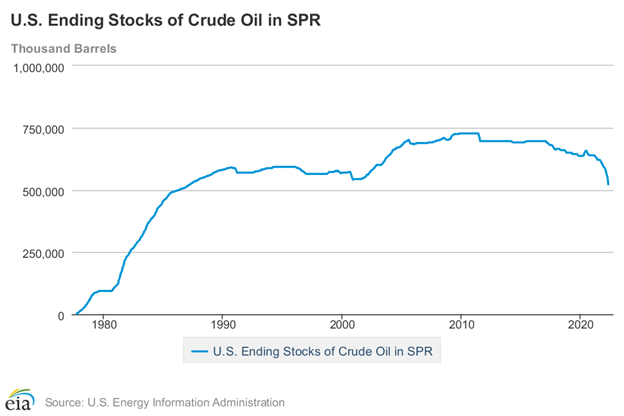
The last time the US Strategic Oil Reserves was this low was January 1985. The US population was then 238 million, The Cosby Show was the top-rated on TV, the threat of the AIDS virus was just beginning to be understood, and a newly appointed NIH Director named Anthony Fauci had just been promoted. In 37 years, some things have changed, and some things have not. One that has not is the need for reliable energy.
The Reserves reached its peak in April 2011 with 726.5 million barrels; today we sit with 453.1 million. Will it take 37 years to replenish the more than 200 million barrels, 160 million that have been siphoned off since March of this year?
The barrels that are being used in 2022, were ordered released by the White House to offset domestic loss of production, pipeline distribution, and less supply compounded by global shortages resulting from a partial embargo against Russia. The order is intended to work to lower gas prices today and help reduce the impact oil prices are having on unacceptably high inflation.
President Biden said in March that the US would release one million barrels of oil a day for six months as petroleum products spiked following the start of the Russian/Ukrainian war. The White House then said, in late July, the US would release another 20 million barrels.
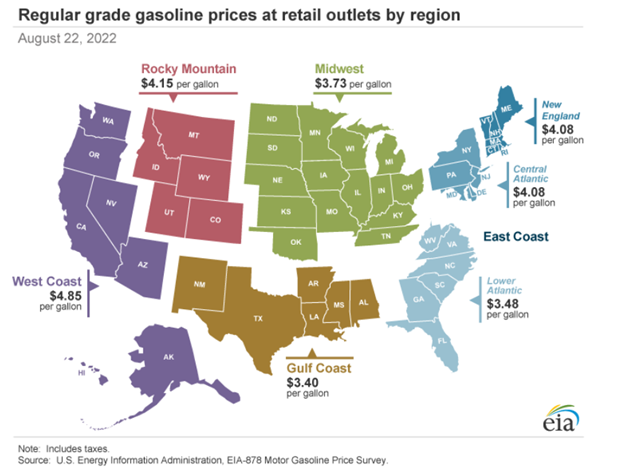
To some degree, it worked as intended. There has been a fall in the price at the gas pumps over the past two months. Much of this has been supply related helped by the reserve releases, and to a lesser extend, demand has also slowed from receding economic activity. WTI crude, the US benchmark price, has dropped around 24%.
That decline has brought US gasoline prices down from above $5 a gallon in June to $3.89 on Tuesday, August 17. Globally, other countries are tapping into their own strategic reserves as well.
What Happens When we Refill It?
The US consumed about 20 million barrels of oil a day on average in 2021, according to the EIA. During the same year, it produced 11 million barrels a day. The Biden administration is proposing to refill the stockpiles under a plan that is likely to see it order 60 million barrels this fall for delivery at an unspecified time in the future. That leaves at least another 100 million barrels to bring the country back to where we were in March 2022 – over two hundred more to bring us back to the peak. It took 37 years last time for the country to stockplile the same amount.
The current infrastructure is not supporting additional oil output, or companies would be pumping now. On July 1, President Biden made public a five-year proposal for offshore oil and gas development in areas of existing production and said the final plan might have anywhere from zero to 11 lease sales.
The range of proposed options were, between two auctions a year and none at all. The plan seemed conflicted with a desire to balance the administration’s efforts to reduce the use of fossil fuels and its calls to increase needed oil and gas.
Energy Demand Moving Forward
Does restocking the Reserves point toward high petroleum demand for a much longer time period than ever expected? Does it also create opportunities for producers of biofuels, for example GEVO?
The current fuel issues are not going to disappear overnight. Borrowing from the future with an intent, and now a plan to pay it back, will require more production than before. Companies that produce are not inclined to make big investments in building out a platform when the political climate is one of wanting to shut production down as soon as possible.
The cost of reducing energy output and then borrowing from reserves, especially when an unexpected embargo is placed on a major supplier, could keep the price of all energy elevated for a much longer time than, the end of a war, of installation of coastal wind farms.
FAT Brands Inc. (FAT) A Tuck-in Acquisition to Improve Factory Utilization and Expand Market Share
FAT Brands (NASDAQ: FAT) is a leading global franchising company that strategically acquires, markets, and develops fast casual, quick-service, casual dining, and polished casual dining concepts around the world. The Company currently owns 17 restaurant brands: Round Table Pizza, Fatburger, Marble Slab Creamery, Johnny Rockets, Fazoli’s, Twin Peaks, Great American Cookies, Hot Dog on a Stick, Buffalo’s Cafe & Express, Hurricane Grill & Wings, Pretzelmaker, Elevation Burger, Native Grill & Wings, Yalla Mediterranean and Ponderosa and Bonanza Steakhouses, and franchises and owns over 2,300 units worldwide. For more information on FAT Brands, please visit www.fatbrands.com.
Joe Gomes, Senior Research Analyst, Noble Capital Markets, Inc.
Joshua Zoepfel, Research Associate, Noble Capital Markets, Inc.
Refer to the full report for the price target, fundamental analysis, and rating.
Acquisition. Yesterday, FAT Brands announced that it agreed to acquire the franchised chain of stores known as Nestlé Toll House Café by Chip from Crest Foods, Inc. While the acquisition increases the Company’s presence in the cookie segment, we believe the driving force to be the opportunity to increase the capacity utilization of the manufacturing business, which currently manufactures cookie dough and pretzel mix for FAT Brands, as well as conducts distribution services for other products used in those operations. Recall, the factory is currently operating at roughly one-third of capacity. At full capacity, the factory could more than double its EBITDA contribution.
Who, and What, Is Nestlé Toll House Café by Chip from Crest Foods, Inc.? While terms of the acquisition were not released, Nestle Toll House Café currently franchises approximately 85 cafés across the U.S., with a concentration in Texas. The very first Nestle Toll House Café by Chip opened in August 2000, in Frisco, Texas and the brand touches over 60 million customers per year. Cafes are commonly found in shopping malls or shopping centers….
This Company Sponsored Research is provided by Noble Capital Markets, Inc., a FINRA and S.E.C. registered broker-dealer (B/D).
*Analyst certification and important disclosures included in the full report. NOTE: investment decisions should not be based upon the content of this research summary. Proper due diligence is required before making any investment decision.
The Big Price Impact on Stocks After Warren Buffett’s Most Active Buying Spree
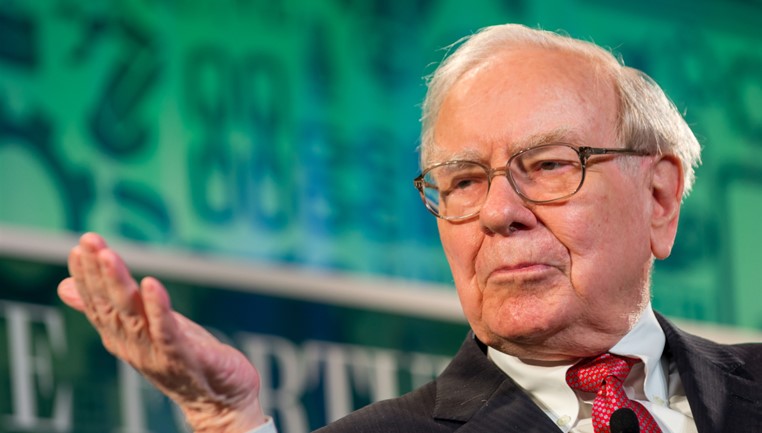
Warren Buffett and Berkshire Hathaway (BRK.A, BRK.B) were actively spending down the company’s large pool of cash last quarter, just as they promised during their recent annual meeting. This makes sense as some stock prices are lower than they have been in years, and a few sectors are showing they could have plenty of upside potential. It makes even more sense when you consider that Berkshire Hathaway was sitting on $144 billion in cash. The inflation rate is now running above 8% and eroding the value of every unearning penny.
Jumping into the market can be costly if wrong, but investor’s ‘dry powder’ is being eroded with increased costs by the day – finding a place for money to grow by at least the inflation rate would seem prudent. The analysts at Berkshire Hathaway are certainly aware of this.
The positive impact of Berkshire showing confidence in a company is often all that is needed to exceed the near non-earnings holding a cash position. Below we look at three Berkshire Hathaway changed positions as reported on May 16, and then compare the stock’s price moves versus the overall market.
Where Did They Gain Exposure
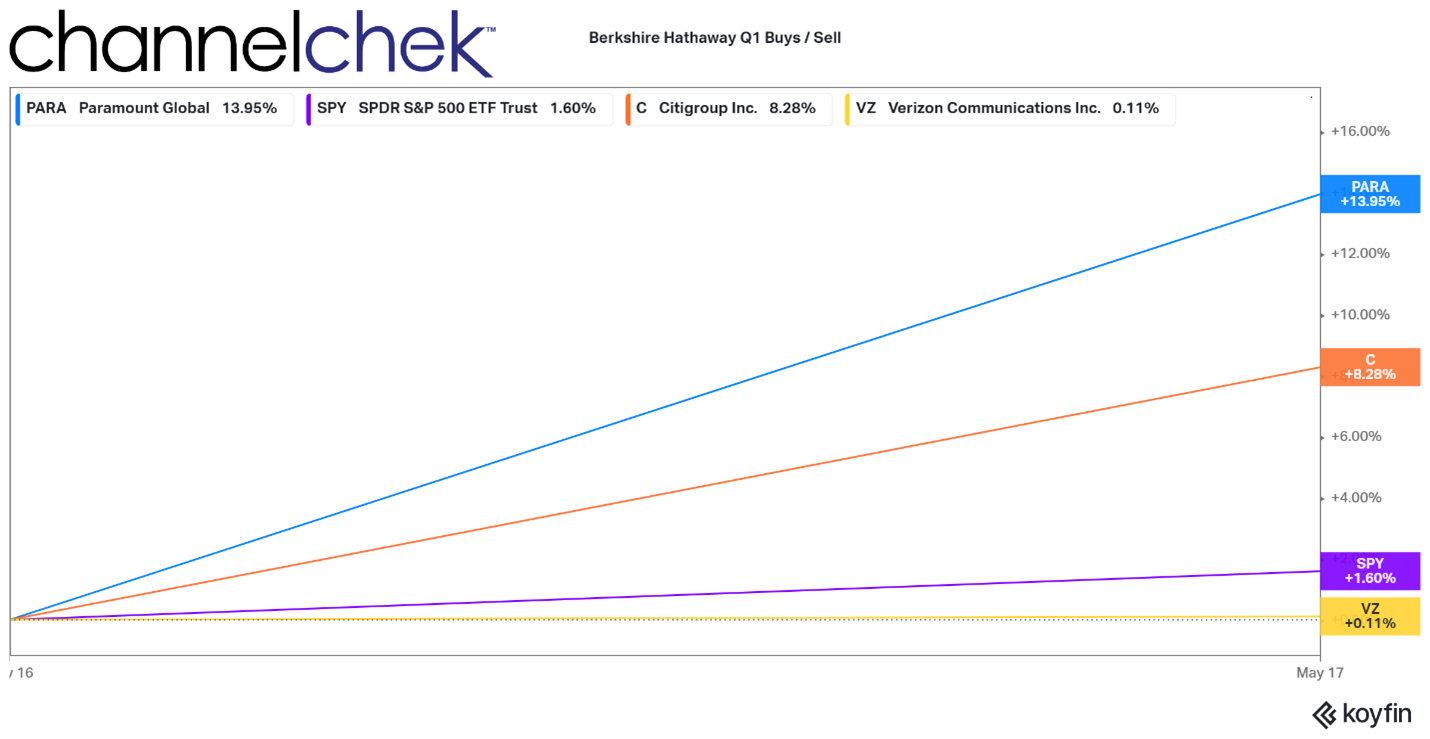
As revealed by the companies 13F filed on May 16, as of March 31 Berkshire Hathaway added Citigroup (C), Paramount Global (PARA), and sold Verizon (VZ). There were older positions added to as well, such as Chevron (CVX), and Activision Blizzard (ATVI). But for the purpose of showing the power of Buffett’s believing a stock is attractive, or in Verizon’s case, no longer attractive, we’ll take a look at the market moves of these companies as of 1pm the day after the 13F was made public.
Source: Koyfin The above chart of Citibank, Paramount Global, and Verizon from the beginning trading on Monday compares the stocks to the S&P 500 performance during the same short period.
The S&P, as reflected during the short period in this chart, beginning on the date of Berkshire’s 13F filing, shows the S&P 500 up 1.60%. This is substantial in a year when the index has mostly been delivering red to investors. Verizon was the most noteworthy sale of Buffett as they brought their position near zero. The company’s stock rose only 0.11%, well below the S&P benchmark performance.
As for the positions opened during the first quarter by Berkshire Hathaway, Citicorp shot up 8.28%. Paramount Global reacted even more strongly, rising double digits to 13.95%.
Lessons
While an SEC-registered portfolio new holdings are kept close to the vest before reported in order to avoid insider trading problems, listening to what someone like Warren Buffett is saying at annual meetings and at other times can allow you to get a sense if they have been active, and in what industries. More important, is whether they are active buying or selling. For an investor that is holding a stock which a well-followed investor has decided to sell, can cause significant underperformance for at least the near term.
Other Pertinent Info from the 13F Filing
During the first quarter of 2022, the value of Berkshire’s US stock portfolio rose by 10% to $364 billion. Buffett had indicated the firm he manages has been struggling to find bargains in recent years. He blamed this on stocks swelling to record highs, fierce competition from private equity firms, and SPACs which increased competition and costs of acquisitions. Even Berkshire’s own rising stock price made it unappealing as a company stock buy-back.
A change of appetite took place in the first quarter of 2022. Berkshire bought $51 billion worth of equities and sold less than $10 billion in stocks. Its net cash reduction of $41 billion helped slash its cash pile by 28% to $106 billion. Q1 2022 marked one of the most active buying periods in Berkshire Hathaway’s history.
Take-Away
Well known, successful investors can either make a winner out of your holding or cause it to trade at a pace below the market. While knowing and trading on information before it is made public can get you in trouble, investors like Buffett do provide guidance. These hints as to their thinking and likely direction may help investors somewhat. This is why it always makes sense to know what they’re saying – it isn’t fun holding something they just reported sold, and the tailwind they create when you’re long the same company can be profitable.
The FDA Breakthrough Devices Program may be a starting point for investors exploring the medical space. It’s designed to create a quicker path for medical devices that provide more effective treatment or diagnosis of life-threatening or irreversible conditions. There are significant benefits for the companies granted access to the program. Lists of devices after the companies have been granted a marketing authorization are available on the FDA website.
While new pharmaceuticals tend to grab headlines quicker than devices, investors looking for public companies, that may be uncorrelated to the pace of US economic growth or the financial markets, may visit the website and then research the companies on Channelchek.
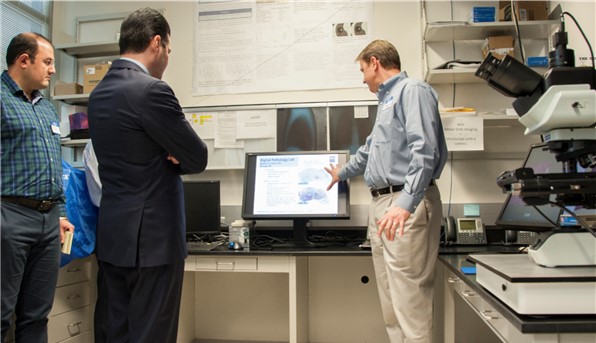
Image Credit: US Food and Drug Administration (Flickr)
Benefits of the Breakthrough Devices Program
The purpose of the Breakthrough Devices Program is to provide patients and health care providers with timely access to novel medical devices by speeding up their development, assessment, and review. At the same time, it preserves the statutory standards for premarket approval, 510(k) clearance, and De Novo marketing authorization, consistent with the Agency’s mission to protect and promote public health.
Manufacturers have the opportunity to interact with the FDA’s experts through several different program options to efficiently address issues that present themselves during the FDA premarket review phase. This feedback from the FDA helps shorten the agreement phase. The company can also expect a prioritized review of its submission. This can have the effect of speeding the product to market with less cost and fewer problems.
How this Works
Pulling an example from the Channelchek library of videos from NobleCon18, we can use Perimeter Medical Imaging AI (PYNKF) to understand what a candidate looks like and how it may bring value to the patient, medical provider, and possibly investors.
Perimeter is an early-stage medical device company that expects its flagship product to address unmet cancer treatment needs. Initially, the device is expected to change the way breast cancer is treated and evaluated to improve outcomes and minimize the chance of recurrence or having to reoperate. In order to apply for the FDA designation, Perimeter’s device was indicated for breast cancer. However, the applications are expected to extend well beyond and into other major cancers in the $3.7 billion total market.
This FDA designation makes for a much more clear regulatory pathway. Perimeter meets the first guideline in that its product has unique technology (breakthrough) that is solving problems with a different method on a scalable platform. The procedures are expected to reduce the cost to patients, minimize the need for repeat surgery and be self-funding from the hospitals’ standpoint. This is because about 20 to 25% of cancer patients now need to return for a re-operation that costs approximately $16,000. Hospitals that adopt the Perimeter AI technology could serve patients better and stand to recover their costs while reducing overall patient costs on average.
Take-Away
There are many ways to uncover companies that are “on the move.” Reviewing those the FDA is likely to help along toward a full “go-ahead” is just one of them. For a more detailed look at Perimeter, their unique business model, and technology, watch the 20-minute video below. For more on understanding the FDA Breakthrough Device Program in order to uncover companies that could change medicine, go to FDA.gov .
To evaluate small and growing companies, explore Channelchek beginning here.