
Ayala Pharmaceuticals (AYLA) – Lowering AYLA To Market Perform


Tuesday, September 20, 2022

Ayala Pharmaceuticals, Inc. is a clinical-stage oncology company focused on developing and commercializing small molecule therapeutics for patients suffering from rare and aggressive cancers, primarily in genetically defined patient populations. Ayala’s approach is focused on predicating, identifying and addressing tumorigenic drivers of cancer through a combination of its bioinformatics platform and next-generation sequencing to deliver targeted therapies to underserved patient populations. The company has two product candidates under development, AL101 and AL102, targeting the aberrant activation of the Notch pathway with gamma secretase inhibitors to treat a variety of tumors including Adenoid Cystic Carcinoma, Triple Negative Breast Cancer (TNBC), T-cell Acute Lymphoblastic Leukemia (T-ALL), Desmoid Tumors and Multiple Myeloma (MM) (in collaboration with Novartis). AL101, has received Fast Track Designation and Orphan Drug Designation from the U.S. FDA and is currently in a Phase 2 clinical trial for patients with ACC (ACCURACY) bearing Notch activating mutations. AL102 is currently in a Pivotal Phase 2/3 clinical trials for patients with desmoid tumors (RINGSIDE) and is being evaluated in a Phase 1 clinical trial in combination with Novartis’ BMCA targeting agent, WVT078, in Patients with relapsed/refractory Multiple Myeloma. For more information, visit www.ayalapharma.com.

Robert LeBoyer, Vice President, Research Analyst, Life Sciences , Noble Capital Markets, Inc.

Refer to the full report for the price target, fundamental analysis, and rating.

Lowering AYLA To Market Perform.  We are lowering our rating on Ayala Pharmaceuticals to Market Perform.  Our Investment Thesis was based on successful development of AL101 and AL102 in several indications. However, the clinical trials have not advanced as we had anticipated while the risk to the stock has increased.

Clinical Trials.  AL101 and AL102 were designed to block activation of the NOTCH pathway and its effects on cancer growth.  We viewed the Phase 2 for AL101 in Adenoid Cystic Carcinoma (ACC) and the Phase 2/3 for AL102 in desmoid tumors as both Orphan indications as well as proof-of-concept that could lead to combination regimens in cancers with NOTCH mutations that are aggressive and difficult to treat.  The Phase 2 TENACITY trial testing AL101 in triple-negative breast cancer (TNBC) was the first indication that could open large patient populations for AL101/AL102.  However, this indication, as well as the collaboration with Novartis for multiple myeloma, has been discontinued.


Get the Full Report

This Company Sponsored Research is provided by Noble Capital Markets, Inc., a FINRA and S.E.C. registered broker-dealer (B/D).

*Analyst certification and important disclosures included in the full report. NOTE: investment decisions should not be based upon the content of this research summary. Proper due diligence is required before making any investment decision. 
Avivagen Inc. (VIVXF) – Slower Quarter but Increasing Activity


Tuesday, September 20, 2022

Avivagen is a life sciences corporation focused on developing and commercializing products for livestock, companion animal and human applications that, by safely supporting immune function, promote general health and performance. It is a public corporation traded on the TSX Venture Exchange under the symbol VIV and is headquartered in Ottawa, Canada, based in partnership facilities of the National Research Council of Canada. For more information, visit www.avivagen.com. The contents of the website are expressly not incorporated by reference in this press release.

Joe Gomes, Senior Research Analyst, Noble Capital Markets, Inc.

Joshua Zoepfel, Research Associate, Noble Capital Markets, Inc.

Refer to the full report for the price target, fundamental analysis, and rating.

Results for Q3. Total revenue for the quarter was $48,606 (all figures are in Canadian $), down from $505,886 the previous year and below our estimate of $100,000. The decrease was due to lower sales in the OxC-Beta product. Net loss was at $1.9 million versus a loss of $1.5 million in the prior year and our loss estimate of $1.54 million. The increased net loss was due to higher salaries expense and a decrease in government grants.

Sales Update for OxC-Beta. Avivagen sold a total of 350 kilograms of OxC-Beta during the third quarter, down from 925 kg in Q2 and 2,550 kg in Q1. Thailand ordered 250 kg during the quarter while Taiwan ordered 100 kg. The average price per kilogram in the quarter was $103.10 versus $102.27 in the second quarter.


Get the Full Report

This Company Sponsored Research is provided by Noble Capital Markets, Inc., a FINRA and S.E.C. registered broker-dealer (B/D).

*Analyst certification and important disclosures included in the full report. NOTE: investment decisions should not be based upon the content of this research summary. Proper due diligence is required before making any investment decision. 

Detecting Deepfake Voice is Now Crucial to Security

Image Credit: Kenya Allmond (Flickr)

Deepfake Audio Has a Tell – Researchers Use Fluid Dynamics to Spot Artificial Imposter Voices

Imagine the following scenario. A phone rings. An office worker answers it and hears his boss, in a panic, tell him that she forgot to transfer money to the new contractor before she left for the day and needs him to do it. She gives him the wire transfer information, and with the money transferred, the crisis has been averted.

The worker sits back in his chair, takes a deep breath, and watches as his boss walks in the door. The voice on the other end of the call was not his boss. In fact, it wasn’t even a human. The voice he heard was that of an audio deepfake, a machine-generated audio sample designed to sound exactly like his boss.

Attacks like this using recorded audio have already occurred, and conversational audio deepfakes might not be far off.

Deepfakes, both audio and video, have been possible only with the development of sophisticated machine learning technologies in recent years. Deepfakes have brought with them a new level of uncertainty around digital media. To detect deepfakes, many researchers have turned to analyzing visual artifacts – minute glitches and inconsistencies – found in video deepfakes.

Audio deepfakes potentially pose an even greater threat, because people often communicate verbally without video – for example, via phone calls, radio and voice recordings. These voice-only communications greatly expand the possibilities for attackers to use deepfakes.

To detect audio deepfakes, we and our research colleagues at the University of Florida have developed a technique that measures the acoustic and fluid dynamic differences between voice samples created organically by human speakers and those generated synthetically by computers.

Organic vs. Synthetic voices

Humans vocalize by forcing air over the various structures of the vocal tract, including vocal folds, tongue and lips. By rearranging these structures, you alter the acoustical properties of your vocal tract, allowing you to create over 200 distinct sounds, or phonemes. However, human anatomy fundamentally limits the acoustic behavior of these different phonemes, resulting in a relatively small range of correct sounds for each.

In contrast, audio deepfakes are created by first allowing a computer to listen to audio recordings of a targeted victim speaker. Depending on the exact techniques used, the computer might need to listen to as little as 10 to 20 seconds of audio. This audio is used to extract key information about the unique aspects of the victim’s voice.

The attacker selects a phrase for the deepfake to speak and then, using a modified text-to-speech algorithm, generates an audio sample that sounds like the victim saying the selected phrase. This process of creating a single deepfaked audio sample can be accomplished in a matter of seconds, potentially allowing attackers enough flexibility to use the deepfake voice in a conversation.

This article was republished  with permission from The Conversation, a news site dedicated to sharing ideas from academic experts. It represents the research-based findings and thoughts of Logan Blue, PhD student in Computer & Information Science & Engineering, University of Florida and Patrick Traynor, Professor of Computer and Information Science and Engineering, University of Florida.

Detecting Audio Deepfakes

The first step in differentiating speech produced by humans from speech generated by deepfakes is understanding how to acoustically model the vocal tract. Luckily scientists have techniques to estimate what someone – or some being such as a dinosaur – would sound like based on anatomical measurements of its vocal tract.

We did the reverse. By inverting many of these same techniques, we were able to extract an approximation of a speaker’s vocal tract during a segment of speech. This allowed us to effectively peer into the anatomy of the speaker who created the audio sample.

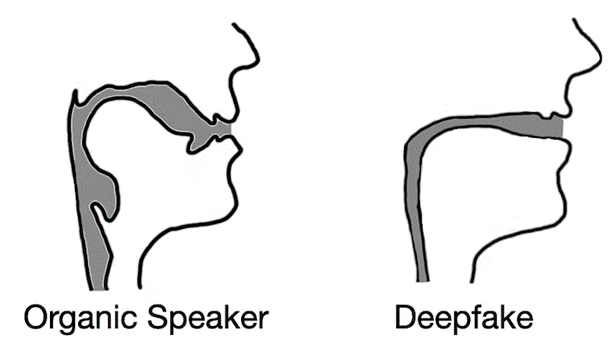
Deepfaked audio often results in vocal tract reconstructions that resemble drinking straws rather than biological vocal tracts. Logan Blue (The Conversation)

From here, we hypothesized that deepfake audio samples would fail to be constrained by the same anatomical limitations humans have. In other words, the analysis of deepfaked audio samples simulated vocal tract shapes that do not exist in people.

Our testing results not only confirmed our hypothesis but revealed something interesting. When extracting vocal tract estimations from deepfake audio, we found that the estimations were often comically incorrect. For instance, it was common for deepfake audio to result in vocal tracts with the same relative diameter and consistency as a drinking straw, in contrast to human vocal tracts, which are much wider and more variable in shape.

This realization demonstrates that deepfake audio, even when convincing to human listeners, is far from indistinguishable from human-generated speech. By estimating the anatomy responsible for creating the observed speech, it’s possible to identify the whether the audio was generated by a person or a computer.

Why this matters

Today’s world is defined by the digital exchange of media and information. Everything from news to entertainment to conversations with loved ones typically happens via digital exchanges. Even in their infancy, deepfake video and audio undermine the confidence people have in these exchanges, effectively limiting their usefulness.

If the digital world is to remain a critical resource for information in people’s lives, effective and secure techniques for determining the source of an audio sample are crucial.

When Stocks Instead of TIPS are Better Hedges Against Inflation

Image Credit: U.S. Dept. of Treasury

What’s the Best Inflation Fighter for Your Savings? Stocks or TIPS?

At a minimum, an investor with an eye toward having more, not less, in the future needs to beat the rate of inflation. Ideally, since the investor ties up their money, the buying power in their account should provide the current inflation rate plus a risk premium over the medium to long term. During the past few months, a number of long-term savers/investors have asked me what I thought about TIPS as a means of exceeding inflation. I have strong opinions on these Treasury securities. My thoughts are rooted in having been a portfolio manager for the country’s second-largest fixed income fund manager back in 1996 when the U.S. Treasury asked for our input on the design of the new bond. The Treasury wanted us to approve of the bonds enough to invest in them – in early 1997 I pulled the trigger on $100 million in the first ever TIPS auction – that was 25 years ago, and there is now enough data to compare the performance of Stocks, TIPS and the rate of inflation. Which one provides better inflation “protection”?

Some Details on TIPS

If you aren’t aware of the intricacies and history of the Treasury Inflation-Indexed Securities, dubbed TIPS, as the working name for the project back in 1996, here’s what you should know in a two paragraphs.

Interest rates were declining through the late 1990s and the Treasury Secretary Robert Rubin had a plan to lessen the government’s interest rate burden by issuing a bond with costs that would be lower with the declining inflation and interest rates. The Canadians, British, and Australians all had a bond type that floated with the countries’ inflation index. The Canadian-style bond had a fixed rate of interest where the principal accreted upward with an inflation index. On this new principal, an unaffected fixed-rate (coupon) would pay interest. The British and the Aussies paid the inflation addition with the coupon, the bondholder didn’t have to wait until maturity to be compensated for price increases. The U.S. adopted the Canadian system of accreting to principal.

The new bond was to be helpful to the U.S. Treasury, the conservative investor, and even the Federal Reserve. Inflation was sinking at the time, so investors were attracted in part to the idea that the securities effectively have a floor since the Treasury would never lower the principal accretion to below zero even if deflation became a problem. Retirees were told they should be thrilled to have a low-risk investment to choose from that paid inflation plus. The U.S. Treasury was looking forward to being able to reduce the interest costs of its debt as there were still bonds outstanding that were paying 14%. As for the Chairman of the Federal Reserve, Alan Greenspan, he was thrilled he’d have a constantly updating investor-driven mechanism that would indicate the market’s current expectation of inflation.

Inflation “Get Real”

Through the late seventies and into the early eighties, inflation was a big influencer on all household decisions. Durable items like washing machines were purchased sooner rather than later because they may cost much more later. Even borrowing to buy made good financial sense. As for investing or saving,  buying short bonds or CDs that always paid more than inflations and then reinvesting similarly when it came due provided the investor with a little more income than inflation (and sometimes a free toaster). The stock market had years where it had negative returns, but for the medium or long-term saver, it far exceeded inflation. This has not seemed to have changed. 

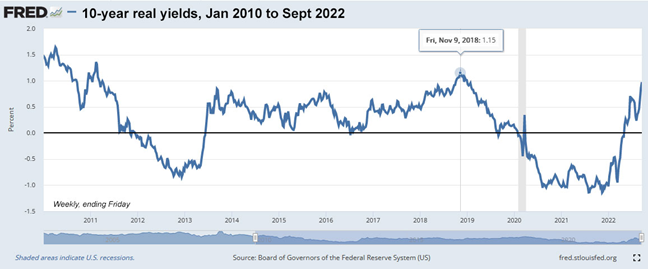
“Get Real” is a slogan that had been used by brokers trying to build enthusiasm for TIPS when they first came out. It refers to real yield, or put another way, the yield after inflation. TIPS were designed to pay the inflation rate plus an interest rate, so the investor earns a real yield. What no one anticipated when the securities were designed is the real yield could go negative, thus providing the investor with inflation minus whatever supply and demand decided.

The chart below demonstrates that over a recent 11-year period, TIPS paid negative real rates about a third of the time. They did not provide the investors with a return above the rate of inflation as originally envisioned.

Source: St. Louis Federal Reserve

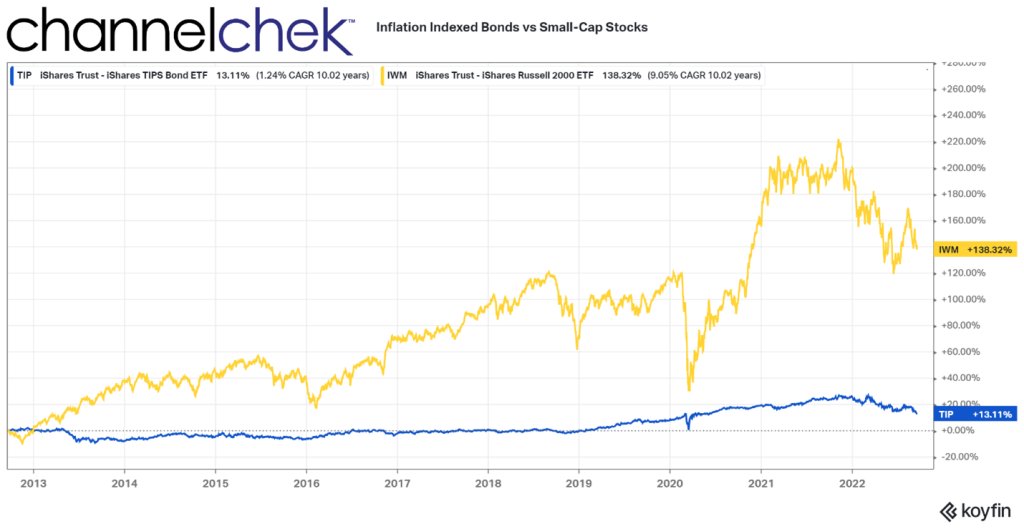
Stocks are not designed to be correlated with the rate of inflation, but they generally do well when the economy is flourishing or expected to flourish (these periods tend to be associated with inflation). And equities fall off when there is a contraction or expectations of a bad business climate. The chart below uses the Russell 2000 Small-Cap Index as a measure of stock market performance. The period shown demonstrates that if one is looking to keep up with or beat inflation by any margin, Small-Cap stocks can be viewed as far superior to TIPS.

Source: Koyfin

During the period from August 2012 until August 2022, prices have risen a combined amount of 28.558%, according to a calculator provided by the Bureau of Labor Statistics. During the same period, an investment in TIPS provided 13.11% to the saver/investor. This equates to a real return of negative 15% over ten years. If the purpose of the investor is to keep up with and beat inflation, TIPS have failed as a decent option.

As for stocks, the downside over short periods has been much larger and deeper declines than TIPS. However, after year one, the declines were never large enough to show underperformance. TIPS failed its main goal of inflation plus. If an investor instead put money in small-cap stocks, they would have exceeded inflation by 110%.

While this is not predictive of the future, it is compelling evidence for anyone with a time horizon beyond a few years to look at the true risk profile of each. TIPS have performed worse than inflation. One reason for this is that bond prices have been held lower than the market would naturally have them because the Fed has taken so many on its balance sheet.

Take Away

The performance of the stock market over the medium to long term has a long history of beating returns of other assets, especially those of bonds. Treasury Inflation-Indexed Securities, the official name for the bond, does not have a “P” in it. The “P” was supposed to stand for “Protected.” Just prior to the first auction, the name was changed as government lawyers pointed out these may not protect the investor from inflation.

The Federal Reserve owns a third of the outstanding U.S. Treasuries, including a large allocation of TIPS.  This unnatural demand holds prices artificially below where the market would price them without the Fed’s impact. This skewing of the results would have been upsetting to former Fed head Alan Greenspan who felt the main appeal to the security was their ability to help predict future inflation.

Stocks have risks, and bonds have risks, if it’s inflation you’re looking to overcome, inflation-linked bonds have been historically off the mark.

Paul Hoffman Managing Editor, Channelchek

Sources

https://www.nytimes.com/1982/02/05/business/record-set-on-30-year-us-bonds.html

https://www.treasurydirect.gov/instit/annceresult/tipscpi/tipscpi.htm

https://www.bls.gov/data/inflation_calculator.htm

https://www.federalreserve.gov/monetarypolicy/bst_recenttrends.htm

The GEO Group (GEO) – NYC NDRS


Monday, September 19, 2022

The GEO Group, Inc. (NYSE: GEO) is a leading diversified government service provider, specializing in design, financing, development, and support services for secure facilities, processing centers, and community reentry centers in the United States, Australia, South Africa, and the United Kingdom. GEO’s diversified services include enhanced in-custody rehabilitation and post-release support through the award-winning GEO Continuum of Care®, secure transportation, electronic monitoring, community-based programs, and correctional health and mental health care. GEO’s worldwide operations include the ownership and/or delivery of support services for 103 facilities totaling approximately 83,000 beds, including idle facilities and projects under development, with a workforce of up to approximately 18,000 employees.

Joe Gomes, Senior Research Analyst, Noble Capital Markets, Inc.

Joshua Zoepfel, Research Associate, Noble Capital Markets, Inc.

Refer to the full report for the price target, fundamental analysis, and rating.

NDRS. We hosted GEO CFO Brian Evans and EVP Pablo Paez for a series of investor meetings in NYC. The discussion revolved around the Company’s positive operating performance in a challenged market, the debt restructuring, and the BI business.

Operating Performance. As we have highlighted previously, The GEO Group has strung together some of its best operating performance ever over the past twelve months, even in the face of challenging market conditions due to government policy changes. Conditions, especially in the immigration sector, would suggest a continued positive operating environment for the Company. 


Get the Full Report

This Company Sponsored Research is provided by Noble Capital Markets, Inc., a FINRA and S.E.C. registered broker-dealer (B/D).

*Analyst certification and important disclosures included in the full report. NOTE: investment decisions should not be based upon the content of this research summary. Proper due diligence is required before making any investment decision. 
FAT Brands Inc. (FAT) – New York City NDRS


Monday, September 19, 2022

FAT Brands (NASDAQ: FAT) is a leading global franchising company that strategically acquires, markets, and develops fast casual, quick-service, casual dining, and polished casual dining concepts around the world. The Company currently owns 17 restaurant brands: Round Table Pizza, Fatburger, Marble Slab Creamery, Johnny Rockets, Fazoli’s, Twin Peaks, Great American Cookies, Hot Dog on a Stick, Buffalo’s Cafe & Express, Hurricane Grill & Wings, Pretzelmaker, Elevation Burger, Native Grill & Wings, Yalla Mediterranean and Ponderosa and Bonanza Steakhouses, and franchises and owns over 2,300 units worldwide. For more information on FAT Brands, please visit www.fatbrands.com.

Joe Gomes, Senior Research Analyst, Noble Capital Markets, Inc.

Joshua Zoepfel, Research Associate, Noble Capital Markets, Inc.

Refer to the full report for the price target, fundamental analysis, and rating.

NYC NDRS. We hosted FAT Brands CEO Andrew Wiederhorn and members of the management team in New York City for investor meetings last week. The tone of the meetings was positive with management highlighting the significant opportunities to grow EBITDA.

Outstanding Franchisee Conference. In late August, the Company hosted its franchisees for a conference. Reports from the meeting indicate an upbeat franchisee group, with FAT inking 150 new franchisee contracts over the three day conference, driving the backlog of new locations to over 1,000. We believe the new contracts are an indicator of the franchisee groups’ confidence in the FAT Brands model.


Get the Full Report

This Company Sponsored Research is provided by Noble Capital Markets, Inc., a FINRA and S.E.C. registered broker-dealer (B/D).

*Analyst certification and important disclosures included in the full report. NOTE: investment decisions should not be based upon the content of this research summary. Proper due diligence is required before making any investment decision. 

Entravision Communications (EVC) – A Sign Of Good Things To Come?


Monday, September 19, 2022

Entravision Communications Corporation is a diversified Spanish-language media company utilizing a combination of television and radio operations to reach Hispanic consumers across the United States, as well as the border markets of Mexico. Entravision owns and/or operates 53 primary television stations and is the largest affiliate group of both the top-ranked Univision television network and Univision’s TeleFutura network, with television stations in 20 of the nation’s top 50 Hispanic markets. The Company also operates one of the nation’s largest groups of primarily Spanish-language radio stations, consisting of 48 owned and operated radio stations.

Michael Kupinski, Director of Research, Noble Capital Markets, Inc.

Refer to the full report for the price target, fundamental analysis, and rating.

Accelerates purchase of Cisneros. The company announced that it paid $22 million and will pay another $22 million in April 2023 for a total of $44 million for the remaining balance that it owes for Cisneros. This accelerates the payment plan for 49% of Cisneros that it agreed to acquire in 2021. Under the original plan, the company was expected to have paid as much as $60 million over the next 2 years. 

Frees management. We believe that the advanced timeline for the payment, which is expected to have included performance fees, frees management to pursue growth opportunities outside of its existing Latin American territories. 


Get the Full Report

This Company Sponsored Research is provided by Noble Capital Markets, Inc., a FINRA and S.E.C. registered broker-dealer (B/D).

*Analyst certification and important disclosures included in the full report. NOTE: investment decisions should not be based upon the content of this research summary. Proper due diligence is required before making any investment decision. 
Digerati Technologies (DTGI) – Our View Of The Proposed Transaction


Monday, September 19, 2022

Digerati Technologies, Inc. (OTCQB: DTGI) is a provider of cloud services specializing in UCaaS (Unified Communications as a Service) solutions for the business market. Through its operating subsidiaries, T3 Communications (T3com.com), Nexogy (Nexogy.com), SkyNet Telecom (Skynettelecom.net) and NextLevel Internet (nextlevelinternet.com), the Company is meeting the global needs of small businesses seeking simple, flexible, reliable, and cost effective communication and network solutions including cloud PBX, cloud telephony, cloud WAN, cloud call center, cloud mobile, and the delivery of digital oxygen on its broadband network.

Michael Kupinski, Director of Research, Noble Capital Markets, Inc.

Patrick McCann, Research Associate, Noble Capital Markets, Inc.

Refer to the full report for the price target, fundamental analysis, and rating.

A vehicle for up-listing. The company announced its plans to enter a business combination with Minority Equality Opportunities Acquisition Inc. (MEOA), a Special Purpose Acquisition Company (SPAC). The transaction, which will result in an up-list to the NASDAQ, should allow the company easier access to the capital markets going forward and potentially accelerate its roll-up strategy.

Transaction details. The SPAC holds $128 million cash in trust. However, there will be SPAC shareholder redemptions prior to the deal closing. We conservatively assume 95% redemption, which would result in proceeds of an estimated $6.4 million in cash. At that redemption rate, Digerati shareholders and warrant holders will retain a 73% equity stake, with 21% going to sponsor shares and 6% going to SPAC shareholders.


Get the Full Report

This Company Sponsored Research is provided by Noble Capital Markets, Inc., a FINRA and S.E.C. registered broker-dealer (B/D).

*Analyst certification and important disclosures included in the full report. NOTE: investment decisions should not be based upon the content of this research summary. Proper due diligence is required before making any investment decision. 
How New Technology Reduces Inflation Data

Image Credit: Kanesue (Flickr)

Why Apple Can Hold the Line on iPhone Prices and Keep Getting Relatively Cheaper

Inflation in the U.S. is surging to near a 40-year high, with prices on food, fuel and pretty much everything seeming to rise more every month.

Smartphones may be an exception.

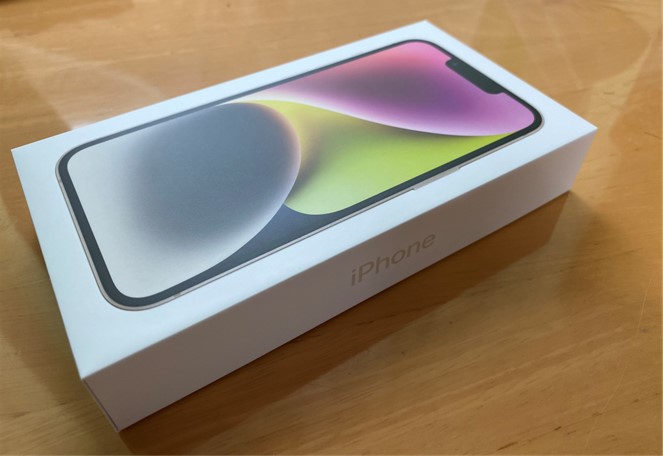
Apple, for example, recently announced its new versions of the iPhone and other gadgets, and turned a lot of heads when it said it wouldn’t charge more despite higher costs to make the devices.

This is puzzling because companies typically raise prices in line with inflation – or at least enough to cover the increased costs of making their products.

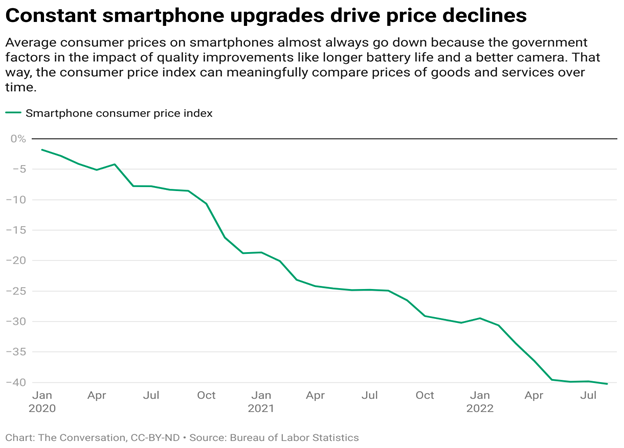
Consumer price data tells an even more befuddling story. The latest consumer price index data suggests smartphone prices are actually down 20.4% in August from a year ago, according to an index released on Sept. 13, 2022. That’s the biggest drop of any detailed expenditure item the Bureau of Labor Statistics tracks, and contrasts with the overall 8.3% increase in prices.

What’s going on?

As an economist teaching business school students, I enjoy exploring and explaining these economic puzzles. I believe there are two basic explanations – one for the data and another for Apple.

Why Consumer Prices on Smartphones Fell

The story behind the consumer price index data is easier to explain, if a bit technical.

The 20% drop over the past year isn’t unusual for smartphones. In fact, according to the index, they almost always go down from month to month. Since the end of 2019, smartphone prices have come down a whopping 40%.

And though smartphones are showing the biggest drop in the index, tech gear more broadly – from computers to smartwatches – also tend to fall over time. In the previous 12 months, televisions are down 19% and what the government calls information technology commodities are down 8.8%.

Part of the reason for their steady decline is found buried in the Bureau of Labor Statistics website. The consumer price index tries to measure a constant quality of goods and services in the economy. This means it seeks to track the price changes of the exact same set of goods and services each month. It’s comparing the price today with the price of the exact same thing a month or year ago.

For most goods, it’s not really an issue because their quality doesn’t change much over relatively small periods of time. For example, an apple you bite into today is pretty much the same as an apple you ate a year ago.

Smartphones and other technology-heavy gadgets are different. Because smartphones are constantly improving in quality – with the latest updates of an iPhone or Samsung Galaxy awaited breathlessly every year – it is more difficult to ensure you’re comparing prices of products of the exact same quality.

For rapidly improving items, the Bureau of Labor Statistics uses what are called “hedonic regression models” to estimate these changes in quality over time. Hedonic models measure the same amount of satisfaction. While this sounds complicated, the goal is simple: to figure out how much each new smartphone feature changes the price.

As a consumer, you are essentially doing this whenever you decide whether it is worth paying the extra money for that marginally better camera or extended battery life when buying a new phone.

And so, the 20.4% drop doesn’t mean you’re going to pay less for a new smartphone. But it does suggest you’re getting 20% more bang for your buck versus the same phone a year earlier. Whether it’s worth it is another question.

Why Apple Kept Prices Flat

That brings us to why Apple didn’t change its prices, even as the quality of the iPhone improved and supply chain costs went up.

Beyond the quality issues, one of the main ways supply chain problems are affecting phones is in the shortage of computer chips. If there is any product dependent on computer chips, it is smartphones. The shortage has resulted in delays to produce cars, trucks and many other consumer items.

The shortage has also increased the price of semiconductor parts. The U.S. government’s producer price index shows the price of semiconductor parts like chips and wafers steadily rising since the COVID-19 pandemic began in 2020, after falling for years. Chip prices are likely going up 20% in the next year.

For these and other reasons, analysts were expecting Apple to increase its prices.

Instead, Apple released its latest iPhone models at the same prices as the last two models, or US$799 for the iPhone 14 and $999 for the pro version. Keeping prices constant during inflationary times means iPhones are getting relatively cheaper.

So why isn’t Apple increasing prices? Is it just being kind to its customers, who have fueled tremendous profits for the company over the past decade?

Probably not.

With a gross profit margin of over 40% – meaning that’s how much it makes over the cost of producing all its products and services – Apple can probably afford to absorb increased chip and other component costs.

My best guess, since the smartphone market is fairly competitive, is that Apple is keeping prices the same to build market share in the U.S. – beyond the record 50% it recently hit – so the iPhone remains one of the best-selling smartphones.

So while the cost of almost everything we buy is rising, you can take some comfort in knowing at least one item is getting both better over time and not succumbing to an inflationary price spiral.

This article was republished with permission from The Conversation, a news site dedicated to sharing ideas from academic experts. It represents the research-based findings and thoughts of Jay L. Zagorsky, Clinical associate professor, Boston University.

There’s a Reason Gold is So Lackluster

Image Credit: Diane Aldrich (Flickr)

Despite Inflation, Gold Has Been on a Bumpy Road

Gold is among the first assets that come to mind when investors look to hedge against inflation. The U.S. and other nations are now experiencing the highest levels of inflation in forty years. As consumer prices continue to increase, gold, in all of its investible forms, has been trading down or sideways at best. Will its value pick up and catch up, or has it lost its shine as an inflation hedge?

Up is Down

In any market, the economic inputs impacting prices are many. One overriding factor that has been keeping gold prices at bay is inflation expectations. That’s right; it sounds counter-intuitive, but up is now down, and down is now up in the markets as investors look several steps out to determine their expectations. In this case, the steps follow this path:

Inflation >> Raising Rates >> Slower Economic Growth >> Recession = Low Inflation

Even during the weeks when the Federal Reserve’s monetary policy making board, the FOMC, meets and is universally expected to raise interest rates, longer rates on the treasury curve trade lower, not up. The markets are being very forward-looking and are more concerned with recession than inflation. I suspect this confounds the Fed’s efforts to slow growth and price pressures via rate increases that are being undermined by recession fears.

Gold is not seeing investors increasing their allocation of bullion, gold certificates, ETFs, gold mining companies, or any other assets linked to the price of gold, in large part because markets view the Fed as on a path to wipe out the economy and inflation. This was apparent last week as so-called meme stock AMC Theaters (AMC) shared a positive event related to their gold holdings, the stock traded down.

Dollar Strength

Outside of the U.S., expectations for a deep or deeper recession are growing. This week the German central bank (Bundesbank) said “There are mounting signs of a recession in the German economy in the sense of a clear broad-based and prolonged decline in economic output. This drives investment in the stronger U.S. economy.

In addition to viewing inflation as a reason for rates to be brought down,  global unrest and the U.S. central bank being perceived as tightening the most aggressively among trading partners has brought consistent strength to the U.S. dollar. When the performance of dollars and gold are viewed side by side, it hasn’t made sense to exchange the U.S. currency for gold. So in effect, gold which is often viewed as a currency is not competing well with greenbacks.

Take Away

Inflation has been rising. And not just in supply chain-related industries, in services as well. The Federal Reserve’s resolve to bring it down by increasing rates in the U.S. is attracting capital from overseas which has been keeping the dollar strong and as a perceived better alternatve to gold.

While gold prices are historically a beneficiary of higher inflation growth, the expectation that the Fed may quickly overshoot and cause a recession which could halt the run-away prices is winning the price tug-of-war with gold buyer enthusiasm.

Paul Hoffman Managing Editor, Channelchek

Sources

https://www.forbes.com/advisor/investing/gold-inflation-hedge/#:~:text=Over%20shorter%20periods%2C%20researchers%20found,constant%20relative%20to%20the%20CPI.

https://www.wsj.com/articles/this-should-have-been-a-great-year-for-gold-heres-why-it-isnt-11663526294?mod=hp_lead_pos3

https://www.politico.eu/article/bundesbank-germany-recession-inflation/

https://www.channelchek.com/news-channel/eureka-amcs-large-stake-in-gold-mining-company-may-pay-off

Don’t Fear the Rate Hike

Image Credit: Samer Daboul (Pexels)

Historically, Tightening Cycles Have Not Caused Long-Lasting Market Damage

The Fed does not plan on having a tight monetary policy, just a less easy one.

On March 16, 2022, the FOMC Committee announced their intention to target a fed funds rate that would be 0.25% higher than it had been. It was the first increase since December 2018, and the hike more than doubled this key interest rate. Fed Chair Powell made it clear it would not be the Committee’s last.

Less than two months later, on May 4, the Fed adjusted the overnight target by an additional 0.50%. This was the largest increase since the year 2000.   But they were just getting started. They suspected they had fallen behind in their mandate of keeping inflation down. Stable prices generally mean balancing supply and demand, and since the Fed couldn’t do much to raise the consumable supply, they acted to dampen demand. They made money more expensive. In mid-June, the Fed hiked by 0.75%, in late July it pushed them up by 0.75% again, and that was the last time the FOMC met.

The next meeting will be held September 20-21st. The perceived guidance is that they will raise rates again by a similar amount as they did in June and July.

Tightening Cycles

The current tightening cycle is a concern for those that fear that it may lower asset prices and lower business activity. The concerns are warranted as tightening cycles are designed to do exactly that, tame prices and slow economic growth. It’s tough medicine but is supposed to provide for better economic health long term.

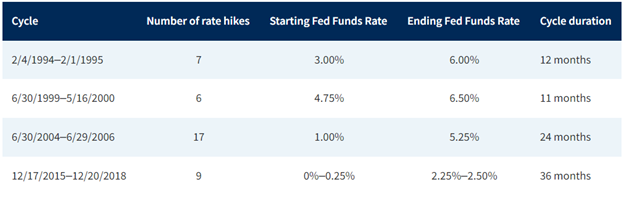
Over the past 30 years, the Fed has convened four recognized tightening cycles – periods when it increased the federal funds rate multiple times.

Source: Federal Reserve

Over three decades, the median number of rate hikes per period is eight, and the median time frame is 18 months (from first to last). How has the economy and markets fared through this recent history? Only two of the periods, the one ending in 2000 and then in 2006, were associated with a recession. In all four cases, the market retreated at first.

If one uses GDP as a measuring stick for an economy that is either growing or receding, then the U.S. was in a recessionary economy for a calendar quarter before the initial 0.25% hike. So the tightening may not put us into a recession, but it does have the potential to retard growth further for a  deeper recession.

Market Performance

Markets have traded lower in the months following the start of a tightening cycle, but in each of the periods defined above, they have ended higher one year later. It would seem that the market fear of what slower growth would do for companies and stock prices were front-loaded; those fears then gave way to buying as expectations became better defined.

Source: Koyfin

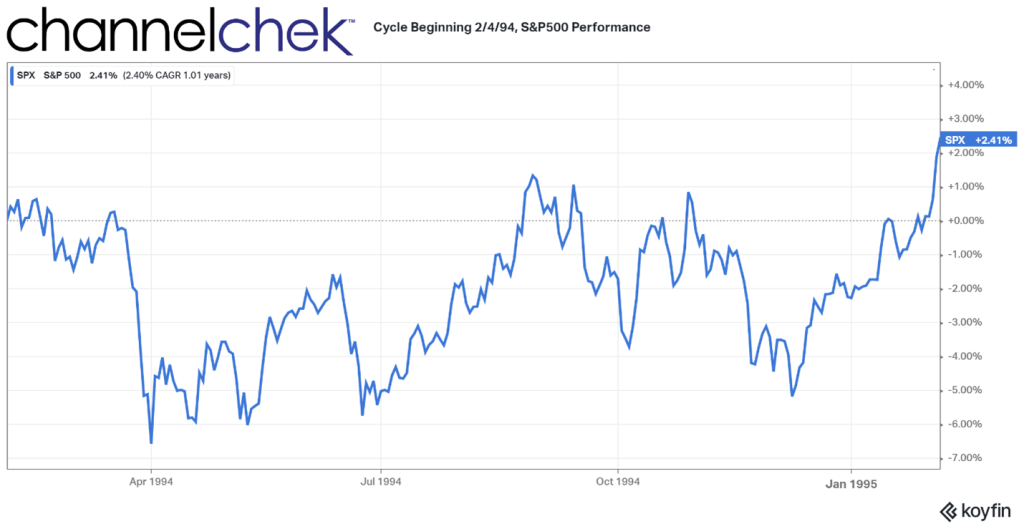
For the tightening cycle that began in 1994, a year after the Fed first took aim at the economy, the S&P 500 Index had already bounced off its low and climbed rapidly to end the 12 months with a positive 2.41% return. At it’s worst, the index had given up 6.50%.

Source: Koyfin

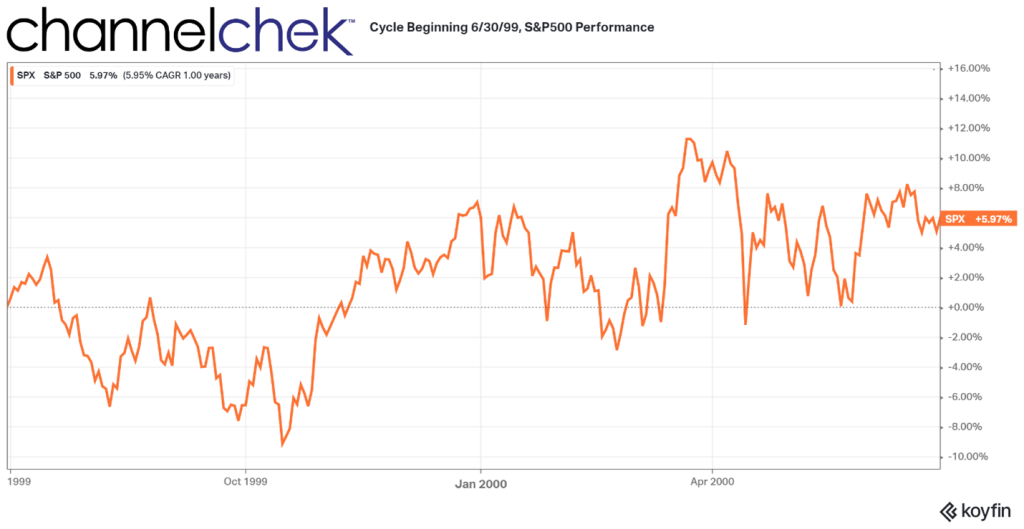
Four months after the tightening cycle began in 1999, the market began marching higher and crossed the breakeven point three times. The first time in August, just 45 days into the cycle, and the last one in May of 2000. For the 12-month period an investor in the index would have gained 5.97%.

Source: Koyfin

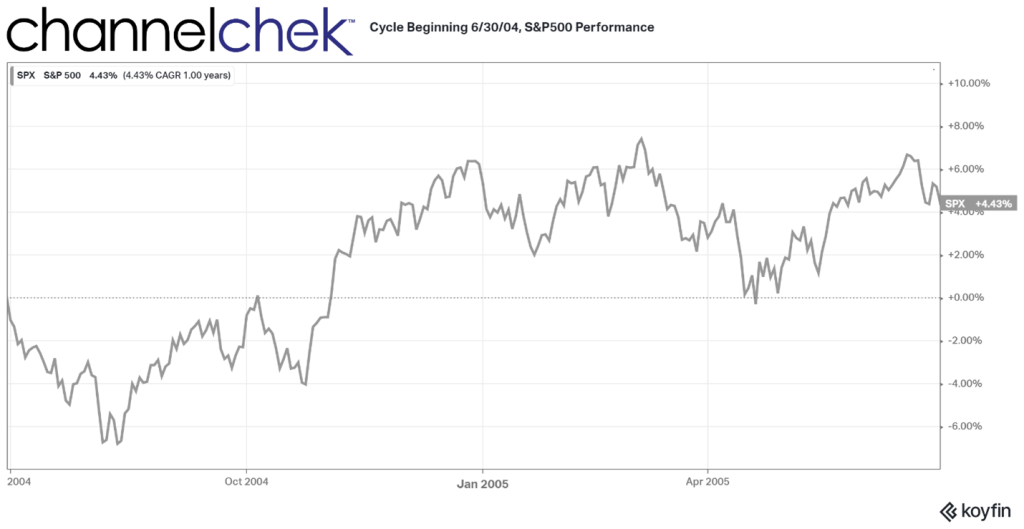
In 2004 the tightening cycle again began on June 30. Stock movement over the 12 months that followed are very similar as 1999. For investors that held for five months, (assuming their holdings approximated this benchmark) they were treated with returns of 4.43% 12 months later.    

Source: Koyfin

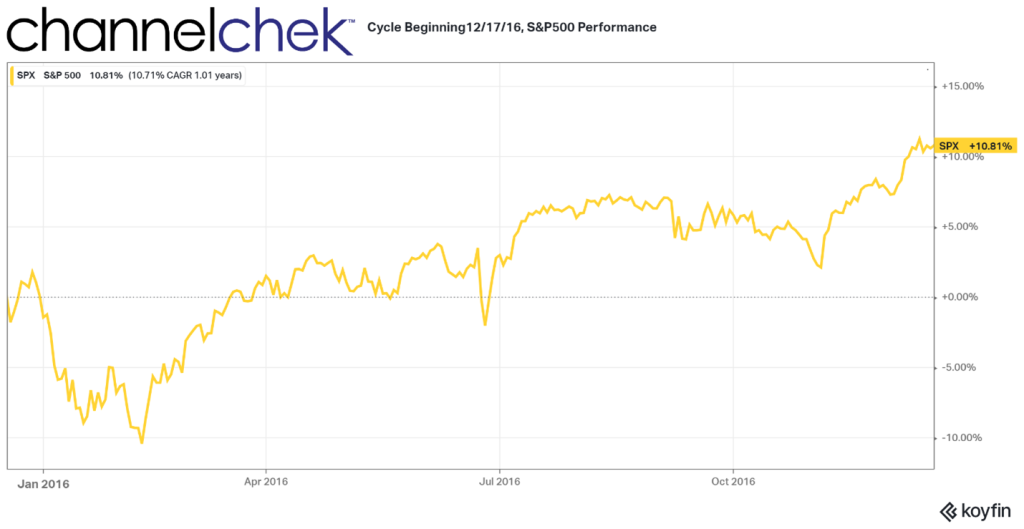
The most recent tightening cycle was seven years ago and began in December. Those invested in securities in 2015 that followed the overall stock market quickly broke even, and for those that held, they were up 10.81% a year later.

On average over the four periods the S&P 500 returned better than 6% after the Fed began a prolonged tightening cycle. The median drawdown is observed to be 9% in the first 49 days following the Fed’s first rate hike. For those that were invested in stocks that were more closely correlated to other indices, their experience was different.

Other Indices (Small Cap, Value, Growth)

Source: Bloomberg

The best average, although it did have a negative return in one of the periods, is the performance of the small cap Russell 2000 index. Investors in small cap stocks would have earned almost twice as much (11.30%) as those invested in the S&P 500 Large cap, almost three times as much earnings as those invested in the Russell 1000 Value stocks, and far more consistent and more than three times the Russell 1000 Growth index.

Take Away

This is not the first time the Federal Reserve has raised rates and implemented a tighter monetary policy. In the past it has not meant doom for the economy. In fact, the policy shift is intended to preserve a healthy economy before it begins causing larger problems for those that depend on jobs and stable prices along with a orderly banking system.

The most recent tightening cycle began six months ago. If history is an indicator, it may last another year, during that time stocks will rebound to a level higher than they were in March when the cycle began. While there are no guarantees that history will accurately point to the future, it helps to know what happened the last four times. Investors may also look to increase their allocation into small cap stocks as they have by far outpaced other indices.

Paul Hoffman

Managing Editor, Channelchek

Sources

https://www.federalreserve.gov/datadownload/Choose.aspx?rel=PRATES

https://www.forbes.com/advisor/investing/fed-funds-rate-history/

https://www.putnam.com/advisor/content/perspectives/

Schwazze (SHWZ) – Expanding in Colorado


Friday, September 16, 2022

Schwazze (OTCQX:SHWZ, NEO:SHWZ) is building a premier vertically integrated regional cannabis company with assets in Colorado and New Mexico and will continue to take its operating system to other states where it can develop a differentiated regional leadership position. Schwazze is the parent company of a portfolio of leading cannabis businesses and brands spanning seed to sale. The Company is committed to unlocking the full potential of the cannabis plant to improve the human condition. Schwazze is anchored by a high-performance culture that combines customer-centric thinking and data science to test, measure, and drive decisions and outcomes. The Company’s leadership team has deep expertise in retailing, wholesaling, and building consumer brands at Fortune 500 companies as well as in the cannabis sector. Schwazze is passionate about making a difference in our communities, promoting diversity and inclusion, and doing our part to incorporate climate-conscious best practices.

Joe Gomes, Senior Research Analyst, Noble Capital Markets, Inc.

Joshua Zoepfel, Research Associate, Noble Capital Markets, Inc.

Refer to the full report for the price target, fundamental analysis, and rating.

Another Acquisition. Wednesday, Schwazze announced the Company has signed definitive documents to acquire certain assets of Lightshade Labs LLC, which contains two dispensaries located at 503 Havana St. in Aurora and 2215 E. Mississippi Ave. in Denver’s vibrant Washington Park neighborhood, which includes the University of Denver. The proposed acquisition is for $2.75 million in cash with an expected closing in the first quarter of 2023. Operating financials were not provided.

The Dispensaries. Both dispensaries are highly rated by Leafly and Weedmaps, with the Aurora location receiving 4.9 out of 5.0 ratings from each and the Washington Park store receiving 4.9 and 4.3 scores. With Schwazze already operating dispensaries about 2 miles away from each location, the acquisitions continue to fill-in existing white space on the map, in our view.


Get the Full Report

This Company Sponsored Research is provided by Noble Capital Markets, Inc., a FINRA and S.E.C. registered broker-dealer (B/D).

*Analyst certification and important disclosures included in the full report. NOTE: investment decisions should not be based upon the content of this research summary. Proper due diligence is required before making any investment decision. 
Salem Media Group (SALM) – A Stronger, More Diversified Company


Friday, September 16, 2022

Salem Media Group is America’s leading multimedia company specializing in Christian and conservative content, with media properties comprising radio, digital media and book and newsletter publishing. Each day Salem serves a loyal and dedicated audience of listeners and readers numbering in the millions nationally. With its unique programming focus, Salem provides compelling content, fresh commentary and relevant information from some of the most respected figures across the Christian and conservative media landscape.

Michael Kupinski, Director of Research, Noble Capital Markets, Inc.

Patrick McCann, Research Associate, Noble Capital Markets, Inc.

Refer to the full report for the price target, fundamental analysis, and rating.

Non-deal road show highlights. CFO Evan Masyr was in St. Louis last week to host meetings with investors. Masyr highlighted significant debt reduction, strong digital media revenue growth, potential upside in Q4 from Political spending and from release of a Dinesh D’Souza book 2000 Mules. Finally, the company is in a much stronger financial position than it has been in decades.

Durability of block programming. Mr. Masyr highlighted the stability and recessionary resilient qualities of block programming that is sold primarily to local and national non-profit ministries. Annual renewal rates exceed 95% and account for 29% of Salem’s total revenue. The stability of revenue from block programming provides a ballast to the cyclical nature of advertising revenue.


Get the Full Report

This Company Sponsored Research is provided by Noble Capital Markets, Inc., a FINRA and S.E.C. registered broker-dealer (B/D).

*Analyst certification and important disclosures included in the full report. NOTE: investment decisions should not be based upon the content of this research summary. Proper due diligence is required before making any investment decision.