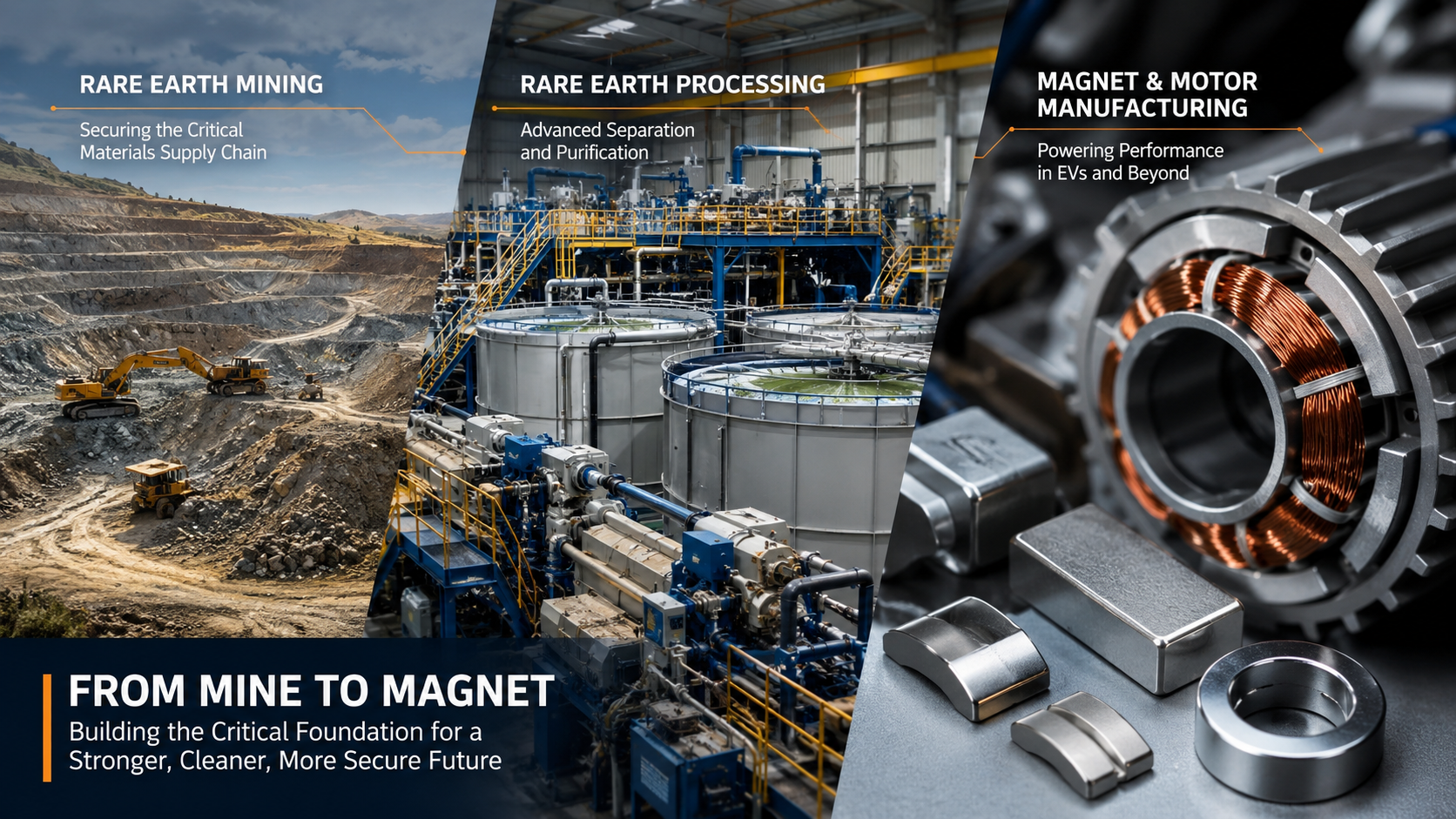
In one of the most strategically significant critical minerals deals of the year, Energy Fuels (NYSE American: UUUU) (TSX: EFR) announced Tuesday it has entered into a definitive agreement to acquire Vacuumschmelze GmbH & Co. KG and its affiliated entities — collectively known as VAC — from private equity firm Ara Partners in a cash-and-stock transaction valued at approximately $1.9 billion. The deal is designed to create a fully integrated rare earth supply chain spanning everything from mining through finished permanent magnet manufacturing, reducing Western dependence on China for materials that are essential to defense, automotive, robotics, and data center applications.
The transaction values VAC at $1.9 billion based on Energy Fuels’ closing share price of $16.12 on June 22, and is structured as $718 million in cash plus 65.853 million newly issued Energy Fuels shares. Energy Fuels will also assume approximately $140 million of VAC’s adjusted net debt. Energy Fuels shares slipped roughly 2% in premarket trading following the announcement, a common reaction when an acquirer issues significant new equity to fund a large deal.
What Energy Fuels Is Acquiring
VAC is not an early-stage company. Headquartered in Hanau, Germany, the business brings more than 100 years of advanced magnetics expertise, over 400 patents, more than 1,000 customers, and manufacturing operations across North America, Europe, and Asia. Its most strategically important asset is a recently commissioned permanent magnet facility in Sumter, South Carolina, which currently has capacity for 2,000 tonnes per year of rare earth permanent magnets and is scalable to 12,000 tonnes per year.
Permanent magnets are the critical end product in the rare earth value chain. They are essential components in electric vehicle motors, wind turbines, defense systems, robotics, and the cooling and power infrastructure inside AI data centers. The overwhelming majority of global permanent magnet production currently takes place in China, which has made supply chain security in this category a top priority for the United States and its allies.
The Mine-to-Magnet Strategy
The strategic logic behind the deal is vertical integration across the entire rare earth value chain. Energy Fuels brings the upstream capabilities — mining, processing, and refining — anchored by its White Mesa Mill in Utah, the only conventional uranium and rare earth processing facility of its kind in the United States. VAC contributes the downstream capabilities of metals and alloy production and finished magnet manufacturing.
Combining the two creates what the company describes as a fully integrated mine-to-magnet platform. Under the plan, rare earth oxides produced at the White Mesa Mill would be converted into metals and alloys at facilities in Korea and the United States, then manufactured into finished permanent magnets at VAC’s Sumter facility and its European operations. The Sumter site is also expected to be fed by rare earth oxides from Energy Fuels’ Donald Project in Australia, which is anticipated to reach a final investment decision in the third quarter of 2026 and be commissioned in 2028.
The Government Backing
The deal does not stand alone. Just last week, Energy Fuels announced it had received conditional US government support to accelerate its growth in rare earths and critical materials, including a $725 million conditional loan from the US Office of Strategic Capital. That federal backing reflects the strategic priority Washington has placed on building domestic and allied critical minerals supply chains, a theme that has run through multiple government interventions in 2026 including stakes in quantum computing companies and rare earth miners.
For investors tracking the critical minerals and rare earth space, the Energy Fuels-VAC combination represents one of the clearest examples yet of a smaller company moving aggressively to build a fully integrated, government-supported alternative to Chinese supply chain dominance. As demand for permanent magnets accelerates across defense, electric vehicles, robotics, and AI infrastructure, control of the full value chain from mine to finished magnet is becoming one of the most strategically valuable positions in the entire materials sector.