
QuickChek – June 3, 2021


PDS Biotechnology Expands VERSATILE-002 study of PDS0101 and KEYTRUDA® in Advanced Head and Neck Cancer

PDS Biotechnology announced the protocol amendment to expand its Phase 2 VERSATILE-002 study to include patients, in an additional arm, who have failed prior checkpoint inhibitor (CPI) therapy (CPI refractory patients)

Research, News & Market Data on PDS Biotechnology

Watch recent presentation from PDS Biotech


Great Bear Provides Two New Detailed High-Grade Long Sections and Reaches 318 Drill Holes Reported on Two Year Anniversary of LP Fault Discovery

Great Bear Resources announced results from its ongoing fully funded $45 million 2021 exploration program at its 100% owned flagship Dixie Project in the Red Lake district of Ontario

Research, News & Market Data on Great Bear

Watch recent presentation from Great Bear


Kratos Appoints Deanna Lund to Board of Directors

Kratos Defense & Security Solutions announced the appointment of Deanna Hom Lund to the Company’s Board of Directors

Research, News & Market Data on Kratos


Indonesia Energy Corporation Participates in Noble Capital Markets Video Interview

President Frank Ingriselli Provides Updates on IEC’s New Drilling Program at Kruh Block and Anticipated Milestones for IEC

Research, News & Market Data on Indonesia Energy

Watch recent presentation from Indonesia Energy


Esports Entertainment Group Completes Acquisition of Helix eSports and ggCircuit

Esports Entertainment Group announced the closing of its acquisition of Helix eSports LLC (“Helix eSports”) and ggCircuit LLC (“ggCircuit”)

Research, News & Market Data on Esports Entertainment Group

Watch recent presentation from EEG


Throwback Thursday – Most Read in May 2021

Here is What You (our audience) Read the Most During May 2021


Lineage Cell Therapeutics Reports Additional Cases Of Retinal Tissue Restoration In Dry AMD Patients Treated With Opregen RPE Cells

Lineage Cell Therapeutics announced that it plans to host a webinar featuring external therapeutic area experts in age-related macular degeneration (AMD), on June 10, 2021 at 4pm ET

Research, News & Market Data on Lineage Cell Therapeutics

Watch recent presentation from NobleCon17


Ocugen Expands COVAXIN™ Commercialization Rights to Include Canada

Ocugen and Bharat Biotech announced that they have entered into an amendment to expand Ocugen’s exclusive territory to commercialize COVAXIN™ to now also include Canada

Research, News & Market Data on Ocugen

Watch recent presentation from NobleCon17


Gray Amends Merger Agreement With Meredith Corporation

Gray Television announced that it offered to amend the parties’ Merger Agreement to increase the total consideration payable by Gray

Research, News & Market Data on Gray Television


Avivagen Inc. Announces Results for the Second Quarter Ending April 30, 2021

Avivagen Inc announced its unaudited financial results for the second quarter of 2021

Research, News & Market Data on Avivagen

Watch recent presentation from NobleCon17

Stay up to date. Follow us:

QuickChek – June 2, 2021


ISG Launches Expanded Global Cybersecurity Unit to Help Clients Contend with Growing Threats

Information Services Group announced it has launched an expanded global cybersecurity unit to help clients contend with the growing threat of cyberattacks

Research, News & Market Data on ISG

Watch recent presentation from NobleCon17


Helius Medical Technologies Appoints Frederick Fantazzia as VP of Sales & Marketing, North America

Helius Medical Technologies announced the appointment of Frederick Fantazzia to the position of Vice President of Sales & Marketing, North America, effective June 1, 2021

Research, News & Market Data on Helius Medical

Watch recent presentation from Helius Medical


electroCore Announces Publication of Study on Non-Invasive Vagus Nerve Stimulation

electroCore announced the publication of a peer-reviewed paper in the journal NPJ Parkinson’s Disease

Research, News & Market Data on electroCore


Eagle Bulk Shipping Inc. Acquires Two Modern Ultramax Bulkcarriers

Eagle Bulk Shipping announced that it has purchased two high-specification 2015-built scrubber-fitted Ultramax bulkcarriers for total consideration of USD 44 million

Research, News & Market Data on Eagle Bulk Shipping

Watch recent presentation from NobleCon17


Capstone Green Energy (Nasdaq:CGRN) To Announce Fourth Quarter & Full Fiscal Year 2021 Results On Thursday, June 10, 2021

Capstone Green Energy announced it expects to release full financial results for its fourth quarter and full fiscal 2021 year, ended March 31, 2021

Research, News & Market Data on Capstone Green Energy

Watch recent presentation from Capstone


Gray Announces Quarterly Cash Dividend Of $0.08 Per Share

Gray Television announced that its Board of Directors has authorized a quarterly cash dividend of $0.08 per share of its common stock and Class A common stock

Research, News & Market Data on Gray Television

Stay up to date. Follow us:

Fear of Tapering May Set the Market’s Tone for Summer


Image Credit: Forsaken Fotos (Flickr)


Stock Market Performance – Looking Forward and Looking Back


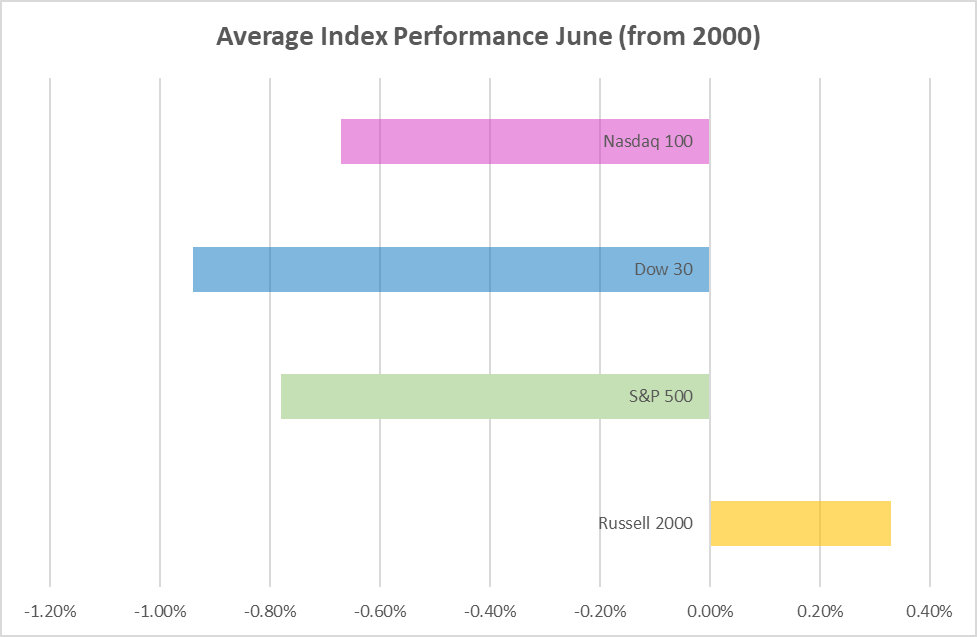
The stock market performance for June and July could hinge on a number of questions investors are considering right now. What they’d like to know is: Will inflation numbers continue to indicate an uptrend of the cost of goods and services? And, will the Fed continue a policy to keep interest rates steady in the face of what may be an economy stimulated to the point of demand-driven price increases?  

The first scheduled opportunity the markets will have this month to hear from the Fed and weigh each word is Friday, June 4.  Federal Reserve Chairman Jerome Powell is scheduled to speak at a global conference about central banks and climate change. The U.S. Fed’s mandate is specifically employment and inflation and has not concerned itself with environmental or political issues. Other central banks around the world have increasingly expanded their role to include the climate and environmental topics.  The slightest step for the U.S. central bank in that direction would indicate a significant departure from its stated role.


Look Back

Two of the three broader stock market indices, (S&P 500, Nasdaq 100, and Russell 2000) were positive during May. The S&P 500 gained .88%, the Russell 2000 was up 1.21% and Nasdaq 100 lost 1.62% of its value. When annualized, the S&P 500 and Russell 2000 are both at a pace above the historical average annual return of the market. After 2020, some equity investors may have become velocitized with the pace and climb experienced after the initial March selloff. Those investors may find this above-average pace still disappointing. The Nasdaq 100 “breather” during May, could also concern some – others understand that slower growth is healthier and more sustainable.


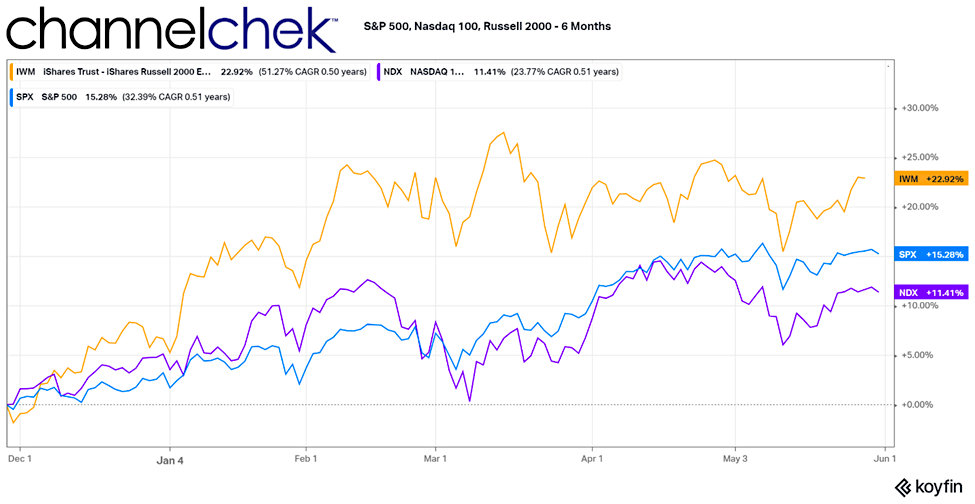
Viewing the indices from the longer six-month perspective, all three are well above their historical average pace. The top performer is the Russell 2000 small-cap stock index. Over the six months, this measure of smaller companies increased by 22.92%. The S&P 500 which measures a broad base of large-cap companies was up 15.28% for the half-year period. And the Nasdaq 100 which was the overall outperformer for much of 2020 lagged the other two indices with a still-respectable 11.41% increase.

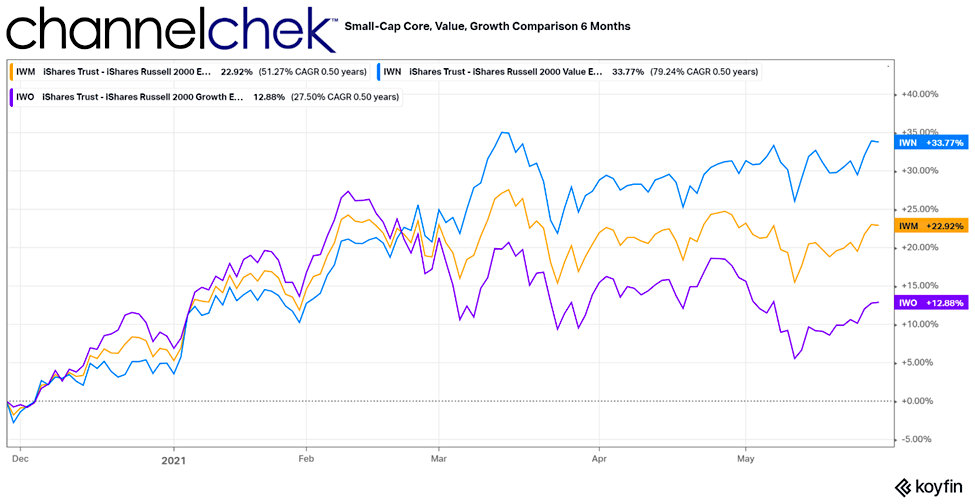
Further segmenting the better performing (6-months) Russell 2000 small-cap index, the better performing small-cap stocks was small-cap value (IWN) which returned 33.77%. Small-cap growth (which was down modestly in May) has returned 12.88% over six months.


Hottest Market Sectors

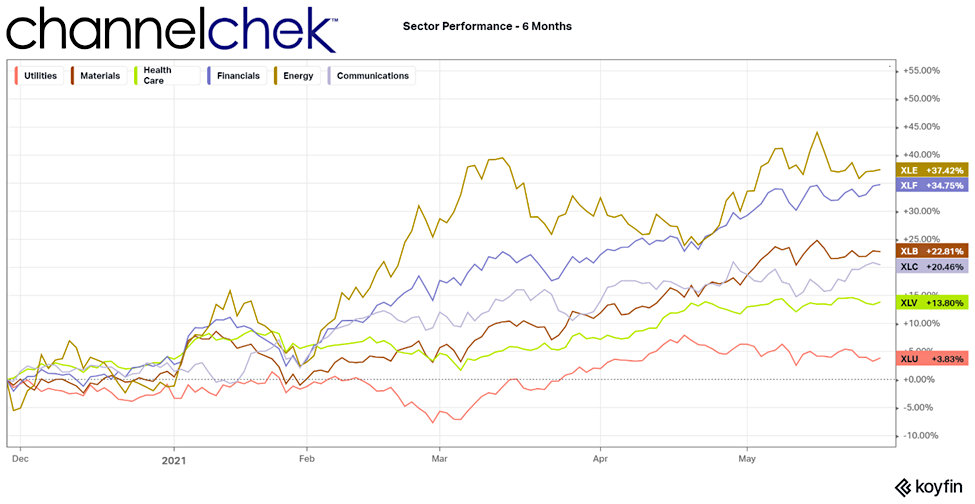
Over the measured six months (December – May), the industry sectors have rotated positions from late 2020. Energy, which had been beaten up and left for dead through much of last year, rose 37.42%. Financials are benefitting from expectations of a steepening yield curve and a large supply of cash in the system. Financials are up 34.75.% in just six months’ time. Materials are up 22.81% as plans for infrastructure projects are being put in place with mega budgets behind them. Communications companies turned in 20.46% for the period. Health care is up 13.80% and materials 3.61%. Utility stocks that are popular for their dividend payments are up by only 3.83%, as higher interest rates would provide alternatives for income/dividend investors.


Take-Away

The word investors are going to be attuned to most in June and through the Summer months is “Taper.” Some voting and non-voting members have used the “T” word in various speeches recently, and it appeared as a discussion item in minutes from the last FOMC meeting. Notching up rates at any time this year would happen well in advance of the expectations the Fed set for the markets through last year.

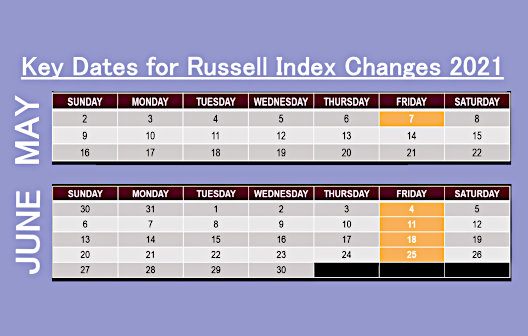
With this, the most intense volatility could surround the afternoon of June 16 when the FOMC wraps up its two-day June meeting, and Fed Chair Powell will address reporters. While Powell speaking always gets the market’s attention, minutes from the April FOMC meeting suggested the Fed may begin to taper if the economy continues to make great growth strides. He’ll be expected to explain how the Fed defines that growth.

Other dates worth noting include Thursday, June 10, when CPI will be reported by the BLS, and each Thursday’s unemployment report, then Consumer Confidence on June 29.

Paul Hoffman

Managing Editor, Channelchek


Suggested Reading

Inflation’s Impact on Stocks – Four Scenarios

The Sustainability of Growing Margin Debt


What Stocks do You Buy When the Dollar Goes Down?

Managing Investment Portfolio Risk


Sources:

https://www.wsj.com/articles/central-banks-jump-into-climate-change-policy-fray-11621166402?mod=article_inline

https://www.newyorkfed.org/research/calendars/nationalecon_cal.html


Stay up to date. Follow us:


Stay up to date. Follow us:

QuickChek – June 1, 2021


PDS Biotech to Host Oncology R&D Day on June 16, 2021

PDS Biotechnology announced it will host an Oncology R&D Day for analysts, investors, and the scientific community from 8:00 – 10:00 AM ET on Wednesday, June 16th

Research, News & Market Data on PDS Biotechnology

Watch recent presentation from PDS Biotech


Great Bear Strengthens Management Team and Provides Update on Regional Projects

Great Bear Resources announced key management appointments

Research, News & Market Data on Great Bear Resources

Watch recent presentation from Great Bear


Palladium One Drills 48 Meters @ 2.2 g/t within 116 Meters @ 1.2 g/t Palladium Equivalent at Haukiaho Trend, Finland

Palladium One Mining announced that 12 holes (1,943 metres) were drilled on the Haukiaho trend at Haukiaho Trend, Finland

Research, News & Market Data on Palladium One Mining

Watch recent presentation from Palladium One


Onconova Therapeutics Announces The Appointment Of Mark Gelder, M.D., As Chief Medical Officer

Onconova Therapeutics announced that Mark Gelder, M.D. will be joining Onconova as Chief Medical Officer (CMO), effective as of June 14, 2021

Research, News & Market Data on Onconova Therapeutics

Watch recent presentation from NobleCon17


Cannabis Growth Operator, Schwazze, Announces Agreement to Acquire Southern Colorado Growers

Schwazze signed definitive documents to acquire the assets of Southern Colorado Growers in Huerfano County, Colorado

Research, News & Market Data on Schwazze

Watch recent presentation from Schwazze


LAFC Sign Esports Entertainment Group as Its Esports Tournament Platform Provider in Multi-Year Deal

Esports Entertainment Group signed a multi-year partnership with the Los Angeles Football Club to be the Major League Soccer franchise’s esports tournament provider

Research, News & Market Data on Esports Entertainment Group

Watch recent presentation from EEG


Garibaldi Mobilizes Exploration Crews

Garibaldi Resources announced that exploration personnel have been deployed to the Company’s camp at km 45 on the Eskay Creek road

Research, News & Market Data on Garibaldi Resources

Watch recent presentation from NobleCon17


Lineage Cell Therapeutics Reports Additional Cases Of Retinal Tissue Restoration In Dry AMD Patients Treated With Opregen RPE Cells

Lineage Cell Therapeutics announced that restoration of retinal tissue was observed in two additional patients enrolled in the Company’s Phase 1/2a study of its lead product candidate, OpRegen

Research, News & Market Data on Lineage Cell Therapeutics

Watch recent presentation from NobleCon17

Stay up to date. Follow us:

Fear of Tapering May Set the Markets Tone for Summer


Image Credit: Forsaken Fotos (Flickr)


Stock Market Performance – Looking Forward and Looking Back


The stock market performance for June and July could hinge on a number of questions investors are considering right now. What they’d like to know is: Will inflation numbers continue to indicate an uptrend of the cost of goods and services? And, will the Fed continue a policy to keep interest rates steady in the face of what may be an economy stimulated to the point of demand-driven price increases?  

The first scheduled opportunity the markets will have this month to hear from the Fed and weigh each word is Friday, June 4.  Federal Reserve Chairman Jerome Powell is scheduled to speak at a global conference about central banks and climate change. The U.S. Fed’s mandate is specifically employment and inflation and has not concerned itself with environmental or political issues. Other central banks around the world have increasingly expanded their role to include the climate and environmental topics.  The slightest step for the U.S. central bank in that direction would indicate a significant departure from its stated role.


Look Back

Two of the three broader stock market indices, (S&P 500, Nasdaq 100, and Russell 2000) were positive during May. The S&P 500 gained .88%, the Russell 2000 was up 1.21% and Nasdaq 100 lost 1.62% of its value. When annualized, the S&P 500 and Russell 2000 are both at a pace above the historical average annual return of the market. After 2020, some equity investors may have become velocitized with the pace and climb experienced after the initial March selloff. Those investors may find this above-average pace still disappointing. The Nasdaq 100 “breather” during May, could also concern some – others understand that slower growth is healthier and more sustainable.


Viewing the indices from the longer six-month perspective, all three are well above their historical average pace. The top performer is the Russell 2000 small-cap stock index. Over the six months, this measure of smaller companies increased by 22.92%. The S&P 500 which measures a broad base of large-cap companies was up 15.28% for the half-year period. And the Nasdaq 100 which was the overall outperformer for much of 2020 lagged the other two indices with a still-respectable 11.41% increase.

Further segmenting the better performing (6-months) Russell 2000 small-cap index, the better performing small-cap stocks was small-cap value (IWN) which returned 33.77%. Small-cap growth (which was down modestly in May) has returned 12.88% over six months.


Hottest Market Sectors

Over the measured six months (December – May), the industry sectors have rotated positions from late 2020. Energy, which had been beaten up and left for dead through much of last year, rose 37.42%. Financials are benefitting from expectations of a steepening yield curve and a large supply of cash in the system. Financials are up 34.75.% in just six months’ time. Materials are up 22.81% as plans for infrastructure projects are being put in place with mega budgets behind them. Communications companies turned in 20.46% for the period. Health care is up 13.80% and materials 3.61%. Utility stocks that are popular for their dividend payments are up by only 3.83%, as higher interest rates would provide alternatives for income/dividend investors.


Take-Away

The word investors are going to be attuned to most in June and through the Summer months is “Taper.” Some voting and non-voting members have used the “T” word in various speeches recently, and it appeared as a discussion item in minutes from the last FOMC meeting. Notching up rates at any time this year would happen well in advance of the expectations the Fed set for the markets through last year.

With this, the most intense volatility could surround the afternoon of June 16 when the FOMC wraps up its two-day June meeting, and Fed Chair Powell will address reporters. While Powell speaking always gets the market’s attention, minutes from the April FOMC meeting suggested the Fed may begin to taper if the economy continues to make great growth strides. He’ll be expected to explain how the Fed defines that growth.

Other dates worth noting include Thursday, June 10, when CPI will be reported by the BLS, and each Thursday’s unemployment report, then Consumer Confidence on June 29.

Paul Hoffman

Managing Editor, Channelchek


Suggested Reading

Inflation’s Impact on Stocks – Four Scenarios

The Sustainability of Growing Margin Debt


What Stocks do You Buy When the Dollar Goes Down?

Managing Investment Portfolio Risk


Sources:

https://www.wsj.com/articles/central-banks-jump-into-climate-change-policy-fray-11621166402?mod=article_inline

https://www.newyorkfed.org/research/calendars/nationalecon_cal.html


Stay up to date. Follow us:


Stay up to date. Follow us:

Do Canadian Companies Remain Private Because of Corporate Governance?


Canadians Aren’t Taking their Companies Public – and it’s a Problem for the Country’s Economy


Stock markets in Canada and the United States are booming right now. So why do so few companies want to join them?

With the exception of a couple of bad years, the last two decades have been a great time to be a public company. Valuations are at record highs and executive compensation has more than doubled as a percentage of corporate profits. Nevertheless, fewer and fewer companies and their managers want to take advantage of these opportunities.

As we show in a recent research study, the number of companies choosing to go public in Canada has been declining sharply since the late 1990s. In fact, so few companies have been interested in listing publicly that the total number of Canada’s public operating companies has declined by more than 40 per cent on a per capita basis. American public markets are not much better. They’re about half the size they were back in the 1990s.

There is surprisingly little concern about this development among Canada’s regulators and politicians. This inattention is probably a mistake. Canada has four times the number of public companies per capita as the United States and the United Kingdom. It depends on its public markets to finance and grow new businesses in a way no other developed country does.


Tech, Pharma Need Public Companies

Even more important is the impact Canada’s public markets has on the ability to grow companies in high-value industries like technology or pharmaceuticals. Experts have pointed out that Canada actually performs well at generating new ideas and starting new businesses.

The country fails, however, on scaling these new businesses up to a size where they can compete in world markets. Aside from one or two companies like Shopify, we don’t create large technology, software, nanotechnology, biotechnology or pharmaceutical companies.

Canada starts with technology that’s the best in the world in these sectors, but something happens before our companies become big enough to kick-start a new industry here. What happens? These valuable businesses get sold to larger companies within their industries, most of which aren’t Canadian.

One study found that of 164 acquisitions of Canadian technology companies between 2004 and 2012, only a single company was purchased by a Canadian buyer. This turns into a vicious cycle — because we don’t have large, mature companies in many industries, the buyers of our promising startups are foreign, and because our startups are acquired early in their development, we don’t grow into large, mature companies.


This article was republished with permission
from 
The
Conversation
, a news site dedicated to sharing ideas from academic
experts.  It was written by
and represents the research-based opinions of
Bryce Tingle N. Murray Edwards Chair in Business Law, University of
Calgary, and
J. Ari Pandes Associate Professor of Finance, University of Calgary


No Spin-off Benefits

This dynamic means we lose the spin-off benefits of mature companies: we don’t train our workers in things like enterprise software sales or commercial nanotechnology research, and we don’t get new business ideas from older companies. Silicon Valley wouldn’t have become what it is today without beginning with large, mature firms like Xerox and Hewlett-Packard. Most entrepreneurs get their world-class ideas from working with more established companies.

What does Canada’s failure to scale technology businesses have to do with our public market problem? When a startup raises capital from outsiders, it must eventually provide them with an exit strategy so they can sell their shares. There are basically two kinds of exit: selling the company, usually to a larger company in its line of business, or taking the company public.

A public listing allows a company to continue to grow while permitting its early investors to sell their shares in the stock market.

Over the past two decades, an increasing number of companies have decided they would rather sell themselves than go public. What happened?


Explanations Don’t Hold Up

In our research, we find that the usual explanations for the public market decline aren’t plausible. They either don’t explain why the decline is happening both in Canada and the United States, or they contradict the dominant fact of the last two decades: public companies have been getting more and more valuable.

Instead, we look at the ways public markets have changed to make corporate governance more painful, less effective and higher risk.

The biggest change over the past two decades or so has been a revolution in the ways public companies are run. Generally, this has involved the transfer of power from managers and boards of directors to less informed and incentivized third parties like proxy advisers and even money managers.

By and large, these initiatives haven’t improved corporate performance, but they have significantly increased the unpleasantness of going public. They take decisions about compensation, board composition, strategy and selling the company out of the hands of the people who know the business best and, as summarized in our research, give it to outsiders who are less effective.

This transfer of power also disadvantages workers, creditors and other constituencies important to the ultimate success of any business.


The Way Forward

In our recently published paper, we give a variety of concrete suggestions to reduce the penalties incurred by executives and boards if they take their companies public, and to make going public more attractive.


They Include:

  • Eliminating the majority voting requirements that were adopted by the TSX in 2014, which can make directors more vulnerable to shareholder action
  • Introducing effective staggered boards to give corporations the option to provide their managers greater independence from shareholder pressure
  • Eliminating an executive compensation disclosure regime that has produced precisely the opposite results from those intended
  • Abandoning any suggestion there are one-size-fits-all corporate governance best practices
  • Reining in the power of proxy advisers, who have become the de facto sources of corporate governance and executive compensation regulation in this country.


These steps would clearly remove major barriers to Canadian companies choosing to scale up in this country.


Suggested Reading:


Lifecycle of a SPAC

Copper Facing an Onslaught of Demand


How PPI impacts CPI

Inflation’s Impact on Stocks, 4 Scenarios


Stay up to date. Follow us:


Stay up to date. Follow us:

Do Canadian Companies Remain Private Because of Corporate Governance


Canadians Aren’t Taking their Companies Public – and it’s a Problem for the Country’s Economy


Stock markets in Canada and the United States are booming right now. So why do so few companies want to join them?

With the exception of a couple of bad years, the last two decades have been a great time to be a public company. Valuations are at record highs and executive compensation has more than doubled as a percentage of corporate profits. Nevertheless, fewer and fewer companies and their managers want to take advantage of these opportunities.

As we show in a recent research study, the number of companies choosing to go public in Canada has been declining sharply since the late 1990s. In fact, so few companies have been interested in listing publicly that the total number of Canada’s public operating companies has declined by more than 40 per cent on a per capita basis. American public markets are not much better. They’re about half the size they were back in the 1990s.

There is surprisingly little concern about this development among Canada’s regulators and politicians. This inattention is probably a mistake. Canada has four times the number of public companies per capita as the United States and the United Kingdom. It depends on its public markets to finance and grow new businesses in a way no other developed country does.


Tech, Pharma Need Public Companies

Even more important is the impact Canada’s public markets has on the ability to grow companies in high-value industries like technology or pharmaceuticals. Experts have pointed out that Canada actually performs well at generating new ideas and starting new businesses.

The country fails, however, on scaling these new businesses up to a size where they can compete in world markets. Aside from one or two companies like Shopify, we don’t create large technology, software, nanotechnology, biotechnology or pharmaceutical companies.

Canada starts with technology that’s the best in the world in these sectors, but something happens before our companies become big enough to kick-start a new industry here. What happens? These valuable businesses get sold to larger companies within their industries, most of which aren’t Canadian.

One study found that of 164 acquisitions of Canadian technology companies between 2004 and 2012, only a single company was purchased by a Canadian buyer. This turns into a vicious cycle — because we don’t have large, mature companies in many industries, the buyers of our promising startups are foreign, and because our startups are acquired early in their development, we don’t grow into large, mature companies.


This article was republished with permission
from 
The
Conversation
, a news site dedicated to sharing ideas from academic
experts.  It was written by
and represents the research-based opinions of
Bryce Tingle N. Murray Edwards Chair in Business Law, University of
Calgary, and
J. Ari Pandes Associate Professor of Finance, University of Calgary


No Spin-off Benefits

This dynamic means we lose the spin-off benefits of mature companies: we don’t train our workers in things like enterprise software sales or commercial nanotechnology research, and we don’t get new business ideas from older companies. Silicon Valley wouldn’t have become what it is today without beginning with large, mature firms like Xerox and Hewlett-Packard. Most entrepreneurs get their world-class ideas from working with more established companies.

What does Canada’s failure to scale technology businesses have to do with our public market problem? When a startup raises capital from outsiders, it must eventually provide them with an exit strategy so they can sell their shares. There are basically two kinds of exit: selling the company, usually to a larger company in its line of business, or taking the company public.

A public listing allows a company to continue to grow while permitting its early investors to sell their shares in the stock market.

Over the past two decades, an increasing number of companies have decided they would rather sell themselves than go public. What happened?


Explanations Don’t Hold Up

In our research, we find that the usual explanations for the public market decline aren’t plausible. They either don’t explain why the decline is happening both in Canada and the United States, or they contradict the dominant fact of the last two decades: public companies have been getting more and more valuable.

Instead, we look at the ways public markets have changed to make corporate governance more painful, less effective and higher risk.

The biggest change over the past two decades or so has been a revolution in the ways public companies are run. Generally, this has involved the transfer of power from managers and boards of directors to less informed and incentivized third parties like proxy advisers and even money managers.

By and large, these initiatives haven’t improved corporate performance, but they have significantly increased the unpleasantness of going public. They take decisions about compensation, board composition, strategy and selling the company out of the hands of the people who know the business best and, as summarized in our research, give it to outsiders who are less effective.

This transfer of power also disadvantages workers, creditors and other constituencies important to the ultimate success of any business.


The Way Forward

In our recently published paper, we give a variety of concrete suggestions to reduce the penalties incurred by executives and boards if they take their companies public, and to make going public more attractive.


They Include:

  • Eliminating the majority voting requirements that were adopted by the TSX in 2014, which can make directors more vulnerable to shareholder action
  • Introducing effective staggered boards to give corporations the option to provide their managers greater independence from shareholder pressure
  • Eliminating an executive compensation disclosure regime that has produced precisely the opposite results from those intended
  • Abandoning any suggestion there are one-size-fits-all corporate governance best practices
  • Reining in the power of proxy advisers, who have become the de facto sources of corporate governance and executive compensation regulation in this country.


These steps would clearly remove major barriers to Canadian companies choosing to scale up in this country.


Suggested Reading:


Lifecycle of a SPAC

Copper Facing an Onslaught of Demand


How PPI impacts CPI

Inflation’s Impact on Stocks, 4 Scenarios


Stay up to date. Follow us:


Stay up to date. Follow us:

QuickChek – May 28, 2021


Esports Entertainment Group Announces Private Placement of $35 Million Convertible Notes with $17.50 Conversion Price

Esports Entertainment Group announced that it has entered into a definitive agreement with an institutional investor for the sale of $35 million in principal amount of 8.0% senior convertible notes

Research, News & Market Data on Esports Entertainment Group

Watch recent presentation from EEG


TAAL Announces 2021 First-Quarter Financial Results

TAAL Distributed Information Technologies announced its financial results for the three months ended March 31, 2021

Research, News & Market Data on TAAL

Watch recent presentation from NobleCon17


Enterprise Blockchain Processor, TAAL, becomes Hut 8’s Newest Hosting Services Partner

Hut 8 Mining Corp. announced its latest hosting partnership with Enterprise Blockchain transaction processor TAAL Distributed Information Technologies Inc.

Research, News & Market Data on TAAL

Watch recent presentation from NobleCon17


Energy Fuels Announces Election of Directors

Energy Fuels announced the results of the election of directors at its annual and special meeting of shareholders held virtually on May 26, 2021

Research, News & Market Data on Energy Fuels

Watch recent presentation from NobleCon17


Cocrystal Pharma Announces the Passing of Chairman, CEO and Co-founder Dr. Gary Wilcox

Cocrystal Pharma announced that Gary Wilcox, Ph.D., Chairman, CEO and co-founder, suddenly passed away Wednesday, May 26 at the age of 74

Research, News & Market Data on Cocrystal Pharma

Watch recent presentation from NobleCon17

Stay up to date. Follow us:

QuickChek – May 27, 2021


Great Lakes Announces Participation in the Noble Capital Markets Virtual Road Show

Great Lakes Dredge & Dock announced their participation in Noble Capital Markets Virtual Road Show Series, presented by Channelchek, scheduled for June 2, 2021

Research, News & Market Data on Great Lakes Dredge & Dock

Watch recent presentation from NobleCon17


Ocugen On Track to Submit Emergency Use Authorization Application to U.S. FDA for its COVID-19 Vaccine Candidate, COVAXIN™

Ocugen confirmed its plan to submit its Emergency Use Authorization (EUA) application for COVAXIN to the U.S. Food & Drug Administration (FDA) in June

Research, News & Market Data on Ocugen

Watch recent presentation from NobleCon17


ProMIS Neurosciences appoints renowned scientist, Dr. David Wishart as Chief Physics Officer

ProMIS Neurosciences announced the appointment of Dr. David Wishart, Distinguished University Professor in the Departments of Biological Sciences and Computing Science at the University of Alberta, as Chief Physics Officer at ProMIS

Research, News & Market Data on ProMIS Neurosciences


PDS Biotechnology Establishes Partnership With Head and Neck Cancer Alliance

PDS Biotechnology announced a strategic partnership to share information about emerging treatment options with clinicians and patients battling HPV-attributed head and neck cancer

Research, News & Market Data on PDS Biotechnology

Stay up to date. Follow us:

QuickChek – May 26, 2021


Cleveland Cavaliers Team Up With Esports Entertainment Group to Become Official Esports Tournament Platform Provider in Multi-Year Deal

Esports Entertainment Group announced a multi-year partnership with the Cleveland Cavaliers to be the NBA franchise’s official esports tournament platform provider.

Research, News & Market Data on Esports Entertainment Group

Watch recent interview with Esports Entertainment Group


PLBY Group Announces Successful Completion of Debt Refinancing

PLBY Group announced the successful completion of the refinancing of their existing credit facility through a $160 million senior secured term loan maturing in May 2027

Research, News & Market Data on PLBY Group

Watch recent presentation from NobleCon17


Palladium One Drills Haukiaho Trend, Intercepts 72 Meters @ 1.8 g/t Palladium-Equivalent, Finland

Palladium One announced that drill results from the Company’s 2,000 meter drill program at Haukiaho have returned significant widths and grades

Research, News & Market Data on Palladium One

Watch recent presentation from Palladium One


Ceapro Inc. Announces Completion of Patient Enrollment in Clinical Study

Ceapro Inc. announced the completion of patient enrollment in its comparison study evaluating high-medium molecular weight beta glucan

Research, News & Market Data on Ceapro Inc.

Watch recent presentation from NobleCon17


Comtech Telecommunications Corp. Awarded $1.6 Million Contract for High-Power Solid-State Amplifiers

Comtech announced that Comtech PST Corp was awarded an additional $1.6 million contract for RF microwave solid-state amplifiers

Research, News & Market Data on Comtech

Watch recent presentation from NobleCon17


ProMIS Neurosciences initiates commercialization of COVID-19 serology assay

ProMIS Neurosciences announced that it has initiated commercialization of its COVID-19 serology assay and has appointed Owen Dempsey to lead the commercialization program

Research, News & Market Data on ProMIS Neurosciences


Allegiant Discovers Bonanza Gold and Silver Grades at Eastside

Allegiant Gold announced bonanza grades in the best drill results to date in the Original Pit Zone, at the 100% owned Eastside gold project in Nevada

Research, News & Market Data on Allegiant Gold

Watch recent presentation from NobleCon17


Euroseas Ltd. Reports Results for the Quarter Ended March 31, 2021

Euroseas announced its results for the three-month period ended March 31, 2021

Research, News & Market Data on Euroseas Ltd

Watch recent presentation from NobleCon17

Stay up to date. Follow us:

What is the Feds position on Crypto, Stablecoin, and CBDCs?


image credit: U.S. Federal Reserve


The Federal Reserve’s Discussion Paper on Digital Currency to be Released this Summer


Last week, Fed Chair Jerome Powell spoke in a video address about CBDCs (Central Bank Digital Currencies) and other cryptocurrencies. He announced the Federal Reserve plans to publish a discussion paper on the potential benefits and risks of issuing a U.S. digital currency during this summer.  He also shared more insight on current thinking.

“The paper represents the beginning of what will be a thoughtful and deliberative process,” said Chairman Powell in his address. He also spoke of regulation making it clear there were no decisions made to date when expressing the eye in which the Fed will look at the matter, “ the Federal Reserve is charged with promoting monetary and financial stability and the safety and efficiency of the payment system. In pursuit of these core functions, we have been carefully monitoring and adapting to the technological innovations now transforming the world of payments, finance, and banking.” Powell also made clear that one decision that has been made is that cash currency is not going away, “We think it is important that any potential CBDC could serve as a complement to, and not a replacement of, cash and current private-sector digital forms of the dollar, such as deposits at commercial banks,” said Powell.

A link for the video is provided below as a “Source,” but, as with most Fed releases, every word is deliberate and therefore worth reading. Here is the complete transcript.


Transcript of Chair Powell’s Message on Developments in the U.S. Payments System

May 20, 2021

Today we are in the midst of a technological revolution that is fundamentally changing our world: reshaping how we communicate, access information, and purchase goods and services. As the central bank of the United States, the Federal Reserve is charged with promoting monetary and financial stability and the safety and efficiency of the payment system. In pursuit of these core functions, we have been carefully monitoring and adapting to the technological innovations now transforming the world of payments, finance, and banking.

The effective functioning of our economy requires that people have faith and confidence not only in the dollar, but also in the payment networks, banks, and other payment service providers that allow money to flow on a daily basis. Our focus is on ensuring a safe and efficient payment system that provides broad benefits to American households and businesses while also embracing innovation. In the Fed’s early days, the development of dedicated telegraph wires facilitated the transfer of funds between banks. In the 1980s, automated clearinghouse services made it possible for electronic bill payments to be an alternative to paper checks. In 2019, the Federal Reserve committed to building the FedNow Service, which will enable banks to provide real-time, or instant, payments to their customers around the clock, 365 days a year, benefiting communities across America.

Recently, the rise of distributed ledger technology, which offers a new approach to recording ownership of assets, has allowed for the creation of a range of new financial products and services—including cryptocurrencies. To date, cryptocurrencies have not served as a convenient way to make payments, given, among other factors, their swings in value. Nonetheless, coins tied to the value of the dollar or another currency—known as “stablecoins”— have emerged as a new way to make payments. These stablecoins aim to use new technologies in a way that has the potential to enhance payments efficiency, speed up settlement flows, and reduce end-user costs—but they may also carry potential risks to those users and to the broader financial system. For example, although the value of a stablecoin may be tied to the value of a dollar, these coins may not come with the same protections as traditional means of payment, such as physical currency or the deposits in your bank account. Therefore, as stablecoins’ use increases, so must our attention to the appropriate regulatory and oversight framework. This includes paying attention to private-sector payments innovators who are currently not within the traditional regulatory arrangements applied to banks, investment firms, and other financial intermediaries.

Technological advances also offer new possibilities to central banks—including the Fed. In particular, technology now enables the development and issuance of central bank digital currencies, or CBDCs. A CBDC is a new type of central bank liability issued in digital form. While various structures and technologies might be used, a CBDC could be designed for use by the general public.

For the past several years, the Federal Reserve has been exploring the potential benefits and risks of CBDCs from a variety of angles, including through technological research and experimentation. Our key focus is on whether and how a CBDC could improve on an already safe, effective, dynamic, and efficient U.S. domestic payments system. We think it is important that any potential CBDC could serve as a complement to, and not a replacement of, cash and current private-sector digital forms of the dollar, such as deposits at commercial banks. The design of a CBDC would raise important monetary policy, financial stability, consumer protection, legal, and privacy considerations and will require careful thought and analysis— including input from the public and elected officials.

To help stimulate broad conversation, the Federal Reserve Board will issue a discussion paper this summer outlining our current thinking on digital payments, with a particular focus on the benefits and risks associated with CBDC in the U.S. context. As part of this process, we will ask for public comment on issues related to payments, financial inclusion, data privacy, and information security.

We are committed at the Federal Reserve to hearing a wide range of voices on this important issue before making any decision on whether and how to move forward with a U.S. CBDC, taking account of the broader risks and opportunities it could offer. The paper represents the beginning of what will be a thoughtful and deliberative process. Irrespective of the conclusion we ultimately reach, we expect to play a leading role in developing international standards for CBDCs, engaging actively with central banks in other jurisdictions as well as regulators and supervisors here in the United States throughout that process.

The Federal Reserve remains committed to ensuring that the public has access to a safe, reliable, and secure payments system. Our forthcoming paper on the evolution of digital payments is intended—along with our other work as a supervisor, regulator, and payment system operator—to advance the objective of ensuring that the payments system and the economy work for all Americans. We look forward to hearing your thoughts on this important topic.


Take-Away

In his announcement, Chairman Powell showed he understood how technology in the past has led to better communication, faster payment systems, and more efficient bank clearing operations. He also was clear that, to date, the experience with cryptocurrencies is that they do not serve as a convenient way to make payments, “given, among other factors, their swings in value.” Adopting new technologies such as distributed ledger systems and a stable payment system is the balance the Fed will likely try to create going forward.

We will know more when the discussion paper is released later this year; in the interim, cryptocurrency exchange rates are likely to move up and down on, among other things, speculation of the tone of the upcoming paper.


Suggested Reading:

Small-Cap Names in a Big Crypto Market

Backed by the Full Faith and Credit of Blockchain


Cryptocurrency and the Howey Test

NFTs are Becoming More Popular with Sports Fans


Sources:

Chairman Powell’s Video Message May 20, 2020


Stay up to date. Follow us:


Stay up to date. Follow us:

QuickChek – May 25, 2021


Esports Entertainment Group to Add Swedish and Spanish-Licensed Gaming Business with Acquisition of Bethard

Esports Entertainment Group raises Fiscal 2022 revenue guidance to $100M-$105M as result of the transaction

See today’s research report from Michael Kupinski, Director of Research at Noble Capital Markets

Research, News & Market Data on Esports Entertainment Group

Watch recent presentation from EEG


Stem Holdings d/b/a Driven By Stem and Tinley Beverage Create Home Delivery Solution for Cannabis Beverages in California

Stem Holdings announced the integration of Stem’s technology into The Tinley Beverage Company’s website

Research, News & Market Data on Stem Holdings

Watch recent presentation from Stem Holdings


Aurania Confirms Significant Amounts Of High-Tech Metals In Tiria-Shimpia Samples

Aurania Resources announced that laboratory assays have confirmed the presence of the high-tech metals gallium and indium in significant amounts in rock-chip samples from the Tiria-Shimpia target in the Company’s Lost Cities – Cutucu Project in southeastern Ecuador

Research, News & Market Data on Aurania Resources

Watch recent presentation from NobleCon17


Seanergy Maritime Holdings Corp. Reports Financial Results for the First Quarter Ended March 31, 2021

Seanergy Maritime Holdings announced its financial results for the first quarter ended March 31, 2021

See today’s research report from Poe Fratt, Senior Research Analyst at Noble Capital Markets

Research, News & Market Data on Seanergy

Watch recent presentation from NobleCon17


TherapeuticsMD Announces Submission of Low Dose BIJUVA® 0.5 mg/100 mg Supplemental New Drug Application to FDA

TherapeuticsMD announced that the Company submitted a supplemental New Drug Application for BIJUVA capsules to the U.S. Food and Drug Administration

Research, News & Market Data on TherapeuticsMD


CanAlaska Promotes Cory Belyk to CEO & Executive Vice President

CanAlaska Uranium announced the promotion of Cory Belyk to Chief Executive Officer and Executive Vice President of the Company effective June 1, 2021

Research, News & Market Data on CanAlaska Uranium


Chakana Advances Resource Definition Drilling With Multiple High-Grade Intercepts

Chakana Copper announced results from eleven in-fill holes totaling 2,873.7m from the Huancarama, Paloma East, and Paloma West tourmaline breccia pipe discoveries

Research, News & Market Data on Chakana Copper

Watch recent presentation from Chakana Copper


Namaste Technologies Announces Phyto Extractions Shatter Now Available Nationally For Medical Consumers

Namaste Technologies announced that the Company’s subsidiary, CannMart Inc. is now distributing Phyto Extractions’ well known shatter products nationally

Research, News & Market Data on Namaste Technologies

Watch recent presentation from NobleCon17


Supermoon! Red Blood Lunar Eclipse! It’s all Happening Tonight

Here is what it means

Stay up to date. Follow us:

What is the Feds position on Crypto Stablecoin and CBDCs?


image credit: U.S. Federal Reserve


The Federal Reserve’s Discussion Paper on Digital Currency to be Released this Summer


Last week, Fed Chair Jerome Powell spoke in a video address about CBDCs (Central Bank Digital Currencies) and other cryptocurrencies. He announced the Federal Reserve plans to publish a discussion paper on the potential benefits and risks of issuing a U.S. digital currency during this summer.  He also shared more insight on current thinking.

“The paper represents the beginning of what will be a thoughtful and deliberative process,” said Chairman Powell in his address. He also spoke of regulation making it clear there were no decisions made to date when expressing the eye in which the Fed will look at the matter, “ the Federal Reserve is charged with promoting monetary and financial stability and the safety and efficiency of the payment system. In pursuit of these core functions, we have been carefully monitoring and adapting to the technological innovations now transforming the world of payments, finance, and banking.” Powell also made clear that one decision that has been made is that cash currency is not going away, “We think it is important that any potential CBDC could serve as a complement to, and not a replacement of, cash and current private-sector digital forms of the dollar, such as deposits at commercial banks,” said Powell.

A link for the video is provided below as a “Source,” but, as with most Fed releases, every word is deliberate and therefore worth reading. Here is the complete transcript.


Transcript of Chair Powell’s Message on Developments in the U.S. Payments System

May 20, 2021

Today we are in the midst of a technological revolution that is fundamentally changing our world: reshaping how we communicate, access information, and purchase goods and services. As the central bank of the United States, the Federal Reserve is charged with promoting monetary and financial stability and the safety and efficiency of the payment system. In pursuit of these core functions, we have been carefully monitoring and adapting to the technological innovations now transforming the world of payments, finance, and banking.

The effective functioning of our economy requires that people have faith and confidence not only in the dollar, but also in the payment networks, banks, and other payment service providers that allow money to flow on a daily basis. Our focus is on ensuring a safe and efficient payment system that provides broad benefits to American households and businesses while also embracing innovation. In the Fed’s early days, the development of dedicated telegraph wires facilitated the transfer of funds between banks. In the 1980s, automated clearinghouse services made it possible for electronic bill payments to be an alternative to paper checks. In 2019, the Federal Reserve committed to building the FedNow Service, which will enable banks to provide real-time, or instant, payments to their customers around the clock, 365 days a year, benefiting communities across America.

Recently, the rise of distributed ledger technology, which offers a new approach to recording ownership of assets, has allowed for the creation of a range of new financial products and services—including cryptocurrencies. To date, cryptocurrencies have not served as a convenient way to make payments, given, among other factors, their swings in value. Nonetheless, coins tied to the value of the dollar or another currency—known as “stablecoins”— have emerged as a new way to make payments. These stablecoins aim to use new technologies in a way that has the potential to enhance payments efficiency, speed up settlement flows, and reduce end-user costs—but they may also carry potential risks to those users and to the broader financial system. For example, although the value of a stablecoin may be tied to the value of a dollar, these coins may not come with the same protections as traditional means of payment, such as physical currency or the deposits in your bank account. Therefore, as stablecoins’ use increases, so must our attention to the appropriate regulatory and oversight framework. This includes paying attention to private-sector payments innovators who are currently not within the traditional regulatory arrangements applied to banks, investment firms, and other financial intermediaries.

Technological advances also offer new possibilities to central banks—including the Fed. In particular, technology now enables the development and issuance of central bank digital currencies, or CBDCs. A CBDC is a new type of central bank liability issued in digital form. While various structures and technologies might be used, a CBDC could be designed for use by the general public.

For the past several years, the Federal Reserve has been exploring the potential benefits and risks of CBDCs from a variety of angles, including through technological research and experimentation. Our key focus is on whether and how a CBDC could improve on an already safe, effective, dynamic, and efficient U.S. domestic payments system. We think it is important that any potential CBDC could serve as a complement to, and not a replacement of, cash and current private-sector digital forms of the dollar, such as deposits at commercial banks. The design of a CBDC would raise important monetary policy, financial stability, consumer protection, legal, and privacy considerations and will require careful thought and analysis— including input from the public and elected officials.

To help stimulate broad conversation, the Federal Reserve Board will issue a discussion paper this summer outlining our current thinking on digital payments, with a particular focus on the benefits and risks associated with CBDC in the U.S. context. As part of this process, we will ask for public comment on issues related to payments, financial inclusion, data privacy, and information security.

We are committed at the Federal Reserve to hearing a wide range of voices on this important issue before making any decision on whether and how to move forward with a U.S. CBDC, taking account of the broader risks and opportunities it could offer. The paper represents the beginning of what will be a thoughtful and deliberative process. Irrespective of the conclusion we ultimately reach, we expect to play a leading role in developing international standards for CBDCs, engaging actively with central banks in other jurisdictions as well as regulators and supervisors here in the United States throughout that process.

The Federal Reserve remains committed to ensuring that the public has access to a safe, reliable, and secure payments system. Our forthcoming paper on the evolution of digital payments is intended—along with our other work as a supervisor, regulator, and payment system operator—to advance the objective of ensuring that the payments system and the economy work for all Americans. We look forward to hearing your thoughts on this important topic.


Take-Away

In his announcement, Chairman Powell showed he understood how technology in the past has led to better communication, faster payment systems, and more efficient bank clearing operations. He also was clear that, to date, the experience with cryptocurrencies is that they do not serve as a convenient way to make payments, “given, among other factors, their swings in value.” Adopting new technologies such as distributed ledger systems and a stable payment system is the balance the Fed will likely try to create going forward.

We will know more when the discussion paper is released later this year; in the interim, cryptocurrency exchange rates are likely to move up and down on, among other things, speculation of the tone of the upcoming paper.


Suggested Reading:

Small-Cap Names in a Big Crypto Market

Backed by the Full Faith and Credit of Blockchain


Cryptocurrency and the Howey Test

NFTs are Becoming More Popular with Sports Fans


Sources:

Chairman Powell’s Video Message May 20, 2020


Stay up to date. Follow us:


Stay up to date. Follow us: