QuickChek – October 21, 2021


Engine Media Announces Upcoming Name Change to Engine Gaming and Media, Inc.

Engine Media Holdings, Inc. announced that it has filed with the TSX Venture Exchange a notice of name change to “Engine Gaming and Media, Inc.” The name change is expected to be effective at the start of trading on October 19, 2021, and the Company’s shares will continue to trade under the “GAME” symbol.

Research, News & Market Data on Engine Media
Watch a recent interview with Engine Media executives


enCore Energy and Azarga Uranium Provide Update on Proposed Transaction and Shareholder Vote

enCore Energy Corp. and Azarga Uranium Corp. provided a corporate update including information concerning the definitive agreement whereby enCore will acquire all of the issued and outstanding common shares of Azarga pursuant to a court-approved plan of arrangement.

Research, News & Market Data on enCore Energy
Watch enCore Energy’s presentation from the Uranium Power Players Investor Forum


PDS Biotech Provides Update on National Cancer Institute-Led Phase 2 Clinical Trial of PDS0101-Based Combination

PDS Biotechnology Corporation announced the temporary suspension of recruitment in the National Cancer Institute (NCI)-led Phase 2 clinical trial (NCT04287868) evaluating PDS0101 (Versamune®-HPV16) in combination with two investigational immune-modulating agents in advanced HPV cancers.

Research, News & Market Data on PDS Biotechnology Corporation
Watch a recent interview with PDS Biotech management team


Cocrystal Pharma to Present Data from its Oral and Intranasal COVID-19 Therapeutics Programs at the World Antiviral Congress 2021

Cocrystal Pharma, Inc. announced that President and co-interim CEO Dr. Sam Lee will present new data from its COVID-19 programs at the World Antiviral Congress 2021 being held in San Diego. Dr. Lee is scheduled to present the “Discovery of oral, broad-spectrum SARS-CoV-2 main protease inhibitors: advancing to clinical development” on Thursday, December 1, 2021 at 11:55 a.m. Pacific time.

Research, News & Market Data on Cocrystal Pharma
Watch a recent interview with Cocrystal management


CoreCivic Announces 2021 Third Quarter Earnings Release and Conference Call Dates

CoreCivic, Inc. announced today that it will release its 2021 third quarter financial results after the market closes on Monday, November 8, 2021.

Research, News & Market Data on CoreCivic
Watch a recent road show replay with CoreCivic management


Esports Entertainment Group Announces Fan-Centered EGL ClubClash Program with Professional Sports Teams

Esports Entertainment Group, Inc. is excited to unveil a brand new, immersive program titled “EGL ClubClash”, which gives fans the opportunity to play on their professional sports team’s behalf to prove which team has the greatest gamers.

Research, News & Market Data on Esports Entertainment Group
Watch a recent interview with Esports Entertainment Group


Stay up to date. Follow us:

 

Cannabis Related Businesses (CRB) New Access to Banking Services


Image Credit: Elsa Olofson (Unsplash)

Banks and Credit Unions Are Now Allowing Services For Marijuana And Cannabis Businesses


Cannabis businesses continue to be challenged with their awkward legal situation. They’re caught between different state and federal laws governing their products. While the U.S. Congress is expected to one day pass cannabis banking reforms and broader legislation for marijuana legalization, most notably the SAFE Banking Act and the  Cannabis Administration and Opportunities Act, there are institutions that are opening their banking systems to help serve the needs of this part of the community.

Background:

Thirty-five states, the District of Columbia, Guam, and Puerto Rico, have all legalized the use of marijuana to some degree. Yet the possession, distribution, or sale of marijuana remains illegal under federal law, this means any contact with money that can be traced back to state marijuana operations could potentially be considered money laundering and expose a bank to significant legal, operational and regulatory risk.

The list of businesses falling between the gap of state and federal law is long. It includes growers, retailers, various vendors, landlords, and employees indirectly tied to the cannabis industry. This poses a legal risk on the federal level for banks if they serve any of these entities or individuals, as indirect connections to marijuana revenues are hard, if not impossible, for banks to identify and avoid.

The rift between federal and state law has left banks trapped between their mission to serve the financial needs of their communities and the threat of potentially severe federal enforcement action.


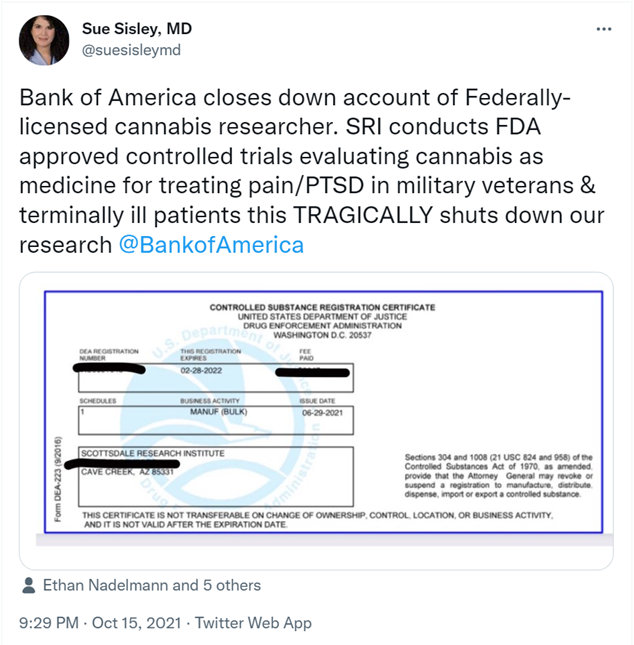
The second-largest bank in the U.S., Bank of America backed off from banking a federally legal research operation last week.


Cannabis Fintech Companies

StandardC is a Fintech company that provides cannabis-related businesses (CRB) with banking services. They’re able to lend, make payments, insure, provide payroll services, and armored transport to CRBs. In a press release, The San Francisco-based company announced in a press release that it now has the capacity to serve over 1,500 CRBs and accept total deposits of over $1.3 billion. 

While cannabis does remain restricted under the Controlled Substances Act (CSA); The Financial Crimes Enforcement Network (FinCEN), which is
the enforcer of the Bank Secrecy Act (BSA) and its Anti-Money Laundering (AML)
requirements, issued guidance (FIN-2014-G001)
in 2014 that “…clarifies
how financial institutions can provide services to marijuana-related businesses
consistent with their BSA obligations.”
 According to Robert Baron, the Chief Experience Officer of StandardC. Mr. Baron is a cannabis banking expert and Certified Anti-Money Laundering Specialist (CAMS, CAMS-RM), He noted in his company’s release that the 2014 guidance provides a framework that is used by his company and its member banks and credit unions to solve the lack of access to banking.  Mr. Baron noted that “While the largest banks sit out on the sidelines, we are solving the banking crisis by deploying proven technology and expertise to enable bankers to meet the needs of the cannabis industry.”

Robert Mann, CEO of StandardC, commented “While Congress deliberates, our network of federally insured financial institutions is taking action to solve the problems faced by the cannabis industry.  They deserve access to banking, and they no longer have to wait for the government to act.”

Take-Away

Despite delays by the U.S. Congress to pass cannabis banking reforms and broader legislation for marijuana legalization, most notably the SAFE Banking Act and the 
Cannabis
Administration and Opportunity Act
, some banks and credit unions are stepping in to help bank this sector. With the help of a fintech company and supporting banks and credit unions, guidance issued in 2014 by FINCen is being relied upon to properly and compliantly structure the services.

Suggested Reading


Federal Law Questions Still Loom for the Cannabis Industry


What’s in the Senate’s Marijuana Tax Proposal


Marijuana Dispensaries and the Impact on Use


Michael Burry’s Earlier Bet Against Tesla Has Been Closed Out


Sources:

https://www.prnewswire.com/news-releases/banks-and-credit-unions-are-now-opening-accounts-for-marijuana-and-cannabis-businesses-301403389.html

https://www.aba.com/advocacy/our-issues/cannabis

https://www.jdsupra.com/legalnews/safe-banking-act-of-2021-where-are-we-5632341/

https://www.usnews.com/news/best-states/articles/where-is-marijuana-legal-a-guide-to-marijuana-legalization

https://twitter.com/suesisleymd/status/1449185818493390851


Stay up to date. Follow us:

 

QuickChek – October 20, 2021


Gray Announces Proposed $1.5 Billion Incremental Term Loan and $500 Million Revolving Credit Facility; Updates Guidance for Third Quarter 2021

Gray Television announced that it is proposing, subject to market and other conditions, to enter into an amendment and restatement of its existing senior credit facility

Research, News & Market Data on Gray Television


FenixOro CEO John Carlesso Featured in Noble Capital Markets C-Suite Interview

FenixOro Gold announced their participation in Noble Capital Markets’ C-Suite Interview Series, presented by Channelchek

Research, News & Market Data on FenixOro Gold


electroCore Announces Publication Reviewing the Prescribing of gammaCore for the Treatment of Cluster Headache in England

electroCore announced the publication of a peer-reviewed paper entitled “Non-invasive vagus nerve stimulation for treatment of cluster headache: a retrospective review of prescribing in England,” in the British Journal of Healthcare Management

Research, News & Market Data on electroCore


Capstone Green Energy (NASDAQ:CGRN) Continues Market Penetration In Latin America With First District Cooling Application For Llanogas

Capstone Green Energy announced that Supernova Energy Services, Capstone’s exclusive distributor for Colombia and Venezuela, secured an order for a three-bay C400 Signature Series microturbine

Research, News & Market Data on Capstone Green Energy

Watch recent presentation from Capstone Green Energy


Palladium One Obtains Both OTCQB Market Listing and DTC Eligibility

Palladium One Mining announced that its common shares are now eligible for settlement through the Depository Trust Company

Research, News & Market Data on Palladium One

Watch recent presentation from Palladium One


Stay up to date. Follow us:

 

Michael Burry Adjusts Tesla Position


Michael Burry’s Earlier Bet Against Tesla Has Been Closed Out


A large group of investors closely follow the transactions of Michael Burry’s Scion Asset Management, LLC. There are even several YouTube channels dedicated to trying to decipher what he may be doing. These videos amass hundreds of thousands of views within a few days when released. When his company’s SEC form 13(f) is made public, the Edgar database is used by copycat investors to see what he held at the last quarter-end, even though that may have been a month and a half earlier.

There are other times that people don’t have to guess what he’s thinking; he broadcasts what he’s up to — Twitter, email interviews, Bloomberg
messaging
, these are his preferred methods. The “Big
Short” investor
is not a fan of public appearances.

Back in May Scion’s quarterly filing was released and poured over by copycat
investors
, curiosity seekers, and reporters. Among other noteworthy positions was an 800,000 put on Tesla ($TSLA) worth $534 million at the time. By the end of the second quarter, that position would have gained in value and been worth more than 1 million. A put option is a contract that provides the holder the right to sell shares at a certain price (strike price) in the future. If the stock falls below the strike price before expiration, the put becomes more valuable. While the contracts are often used by trading desks and others to hedge positions, in the Scion’s case, it was clearly a bet the price of Tesla was too high.


In the past, Burry has called Tesla’s valuation of more than $800 billion “ridiculous” and has tweeted to CEO Elon Musk suggesting he should raise more capital and sell stock to take advantage of such high prices.

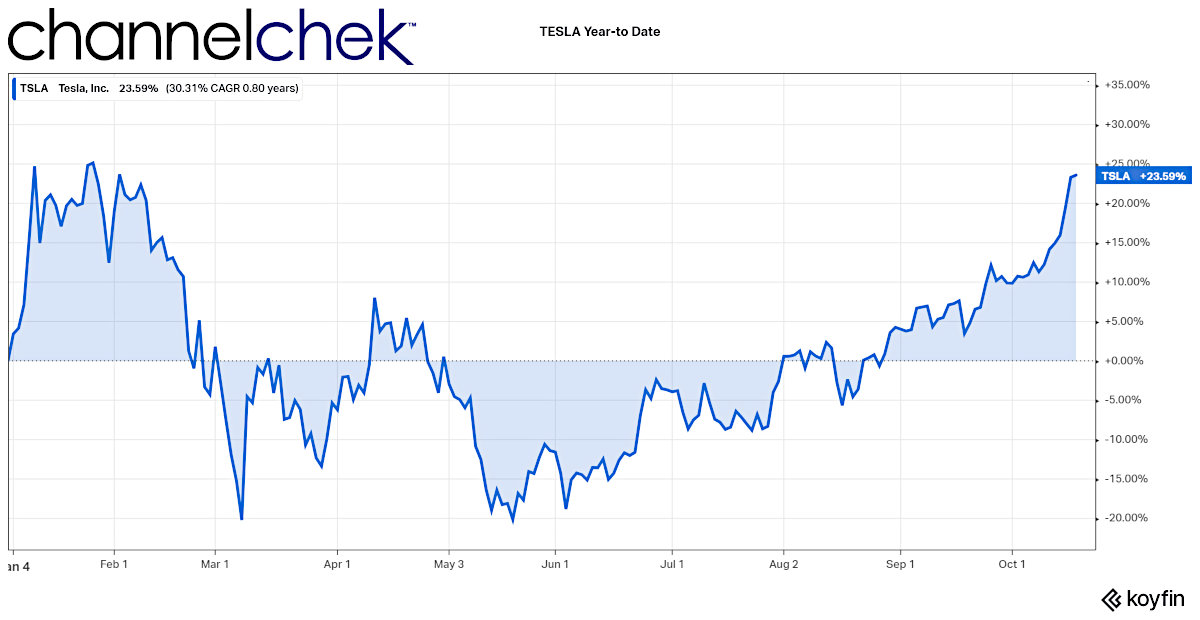
Burry, who also maintains a license as a medical doctor, emailed CNBC last week and said he is no longer “short” Tesla. Shares of Tesla are up 23.6% year-to-date and are approaching the high they reached earlier in the year. The stock did experience around a 45% decline from its record high as many tech stocks experienced weakness mid-year. There is no telling from the available information when he traded out of his put options and whether or not it was a profitable trade.

Take-Away

Dr. Michael Burry has a large following. While he is not one to go on TV and discuss his positions and views as other asset managers do, his followers are often treated to a Twitter
rant
or insight from a brief message he will send to a news outlet.

When a famous investor speaks about their views, there can be self-fulfilling price action that is not always long-lived. It’s not clear what the purpose of Burry’s most recent “heads-up” related to not speculating against Tesla is. But in the past five days, the stock has increased 6.4% while the overall market (S&P500) is only up 1.5%.


Paul Hoffman

Managing Editor, Channelchek

Suggested Reading:


Deflation, Not Inflation is Risk Says Cathie Wood


Why Michael Burry Has Better Opportunity Than Cathie Wood


Sources:

https://sec.report/Document/0001567619-21-010281/primary_doc.html

https://markets.businessinsider.com/news/stocks/big-short-investor-michael-burry-no-longer-short-tesla-tsla-2021-10

https://www.youtube.com/watch?v=W9KTUDXzx5E


Stay up to date. Follow us:
 

The SEC’s Final Report on Short Squeeze Activity


The SEC Issues 44 Page Report On January Short Squeeze


The Securities and Exchange Commission (SEC) released a report yesterday (October 18) with conclusions on January’s “meme stock madness” and for some, “short-squeeze sadness. ” While many like to think the little guy with the trading app got to slay the big bad hedge funds, according to the SEC, it didn’t really happen that way.

The SEC report on trading activity from January, along with a statement from SEC Chair Gary Gensler, says the Commission will use the episode to try to figure out how to make the markets more “fair, orderly, and efficient.” Although the short squeeze and the surprise restrictions on trading are often tied to GameStop ($GME) and Robinhood ($HOOD), many seemingly “dead-money” stocks shot higher during the second half of January. The cause was said to be retail investors on stock forums and message boards like the subreddit r/wallstreetbets conspiring to band together and buy until margin calls forced short-sellers to cover.  

The movement was followed by many brokers restricting trading in the more active names ($AMC, $GME, $BB, $IBKR, $NOK, etc.), this caused confusion and cries of foul play among non-institutional market participants.


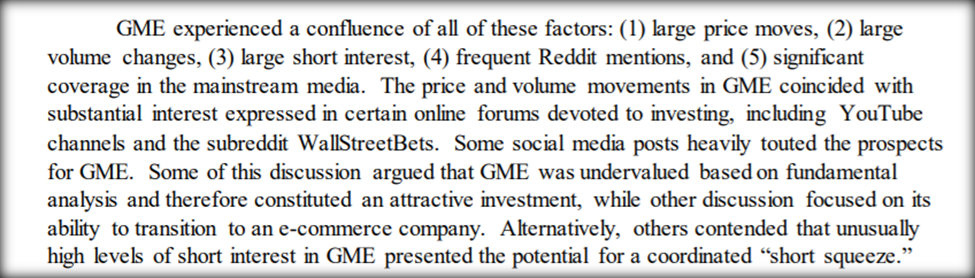
Page 16 of SEC Report on meme stocks dated October 18, 2021


The idea that the little guys were beating the Wall Street “machine” and that something intentionally unfair and nefarious occurred to suppress their full victory was debunked in the 44 page SEC report on the matter.

SEC Recommendations

While the report is boring compared to the drama and conjecture that occurred earlier in the year, the Commission makes specific recommendations about how the market should change and could be improved. Specifically, the report says that it would benefit the markets if trades had shorter settlements so clearinghouses wouldn’t have to hold as much collateral to prevent buyers and sellers from defaulting.

The SEC report observes that the primary reason behind the move up in GameStop shares was not a short squeeze but instead an overall enthusiasm of self-directed investors buying active stocks. While some short-sellers did appear to cause upward movement in the stock when they covered their open positions, the moves were overshadowed by the high volume of buyers of the stock. Details of the spike of retail interest can be summarized by this one line in the SEC release, “By Jan. 27, the number of unique accounts trading GME on a given day increased from less than 10,000 at the beginning of the month to nearly 900,000.”

Other Data

On Dec. 31, 2020, short interest in GameStop rose to 109%. This level convinced some retail traders that there was “naked short selling” going on. This is not a legal practice, but it is accomplished by shorting stock without first borrowing it. The SEC found that there was a higher than normal number of shares that sellers failed to deliver. This can occur with naked short sales because the short-seller doesn’t have the stock to deliver. The SEC report points out that other factors can explain the failures to deliver, and that there were not “persistent fails to deliver.” and they did not span multiple days. The SEC pointed to other reasons why short interest can spike above 100%, “If someone purchases a stock from a short seller and subsequently lends the stock out again, it will appear as if the stock was sold short twice for the purpose of the short interest calculation,” the report says.

What Part Did
Robinhood Play?

The report seems to support the explanation that brokers like Robinhood gave for restricting the purchase of some tickers. At the time, stockbrokers said they were forced to halt trading because of escalating demands from their clearinghouse(s) that required additional collateral to cover any potential losses. The clearinghouses did not want to be on the hook for covering losses in the event that trades failed as the increase in volume created a dangerous and challenging situation.

Brokers took special steps to meet the demand, Robinhood raised $3 billion in emergency funding. Another broker implemented trading restrictions for a different reason, they ran out of unique IDs to identify orders. The events of those days are now being fought over in court, and there still could be improper behavior uncovered. Additionally, the failure of market brokers and clearinghouses to keep up with the speed of the action raises concerns about how the market will handle the influx of new investors.

Overall Conclusion

The SEC report does not point to or suggest collusion between brokers and hedge funds or any other participants that would explain an alternative reason for the trading halts. In other words, no foul play was found.

There are some leanings in the report as to how markets might be revised down the road. The SEC’s conclusions include recommendations that they examine how behavioral prompts from online brokers may encourage trading among retail customers.  Payment for order flow is something else that is still being reviewed and how payment for order flow, (payments from market-makers to brokers to execute their trades) impacts small investors. The SEC admits in the report that regulators would benefit if there was more info out there on short selling.


Suggested Reading:


Would T+1 Settlement Prevent Margin Calls?


Robinhood’s IPO and its Place in Stock Market History


Is This Bullish for GameStop?


Polarized Opinions Around the GameStop Short Squeeze


Sources:

https://www.sec.gov/news/press-release/2021-212

https://www.sec.gov/files/staff-report-equity-options-market-struction-conditions-early-2021.pdf

https://www.cbsnews.com/news/securities-and-exchange-commission-gamestop-meme-stocks-order-flow/

https://www.barrons.com/articles/sec-report-changes-what-we-know-about-januarys-gamestop-frenzy-51634590024


Stay up to date. Follow us:

 

QuickChek – October 19, 2021


Comtech Telecommunications Corp. Announces New Cybersecurity Solution

Comtech Telecommunications announced that during its first quarter of fiscal year 2022, it launched a new cybersecurity brand, CyberStronger™

See today’s research report on Comtech from Joe Gomes, Senior Research Analyst at Noble Capital Markets

Research, News & Market Data on Comtech

Watch recent presentation from Comtech


1-800-FLOWERS.COM, Inc. to Release Results for its Fiscal 2022 First Quarter on Thursday, October 28, 2021

1-800-FLOWERS.COM, Inc. announced that the Company will release financial results for its fiscal 2022 first quarter (ended 9/26/21) on Thursday, October 28, 2021

Research, News & Market Data on 1-800-FLOWERS.COM


Seanergy Maritime Announces Acquisition of its 17th Capesize Vessel with Prompt Delivery and Completion of Previously-Announced Vessel Sale

Seanergy Maritime announced that it has entered into a definitive agreement with an unaffiliated third party to purchase a Capesize vessel

Research, News & Market Data on Seanergy Maritime

Watch recent presentation from Seanergy Maritime


Ocugen Inc. to present pre-clinical data for OCU410 at 2nd Annual Dry AMD Therapeutic Development Conference

Ocugen announced that its head of Research and Development, Arun Upadhyay, PhD, will present pre-clinical data demonstrating how the company’s second modifier gene therapy candidate, OCU410, could potentially be an effective therapeutic for Dry Age-related Macular Degeneration (Dry AMD)

Research, News & Market Data on Ocugen

Watch recent presentation from Ocugen


Kratos Breaks Gigabit Barrier with OpenSpace™ Virtualized Wideband Receivers for Earth Observation Missions

Kratos Defense & Security Solutions announced that it has broken the gigabit throughput barrier with its OpenSpace™ virtualized wideband receivers delivering over a gigabit per second performance running solely on commercially available, off-the-shelf x86-based computers

Research, News & Market Data on Kratos


Stay up to date. Follow us:


Marijuana Dispensaries and the Impact on Use


Image Credit: GoToVan

Cannabis Store Openings in Canada Only Slightly Affected the Number of Users


This article was republished with permission from  The
Conversation
, a news site dedicated to sharing ideas from academic experts. It represents the research-based findings and thoughts of 
Michael J. Armstrong, Associate professor of operations research, Goodman School of Business, Brock University


Despite Canada approaching its third anniversary of cannabis legalization, some municipalities still ban licensed shops. Other countries talking about legalizing cannabis also seem inclined toward minimizing legal access. But my research suggests those policies are probably counterproductive.

Canada legalized recreational cannabis on Oct. 17, 2018. After initial product shortages eased in spring 2019, store openings and retail sales soared. Monthly sales hit $339 million in July 2021 and the national store total now exceeds 2,600.


Line chart showing relative number of Canadian cannabis
users, stores and sales


User numbers have also grown. In 2018, 14 per cent of the population aged 15 and up admitted to using cannabis. That reached 20 per cent in 2020, equivalent to 6.2 million users.

Quarterly recreational cannabis sales, stores, and user prevalence, as percentages of fourth quarter 2020 values. Prepared by author from government data.

Canada’s cannabis approach differs greatly from the American (USA) one. But both countries share one detail: municipal governments opting out of allowing cannabis stores.

Do experts have something to add to public debate?

Local Store Bans

Several million Canadians live in places that ban licensed shops, including cities like Mississauga, Ont., and Surrey, B.C.

Meanwhile in the U.S., most California municipalities opted out of allowing stores after recreational sales began there in 2018. More recently, 71 per cent of towns in New Jersey and 90 per cent of those in Maine did likewise. New York’s communities have until Dec. 31 to decide.

Licensed shops could provide economic benefits. But some politicians and residents worry they’d also boost cannabis use and crime.

This apparent trade-off motivated my research.


Stores, Sales and Users

My study compared per capita growth in store numbers, recreational cannabis sales dollars and user numbers from 2018 to 2020 in Canada.

Stores and sales were strongly related. Differences in provincial store growth explained 46 per cent of the differences in sales growth. That’s a lot, given that many other factors like pricing, consumer tastes and weather also affect sales.

By contrast, store growth explained just eight per cent of user growth. A simple quarterly trend better explained the user increases.

In other words, almost the same user growth occurred regardless of how many shops opened. But where shops were plentiful, users increasingly bought legally.

One reason for the weak stores-and-users relationship was that user estimates came from government surveys with large error margins. They might not detect subtle changes.


Legal Versus Illegal Markets

The black market provides another likely reason. Licensed shops clearly increase access to legal products. But they only marginally increase overall access if illegal dealers are already widespread.

Consider the southern Ontario city of Hamilton. In January 2019, the city had 34 illegal dispensaries and countless online dealers. So when the first licensed shop opened three months later, it suddenly made legal products accessible. But the city’s total cannabis supply barely budged. Advertising restrictions likely played a role. Cannabis retailers couldn’t use ad blitzes or free samples to stimulate demand.

Canada’s 2018-20 user growth might have instead come from legalization’s removal of criminal penalties. That could have encouraged non-users to start, regardless of whether shops opened nearby.

Or the growth might have just represented ongoing trends. Canada’s cannabis use had been increasing since 2010.

My study analyzed province-level outcomes. But it has implications for other government levels too.


Are Opt-Outs Mostly Cop-Outs?

At the municipal level, politicians banning licensed stores might think they’re protecting residents.

But my study implies communities will see similar user growth after legalization whether they allow shops or not.

Those users will increasingly buy legally if local shops open. But without such stores, users will keep visiting illicit sources where products might be misrepresented or contaminated.

This means community store bans could lead to more crime and health problems rather than less.

It’s probably OK for politicians to briefly delay store licensing while they update local regulations. But beyond that, retail opt-outs risk becoming political cop-outs that hide problems instead of addressing them.

Similar logic applies at the national level when countries legalize.

Legalizing Countries Need Legal Access

Mexico’s courts ruled in 2018 that cannabis should be legal there. But its Congress still hasn’t passed legislation. One proposed bill would have legalized cannabis but made it very inaccessible.

South Africa has been similarly slow at implementing its own court’s 2018 ruling.

Both countries should rethink their reluctance. If they don’t provide practical legal access to a theoretically legal substance, they risk getting legalization’s pains without its gains. The main winners will be illicit dealers.

Switzerland and the Netherlands should consider this issue too during their cannabis pilot studies next year. As should other countries contemplating legalization, like Luxembourg, Italy, Germany and the U.S.

Of course, there’s more to sales than just stores. Research suggests ample supplies, convenient shopping hours and competitive prices also matter. And don’t forget product quality or package design.

Cannabis legalization is complex. Canada is still learning from its experiences. Hopefully other countries can learn from them too.


Suggested Reading:


Cannabis Customers Served by the Ice Cream Truck Delivery Model


Does Net Profit Matter for Marijuana Stocks


The Technological Invasion in Cannabis Cultivation


Apple’s Marijuana Decision Will Lead to Many Critical Decisions for Investors


Stay up to date. Follow us:

 

WallStreetBets Founder May Create Controversial ETP


Image Credit: Ivan Radic (Flickr)

Founder of WallStreetBets has a New Idea for CopyCat Investors


Copycat investors or coattail investors have sought to invest like Warren Buffett, Michael Burry, Carl Icahn, and even Cathie Wood. It’s a legitimate method of picking stocks and building a portfolio. Just copy what someone successful is investing in. But what about others in the public arena? WallStreetBets founder Jaime Rogozinski may create an ETP based on one of the most successful investors in recent years.

Jaime Rogozinski founded WallStreetBets, and authored the popular book, WallStreetBets, How Boomers Made the Worlds’s Biggest Casino
for Millennials.
Both were an attempt to expose “shocking trends” in the current financial system.  In some ways, Rogozinski’s creations have backfired on his original intent as they have been adopted by some of the very folks he was trying to expose. He’s no longer active in the immensely popular subreddit group he started and has intentionally distanced himself from it. Still, there is no question about the huge impact his creation has on investors in this new age of app and meme investing. As a successful businessman and investor, Rogozinskie has a knack for spotting trends early and sniffing out the next big thing. At the same time, Rogozinski has expressed chagrin over being right on movements he has been critical of. With this in mind, he may launch a controversial investment product based on the investments of one of today’s most insightful speculators, Nancy Pelosi’s husband.

The New Idea

Rogozinski believes there is real potential for an investment product that tracks the bets of Paul F. Pelosi. In an interview, he suggested a Pelosi-themed exchange-traded portfolio (ETP) could be incarnated on a platform that is part of his latest push to empower retail investors. “I got this idea, somewhat of a joke, but I can’t shake it so I’m probably going to start pushing for it, which is this ‘Nancy ETP,'” Rogozinski told the online magazine Market
Insider
.

The portfolio would be on the new WallStreetBets DApp. This DApp is a blockchain-based shop for stocks and other assets, the products and offerings extend beyond one particularly curious ETP. The new DApp is an expression of what Rogozinski sees as the next big thing in the financial world, he’s a strategic partner in its creation. “This is very much a way for me to say crypto and Wall Street are definitely going to merge and they’re starting to spill into each other already,” he was recently quoted as saying. “For far too long, I made the mistake of assuming blockchain technology and cryptocurrencies were one in the same thing – and they’re not,” Rogozinski said. “This whole DeFi (decentralized finance) infrastructure that’s able to create a parallel ecosystem in finances is astoundingly powerful, more than I could have imagined.”

Nancy ETP

Rogozinski’s idea for an automated Nancy Pelosi ETP would highlight a key feature on the WSB DApp. The platform allows members of the community to suggest the creation and the makeup of ETPs. The WSB DApp platform has a native token, the $WSB governance token that people can buy and then use to vote on the type of assets and weightings that should go into one of the ETPs. So if you are a member, and you believe a particular ETP should be made up of stocks that say carry an outperform rating by Noble Capital Markets equity analysts, token holders can signal transactions on an idea like this during voting cycles within the DApp

A Paul Pelosi-centered ETP would apply the “if you can’t beat them, join them” approach while drawing attention to the newest business interest of Rogozinski, attention fueled by outrage and debate over current headlines. In the case of Paul Pelosi, one trade, in particular made headlines. It involved shares of Google parent Alphabet that made $5.3 million for him prior to a House Judiciary Committee vote on tech antitrust regulation. Spokespersons for Speaker Pelosi told media outlets she owns no stock herself and had no knowledge of her husband’s equity purchases. Rogozinski said, “people are able to make money,” with a product like the “Nancy ETP”,  “nothing’s sure but past performance is definitely impressive,” he said speaking about Paul Pelosi’s stock picks.


Take-Away

The Pelosi theme has a strong mix of ingredients to prompt discussions on WallStreetBets and other forums that should serve to promote the WallStreetBets DApp. As we have all seen with other social media-based trafficking in ideas, a large enough herd does move markets. Whether the DApp and the ideas and information expressed on it is impactful remains to be seen.

The WallStreetBets DApp is an ongoing entity that states its intention as trying to
undermine any manipulation or, at a minimum place self-directed investors on the same side as any perceived market manipulation. It’s probably worth paying attention to.
  As for those mimicking Warren Buffett who is 91, or Paul Pelosi who is 82, websites like Channelchek and the WallStreetBets DApp may help these investors progression into a plan B in case these two stop investing at some point.

Paul Hoffman

Managing Editor, Channelchek

Suggested Reading:


You Can Own a Piece of r/wallstreetbets


Decentralized Apps (“Dapps”) Using Blockchain to Change the Internet


Decentralized Finance, Is It The Future?


Facebook’s Practice of Whitelisting Accounts is Being Reviewed


Sources:

https://www.wsbdapp.com/

https://en.wikipedia.org/wiki/Paul_Pelosi#:~:text=San%20Francisco%2C%20California%2C%20U.S.&text=Paul%20Francis%20Pelosi%20Sr.,capital%20investment%20and%20consulting%20firm.

https://www.investopedia.com/articles/investing/011414/how-be-perfect-copycat-investor.asp

https://markets.businessinsider.com/news/stocks/jaime-rogozinski-interview-wallstreetbets-founder-wsb-dapp-nancy-pelosi-commentary-2021-10


Stay up to date. Follow us:

 

QuickChek – October 18, 2021


Sierra Metals Reports Third-Quarter 2021 Production Results, Expecting To Meet Low End Of Revised Annual Production Guidance As The Production Ramps Up To Full Capacity At All Three Mines

Sierra Metals announced third-quarter 2021 production results

Research, News & Market Data on Sierra Metals

Watch recent presentation from Sierra Metals


Dr. Patrick Gruber to Participate in a Water Tower Research Fireside Chat on Thursday, October 21, 2021 at 4:30 pm EDT

Gevo announced that Dr. Patrick Gruber, Chief Executive Officer, will participate in a Water Tower Research Fireside Chat on Thursday, October 21, 2021 at 4:30 pm EDT

Research, News & Market Data on Gevo

Watch recent presentation from Gevo


Avivagen Secures Large OxC-beta™ Livestock Order in Asia

Avivagen announced it has signed a significant new purchase agreement to supply its largest customer in Asia with a 6.3 tonne order of OxC-beta™ Livestock

Research, News & Market Data on Avivagen

Watch recent presentation from Avivagen


Comtech Announces $100 Million Strategic Growth Investment

Comtech Telecommunications announced a $100.0 million investment by current shareholder White Hat Capital Partners LP and Magnetar Capital

Research, News & Market Data on Comtech

Watch recent presentation from Comtech


Stay up to date. Follow us:

 

Inflation and the Reflation Trade


Image Credit: Alexandr Podvalny (Pexels)

Inflation Seems Persistent, What Now?

One of the primary goals of investors is to out-earn inflation. At a minimum, keeping up with inflation helps our stored wealth from losing purchasing power. As CPI measurements have shown a higher inflation rate this year than we have seen over the past decade, investor concerns naturally have turned to consumer prices investor conversations are often centered around finding the best reflation investments. The definition of “reflation trade” is finding assets that will outperform in a long-lived inflationary environment.  

Background:

The year-over-year rate of inflation ran below 2.5% throughout the 2010s.  This past summer, increased prices brought CPI and other measures well above 5%, indications are that upward pressure on prices will continue. The cost of basic inputs such as labor, raw materials, shipping, and energy are all pushing costs of final goods and services higher. If corporate tax rates are also increased, this burden will also be passed through to the consumer. In addition to increased costs pushing prices higher, scarcity has provided businesses an opportunity to require higher price tags on the goods already on their shelves. It’s the perfect setup for inflation to continue at the levels we’ve seen in recent months or move even higher.

Inflation
Friendly Investments

Every market cycle and inflation cycle has its own set of winners and losers. The winners this time around (assuming inflation is not transitory) may be different than last. However, there is a long history of inflation from which to look back on, and even recent history can put probabilities more in an investor’s favor.

The more popular reflation trade suggestions from some investment professionals I’ve spoken to on the subject suggest everything from Treasury Inflation-Indexed Notes (TIPS), to farm land and related basics of food production. Other thoughts included commodities,  producers of basic materials,  commodities, and technology.


TIPS

Back in 1997, I participated in the first Treasury auction of inflation-protected securities.  Prior to that I was involved in discussions on behalf of my employer, with Secretary Robert Rubin’s U.S. Treasury team in 1996 meeting to resolve what my employer would support and perhaps build a fund around. From this experience, I have a strong understanding of and opinions of U.S. Treasury Inflation-Protected Notes.

Sticking to just facts and data, TIPS carry a fixed interest rate, well below similar maturity treasuries. As inflation (non-seasonally adjusted CPI-U) rises or falls, this amount is accreted to the principal of the bond. The semi-annual interest rates are calculated using the coupon (initial interest rate set at auction) multiplied by the new inflation-adjusted principal (divided by two for half a year). At maturity, the investor receives the final interest payment along with the principal adjusted for inflation’s impact.


The above chart represents a TIP with an original maturity of ten years
and a coupon of 7/8%. As interest rates traded lower after 2004, TIPS spread themselves
off traditional treasuries and traded at a premium, providing a negative
return yield to investors while accreting the inflation rate to principal to be paid
at maturity.


While the first chart demonstrates yield, the above shows year-over-year total return over the past 12 months. CPI increased 285% during this time while the value of a TIPS portfolio increased 4.2%.

Farming

Chris Rawley is the CEO of the investment company Harvest Returns. His company provides capital to farmers or ranchers while creating income-oriented investment opportunities for qualified investors. Channelchek reached out to Chris who made a case for the industry he specializes in, “Farmland and agriculture make good inflation-proof investments. In addition to arable farmland shrinking around the globe, historically, land has appreciated in concert with the money supply. Food production is also generally a recession-proof industry, as growing populations continue to eat regardless of the economy,” said Rawley.

While people can put off the purchase of a new car, home furnishings, vacations, etc., existence relies on buying goods from farms. It’s unavoidable. Unlike TIPS and other public market securities, many of the investments in this category are for long-term-minded investors.

Healthcare/Technology

Companies that can successfully pass their increased costs on to the consumer without losing some along the way are by definition inflation resistant. Many examples of this exist in healthcare. Not unlike food, people will continue to find a way to provide for their most basic needs. Maintaining one’s health is basic.

Many consumers view keeping up with technology as basic. Within technology, the FAANG stocks, including Apple and Netflix as well as many smaller technology companies, don’t seem to lose demand as they increase their prices. People are still lining up to buy new iPhones, watching movies, and buying through Amazon Prime.

Basic
Materials

There are raw materials that are required for production by manufacturing businesses if they plan to stay in business. This includes timber, metals, and chemicals. Investing could, in some cases, be direct in the commodity or commodity futures. Investing in the producers, including mining companies, energy, chemical manufacturers, and lumber, could put the investor at the broadest end of the manufacturing process. 

 Consumer
Staples

There are products that most modern-day people won’t live without. The most basic foods are in this category, but if you recall the run on toilet paper as the pandemic set in, you know that people will risk their lives for basic amenities, including hygiene products. The theme is the same as some of the others above. If pricing is not going to be an issue for one reason or another, and the company is not overly diversified into more discretionary items, they may be worth looking at.

Government
Spending

The government’s appetite doesn’t take a break because of inflated prices. In fact, should a bout of high inflation be coupled with weaker growth, the government typically steps up fiscal spending to prime the pump and get money moving. Current spending themes are infrastructure, including transportation such as dredging harbors to make room for larger ships, improving the rail system, airport renovations, and highway projects. Part of this is subsidizing green initiatives to change the countries main production of electricity. The government also contributes a lot to support the healthcare system.

Take-Away

If inflation continues at the current pace, consumer behavior will change. Some of the better investment opportunities will be in companies where demand is maintained despite higher prices. Stocks of companies that produce discretionary items may not fare as well. In addition to consumers’ must-have list of food, consumer staples, and some technology, manufacturers also keep a must-have list. This list includes all the inputs to manufacturing, whether it be metals, textiles, timber, or even energy. The companies that produce these for businesses that have customers, will have pricing power as their customers need the basic building blocks to survive. The U.S. government is the largest consumer of all. Following where Washington is spending can lead you to companies with a customer that doesn’t balk at the price and seems to be resistant to economic downturns.

Paul Hoffman

Managing Editor, Channelchek

Suggested Reading:


If Oil and Other Commodity Prices Feed Inflation, Where Might Investors Look?


The Sources of Deflationary Pressure According to Cathie Wood


Some Color on Prices and the Market’s Fixation on Inflation


U.S. Government Spending provides Investment Opportunities on Infrastructure


Sources:

https://www.treasurydirect.gov/indiv/research/indepth/tips/res_tips_rates.htm

https://www.bts.dot.gov/sites/bts.dot.gov/files/docs/browse-statistical-products-and-data/transportation-economic-trends/215951/transportation-economic-trends-2017-chapter-7.pdf

www.Koyfin.com


Stay up to date. Follow us:

 

What Does a Bitcoin ETF Do for Investors?


Image Credit: Lukas (Pexels)

What the Approved Bitcoin ETFs do for the Markets

The questions “when will we see a Bitcoin ETF?” and “how will a Bitcoin ETF be structured?” have finally been answered. The answer to the first is “next week,” the second answer is more complicated. The Securities and Exchange Commission (SEC) has agreed to allow the first two U.S. Bitcoin futures-based ETFs.  However, the ETFs won’t own Bitcoin. According to Bloomberg News, the accepted proposals by Invesco and  ProShares are devised based on futures contracts. The derivative structure, rather than crypto asset ownership, differentiate them from previous Bitcoin ETF proposals the SEC had given the thumbs down.

Why is a Bitcoin ETF
Important?

A Bitcoin ETF that attempts to mirror the crypto’s price movement seems on the surface to be inferior to just buying the currency. Why include so many inefficient middlemen? Why not just invest in Bitcoin directly? First, in the form of a security, investors are allowed to hold these tradeable assets in their stock market brokerage account without going through any additional storage process.

A more important benefit is that a Bitcoin ETF is an investment vehicle; this allows qualified money (retirement assets) such as IRA deposits to take part in this investment class. Investors will be able to simply purchase the ETF as they would any other stock. Their brokerage account is as likely to be able to accommodate the transaction as any other listed and active stock.

Investors will also be capable of shorting the ETF if they believe the price of Bitcoin will decline. This is not something that can be done using the current cryptocurrency exchanges.

Familiarity may be the greatest benefit. Stocks, including ETFs, are much better understood throughout the investment and regulatory world than cryptocurrencies. Even as the coins and tokens develop a longer history, an investor looking to get involved in the digital currency could focus on trading a vehicle they already have experience with, one that follows the same rules. And rules are important to the various authorities regulating the markets to protect investors and oversee the sale of investments. While there is debate as to whether cryptocurrencies are securities or not, there is certainty as to whether an SEC-registered ETF is a security under securities law.


Bitcoin ETF
History

The first SEC application for a Bitcoin ETF was by the Winklevoss twins back in 2013. This and all others that followed had been rejected by the commission, citing concerns over regulation and volatility. Gary Gensler is in his first year as SEC Chair. He has a deep understanding of the asset as he had taught blockchain and cryptocurrency courses at MIT. After creating boundaries, he opened the door by saying crypto ETFs that comply with its strict laws could provide investors significant protections.

Changes in regulation and high scrutiny will continue to exist over cryptos. Just last Wednesday (October 13), The Bank of England’s deputy governor Jon Cunliffe called for urgent regulation and warned a crypto crash could cause a 2008-level financial meltdown.

The price of Bitcoin spiked above $59,800 this morning, hitting its highest level since April as speculators have more evidence the road toward broad acceptance and integration into the investment world has accelerated with the new ETFs.

Take-Away

ETF offerings come in many different flavors and risk levels. Bitcoin is still a volatile asset, and an ETF that tries to mimic that volatility is fraught with challenges. Also, most ETFs are far more diversified than one with a single underlying asset benchmark.

Expect much more attention paid to Bitcoin next week as the two new products launch. The approval of a Bitcoin ETF will certainly provide the leading cryptocurrency more legitimacy over the thousands of other digital assets. The SEC has approvals are a big step, and ProShares and Invesco have created a template for others to follow. As the futures markets mature for other digital assets, a broader range of crypto ETFs could be brought to market as well.

Paul Hoffman

Managing Editor, Channelchek

Suggested Reading:


Imagine a Bitcoin ETF With No Underlying Bitcoin Assets


Severe Punishment for All Things Crypto in China – Who’s Impacted?


Is Coinbase Planning to “School” the SEC on Cryptocurrencies?


The “Volt Crypto Industry Revolution and Tech ETF” Stops Short of Crypto Investing


Sources:

https://www.invesco.com/us/en/insights/digital-assets-blockchain-cryptocurrency-etfs.html

https://www.fool.com/the-ascent/buying-stocks/articles/how-the-winklevoss-twins-amassed-a-6-billion-bitcoin-fortune/

https://www.bloomberg.com/news/articles/2021-10-15/bitcoin-futures-etf-said-not-to-face-sec-opposition-at-deadline

https://cardinalguide.com/posts/what-is-qualified-money-and-non-qualified-money/

https://www.investopedia.com/investing/bitcoin-etfs-explained/


Stay up to date. Follow us:

 

QuickChek – October 14, 2021


Chakana Reports 268M of 1.17 g/t Gold, 0.55% Copper and 19.2 g/t Silver (1.48% Cu-EQ) in Breccia Pipe 5 from Surface at Soledad, Peru

Chakana Copper announced results from fourteen resource definition holes drilled in Bx 5 totaling 2,052.75m at the Soledad project, Ancash, Peru

Research, News & Market Data on Chakana Copper

Watch recent presentation from Chakana Copper


electroCore Announces Regulatory Approval in Canada to Treat Adolescent Migraine

electroCore announced that the company received an amended Medical Device License from Health Canada to expand the label of gammaCore nVNS to include the acute and preventive treatment of migraine in adolescents between 12 and 17 years of age

Research, News & Market Data on electroCore


Gevo to Report Third Quarter 2021 Financial Results on November 10, 2021

Gevo announced that it will host a conference call on Wednesday, November 10, 2021

Research, News & Market Data on Gevo

Watch recent presentation from Gevo


Cocrystal Pharma to Present at the Dawson James 2021 Small Cap Growth Conference on October 21, 2021

Cocrystal Pharma announced that management will present at the Dawson James 2021 Small Cap Growth Conference on Thursday, October 21, 2021

Research, News & Market Data on Cocrystal Pharma

Watch recent presentation from Cocrystal Pharma


Stay up to date. Follow us:

 

QuickChek – October 13, 2021


Eagle Bulk Shipping Inc. to Issue Third Quarter 2021 Results and Hold Investor Conference Call

Eagle Bulk Shipping announced it will report its financial results for the third quarter ended September 30, 2021, after the close of stock market trading on Thursday, November 4, 2021

Research, News & Market Data on Eagle Bulk Shipping

Watch recent presentation from Eagle Bulk Shipping


Esports Entertainment Group Reaches $1 Million Milestone in Crypto Mining Since Launch in May

Esports Entertainment Group announced that ggCircuit’s crypto mining application for LAN centers has crossed the $1 million mark

Research, News & Market Data on EEG

Watch recent presentation from EEG


Comtech Telecommunications Corp. Awarded $4.6 Million in Orders from the U.S. Army for Mobile Satellite Equipment

Comtech Telecommunications announced that during its first quarter of fiscal 2022, it was awarded $4.6 million of funding from the U.S. Army to provide ongoing system refurbishments, sustainment services and baseband equipment

Research, News & Market Data on Comtech

Watch recent presentation from Comtech


Garibaldi Drilling Shifts To Casper

Garibaldi Resources announced that the 2021 exploration program will shift drilling for safety reason to the lower elevation Casper quartz gold vein target north of Nickel Mountain within the Company’s 180 sq.km Eskay Claim Group in Northwest British Columbia

Research, News & Market Data on Garibaldi Resources

Watch recent presentation from Garibaldi Resources


Stay up to date. Follow us: