
Are the Markets Priced for the Worst-Case Scenario?


Image Credit: Alphatradez (Pexels)

Does “Buy the Rumor, Sell the News” Apply to Today’s Markets?


Is the current market selloff a case of “Buy the rumor, sell the news”? The expectation that the upcoming Fed announcement is going to surprise investors with an even more hawkish stance than previously declared is the impetus for the current selloff. The presumed certainty is so great that the market may be positioned for the worst, and have this expectation already priced it in. If the Fed’s position is instead unchanged or otherwise less severe than feared, it could lead to a relief rally.


Background

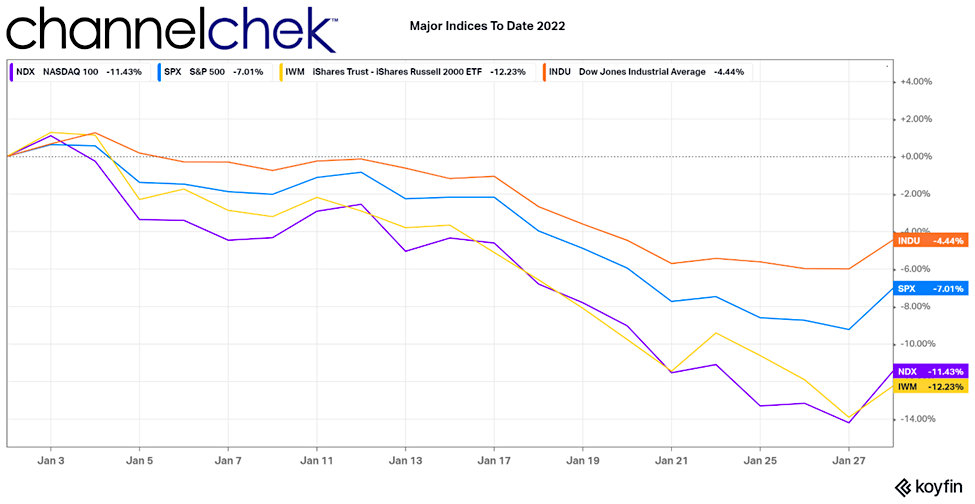
The S&P 500 is down over 8% over the first 24 days of the year, the Nasdaq Index is down 12%, and both have fallen several more percentage points from their highs attained last year. Many highly followed tech stocks have fallen even further. Much of the selloff has been attributed to a hawkish Fed that is planning to raise interest rates to combat rising inflation. A modest increase in rates was expected heading into the new year. The market’s concern is now that the Fed will act with more resolve. The current selloff appears to be fear of the worst case for many sectors of the market, especially those that are impacted most by borrowing costs.


Is Relief on the Way?

If the market’s fears are correct and the Fed ramps up its hawkish rhetoric, will the markets have much further to fall? This risk may have already been substantially reduced with the current price action. If instead, the Fed sets a less aggressive timeline than priced in, many traders will wish they bought at current prices. And for those that are contemplating selling, they may be handed a better opportunity.

JP Morgan’s top equity strategist, Marko Kolanovic says the market correction could be approaching its “final stages.” In a note released this week, Kolanovic said the recent bearishness in stocks is out of line with momentum in economic activity, easing supply bottlenecks, and what JP Morgan expects will be a strong earnings season.  “While some are concerned that rising input prices will eat into margins, we expect margins to remain resilient thanks to strong activity and prices outpacing wage inflation,” Kolanovic wrote.

Investor sentiment has turned bearish, causing technical indicators to suggest oversold conditions, “we could be in the final stages of this correction. While the market struggles to digest the rotation forced on it by raising rates, we expect the earnings season to reassure,” Kolanovic explained.

According to the latest AAII Sentiment Survey, bullish sentiment fell to a low not seen since the coronavirus selloff. At the same time, bearish sentiment rose to a 16 month high. For many contrarian investors, that bearish sentiment suggests something between incremental buying and loading up on favorite sectors.

The Fed is in a tough spot and may again use unconventional tools to navigate. If the market continues to decline, it has implications for the overall economy and employment. Should the selloff continue, Kolanovic sees the Fed potentially stepping in with policy changes to stem the decline. “In a worst-case scenario, we could see a return of the ‘Fed
put
,'” Kolanovic said.

Fed thinking could be altered by a continued steep market correction which may translate into fewer and smaller interest rate hikes in 2022 or a return to a longer-term tapering.  Just as when a quarterback calls a play, the movement on the field may quickly dictate other means of moving the ball toward the goal line. If the Feds plan to fight inflation and maintain a strong economy runs afoul, it certainly has other less aggressive offensive options to implement toward its goal.

Take-Away

As with all things related to predicting economic trends (or even forecasting weather), the expectations never match what is actually experienced. If the Fed is predicting one set of conditions, and it appears that another set is unfolding, they can turn on a dime. The Fed has done this unannounced before. It has also pulled tools from its quiver that have previously gone unused.

The most recent selloff appears to be based on the worst-case scenario; as JP Morgan’s top strategist has written, the economy is growing with very strong momentum.

Is there a better sell opportunity in the near future, is this a buying opportunity? Time will tell.

Paul Hoffman

Managing Editor, Channelchek


Suggested Reading


Will the Fed “Put” Become Worthless?


Climbing a “Wall of Worry”


The Correlation of Passive Ownership and Underperformance


Safe Haven Comparison During Downturns, Bitcoin vs. Gold


Sources

https://www.nasdaq.com/articles/vix-etfs-surge-as-stocks-continue-to-tumble

https://www.cnbc.com/2022/01/24/jpmorgans-kolanovic-says-selling-is-overdone-as-stocks-tumble.html

https://www.aaii.com/sentimentsurvey

https://www.thebalance.com/what-does-buy-the-rumor-sell-the-news-mean-1344971

www.koyfin.com


Stay up to date. Follow us:


Channelchek Small-Cap Recap 2022-01-24


Channelchek Small-Cap Recap


Stocks Trending Today:


EXTN +57% (1:30pm) 48.9M volume 33.3M Float

Exterran Corporation
(NYSE: EXTN)
gapped up at the open and shares have been trending higher later in the trading session. The Company offers solutions in the oil, gas, water and power markets. Its segments include contract operations, aftermarket services and product sales. The Law Firm Ademi, LLP requested that shareholders contact them and they are investigating the conduct of Exterran’s board of directors, and whether they are (i) fulfilling their fiduciary duties to all shareholders, and (ii) obtaining a fair and reasonable price for Exterran in an acquisition deal.


PIXY +33.9% (1:30pm) 39.7M volume 28.7M Float

ShiftPixy Inc.
(Nasdaq:PIXY)
Specializes in staffing and human capital management. The company provides solutions for large contingent part-time workforce demands, primarily in the restaurant, hospitality, and maintenance service trades. They announced today the development of a robust non-fungible token (NFT) gamification loyalty program. ShiftPixy has plans to release it in 2022 as the Company prepares for the launch of its Ghost Kitchen food brands.


ARDS +26.9% (1:30pm) 7.9M volume 14.1M Float

Aridis Pharmaceuticals Inc.
(NASDAQ:ARDS)
is a late-stage biopharmaceutical company. It is engaged in the discovery and development of targeted immunotherapy using fully human monoclonal antibodies, or mAbs, to treat life-threatening infections. shares rose 35.6% to $2.17 during Monday’s regular session. The current daily volume is running over 600% above Aridis Pharmaceuticals’s average full-day volume over the last 100 days.


Ticker

% Gain

Shares Float

Volume
EXTN +57% 33.3M 48.9M
PIXY +33.9% 28.7M 39.7M
ARDS +26.9% 14.1M 7.9M


Wall Streets Tools to Copycat Meme Stock Investor Successes


Is it Game-Over for Meme Stock Investors?


The tide turned about a year ago.  Professional traders scoffed at the activity they were witnessing in presumed “dead” stocks.  GameStop (GME), AMC Theaters (AMC), both skyrocketing.  Even presumed pandemic nightmare companies such as Hertz (HTZ), international bulk carrier Seanergy (SHIP), and  Norwegian Cruise Lines (NCLH) saw unexpected
buy interest
from self-directed investors.  TV pundits discussed how the retail traders placing these trades were going to get wiped out.  Meanwhile, retail’s combined activity hurt the value of a few powerful funds, notably those that had massive shorts in some of these companies.  Their activity even caused retail brokers like E*Trade (MS) and Robinhood (HOOD) to
halt
some activities
in the popular retail shares.  It used to be that small investors tried to mimic the professionals.  Now, tools are being created so the big guys can monitor communication, sentiment, and activity on social media platforms such as Reddit, Twitter (TWTR), and Stocktwits.

Money Flows

Economics 101 tells us prices move up when demand increases with unchanged supply.  This is just as true for stocks as it is for Gold,
oil, or even tulip
bulbs
.  By the same math, there are worthwhile companies whose value is not yet recognized that would likely be priced higher with more attention.  And companies with extremely unpredictable tomorrows that, if the masses all moved to buy at once, would surely see a price increase.  

A number of hedge funds that underestimated the tenacity of the r/wallstreetbets traders, were resolved to hold their short positions while the retail demand was increasing.  In the end, it’s calculated that managed funds lost $20 billion in this Davey vs. Goliath match-up.

These money flows, possibly even stimulus
check
 funded accounts, “left a mark” on institutional investors.  No previous experience or education prepared them for this phenomenon.  Prices of fallen-from-favor household name stocks were soaring by hundreds of a percent.  Their experience instead indicated they should side against the amateurs.


Change of Thinking

As it became widely known that retail traders or amateur investors plotting on social media and message boards were capable of running-up stocks or commodities, the pros took a “game-on” stance.  It was a game they didn’t win, beaten down companies like GameStop rose 2,000% in the face of pros shorting the stock.


“If enough people with enough money start valuing stocks a different way, their new metrics matter, too, even if you think they’re absurd,” – Jim Kramer, discussing the climb in Wendy’s (WND) shares, June 8, 2021.


After almost a year, professionals are recognizing that the market’s climate has changed, and they should amass the tools they need to combat the new environment.  A company called Sentifi, with the tagline “Better Investments With Collective
Intelligence,”
has just signed a deal to provide “alternative data” to Morningstar.  The company keeps track of hundreds of millions of messages across social media websites like Twitter and Reddit.  It observes shifts in chatter that can help predict which companies or assets are about to soar or plummet.  Morningstar which is one of the most broadly followed investment analytics providers will be integrating Sentifi’s sentiment and attentive analytics into its products as an additional toolset.  The intent is to provide users, including fund managers, financial advisors, and other investors, a means to keep pace with market shifts and price signals.  The expectation is to uncover shifts in sentiment early, discern investment opportunities and risks inherent in the changes.  

While Morningstar is integrating Sentifi into its product line, many other companies, particularly hedge funds, began to rely on its analysis last year.  Other large firms have built their own data gathering information systems.  At UBS, analysts now monitor retail trading activity; in-house traders use the information as one of their decision-making tools.  The investment bank directly tracks retail flows and volumes, analyzes options activity, and monitors social-media sentiment to determine the strength of what self-directed investors may be doing.  Keith Parker is the head of US equity strategy at UBS, he has said, “For the most part, retail doesn’t impact or traffic in tons of stocks.  But the ones that they do, they tend to have pretty outsized influence.  And so it does matter at the extremes.”


Take-Away

As the expression goes, kill or be killed.  As the markets evolve, so must the players in order to continue to interact with the market.  An increasing number of professionals are not just taking retail stock market activity seriously; they are committed to benefitting from it.  The benefit can be both offensive and defensive.  It remains to be seen if the offensive plays that could be categorized as joining with the retail action will induce even more pronounced swings, but it is clear that information is readily available to them as the so-called meme stock investors are effectively writing their plays out where they can be seen and studied.  Their tactics may need to be altered.

Paul Hoffman

Managing Editor, Channelchek


Suggested Reading


You Can Own a Piece of r/WallStreetBets


Tulip Mania Compared to Cryptocurrencies and Meme Stock Investing


Short-Sellers Vs. GameStop Buyers


Are Meme Stocks Improving Flawed Markets?


Sources

https://www.youtube.com/watch?v=aSUuB4cLWPU

https://www.morningstar.com/news/business-wire/20211208005489/sentifi-announces-addition-of-alternative-data-into-morningstar-data-products


Stay up to date. Follow us:


Wall Street’s Tools to Copycat Meme Stock Investor Successes


Is it Game-Over for Meme Stock Investors?


The tide turned about a year ago.  Professional traders scoffed at the activity they were witnessing in presumed “dead” stocks.  GameStop (GME), AMC Theaters (AMC), both skyrocketing.  Even presumed pandemic nightmare companies such as Hertz (HTZ), international bulk carrier Seanergy (SHIP), and  Norwegian Cruise Lines (NCLH) saw unexpected
buy interest
from self-directed investors.  TV pundits discussed how the retail traders placing these trades were going to get wiped out.  Meanwhile, retail’s combined activity hurt the value of a few powerful funds, notably those that had massive shorts in some of these companies.  Their activity even caused retail brokers like E*Trade (MS) and Robinhood (HOOD) to
halt
some activities
in the popular retail shares.  It used to be that small investors tried to mimic the professionals.  Now, tools are being created so the big guys can monitor communication, sentiment, and activity on social media platforms such as Reddit, Twitter (TWTR), and Stocktwits.

Money Flows

Economics 101 tells us prices move up when demand increases with unchanged supply.  This is just as true for stocks as it is for Gold,
oil, or even tulip
bulbs
.  By the same math, there are worthwhile companies whose value is not yet recognized that would likely be priced higher with more attention.  And companies with extremely unpredictable tomorrows that, if the masses all moved to buy at once, would surely see a price increase.  

A number of hedge funds that underestimated the tenacity of the r/wallstreetbets traders, were resolved to hold their short positions while the retail demand was increasing.  In the end, it’s calculated that managed funds lost $20 billion in this Davey vs. Goliath match-up.

These money flows, possibly even stimulus
check
 funded accounts, “left a mark” on institutional investors.  No previous experience or education prepared them for this phenomenon.  Prices of fallen-from-favor household name stocks were soaring by hundreds of a percent.  Their experience instead indicated they should side against the amateurs.


Change of Thinking

As it became widely known that retail traders or amateur investors plotting on social media and message boards were capable of running-up stocks or commodities, the pros took a “game-on” stance.  It was a game they didn’t win, beaten down companies like GameStop rose 2,000% in the face of pros shorting the stock.


“If enough people with enough money start valuing stocks a different way, their new metrics matter, too, even if you think they’re absurd,” – Jim Kramer, discussing the climb in Wendy’s (WND) shares, June 8, 2021.


After almost a year, professionals are recognizing that the market’s climate has changed, and they should amass the tools they need to combat the new environment.  A company called Sentifi, with the tagline “Better Investments With Collective
Intelligence,”
has just signed a deal to provide “alternative data” to Morningstar.  The company keeps track of hundreds of millions of messages across social media websites like Twitter and Reddit.  It observes shifts in chatter that can help predict which companies or assets are about to soar or plummet.  Morningstar which is one of the most broadly followed investment analytics providers will be integrating Sentifi’s sentiment and attentive analytics into its products as an additional toolset.  The intent is to provide users, including fund managers, financial advisors, and other investors, a means to keep pace with market shifts and price signals.  The expectation is to uncover shifts in sentiment early, discern investment opportunities and risks inherent in the changes.  

While Morningstar is integrating Sentifi into its product line, many other companies, particularly hedge funds, began to rely on its analysis last year.  Other large firms have built their own data gathering information systems.  At UBS, analysts now monitor retail trading activity; in-house traders use the information as one of their decision-making tools.  The investment bank directly tracks retail flows and volumes, analyzes options activity, and monitors social-media sentiment to determine the strength of what self-directed investors may be doing.  Keith Parker is the head of US equity strategy at UBS, he has said, “For the most part, retail doesn’t impact or traffic in tons of stocks.  But the ones that they do, they tend to have pretty outsized influence.  And so it does matter at the extremes.”


Take-Away

As the expression goes, kill or be killed.  As the markets evolve, so must the players in order to continue to interact with the market.  An increasing number of professionals are not just taking retail stock market activity seriously; they are committed to benefitting from it.  The benefit can be both offensive and defensive.  It remains to be seen if the offensive plays that could be categorized as joining with the retail action will induce even more pronounced swings, but it is clear that information is readily available to them as the so-called meme stock investors are effectively writing their plays out where they can be seen and studied.  Their tactics may need to be altered.

Paul Hoffman

Managing Editor, Channelchek


Suggested Reading


You Can Own a Piece of r/WallStreetBets


Tulip Mania Compared to Cryptocurrencies and Meme Stock Investing


Short-Sellers Vs. GameStop Buyers


Are Meme Stocks Improving Flawed Markets?


Sources

https://www.youtube.com/watch?v=aSUuB4cLWPU

https://www.morningstar.com/news/business-wire/20211208005489/sentifi-announces-addition-of-alternative-data-into-morningstar-data-products


Stay up to date. Follow us:


The First Cryptocurrency Exchange Hacked in 2022


Image: TV Ad for Crypto.com

Have You Positioned Your Account to Not Fall Victim to a Crypto-Exchange Hack?


Storing cryptocurrency in a “hot wallet” rather than a “cold wallet” could make the difference between becoming a victim of theft or remaining secure. When inactive, crypto holders should consider locking their wallets down as tightly as possible.  In the recent case of the 4600 ETH, worth almost $15m, reportedly stolen from the exchange where Matt Damon is the ad personality, it is still unclear if there will be lasting damage.

Crypto Safety

Cybercriminals are becoming sophisticated at transferring, undetected,  crypto assets from digital wallets. In actual use, a digital or crypto wallet does not store an individual’s crypto holdings; instead what it provides for is access via a digital key. This key allows entrance and the ability to trade online.  A private key is an individual’s digital identity to the market. If someone should possess this identifier, they can engage in unauthorized transactions or transfers.

Storing assets in what is known as a hot wallet that is connected to the internet could make your assets prone to theft. The reason is there may be access to your computer or mobile device, which allows seeing this key. If the private key is instead stored as part of a cold wallet (sometimes called a hardware wallet), access to the key is unavailable to anyone remote from the hardware. 


What Occurred

Some of Crypto.com’s Ether hot wallets were reportedly hacked this week. Users of the exchange found themselves missing assets, some with sizeable value.  Crypto.com announced on Twitter on Sunday evening that an investigation into the “suspicious activity” was underway.


By noon on Monday (January 17) Chris Marszalek, CEO of crypto.com, calmed clients with the below tweet. It still isn’t clear whether funds were ever lost or not. The blockchain security company, PeckShield which describes itself on its website as “…a security company which aims to elevate the security, privacy, and usability of entire blockchain ecosystem by offering top-notch industry-leading products.” Had tweeted a dollar value associated with the alleged theft and what appears to be a list of transactions washed through Tornado.cash. Tornado.cash is an ETH-based coin mixer.


While Crypto.com reported, “all funds are safe”, there were multiple replies to the tweets complaining of missing cryptocurrency, including both Bitcoin (BTC) and Ethereum (ETH). Some of these tweets were later followed by tweets saying the exchange has restored its missing funds.


How it Happened

The attackers reportedly found a way to bypass the two-factor authentication (2FA) security measures on the exchange. When alerted, Crypto.com stopped transactions. They used Twitter to ask account holders to sign into the app and their exchange account to reset their 2FA information. The company made updates and stated once the update had been implemented, withdrawals and transactions would again be enabled.


Take-Away

Crypto.com appears to have been compromised by a hack of its centralized exchange in 2022. A good way to make sure if there is another attack during the year, that you’re not a victim is to make sure your access key is not available online. A cold account could go a long way to avoid becoming a victim.


Paul Hoffman

Managing Editor, Channelchek


Suggested Reading


Threats to Your Personal Information


Should Investors Listen to Influencers?


The Cost of Pandemic Inspired Cybercrime in Education


Is Ethereum More Useful Than Bitcoin?


Sources:

https://crypto.com/security

https://www.shacknews.com/article/128370/cryptocom-pauses-withdrawals-after-theft-in-several-users-wallets

https://qz.com/2110791/celebrities-push-cryptocurrencies-but-fans-carry-all-the-risk/


Stay up to date. Follow us:


Differences in the Canadian Exchanges vs US


Are You Up to Speed on the Canadian Stock Market?


The Canadian stock market differs in many ways from that in the U.S. To begin with, they are each priced in their local currency. The Canadian dollar exchange rate is about 20% under US dollars. Another impactful difference is the entire population of Canada is 1.5 million people fewer than the state of California. With one-tenth the population of the entire US, the market is not inclined to trade as deep or to have as many large companies on the main exchanges.

For a US investor looking northward, they may find that a Canadian company they are interested in has an ADR on a US exchange allowing any currency exchange to be avoided. If not, to trade in Canada they may need to open a bank account in each currency and will naturally be exposed to any currency risk relative to their native currency.


Sector Comparison

Many of the same sectors exist across the two exchanges, but there is a heavy weighting in Canada toward natural resource companies as the country is rich in oil and minerals. As a comparison of industries, this is how the two countries compare. For comparison across the border within the sectors, some recommend using price earnings to determine value, just as one would when comparing two stocks in the same dominion.

Basic Materials – Canada is 1.6 times bigger

Capital Goods – US is 6.5 times bigger

Conglomerates – US is 2.4 times bigger

Consumer Cyclical – US is 16 times bigger

Consumer Non-Cyclical – US is 8 times bigger

Energy – US is 1.54 times bigger

Financial – US is 5.66 times bigger

Healthcare – US is 10 times bigger

Services – US is 8 times bigger

Technology – US is 11 times bigger

Transportation – US is 8 times bigger

Utilities – US is 5.4 times bigger


Two standouts in Canada are basic materials which you can see above is quite a bit larger than the U.S. market. And banks, which in Canada did not experience the problems the US banks did during the subprime mortgage crisis. A case can be made that the Canadian banking sector offers diversification alongside holdings in U.S. banks. Canadian railway companies are also large and may offer unique opportunity different from U.S. transportation companies.

Stock Exchanges

In Canada, stocks with low market caps make up a large part of the securities industry.

The TSX Venture Exchange (TSX) is located in Calgary it is often called the junior listings market as it caters to early companies. Listing a company on the exchange is relatively.

The TSX Alpha Exchange (Alpha), is a market for trading securities listed on other Canadian exchanges.

The Canadian Securities Exchange (CSE), is an exchange designed for emerging issuers.


Suggested Reading:


Do Canadian Companies Remain Private Because of Corporate Governance?


Copper facing an Onslaught of Demand


Repurposing Power Plants for Crypto Mining


Cathie Wood Clears Way to Invest in Bitcoin ETFs from Canada


Sources:

https://ca.practicallaw.thomsonreuters.com/7-575-5349?transitionType=Default&contextData=(sc.Default)&firstPage=true

https://medium.com/@jacobgottlieb44/the-differences-between-canadian-and-american-stock-exchanges-3d4514b313b9

https://dividendearner.com/differences-canadian-us-stock-markets/


Stay up to date. Follow us:


Powells Apparent Shift on Digital Currency


Image Credit: Johannes Plenio

New Light Shed on the Federal Reserve’s Road Toward Accepting Cryptocurrency


Much of Fed Chairman Jay Powell’s confirmation hearing, essentially a job interview to keep his job, was sleepy. He straddled a lot of fences and tried to make everyone happy while not saying anything that could be overblown and impact the economy or roil markets. Digital currencies came up in a question, and his response shed much more needed light on the Fed’s
unofficial stance
. Powell also offered clearer insight on his thoughts on privately issued cryptocurrency.

Position on Digital Currency

Powell was responding to a question asked by Sen. Pat Toomey during the hearing. Toomey asked, “If Congress were to authorize and the Fed were to pursue a central bank digital dollar, is there anything about that that ought to preclude a well-regulated, privately issued stable coin from co-existing with a central bank digital dollar?” Powell’s response was without hesitation. “No, not at all,” Powell said confidently.

Addressing an inquiry as to the state of the Fed’s long-promised, much-awaited report, from Senator Mike Crapo remotely from the Dirks, Powell said the Fed’s report on digital currencies is not “quite where we needed to get it” but would be released soon. The Fed chair explained the delayed report was the consequence of “changes in monetary policy.”  The
report
is expected to discuss official policy surrounding the possible rollout of a central bank digital currency in the U.S. “It’s more going to be an exercise in asking questions and seeking input from the public rather than taking a lot of positions on various issues, although we do take some positions,” said Powell. “The report really is ready to go and I would expect we will drop it — I hate to say it again — in coming weeks.”

Other Digital Currency News

Powell’s testimony came the same day (January 11) Representative Tom Emmer’s Twitter post attracted thousands of retweets and  “Likes.” In it, he indicated he would be presenting new legislation on digital currency. It’s unclear what the legislature may be. It could be an attempt at “fixing” the definition of a broker in the infrastructure law, which took effect in November 2021, or another regulatory path to encourage innovation in the crypto industry.


Take-Away

The lack of clarity from Washington, including the Fed, Congress, and the SEC, on how to regulate the ongoing upsurge in the private digital currency space has caused those in the US Capitol, Wall Street, and the crypto universe to clash. Answers as to the official direction may be ahead as Powell confirmed that the central bank is planning to publish its much-awaited report on digital currencies in the coming weeks. This came after he pointedly agreed that a digital currency could co-exist within our monetary system with traditional cash dollars.


Paul Hoffman

Managing Editor, Channelchek


Suggested Reading:


Is Gold Still Preferred Over Large Digital Currencies as a Safe-Haven Asset?


Non-Fungible-Tokens Have Become a New Revenue Source for Once Stodgy Institutions


About the Central Bank Digital Currency Position Report, That’s Late


How Close is the US to Having a Digital Currency?


Sources:

https://markets.businessinsider.com/news/currencies/cryptos-fed-cbdc-digital-coin-central-bank-coexist-powell-toomey-2022-1

https://cointelegraph.com/news/us-lawmaker-hints-at-upcoming-crypto-legislation-as-jerome-powell-says-fed-will-release-report-on-digital-currency-soon

https://twitter.com/RepTomEmmer


Stay up to date. Follow us:


Why Does Coinbase Close Down for Employees for Four Weeks


Coinbase Closing Down for Four Weeks So Employees Can Chill


One doesn’t run a marathon each day and expect that months or years later they will still be able to put in a solid effort. Anything with an intense ongoing effort requires idle time, and a chance to recharge before getting back to the difficult pace. This is the reason Coinbase is giving employees four full weeks where production essentially shuts down – to balance out their “intense work culture.”


According to its blog published this week about company culture, written by its chief people officer, nearly the entire company will shut down in order to avoid work from piling up. The shutdown time won’t be consecutive weeks but instead scheduled approximately one week per quarter.


The cryptocurrency exchange that went
public
in April of 2021 first experimented with “recharge weeks” in 2020 after discovering that many employees weren’t taking time off.  The blog post explains, “Despite our FTO policy for most employees, we realized in 2020 that many employees weren’t taking enough time off to recharge, either because they didn’t want to force their teammates to cover for them or because they didn’t want to fall behind on their work.” The chief people officer explained the culture is not one of family, but one of teamwork. This forced time out prevents employees from undermining the success of themselves or the company that could occur if they did not take a breather. Coinbase teams with critical 24/7 responsibilities, such as customer service and security, scheduled alternate recharge weeks.


The blog post discusses company culture by saying, “For most of us, Coinbase is the most intense place we’ve ever worked,” it explains “That intensity is only magnified by the current
moment
in crypto, and it often results in long days and long weeks.” This is why the forced time off is critical. During the employee “recharge weeks,” nearly the entire company will shut down in order to avoid work from piling up.


Paul Hoffman

Managing Editor, Channelchek


Suggested Reading:


The Latest on Digital World Acquisition Corp’s Progress (Trump Media SPAC Deal)


NFTs are Becoming More Popular with Sports Fans


Coinbase to Propose a Regulatory Framework for Digital Currency


Is Interest Paid on Crypto Holdings an SEC Violation?


Sources:

https://blog.coinbase.com/working-at-coinbase-intense-and-demanding-balanced-by-deliberate-recharge-time-a5235b9fa920


Stay up to date. Follow us:


Channelchek Small-Cap Recap 2022-01-12


Channelchek Small-Cap Recap


Stocks Trending Today:


ECOR +62% (3:30pm) 67.37M volume 70.7M Float

electroCore,
Inc. (Nasdaq: ECOR)
is a commercial-stage bioelectronic medicine company with a platform for non-invasive vagus nerve stimulation therapy initially focused on neurology and rheumatology.  electroCore Inc. shares are up Wednesday after the company said its gammaCore non-invasive vagus nerve stimulation received U.S. Food and Drug Administration breakthrough device designation for the treatment of posttraumatic stress disorder. Recent research on ECOR available here on Channelchek.


IPOOF +18.05% (3:45pm) 608K volume 86.2M Float

InPlay Oil (OTC: IPOF, IPO:CA) is a junior oil and gas exploration and production company with operations in Alberta focused on light oil production. The company operates long-lived, low-decline properties with drilling development and enhanced oil recovery potential as well as undeveloped lands with exploration possibilities. The company announced today that its Board of Directors has approved a $58 million capital program for 2022. Recent research on IPOOF / IPO:CA is available
here on Channelchek.


Ticker

% Gain

Shares Float

Volume
ECOR +62% 70.7M 67.37M
IPOOF +18.05% 86.2M 608K


Why Does Coinbase Close Down for Employees for Four Weeks?


Coinbase Closing Down for Four Weeks So Employees Can Chill


One doesn’t run a marathon each day and expect that months or years later they will still be able to put in a solid effort. Anything with an intense ongoing effort requires idle time, and a chance to recharge before getting back to the difficult pace. This is the reason Coinbase is giving employees four full weeks where production essentially shuts down – to balance out their “intense work culture.”


According to its blog published this week about company culture, written by its chief people officer, nearly the entire company will shut down in order to avoid work from piling up. The shutdown time won’t be consecutive weeks but instead scheduled approximately one week per quarter.


The cryptocurrency exchange that went
public
in April of 2021 first experimented with “recharge weeks” in 2020 after discovering that many employees weren’t taking time off.  The blog post explains, “Despite our FTO policy for most employees, we realized in 2020 that many employees weren’t taking enough time off to recharge, either because they didn’t want to force their teammates to cover for them or because they didn’t want to fall behind on their work.” The chief people officer explained the culture is not one of family, but one of teamwork. This forced time out prevents employees from undermining the success of themselves or the company that could occur if they did not take a breather. Coinbase teams with critical 24/7 responsibilities, such as customer service and security, scheduled alternate recharge weeks.


The blog post discusses company culture by saying, “For most of us, Coinbase is the most intense place we’ve ever worked,” it explains “That intensity is only magnified by the current
moment
in crypto, and it often results in long days and long weeks.” This is why the forced time off is critical. During the employee “recharge weeks,” nearly the entire company will shut down in order to avoid work from piling up.


Paul Hoffman

Managing Editor, Channelchek


Suggested Reading:


The Latest on Digital World Acquisition Corp’s Progress (Trump Media SPAC Deal)


NFTs are Becoming More Popular with Sports Fans


Coinbase to Propose a Regulatory Framework for Digital Currency


Is Interest Paid on Crypto Holdings an SEC Violation?


Sources:

https://blog.coinbase.com/working-at-coinbase-intense-and-demanding-balanced-by-deliberate-recharge-time-a5235b9fa920


Stay up to date. Follow us:


Powell’s Apparent Shift on Digital Currency


Image Credit: Johannes Plenio

New Light Shed on the Federal Reserve’s Road Toward Accepting Cryptocurrency


Much of Fed Chairman Jay Powell’s confirmation hearing, essentially a job interview to keep his job, was sleepy. He straddled a lot of fences and tried to make everyone happy while not saying anything that could be overblown and impact the economy or roil markets. Digital currencies came up in a question, and his response shed much more needed light on the Fed’s
unofficial stance
. Powell also offered clearer insight on his thoughts on privately issued cryptocurrency.

Position on Digital Currency

Powell was responding to a question asked by Sen. Pat Toomey during the hearing. Toomey asked, “If Congress were to authorize and the Fed were to pursue a central bank digital dollar, is there anything about that that ought to preclude a well-regulated, privately issued stable coin from co-existing with a central bank digital dollar?” Powell’s response was without hesitation. “No, not at all,” Powell said confidently.

Addressing an inquiry as to the state of the Fed’s long-promised, much-awaited report, from Senator Mike Crapo remotely from the Dirks, Powell said the Fed’s report on digital currencies is not “quite where we needed to get it” but would be released soon. The Fed chair explained the delayed report was the consequence of “changes in monetary policy.”  The
report
is expected to discuss official policy surrounding the possible rollout of a central bank digital currency in the U.S. “It’s more going to be an exercise in asking questions and seeking input from the public rather than taking a lot of positions on various issues, although we do take some positions,” said Powell. “The report really is ready to go and I would expect we will drop it — I hate to say it again — in coming weeks.”

Other Digital Currency News

Powell’s testimony came the same day (January 11) Representative Tom Emmer’s Twitter post attracted thousands of retweets and  “Likes.” In it, he indicated he would be presenting new legislation on digital currency. It’s unclear what the legislature may be. It could be an attempt at “fixing” the definition of a broker in the infrastructure law, which took effect in November 2021, or another regulatory path to encourage innovation in the crypto industry.


Take-Away

The lack of clarity from Washington, including the Fed, Congress, and the SEC, on how to regulate the ongoing upsurge in the private digital currency space has caused those in the US Capitol, Wall Street, and the crypto universe to clash. Answers as to the official direction may be ahead as Powell confirmed that the central bank is planning to publish its much-awaited report on digital currencies in the coming weeks. This came after he pointedly agreed that a digital currency could co-exist within our monetary system with traditional cash dollars.


Paul Hoffman

Managing Editor, Channelchek


Suggested Reading:


Is Gold Still Preferred Over Large Digital Currencies as a Safe-Haven Asset?


Non-Fungible-Tokens Have Become a New Revenue Source for Once Stodgy Institutions


About the Central Bank Digital Currency Position Report, That’s Late


How Close is the US to Having a Digital Currency?


Sources:

https://markets.businessinsider.com/news/currencies/cryptos-fed-cbdc-digital-coin-central-bank-coexist-powell-toomey-2022-1

https://cointelegraph.com/news/us-lawmaker-hints-at-upcoming-crypto-legislation-as-jerome-powell-says-fed-will-release-report-on-digital-currency-soon

https://twitter.com/RepTomEmmer


Stay up to date. Follow us:


Why 2022 Investing Will Need to be Different


Image Credit: Marie LaFauci

Is the Tide Turning on Equity Investors?


The Federal Reserve has been accommodating economic growth since at least 2008. A broad stock market bet against the Fed during this 13-year period would have been like trying to swim against the tide. Only in 2018 did the market (S&P 500) have a negative return. The dip that year was in response to fiscal policies, including trade tariffs.

Last week the Fed released minutes from an FOMC meeting held three weeks earlier. These meetings are where Fed governors decide on the stance of monetary policy, making money easier or tighter within the economy. Within the minutes it was clear that the Fed viewed the job market to be near statistically peak levels; they also discussed shrinking their balance sheet. In other words, money that was put into the market to help lower rates and stimulate growth through bond purchases would be unwound by selling securities which has the effect of taking money out of the economy. One reason the market reacted so abruptly is that Fed Chairman Jerome Powell gave a statement to reporters after that meeting, as he normally does, and did not mention this seemingly important change in thought back then.

By the end of last week (January 7), the Nasdaq had fallen 4.5%, the S&P 500 had fallen 1.9%, and the Russell 2000 Small-Cap index by 2.8%. During the Fall of 2020, the Fed chairman presented inflation as not a concern, “transitory” is how he described any pricing strength. Many market watchers at the time saw inflation as more than fleeting and a potential problem. But, not unlike mentioned earlier, going against the Fed can be costly. So, the market did not react to the many forecasts of higher inflation and rates.


Investment Style Shifts

During the period from 2008 until the present, not all sectors or stocks participated in the strong market growth. One only has to look at a comparative chart of the energy sector to realize this. As the Fed begins to step on the economic brakes, there will be sectors and stocks that either benefit from the changed financial situation or have a strong enough product and management team to prosper despite the less accommodative stance of the Fed. Investing in the broader market may be detrimental.

Identifying the sectors poised for growth in a weakened market and the stocks within the sectors that have the greatest opportunity now has increased importance. This may be a dramatic shift for those that have been investing for only a dozen or fewer years. During this time stock fundamentals seemed less important in the selection process than just making sure one was in the market. The truth is fundamental analysis of the various industries and companies within those industries has always been important, it’s just that short-cuts like just climbing aboard an index fund for the ride were easy and rewarding.

Were likely to go through a period where strong economic news is viewed as bad because it could mean a need to accelerate rate hikes, and bad economic news is bad because the Fed isn’t likely to back off even when there are pockets of weakness.


Looking Forward

Very successful investors have been warning against mismatched valuations in indexed funds for a couple of years. These “mismatches” have only broadened since then. Now may be the time for those that believed indexed funds offered diversification to understand that this is less true now than ever before. Also, better understand what you’re buying and the growth potential of individual companies. For example, as of Thursday (January 6), 38% of Nasdaq stocks had fallen 50% or more from their 52-week highs. The benchmark was only down by 5.7% from its all-time high. This is because of the heavy weighting of big tech that remained strong. These stocks mask the underlying weakness of the other companies in the index. Should their massive valuations come more in line with historical norms, they could pull down the index significantly.


Take-Away

The tone of the last Fed meeting, based on the minutes, indicates a more rapid change in direction at the Fed. This has already roiled markets that have been benefitting from years of increasingly accommodative policy. As the tide turns, finding the sectors with the better prospects and the specific stocks within those sectors will require a little more diligence. If you have not already done so, we continue to recommend registering, at no cost, for Channelchek emails; these include research by top-ranked equity analysts and insightful articles on various industries, markets, and economic activity.

Paul Hoffman

Managing Editor, Channelchek

Suggested Reading:


Is the Index Bubble Michael Burry Warned About Still Looming?


Index Funds May Still Fall Apart over Time


Peter Lynch Echoes Michael Burry’s Warning Over Index Fund Investments


Why Michael Burry has Better Opportunity Than Cathie Wood

Sources:

www.koyfin.com

https://www.federalreserve.gov/newsevents/pressreleases/monetary20220105a.htm

https://www.barrons.com/articles/stock-market-tech-stocks-federal-reserve-51641603791


Stay up to date. Follow us: